


|
LISTEN TO THIS THE AFRICANA VOICE ARTICLE NOW
Getting your Trinity Audio player ready...
|
Four people are dead in Homa Bay County, the latest victims of the emerging goon-for-hire industry in Kenya’s political scene.
Youths recruited days in advance attacked a political convoy there on August 16, according to Nation’s reporting based on police sources and interviews with the attackers themselves.
Some of those same police stand accused of working alongside the attackers rather than stopping them.
The youths were paid between 2,000 and 4,000 shillings each to block a rival’s path.
Kenya’s political class, across every party and every region, has spent the past year building a functioning trade in hired violence ahead of the August 2027 general election.
Researchers have already priced that trade down to a shilling.
Kenya heads into its next election with a documented rate card for political violence and no financier ever charged for using it.
That combination threatens the one thing Kenya has managed to protect since 2007, a transfer of power that does not require counting bodies first.
A Convoy Blocked, A County Locked Down
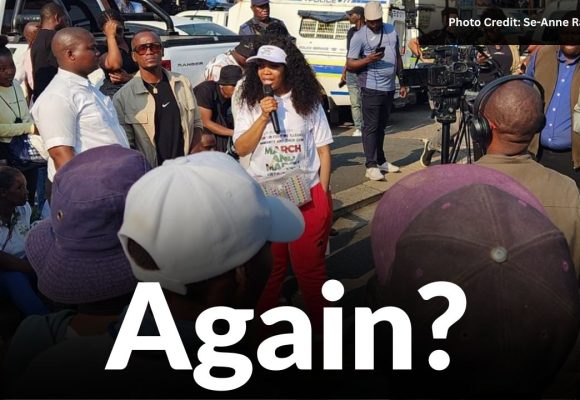
The Linda Mwananchi caravan is a breakaway opposition faction.
Nairobi Senator Edwin Sifuna, Siaya Governor James Orengo and Embakasi East MP Babu Owino lead it.
They tried to hold rallies across Homa Bay County on August 16.
Armed youths blocked the roads, stoned vehicles and swung machetes as the convoy moved from Sindo toward Homa Bay Town.
A hotel had already been raided the night before by dozens of youths searching for opposition supporters.
By the following Tuesday, the death toll had climbed to four.
The dead included a police officer struck by a stone and a foreign national run over during the chaos.
Sifuna later called the violence a coordinated operation rather than spontaneous unrest.
He said it was “a deliberate operation.”
Linda Mwananchi’s own account goes further, alleging that some officers coordinated with the armed youths rather than confronting them.
The Money Behind the Machetes
Nation’s reporting drew on police sources and youths who took part in the attack.
It found that a meeting the night before the rally at Lo Rateng was hosted by Homa Bay Town MP Peter Kaluma.
Kaluma was recorded there urging supporters to keep rival political figures out of the county.
He accused them of infiltrating the Orange Democratic Movement’s own structures.
The higher pay rate went to youths ferried in from neighboring Migori County.
Kaluma has separately alleged that former President Uhuru Kenyatta delivered 100 million shillings to Orengo two days before the rally.
He claims the money funded the opposition’s mobilization, though he has offered no public evidence for it.
Owino has denied it.
The National Cohesion and Integration Commission summoned Kaluma himself on August 19.
Separately, the summons concerned remarks in which he told a crowd that hotel owners must hand over guest lists.
He told them, in comments the commission quoted directly, “we might deal with the hotel too.”
Homa Bay Political Violence coverage
Idle Hands, An Absent State
None of this works without a supply of young men willing to take the job.
Kenya’s median age is about 20.5 years, and Kenyans under 35 make up more than three-quarters of the population.
That is the generation the economy has never managed to absorb.
Kenya’s own statistics agency put youth unemployment at 11.9 percent in 2024, a narrow government measure that counts only those with no work at all.
The Federation of Kenya Employers estimates the real figure closer to 67 percent among Kenyans aged 15 to 34, once informal, unstable and underpaid work is counted as inadequate rather than as a job.
Both numbers point to the same shortage, since more than a million young Kenyans enter the labor market every year with too few formal jobs waiting for them.
The Odipo Dev interviews found that shortage beneath nearly every goon’s account of why he took the work.
One informant, a university-educated garbage collector named Dennis, framed his daily motivation as simply making it to the next morning.
Another, identified as Sharif, said his young daughter’s needs left him with no other realistic option.
Neither man described himself as drawn to violence for its own sake, only as someone the formal labor market had already written off before any politician came calling.
Government failure explains why so many young men are available for hire.
Government inaction explains why they keep getting hired anyway.
No financier of any incident documented in this report has ever faced prosecution.
Interior Cabinet Secretary Kipchumba Murkomen has told the public that goonism is “hyped around politics,” even while acknowledging that courts released thousands of protest-era detainees on bond.
A state that will not create jobs for its young people and will not prosecute the politicians who exploit that absence has made a choice, whether or not it ever announces one.
In practice, that choice looks like tacit approval, since the market keeps clearing at the same price no matter which administration is in office.
Every Job Has A Price
None of this required inventing a system.
Odipo Dev and the civic collective Tribeless Youth spent weeks in 2025 interviewing forty goons, five recruiters and five security officers.
They published their findings that November in a report titled “Goonland.”
The rate card they documented scales with the buyer’s rank.
It runs from 500 shillings to disrupt a protest for a ward representative up to 2,500 shillings for a job commissioned by a businessman.
Land disputes and confrontations with rival gangs fetch more.
Payment happens in cash, usually at a petrol station, before the job rather than after.
No paper trail survives the transaction.
The same researchers checked their rate card against the calendar and found something worse.
Close to half of the twenty-one counties scheduled for by-elections in November 2025 had already experienced goon-linked violence before a single vote was cast.
That is not a rate card for isolated incidents.
It is a rate card for a standing service.
Inside the Chain of Command
Odipo Dev and Tribeless Youth did not stop at pricing the violence.
They mapped who moves the money and who gives the orders.
At the top sits the client, a term goons render in Sheng as “mhesh,” ranging from a ward representative to a governor or a businessman.
Below the client sits a personal assistant or handler, who translates the client’s wishes into a budget and a plan while keeping the client’s name off it.
The handler commissions a recruiter, known on the street as the “Big Fish,” who is not a fighter but a manager of other people’s violence.
One goon interviewed for the report, identified only as Maurice, described that layer’s function bluntly, saying of the recruiters, “Without them, we can’t operate.”
Below the recruiter sit scouts, sometimes low-level politicians themselves, who supply local intelligence and identify which foot soldiers are available.
Mules, a role the report found is often filled by women precisely because they draw less suspicion, move weapons and cash between links in the chain.
At the very bottom is the foot soldier, who executes the job and absorbs nearly all of the physical risk for the smallest share of the money.
Every layer above the foot soldier exists for one purpose, and that purpose is distance.
The client never touches the weapon, never speaks to the foot soldier, and never appears in a single transaction that could be traced back to him.
The Men Who Take the Job
Journalist and Odipo Dev researcher Darius Okolla interviewed goons directly for a companion piece published in The Elephant, and what he found complicates the money-only explanation.
Cash matters most to what the report calls “the Soldier,” a foot soldier who shows up, does the job, and gets paid with little reflection.
But researchers identified three other recurring types among the men they interviewed.
“The Enforcer” treats goon work as a career path, one built on toughness and loyalty rather than a single payday.
“The Bully” is drawn to the control and local dominance the role provides in a life that otherwise offers him little of either, and one informant told researchers plainly that he wants to be a big fish one day.
“The Ideologue” commits to a cause or a political identity rather than a client, showing up because he believes in the side he is fighting for.
Okolla’s reporting also surfaced how thin the reward looks once you climb the ladder from the ground.
A goon paid to work for a member of county assembly earns 500 shillings for the job, an amount one informant said would not even finish his hunger.
The same informant said a governor’s job at least felt like something worth shaking your head over.
That gap between the foot soldier’s cut and the recruiter’s cut is not incidental.
It is the incentive structure that keeps the pipeline supplied with volunteers who believe today’s assignment is a step toward tomorrow’s promotion.
A Door That Doesn’t Open
The Goonland researchers also asked the obvious question: whether a legitimate job would pull these men out.
The report’s honest answer is that it helps, but not as much as it should.
Steady employment removes the immediate financial pressure that makes 500 shillings look like a reasonable price for a day of violence.
It does not remove the men who recruit for that violence, who Okolla found are frequently the same brokers who supply construction or car-wash work in the same neighborhoods.
Leaving carries its own danger separate from money.
Researchers heard accounts describing anyone who tries to exit as a suspected traitor, at risk of violence from the network he is trying to leave.
One informant told Okolla that his own crew lost a member who was captured and beaten by protesters during an assignment and later died from his injuries.
The recommended exit, according to men who had tried it, is not a new job in the same city but a departure from Nairobi entirely, staying away long enough to be forgotten.
Kenya is not just failing to arrest the financiers of this system.
It has built a labor market with almost no legitimate off-ramp for the young men doing the dying inside it.
The Blueprint Moi’s Money Built
Kenya’s goon economy has an origin story, and it runs through the man now occupying State House.
Youth for KANU ’92 launched in March 1992 to campaign for President Daniel arap Moi ahead of Kenya’s first multiparty election.
A young businessman, Cyrus Jirongo, chaired it.
William Ruto, then 24, ran its secretariat.
Historian Charles Hornsby later wrote that the group “served as the president’s hit team during the primaries.”
The group’s cash flow was so vast that Kenyans nicknamed the newly printed 500-shilling note “the Jirongo” after its chairman.
Moi won that December 1992 election, and YK’92’s leaders expected their reward.
Jirongo and his circle believed they had personally delivered the president’s victory, and they wanted real power and government positions to show for it.
The reward never came the way they wanted it.
Jirongo turned his frustration on the KANU old guard he blamed for shutting him out, chiefly Vice President George Saitoti, Secretary-General Joseph Kamotho and power broker Nicholas Biwott, the trio widely seen as the party’s actual inner circle.
He accused Saitoti of corruption tied to the Goldenberg scandal and demanded a crackdown.
He separately accused Biwott of allowing toxic waste to be dumped in North Eastern Kenya.
Jirongo told insiders that every politician has a price, a line that landed as either blunt honesty or a confession of exactly how YK’92 had operated all along.
Saitoti and the old guard read Jirongo’s attacks as an attempt to build an independent power base rather than remain a tool of the president who had created him.
Moi sided with his veterans over his own youth wing.
He suspended YK’92 in March 1993 and disbanded it that June.
He also moved to financially ruin the man who had led it.
The National Social Security Fund canceled a 1.2 billion shilling housing deal with Jirongo’s company, and the company collapsed into bankruptcy soon after.
Ruto was arrested days after the disbandment on conspiracy charges tied to opposition figure Kenneth Matiba, charges that were never proven.
Jirongo died in a road accident on the Nairobi-Nakuru Highway in December 2025.
His family has publicly questioned the official account.
The Directorate of Criminal Investigations found no evidence of foul play.
A 1995 Beating in Nakuru, A Warning Missed
Moi’s formal disbandment of YK’92 did not disband what it had built.
Barely two years later, in August 1995, conservationist and Safina party founder Richard Leakey was whipped and beaten outside a Nakuru courthouse.
Eyewitnesses identified the attackers as KANU Youth Wingers.
That was the same broader class of paid party enforcers that YK’92 had helped professionalize and fund into a going concern.
Kenya’s foreign minister at the time dismissed Leakey’s injuries as stagecraft for Western sympathy.
That denial previewed almost exactly how today’s financiers wave away video evidence and hospital records from Homa Bay.
The organization on paper died in 1993, but the method it perfected never needed a name to keep working.
Paying young men in cash to break an opponent’s momentum outlived its own founding document.
That is the seed YK’92 actually planted.
Kenya has been harvesting it in election cycles ever since.
Kisumu, Kakamega, Ol Kalou: One Playbook, Every Side
No single faction owns this playbook.
Evidence of hired violence runs in every political direction.
Vihiga Senator Godfrey Osotsi was beaten and robbed by hooded youths in daylight at a Kisumu mall in April.
He called it an assassination attempt.
The bloodiest recent example came from the Ol Kalou by-election in July, where two men, James Muigai Mwathi and Zacharia Gakinya Mukora, were killed in separate attacks on election day.
Muigai died after staying behind to guard his polling station, and Gakinya was shot leaving his as he headed back to work.
Masked men in vehicles with covered plates disrupted campaigning there.
Kenya’s electoral commission had already warned two days earlier that goons were being mobilized to disrupt the vote.
Each of these attacks drew CCTV footage, phone video, or vehicle registration numbers pointing to specific actors.
None of them produced a single politician in court.
Silencing the Messenger, Attacking the Camera
Journalists covering this violence have become targets in their own right, not incidental casualties of it.
AFP journalists Fred Ooko and Brian Ongoro were assaulted at Homa Bay and had their equipment seized while covering the rally.
At the Ol Kalou by-election, at least ten reporters were separately attacked and robbed, a number large enough that it looks less like chaos catching bystanders and more like a specific effort to clear witnesses from the scene.
The pattern extends to the tools of documentation themselves.
Equipment seizures at Homa Bay and Ol Kalou did not stop at assault, since cameras, phones and memory cards were taken along with the beatings.
A market built on leaving no paper trail on payment has an obvious interest in leaving no video trail on delivery either.
That makes press freedom in Kenya’s 2027 election cycle a direct casualty of the goon economy rather than a separate problem running alongside it.
Foot Soldiers Arrested, Financiers Untouched
Interior Cabinet Secretary Kipchumba Murkomen told a Senate committee in April that more than 104 criminal gangs were operating nationwide under political patronage.
Police claimed more than 300 arrests.
No politician was among them.
Former Law Society of Kenya president Faith Odhiambo has called the result a procurement system.
She argues that “until we prosecute the buyers, the market remains open.”
Crime Si Poa executive director Peter Ouko frames the same gap more bluntly.
He says every goon operating today answers to a specific sponsor.
That sponsor has never had to answer for it himself.
The National Crime Research Centre’s own count found dozens of active gangs concentrated in Mombasa, Nairobi and Kilifi.
Researchers warned that politicians sometimes help arrested members walk free.
That lets them regroup as what the report calls informal political enforcers.
Nobody Is Counting the Dead, By Design
Ask how many Kenyans have died in goon attacks since Ruto took office, and no single number exists.
ACLED tracks political violence in Kenya event by event, and its analysts comment publicly on goon attacks as they happen.
Even that dataset cannot cleanly separate a death caused by a hired attacker from one caused by police, a rival protester or the general chaos of a crowd that includes all three.
The Kenya National Commission on Human Rights documents incidents as they occur, but it publishes narratives, not a running toll.
The National Crime Research Centre counts gangs by county, not the people those gangs have killed.
That gap is not a failure of Kenyan or international record-keeping.
It is the same design that pays goons in cash at petrol stations specifically so no receipt survives the transaction.
A market built to leave no paper trail on the payment side produces a body count with no paper trail either, and both absences serve the same buyers.
Diplomats Are Watching, Kuria Says
Former Cabinet Secretary Moses Kuria delivered the sharpest public warning of the cycle in January.
He told reporters he had spoken with diplomatic contacts.
Those contacts, he said, are convinced Kenya’s reliance on hired violence will eventually reach The Hague again.
He added that this time “no witnesses will disappear.”
Civil society groups have echoed their alarms.
The Kenya National Commission on Human Rights called in August for investigation of every person culpable, financiers included.
Amnesty International Kenya has condemned both the Ol Kalou and Homa Bay violence.
It has pressed for accountability that reaches beyond the youths arrested at the scene.
The Difference From 2007 Is Location, Not Intent
Kenya has lived through election violence organized around a single flashpoint before.
The 2007 to 2008 post-election crisis, sparked by a disputed presidential tally, killed 1,133 people and displaced more than 600,000, according to the Waki Commission’s own count.
That violence was devastating, but it was also geographically concentrated, breaking out hardest in the Rift Valley, in Nyanza and in a handful of Nairobi’s poorest neighborhoods.
The goon economy documented in this report does not share that shape.
It is a distributed, county-by-county service with its own standing price list, and researchers found that close to half of the twenty-one counties holding by-elections in November 2025 had already experienced goon-linked violence before voters ever reached the polls.
Vocal Africa’s Hussein Khalid warned in July that if the trend continues unchecked, Kenya will not manage a free, fair and peaceful election in August 2027.
The Kenya National Commission on Human Rights used similarly stark language in August, warning that the country is approaching what it called a precipice.
If 2007 was one deep wound concentrated in a few specific places, an election run on today’s rate card risks becoming many smaller wounds opened at once, in polling stations spread across dozens of counties rather than in a handful of contested strongholds.
Kenya would not need a repeat of 2007’s scale in a single location to suffer comparable national damage.
It would only need this year’s rate card applied simultaneously, on one voting day, in enough of its 47 counties.
What 2027 Will Actually Cost
Kenya’s next general election is a year away.
The market for political violence has never been more organized or more openly priced.
A rate card built for 1992 outlived its own organization.
It survived a disbanding, survived the fall of the man who ran it, and survived every arrest that stopped at the foot soldier.
Kenya’s 2022 transition proved a handover of power does not have to be violent to be real.
Homa Bay is the clearest sign yet that 2027 could break that streak, one paid attack at a time.
Methodology note: This report draws on contemporaneous Kenyan and international news coverage of the August 2026 Homa Bay attack, the November 2025 Odipo Dev and Tribeless Youth “Goonland” study and Darius Okolla’s companion reporting for The Elephant, government and civil society statements, labor market data from Kenya’s statistics agency and the Federation of Kenya Employers, and historical reporting on Youth for KANU ’92 and the 1995 attack on Richard Leakey. Names such as Maurice, Dennis, Sharif and Pascal are the coded identities Odipo Dev assigned to protect informants, not their real names. Claims made solely by interested political actors, including funding allegations against named politicians, are attributed to those actors rather than stated as fact. Contested figures were cross-checked across independent outlets where multiple versions existed.









LEAVE A COMMENT
You must be logged in to post a comment.