

|
LISTEN TO THIS THE AFRICANA VOICE ARTICLE NOW
Getting your Trinity Audio player ready...
|
THE PEOPLE’S PRESIDENT, PART II
This is Part II of a series. Read Part I, What Kenya Is Refusing to Say One Year After Raila Odinga’s Death:
The cover-up of Kenya’s 2007 election did not require secrecy.
It required something far easier to maintain: institutional paralysis, political convenience, and a reliable tendency among African elites to protect each other across ideological divides when accountability threatens shared power.
Every serious institution that looked at the 2007 election found serious problems.
None of them followed those findings to a legal conclusion.
What the Commissions Built, and Then Left Unfinished
The Kriegler Commission documented the crime in meticulous procedural language.
It found that the Electoral Commission of Kenya lacked independence, capacity, and legitimacy. It found serious defects in the voter register before polling began. It found large discrepancies between its own constituency-level reconstructions and the official national tally, worth tens of thousands of votes in Kibaki’s favor. It declared the results “irretrievably polluted.”
Then it examined only 18 of 210 constituencies, declared the errors random, and declined to name a winner.
The commission’s own mandate asked it to investigate vote counting and tallying at all levels. It did not complete that mandate. Instead, it produced a comprehensive account of a broken process, paired with a conclusion that no one could know who won, a conclusion the evidence it had just assembled did not support.
A leaked diplomatic cable from then-U.S. Ambassador Michael Ranneberger went further than the commission ever would. It noted that ECK officials at KICC had altered constituency results so that total presidential votes cast exceeded parliamentary votes by 459,100.
Ranneberger concluded that neither party could claim a clean result. Yet the cable echoed the diplomatic caution that would define the international response: the situation was murky, the fraud was bilateral, and stability was the priority.
That framing, mutually imperfect, nobody can know, let’s move on, became the cover under which accountability was buried.
The Waki Commission Drew the Line Kriegler Wouldn’t
The Commission of Inquiry on Post-Election Violence, known as the Waki Commission, was less cautious.
It named the announcement of the December 30 presidential result as the immediate trigger of the violence that followed. It recommended that the government establish a special tribunal of national and international judges to prosecute perpetrators.
When the government did not comply within the stipulated period, the commission handed its sealed list of named suspects to former United Nations Secretary-General Kofi Annan, who in July 2009 passed it to the International Criminal Court prosecutor.
That handover was the moment the accountability process nearly broke through.
Six prominent Kenyans were ultimately charged with crimes against humanity: then-Deputy Prime Minister Uhuru Kenyatta, Member of Parliament William Ruto, former Head of Public Service Francis Muthaura, former Police Commissioner Mohammed Hussein Ali, former Cabinet minister Henry Kosgey, and journalist Joshua Arap Sang. Charges were confirmed against four of them in January 2012.
Every single case collapsed.
The ICC’s Kenyan Failure
The pattern of collapse is instructive.
Charges against Muthaura were withdrawn in March 2013 after a key prosecution witness recanted. The ICC withdrew charges against Kenyatta in December 2014, with Prosecutor Fatou Bensouda citing the Kenyan government’s failure to hand over documentary evidence the court had requested.
In April 2016, charges against Ruto and Sang were vacated after a trial chamber declared a mistrial, citing systematic interference with witnesses.
Bensouda described a “steady and relentless stream of false media reports,” along with efforts to expose protected witnesses and to harass and intimidate people willing to testify. The ICC formally closed its Kenya investigation in 2023. It now pursues only two individuals, both accused of witness tampering, the very crime that destroyed the core cases.
The political irony is total.
Kenyatta and Ruto, who were on opposite sides of the 2007 violence and rivals in that election environment, formed a political alliance ahead of the 2013 election, driven largely by a shared interest in keeping each other’s ICC cases manageable.
They won the presidency and deputy presidency together. And then led the government responsible for cooperating with the ICC. The investigation collapsed under a government led by the two men it was investigating.
More than 1,100 people were killed, and over 600,000 were displaced. No senior Kenyan official has been convicted of anything connected to the 2007 violence or the fraud that triggered it.
The Architects of the Fraud Are Still in Public Life
Part I of this series documented how the mandate was stolen, including the operational details. Those accounts are now public record.
Alfred Mutua, who, according to the NTV and Daily Nation Stolen Ballot investigation, coordinated the lights-out operation at KICC and maintained direct pressure on the KBC editor-in-chief through the night, currently serves as Cabinet Secretary for Labour and Social Protection in the Ruto government.
Francis Muthaura, named in Stolen Ballot as one of the five men in the State House boardroom directing the operation on the night of December 30, faced ICC charges that were dropped after a witness recanted. He returned to public life.
Nimrod Mbai, who, according to Stolen Ballot, carried a green file through a darkened corridor and escorted Kivuitu out of KICC to enable the controlled announcement, is now a member of Parliament. He made his confession publicly. He remains in office.
Philip Kisia, who said he threw the power switch at KICC on instruction, has faced no legal proceedings.
The Oath Behind the Operation
Martha Karua, then Kibaki’s election agent, argued that the swearing-in on December 30, 2007 had to happen immediately, and she witnessed it herself. She has defended that position repeatedly, including in her memoir Against the Tide, and has expressed no regret about the act itself.
In March 2026, following the Stolen Ballot revelations, Karua again defended her role. She described herself as an agent for Kibaki in the way Siaya Governor James Orengo was an agent for Odinga.
The comparison does not hold. Orengo was an agent for the candidate the evidence now shows actually won. Karua pushed for a swearing-in within hours of a result that was still in dispute.
Her actions that night did not happen in a political vacuum. Karua herself has described the climate that shaped her generation.
In a recorded interview, she recalled the 1969 oathing as a primary school pupil. Mount Kenya residents, including schoolchildren, walked to Kenyatta’s Gatundu home and to sites closer to her own, such as Kabare, to take it.
As she heard it then, the pledge was that the presidency would not go beyond Mount Kenya, and especially not to the “Luo Nation.”
Her father, a devout Christian, refused to take part. Karua said the family feared reprisals, because she heard that people were beaten or killed for declining.
She described the episode as the solidifying of tribal politics in independent Kenya. In her telling, leaders had borrowed the colonial divide-and-rule method because Kenyatta had fallen out with Jaramogi Oginga Odinga.
The ceremonies came in July 1969, after the assassination of Cabinet minister Tom Mboya. Njenga Karume, one of Kenyatta’s closest allies, described the oath in his autobiography Beyond Expectations and wrote that it further polarized the Kikuyu community.
In March 2022, Taifa Leo reported that Muigai Kung’u, a cousin of Uhuru Kenyatta, said the oath barred the Jaramogi Odinga bloodline from the presidency.
It held sway in politics for decades. Gatundu South MP Moses Kuria cited it at a rally, saying it remained binding. In 2022, elders of the Kiama Kia Ma council formally broke it so their community could back Raila Odinga’s bid. Their chairman noted that Kibaki’s election had already defied it without consequence.
Karua’s own path complicates the picture. She defended Kibaki’s 2007 swearing-in. In 2022, she ran as Odinga’s running mate.
No evidence shows the oath directed the operation at KICC. Individual choices drove the mechanics of that night.
Still, it helps explain the climate in which those choices were made. For 38 years, a belief circulated across generations of Mount Kenya politics that a Luo presidency should be prevented. When Raila Odinga, son of Jaramogi, reached the threshold in December 2007, that belief was still in circulation.
Understanding that context does not excuse what happened. It names a barrier to national cohesion that Kenya has still not dismantled.
The Structure of Impunity
This outcome was not merely a matter of political will. It was a set of deliberate structural choices, made across multiple governments, designed to keep accountability at a safe distance from those in power.
The Kriegler Commission’s mandate was deliberately limited. It could examine and recommend. It could not prosecute. Prosecution required a political decision by a government that had been elected on the back of the stolen mandate.
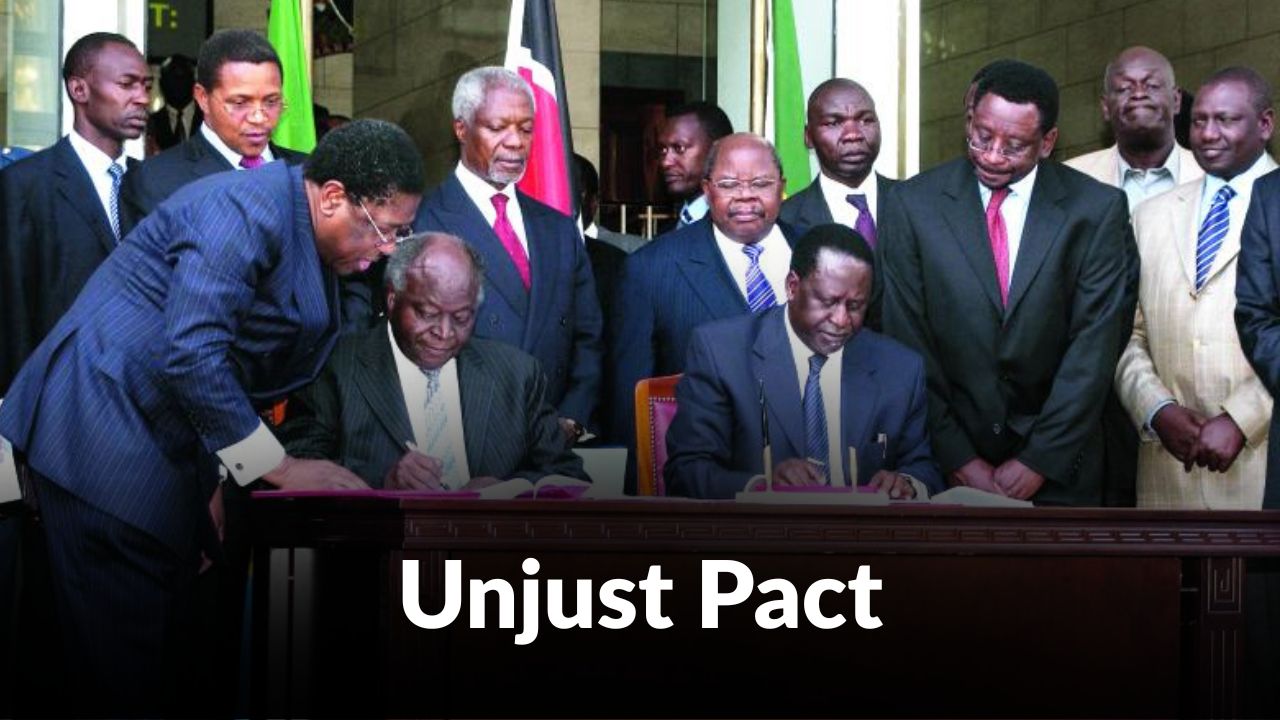
The 2008 National Accord, brokered by Annan, ended the violence and established a Grand Coalition government with Kibaki as president and Odinga as prime minister.
That power-sharing arrangement was necessary to stop the bloodshed. It was also the moment the formal demand for accountability was traded away. Odinga himself accepted the deal, because the alternative was more death. That was not weakness. It was a rational response to an impossible situation.
But the deal’s legacy was the permanent suspension of accountability for the fraud.
Odinga got the prime ministership. Kibaki kept the presidency. The men who ran the operation kept their positions, their networks, and their freedom.
When the Waki Commission handed its suspect list to Annan and ultimately to the ICC, it was because domestic political will to prosecute was already gone. When the ICC process collapsed under witness tampering and government obstruction, the last external mechanism with any reach was extinguished.
No active legal process anywhere in the world addresses the theft of Kenya’s 2007 presidential election and the deaths that followed.
Silence as Policy
The cover-up was not a single act. It was a sustained institutional posture maintained across four governments. The Kibaki government organized it and held it together from December 30, 2007 onward.
A Grand Coalition government, which included Odinga as prime minister from 2008 to 2013, inherited it and absorbed it into the terms of political coexistence.
The Kenyatta government, which came to power in 2013 with both ICC-charged men on the ballot, had the most obvious structural reason to keep it buried.
President Ruto’s government, which came to power in 2022 and is now incorporating ODM into its coalition, has extended that continuity. By July 2026, the party Odinga built was openly backing the president whose entire political career was built in the same system that stole the 2007 election, and whose ICC case collapsed under the same witness-tampering machinery that protected everyone else.
Even after the explosive confessions documented in the Stolen Ballot investigation, no serving Kenyan government has called for a full audit of the 2007 results.
No parliament has passed a resolution stating that the announced result was not credible.
Worse, no commission has been convened to rule on the electoral fraud itself. Kenya’s Truth, Justice and Reconciliation Commission reported in 2013, but its mandate covered historical injustices, and Parliament has never adopted its report.
Kenya’s political class has reached an unspoken consensus: the truth about 2007 is too dangerous to state officially, because stating it would require the state to account for what it did with the mandate it stole.
Some will say Kenya should leave 2007 alone. The wounds are old, they will say, and the country has worked hard to keep the peace.
The peace is real. Kenya has not moved on.
Moving on means telling the truth and then setting it down. Kenya set the truth down without ever telling it. Odinga disputed the results of 2013, 2017 and 2022, and each cycle opened with the same doubts about who counts the votes.
Silence did not close 2007. It carried 2007 forward.
Why Recognition Is Not Optional
Kenya heads into August 2027 with the same fault lines intact.
Opposition parties question the electoral commission’s independence before every cycle. The ethnic calculus that structured the 2007 fraud still drives elite political arithmetic. The culture of impunity for election manipulation has been confirmed, not dismantled, by the nineteen years that followed.
Democracy for Citizens Party leader Rigathi Gachagua put the stakes bluntly in May 2025. Speaking on Obinna Live TV, he warned that if the electoral commission tampers with the 2027 vote, 2007 “will look like a Christmas party.”
He later said the remark was a caution to the commission, not a call to violence. Either way, it shows that nineteen years after the fraud, senior Kenyan leaders still measure the future by the catastrophe the past produced.
The Kenyans who will live longest with the answer are the youngest.
Gen Z was too young to vote in 2007, or not yet born. In June 2024, young Kenyans filled the streets over the Finance Bill, entered Parliament, and forced Ruto to withdraw it. They organized without party structures and without the ethnic arithmetic that has governed Kenyan politics since independence.
They did not make the 2007 bargain. They inherit its results.
The argument for posthumous presidential recognition of Raila Odinga is not a backward-looking exercise in grief.
It is a forward-looking democratic obligation.
Recognizing that the 2007 election was stolen, and that Odinga held the mandate, would require the Kenyan state to do something it has never done: issue an official finding that the presidential result was fraudulent, name the institutional failure that produced it, and acknowledge the human cost of the cover-up.
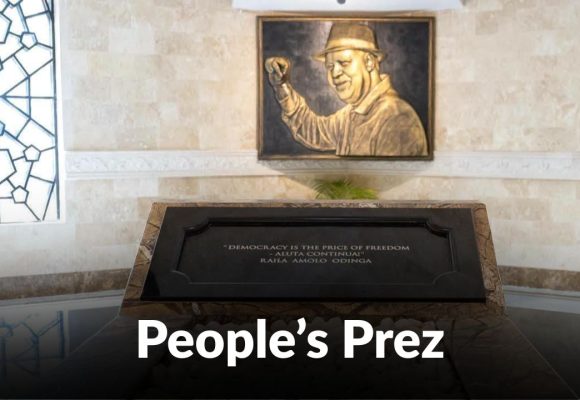
A civilian honor cannot do that. The Chief of the Order of the Golden Heart placed Odinga among Kenya’s heroes. It did not restore the democratic record.
A parliamentary resolution, supported by a formal review of the Kriegler evidence and the Stolen Ballot confessions, could do what the honor could not.
It would not give Odinga a presidency he never held.
It would give Kenya a history it has been refusing to write.
Part III of this series examines what that recognition would require, the constitutional tools already available, and why Kenya cannot afford to miss the August 2027 window.
Methodology Note: This report draws on the published findings of the Kriegler and Waki commissions, ICC public records on the Kenya cases, the NTV and Daily Nation Stolen Ballot series from March 2026, Martha Karua’s memoir and recorded interviews, a leaked U.S. diplomatic cable reported by the Daily Nation, and Njenga Karume’s autobiography on the 1969 oath. Remarks by Rigathi Gachagua come from his May 2025 television interview as reported by Kenyan news outlets. Current officeholders’ positions come from Kenyan news reporting published between July and October 2026.

LEAVE A COMMENT
You must be logged in to post a comment.