

|
LISTEN TO THIS THE AFRICANA VOICE ARTICLE NOW
Getting your Trinity Audio player ready...
|
This is Part 1 of 2 of this report.
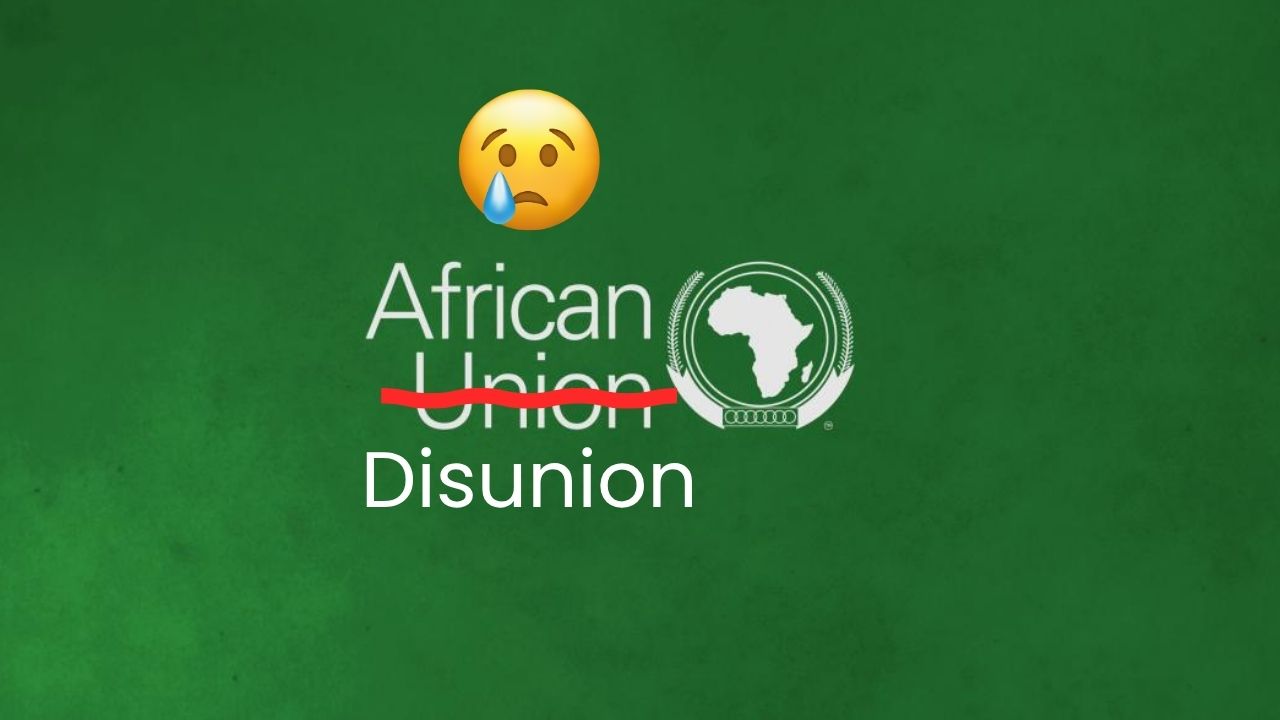
There’s a saying that those who don’t learn from history are doomed to repeat it.
Africa carries a history rich, complex, and painful enough to have undermined its own unity again and again, on the road toward the dream of pan-Africanism.
These two parts trace that history from the slave trade through the present day.
Part One covers how the pattern was built, from the 1440s through Ivory Coast’s 1994 citizenship law.
Part Two covers what the pattern looks like now, and what ending it will actually require.
Five centuries connect the cases in both parts directly.
Each era used different labels, captive and free, tribe and subject, citizen and alien, Afrophobia, but the underlying move was the same.
Africans with power chose a foreign buyer, a foreign administrator, or a foreign-drawn border over their own neighbors, and other Africans went along with it.
Foreign traders, colonial officials and today’s buyers of African minerals did not invent that habit, they only benefited from it each time it resurfaced.
Borders, cargo manifests and identity cards were the instruments, not the cause.
That cause was always a choice made inside Africa, and naming it plainly, rather than pointing outward, is what this series is trying to do.
Coastal Kingdoms Turned Captives Into Currency
Portuguese ships began carrying captive Africans out of the continent in the 1440s, decades before Columbus reached the Caribbean.
Emory University’s Trans-Atlantic Slave Trade Database, the primary academic record of the trade, puts total embarkations at just over 12.5 million people across the full span of the trade through 1866.
Roughly 1.8 million of them died crossing the ocean, a figure the database and independent mortality studies confirm almost exactly, with death rates running above 20 percent in the trade’s early centuries and closer to 5 percent by its final decades.
Those figures alone undercount the human cost.
Additional people died in the wars, raids and forced marches to the coast that produced the captives in the first place, though the exact toll from that inland violence is harder to document than shipping records.
Europeans rarely marched into the interior to seize people themselves.
Coastal kingdoms and inland states did that work, and some built real power on it.
Dahomey, in what is now Benin, ran an organized system of raiding and sale that funded its army and expanded its territory.
Ashanti Empire forces, based in present-day Ghana, captured rivals in war and sold them for firearms that fed further conquest.
Kongo’s rulers, governing territory now split between Angola and the Democratic Republic of the Congo, exported captives to sustain diplomatic and material ties with Portugal.
None of this was uncontested inside Africa.
King Afonso I of Kongo initially worked with Portuguese traders, then turned against the arrangement once he saw what it was doing to his own population.
In a 1526 letter to the Portuguese crown, he complained that traders were depopulating his kingdom by taking “many of our people.”
His warning went unheeded, and the trade from his region continued for decades after his death.
Disunity Let Outsiders Set the Terms
European and American merchants created the demand for captives, financed the ships, and built the plantation economies that made human labor valuable in the first place.
That demand alone could not have moved 12.5 million people without African partners willing to supply it, and Africa in the 1500s was not a single nation able to refuse the offer as one.
Hundreds of independent kingdoms and city-states competed with each other for territory, trade routes, and firearms, and European traders learned quickly to play one rival against another.
Guns were often the currency African elites wanted most, and guns were the surest way to win the next war against a neighboring African state and capture the next round of prisoners.
That cycle, war for captives, captives for guns, guns for the next war, needed a continent divided against itself to keep running.
A unified political response could have starved the trade of supply the way a handful of resisting kingdoms tried, and failed, to do alone.
Cowrie shells tell the same story from a different angle.
Historian Toby Green estimates that roughly 30 billion cowrie shells entered the Bight of Benin alone between 1500 and 1875, a foreign currency that coastal states adopted so completely it destabilized their own economies.
African participation in the trade was real, documented, and consequential, and African disunity made it possible as much as European demand.
Both facts belong in the same sentence, because crediting only the buyer lets everyone else off the hook.
Colonial Rule Manufactured the Categories It Later Called Tribal
If the slave trade taught some African elites that captured neighbors could be currency, European colonial rule taught entire populations that ethnic identity itself could be assigned, ranked and enforced.
Rwanda offers the starkest case.
Hutu, Tutsi and Twa identities existed before colonization, but they described clan and occupation more than fixed ancestry, and Belgian administrators changed that permanently.
Starting in the early 1930s, Belgium required every Rwandan to carry an identity card listing an ethnic label, backed by pseudo-scientific measurements of noses, skulls and cattle ownership meant to prove Tutsi racial superiority under a theory researchers call the Hamitic hypothesis.
One striking detail underlines how manufactured this was.
Kinyarwanda, the language spoken by Hutu and Tutsi alike, has no native word for ethnicity.
Colonial administrators translated that term, ubwoko, as race, though it actually means clan.
Belgian officials favored the Tutsi minority for administrative posts, hardening a distinction that had once allowed movement between groups.
When Belgium reversed course and backed a Hutu-led revolt in 1959, the same rigid categories it had built were used to drive tens of thousands of Tutsis into exile.
Those colonial-era cards outlived Belgian rule by decades, and Hutu extremists later used the same ethnic registry system to identify targets during the 1994 genocide against the Tutsi.
Nigerian historian Moses Ochonu, writing in the Journal of African History, argues that colonial administrations across the continent repackaged their own political and economic exclusion of certain groups as if it were primordial hostility between Africans themselves.
Colonial officials needed African communities divided to govern cheaply, and the categories they invented for that purpose proved durable long after independence.
That strategy only worked because no regional alliance of African states existed strong enough to make dividing a colony more costly than governing it honestly.
Ghana and Nigeria Perfected the Cycle First
West Africa’s two largest economies spent nearly two decades trading the same accusation back and forth, each certain the other had started it.
Ghana went first.
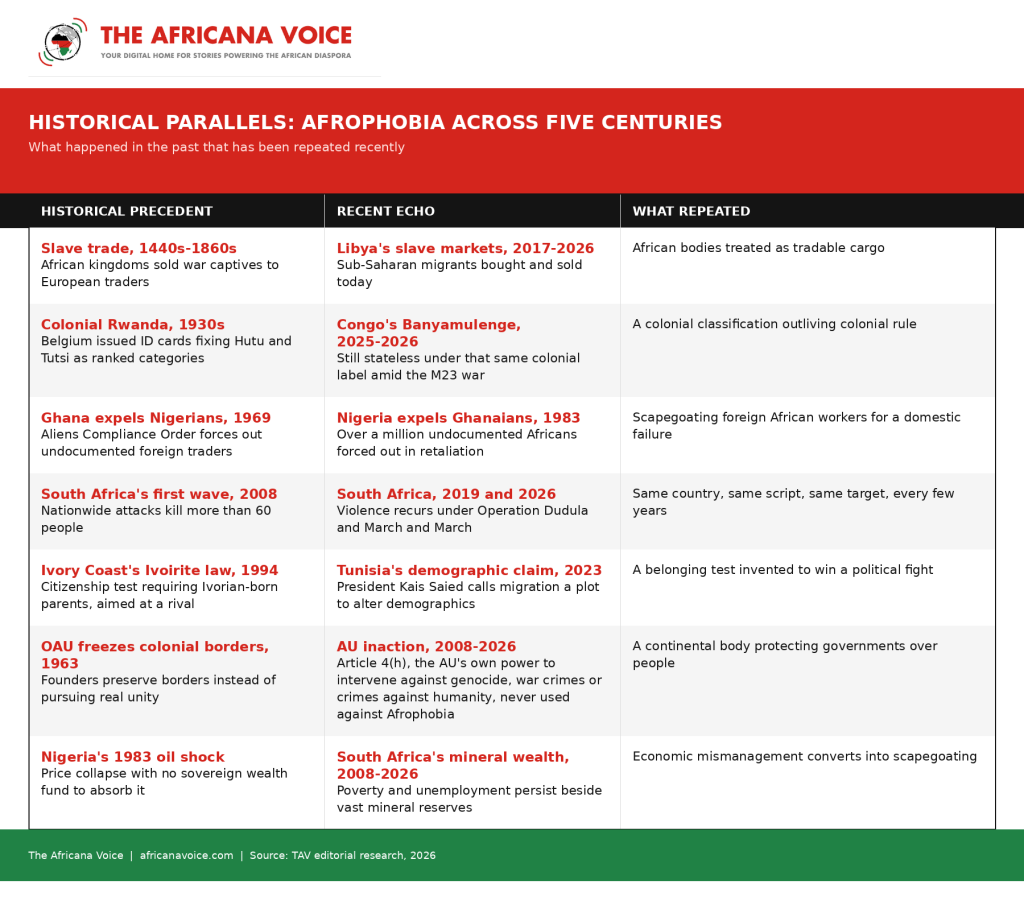
Prime Minister Kofi Busia’s government issued the Aliens Compliance Order on Nov. 18, 1969, giving foreign nationals without residence permits roughly two weeks to regularize their status or leave.
Nigerians were the largest group affected, and contemporaneous 1970 press estimates put the number of Nigerians who left Ghana somewhere between 100,000 and 200,000, though total estimates for all nationalities combined run far higher in some academic and retrospective accounts, a spread wide enough that no single figure should be treated as settled.
Togolese, Malian and Nigerien traders were swept up as well.
Nigeria returned the gesture fourteen years later on a larger scale.
Facing a collapse in oil revenue and an approaching election, President Shehu Shagari ordered undocumented migrants to leave the country within two weeks in January 1983.
Nigerian government estimates at the time put at least 1.2 million people affected, while widely repeated secondary figures run as high as 2 million, a ceiling researchers treat as a maximum rather than a confirmed count.
More than half were Ghanaian, but the order swept up undocumented Nigeriens, Chadians, Cameroonians, Togolese and Beninese as well.
Ghanaians carried their belongings in the cheap checkered bags that gave the whole episode its enduring nickname, Ghana Must Go, even though the expulsion order applied to undocumented Africans of any nationality.
A second expulsion followed under military ruler Muhammadu Buhari in April 1985, forcing out roughly 700,000 more undocumented immigrants.
Economic distress did not create that hostility out of nowhere.
Nigerian officials facing a cratering economy and an upcoming vote found it easier to blame foreign workers than to address falling oil prices and depleted reserves, exactly as Busia’s government had done in Accra fourteen years earlier facing its own economic strain.
That bag became a permanent symbol across West Africa of how quickly a fellow African migrant can be redefined as a national threat.
Kenya’s Wagalla Massacre: A 27-Year Cover-Up
Kenya’s own history holds a version of this pattern that took decades to reach the national conversation, and it never required crossing a border at all.
Ethnic Somalis in Kenya’s Northern Frontier District rejected inclusion in the new Kenyan state at independence in 1963, preferring union with Somalia, and the resulting Shifta War killed more than 4,000 people before a 1967 ceasefire.
Jomo Kenyatta’s government forced residents of the region into fortified settlements and treated the entire ethnic Somali population as a security threat, a posture that outlasted the war itself by decades.
On Feb. 10, 1984, Kenyan Army units began a four-day operation that rounded up thousands of ethnic Somali men from the Degodia clan at an airstrip near Wajir, denying them food and water while beating and torturing them for confessions about hidden weapons.
Soldiers also burned homes, looted property, and raped women and girls left behind in the villages, some as young as eight, according to the government’s own Truth, Justice and Reconciliation Commission.
Kenya’s government initially put the death toll at 57.
Its own investigation found “close to a thousand” killed and said it was unable to determine the precise number, while eyewitness accounts have put the toll as high as 5,000.
That gap between an official count of 57 and eyewitness estimates nearly a hundred times larger did not close until the commission’s 2011 report, twenty-seven years after the massacre.
Five years after Wagalla, President Daniel arap Moi’s government launched a nationwide screening exercise requiring every ethnic Somali over 18 to prove Kenyan citizenship, often reaching back generations, before receiving a so-called pink identity card.
Somali families who had lived in Kenya since before independence were denied the ordinary identity documents that determine access to jobs, schools and services, treated as foreign in the only country most of them had ever held citizenship in.
That screening requirement persisted in practice for decades, and President William Ruto did not sign a proclamation ending it until February 2025, calling the old system discriminatory.
Kenyan reporting more than a year later still found families describing the vetting system as officially abolished but unofficially “hanging,” with bribery required to get an ID processed.
Kenya used the same tool Ivory Coast would later formalize in its 1994 electoral code, a citizenship test applied selectively to one ethnic group, to treat its own people as guests in their own country.
Ivoirite Turned Citizenship Into a Weapon
Ivory Coast supplies the clearest example of a government inventing a legal category specifically to exclude Africans it had previously welcomed.
President Felix Houphouet-Boigny had opened the country to migrant labor from Burkina Faso, Mali and northern Ivory Coast through the 1960s and 1970s, building one of West Africa’s strongest economies on that labor.
After his death in 1993, his successor Henri Konan Bedie formalized the term Ivoirite through a new electoral code promulgated Dec. 8, 1994, requiring presidential candidates to be born to two Ivorian-born parents.
Bedie relaunched the concept publicly in August 1995 ahead of his own re-election, a move widely read as targeting his chief rival, northern politician Alassane Ouattara, whose family had ties to Burkina Faso.
He won the October 1995 election with more than 96 percent of the vote after rival candidates were disqualified or withdrew.
A contemporaneous account from the University of Pennsylvania’s African Studies archive estimated roughly 4 million residents of non-Ivorian origin were affected by the accompanying voting restrictions.
That concept metastasized into daily harassment, a 1999 coup, and a civil war that split the country between a government-held south and rebel-held north from 2002 to 2007, killing roughly 1,700 people and displacing 750,000.
A second war followed in 2010 and 2011 when incumbent Laurent Gbagbo refused to accept Ouattara’s internationally certified election win, a conflict that killed more than 3,000 people, displaced over a million, and included more than 150 documented rapes.
An International Criminal Court prosecution followed, trying Gbagbo on charges of crimes against humanity, the first former head of state that court ever tried.
Ouattara finally took office in 2011, and the most exclusionary citizenship provisions were later weakened, but the precedent remained: law can redraw belonging to fit a political outcome, and thousands can die once it does.
That is where the pattern stood by the mid-1990s, a set of tools already tested across five centuries and three regions.
Part Two picks up from Ivory Coast’s precedent and follows the same choice into the twenty-first century, through Libya’s slave markets, Congo’s ongoing war, and South Africa’s own recurring violence, before turning to what actually stops it.
METHODOLOGY NOTE
This analysis draws on the Trans-Atlantic Slave Trade Database at Emory University, peer-reviewed journals including the Journal of African History and Past & Present, academic and human rights sources on Kenya’s Wagalla massacre and Ivory Coast’s civil wars, and contemporaneous reporting from Ghanaian and Nigerian outlets. Figures for the transatlantic slave trade, the 1969 and 1983 West African expulsions, and the Wagalla massacre death toll reflect ranges rather than single fixed numbers, given incomplete records or disputed sourcing, and are presented as such in the text. Part 2 of this series covers North Africa, Congo, South Africa, the African Union’s record, and the resource-governance argument, with its own methodology note and source log.







LEAVE A COMMENT
You must be logged in to post a comment.