

|
LISTEN TO THIS THE AFRICANA VOICE ARTICLE NOW
Getting your Trinity Audio player ready...
|
This is Part I of a series. The series continues with Part II: The Men Who Got Away.
Mama Ida Odinga had one request as October 15, 2026 approached.
“He belonged to many people, belonged to denominations, belonged to many parties,” she said ahead of the first anniversary of her husband’s death. “Let’s give him a good sign-off.”
Kenya did not listen.
What was meant to be a solemn gathering at Migwena Cultural Grounds in Bondo became something the Daily Nation, the country’s paper of record, called a “Day of Shame.” Stones were thrown at the VIP tent. Security personnel used plastic chairs as shields.
One person was stabbed. Rival ODM factions fought openly over the party’s 2027 direction, turning a memorial into a succession battle. ODM party leader Oburu Oginga was absent. President William Ruto, who had been expected to attend, did not come.
Mama Ida addressed the crowd anyway, grief-worn and composed.
“This past year has not been easy for us, the Odinga family,” she said. “We lost Raila, and lost his sister within a period of 40 days. It has been very heavy in our hearts.”
Winnie Odinga, Raila’s daughter, used the occasion to announce she would contest the Nairobi Senate seat in 2027. Raila Odinga Junior outlined his own political ambitions.
Nairobi Senator Edwin Sifuna, ousted as ODM secretary-general and now building his own presidential vehicle, arrived at Migwena and told the crowd that politics is persuasion, not dictatorship.
Nobody was talking about Raila.
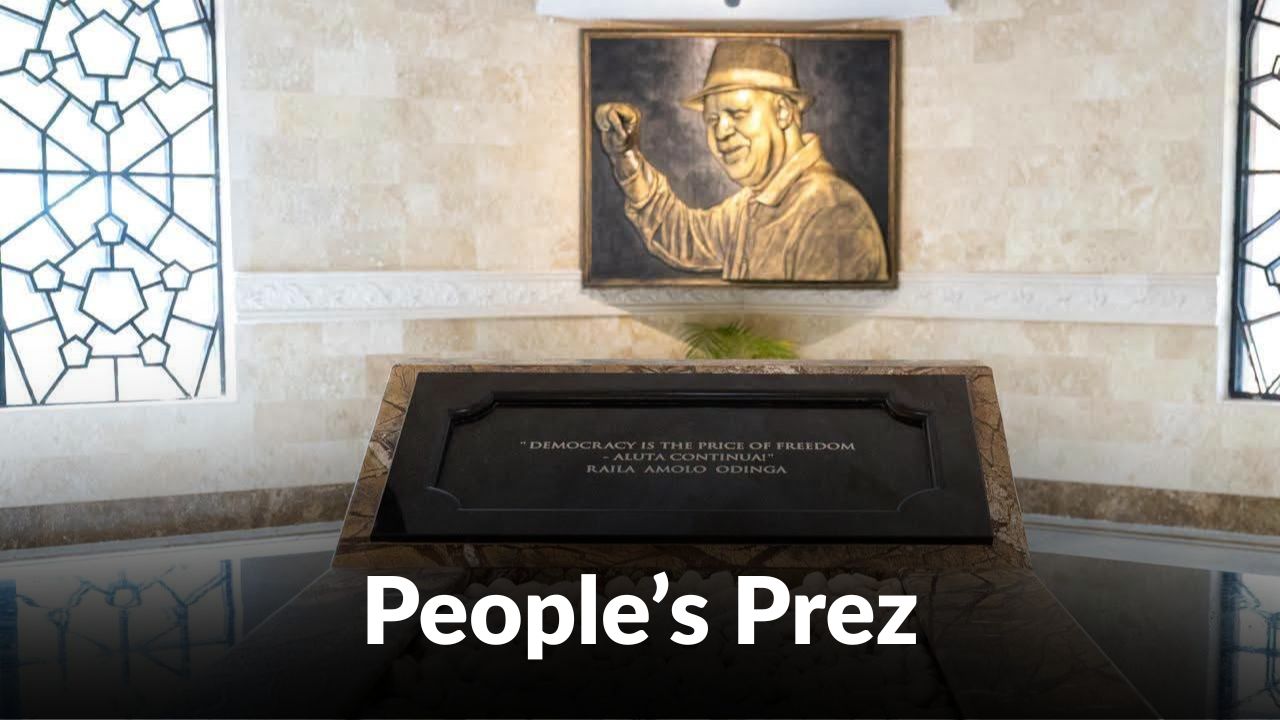
The chaos at Bondo on Thursday best sums up where Kenya stands one year after his death. The country built him a mausoleum. It commissioned it on October 7, eight days before the anniversary, with Ruto calling him a “once-in-a-generation” leader. It lit up the Kenyatta International Conference Centre with his image, the same building where his presidential mandate was stolen on the night of December 30, 2007.
Then, on the day set aside to honor him, the political class turned his memory into a venue for their own contests.
Kenya is very good at honoring Raila Odinga. It has never found the will to correct the record.
The Question Kenya Has Been Avoiding
Raila Odinga won the 2007 presidential election.
The accumulated evidence supports that conclusion without ambiguity: the pre-election polling, the parliamentary sweep, a suppressed exit poll funded by the United States government, statistical anomalies in the official tally, the ECK chairman’s own admissions, and two separate rounds of operational confessions from men who were in the room.
The USAID-funded exit poll, conducted on election day across 67 of 71 districts and covering 5,495 respondents, placed Odinga at 46.07 percent and Kibaki at 40.17 percent, a six-point margin the poll’s authors described as statistically reliable.
IRI’s East Africa director later confirmed the poll was treated as a “hot potato” inside the organization and was held without public comment for months. When USAID published its own account of the result, it concluded the poll named the wrong candidate as winner.
That finding matched every other indicator. ODM won 99 of the 210 directly elected parliamentary seats. Kibaki’s Party of National Unity won roughly 30 on its own. In Kenya’s 2007 electoral structure, voters cast presidential and parliamentary ballots simultaneously, at the same stations. A national parliamentary wave for ODM produced a presidential outcome for PNU that has never been credibly explained.
The Night the Lights Went Out
The fraud did not live in the voting queue. It lived in the tallying room.
According to the March 2026 NTV and Daily Nation investigation, Stolen Ballot, ECK chairman Samuel Kivuitu’s declaration was recorded in a separate room, placed on a tape hidden inside a KBC technician’s sock, and smuggled out as ODM politicians tried to force their way into KICC.
Philip Kisia, then managing director of KICC, told the investigation he received instructions to switch off the lights at the tally center. When he hesitated, Alfred Mutua called him, then put a cabinet minister on the line to reinforce the order.
At that same moment, inside a State House boardroom, five men directed the operation: President Kibaki himself, government spokesman Alfred Mutua, Deputy Chief of the General Staff General Julius Karangi, Head of Public Service Francis Muthaura, and Internal Security Minister John Michuki.
Nimrod Mbai, then a security operative and now a member of Parliament, told the investigation that Mutua called him on a private line and told him they did not know how the night would end, but that Kibaki must remain president. Mbai said he was given a second weapon, a password to use with Kivuitu, and instructions to escort the ECK chairman through a darkened corridor while carrying a green file said to contain the result.
He drove in convoy to State House, where Kibaki was sworn in at dusk.
A separate confession came a year before Stolen Ballot, in March 2025, at a burial in Machakos. Royal Media Services chairman SK Macharia said his parallel tally showed Odinga winning by 1.8 million votes, and that people took him from his home at night while Mount Kenya returning officers gathered and used their forms to alter figures in Kibaki’s favor.
“I was taken to my office,” Macharia said. “I found some people whose names I will not mention. And we changed all those figures, and Kibaki won the election.”
He had said something similar before the Kenya Senate in January 2017. Each time, the claim was denied and absorbed by the political cycle without legal consequence.
What the Commissions Refused to Say
The Independent Review Commission, led by South African judge Johann Kriegler, examined only 18 of 210 constituencies and still found large discrepancies between its reconstruction and the official ECK results.
It found the results “irretrievably polluted.”
Then it stopped.
Rather than expand the audit to all 210 constituencies, the commission declared the errors random and declined to name a winner. That decision gave the Kibaki administration the cover it needed. “Nobody can know who won” became the official alibi of a political order with every incentive to prevent the truth from landing.
The Waki Commission, which investigated the violence that followed, drew the connection Kriegler would not. The December 30 announcement was the immediate trigger of post-election violence that killed more than 1,100 people, displaced up to 600,000, injured thousands, and left more than 100,000 properties destroyed.
The electoral fraud was not a procedural violation. It was the detonator of atrocity.
Almost no one has been held accountable for the fraud itself. The ECK was dissolved. Some men publicly linked to the operation’s mechanics later held public office.
The Party He Built Is Now Backing the Beneficiary
One year after Raila Odinga’s death, the Orange Democratic Movement is engaged in the most consequential act of institutional self-betrayal in its 21-year history.
In July 2026, ODM party leader Oburu Oginga, Raila’s elder brother, announced that the party would not field a presidential candidate in the 2027 general election for the first time since its founding. “Candidate wetu ni President William Ruto,” Oginga said.
William Ruto’s 2022 presidential victory came after a campaign that exploited the political vacuum left by Raila’s repeated denial of power. The party built to challenge the same elite networks that stole the 2007 election is now preparing to deliver its votes to the sitting president who emerged, in part, from the political order those networks sustained.
Ruto has publicly moved to claim Raila’s legacy, and an Infotrak survey released in July placed UDA at 22 percent and ODM at 21 percent. The party Raila built to be a majority force is now statistically tied with its presumed coalition partner, having surrendered the one leverage point, a presidential candidacy, that could have made the negotiation equal.
ODM deputy party leaders have accused Ruto of undermining the party’s structures, engaging officials directly and bypassing party organs, creating rifts in the process. The party has been issuing contradictory statements on its 2027 position for months.
The confusion has a name.
A Heir They Rejected
Nairobi Senator Edwin Sifuna spent years as ODM secretary-general positioning himself as the keeper of Raila’s political vision. After Raila’s death, he became the party’s loudest voice, insisting ODM must field its own presidential candidate and not surrender its founding opposition identity to a coalition with Ruto.
The party removed him.
Political leaders allied to Oburu Oginga removed Sifuna as secretary-general, citing what they described as disrespect to party leadership and the issuing of personal opinions as official party positions.
His appeal against dismissal was rejected by the Registrar of Political Parties in July 2026. He subsequently signaled a departure from ODM, building his Linda Mwananchi movement into the foundation for an independent presidential run.
Sifuna is now running for president under The Equitable Party, a move his ouster from ODM accelerated.
The irony is unavoidable. The man most publicly committed to Raila Odinga’s founding vision for ODM was expelled by the party that claims to honor that vision. The man Raila’s brother backed is now steering ODM toward the very coalition arrangement that Odinga himself said, as late as 2025, the MOU between ODM and Ruto’s administration did not require.
After Raila’s death, Sifuna consistently argued that supporting Ruto’s re-election was not part of the 10-point Memorandum of Understanding signed between the former prime minister and the president, which centered on implementing the National Dialogue Committee report and addressing governance challenges.
He was outvoted, outmaneuvered, and pushed out of the house Raila built.
A Debt the Republic Has Not Paid
On October 20, 2025, five days after Raila Odinga died, President Ruto posthumously conferred on him the Chief of the Order of the Golden Heart, Kenya’s highest civilian honor.
It was a significant gesture. It was also insufficient.
The honor acknowledged his service as prime minister, his role in the 2010 constitutional process, and his decades of democratic advocacy. It did not address the central fact that Kenya twice stripped him of the presidential mandate he had given by fraud and judicial nullification.
Posthumous recognition of Odinga’s 2007 presidential mandate would not be ceremonial. It would correct the democratic record: an acknowledgment by the Kenyan state that the official result of December 30, 2007 was fraudulent, that the winner was not declared, and that the republic owes its own democratic history an honest accounting.
It would not retroactively install Odinga as a former president in any administrative sense.
It would restore what the evidence now overwhelmingly supports.
KICC lit up last night in his image. The building where the lights were switched off so that his mandate could be stolen was illuminated in tribute to the man that mandate belonged to.
Kenya is very good at honoring Raila Odinga. It has never been willing to tell the truth about what it did to him.
That reckoning is overdue. ODM fights for survival one year after his death, the party he built fragmenting, his vision being traded for cabinet seats, and the men who benefited from the theft of his mandate still shaping the country’s political future.
Parts II and III of this series will examine the cover-up, the institutional pathway for recognition, and the unfinished argument Kenya must have before August 2027.

LEAVE A COMMENT
You must be logged in to post a comment.