

|
LISTEN TO THIS THE AFRICANA VOICE ARTICLE NOW
Getting your Trinity Audio player ready...
|
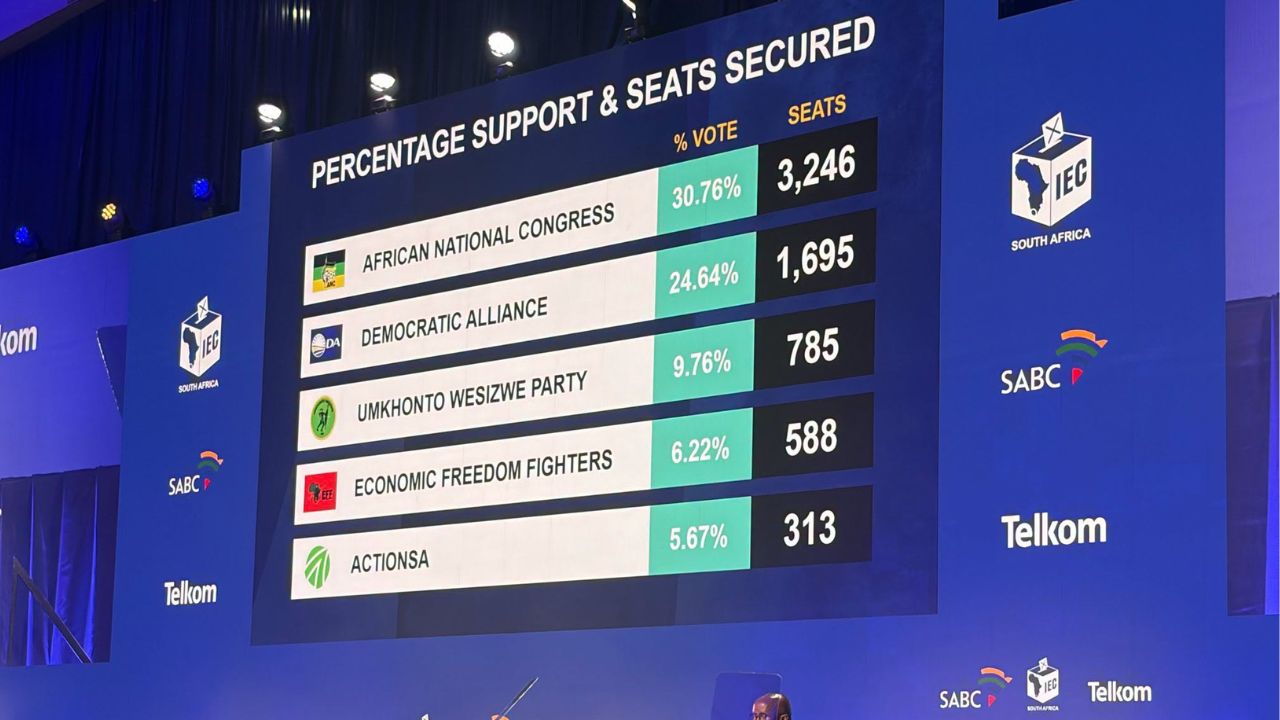
South Africa’s African National Congress won 30.76% of the vote in the Nov. 4 local elections, its lowest share since 1994.
Parties that campaigned hard on immigration took much of what it lost, and they now hold swing seats in the country’s biggest cities.
Those cities are home and marketplaces to people from across the continent.
Councils run metro police and write the rules for street trading, so the deals struck this month will shape daily life for traders from Harare, Maputo and Lagos.
The ANC Now Governs Alone in Only 53 Municipalities
Mosotho Moepya, chairperson of the Electoral Commission of South Africa, declared the vote free and fair on Nov. 8.
Final results gave the ANC 3,246 council seats. Its vote share was 45.59% in 2021.
Second place went to the Democratic Alliance with 24.64% and 1,695 seats.
Jacob Zuma’s uMkhonto weSizwe Party, known as MK, placed third with 9.76% and 785 seats in its first local election.
Next came the Economic Freedom Fighters at 6.22% and ActionSA at 5.67%.
Outright ANC control fell to 53 municipalities from 122 five years ago.
In the metros, the DA kept its Cape Town majority and finished first in Johannesburg, Tshwane, Ekurhuleni and Nelson Mandela Bay.
Only Buffalo City and Mangaung still have the ANC in first place.
Turnout rose to 52% from 45.9% in 2021, so the result cannot be blamed on voters staying home.
“This has been a very catastrophic outcome for the ANC,” said Fikile Mbalula, the party’s secretary-general.
Its decline is long-running: 64.8% in 2006, 61.9% in 2011, 53.9% in 2016.
ANC Voters Switched to MK and ActionSA, Not Only to the DA
A News24 ward analysis of the Gauteng metros and eThekwini found that former ANC wards mostly went to two parties.
MK won 73 wards in eThekwini, 71 of them from the ANC.
ActionSA took 53 wards across Johannesburg, Tshwane and Ekurhuleni, all but one from the ANC.
Herman Mashaba’s party jumped from 8.6% to 22.07% in Tshwane and from 6.6% to 18.5% in Ekurhuleni.
In eThekwini, the metro that includes Durban, MK won 38.29% and 86 of 223 seats.
ANC support there collapsed from 42.1% to 16.43%.
Both parties call for stricter action on undocumented migrants.
Immigration Was on the Ballot, but It Does Not Explain Everything
March and March, the Durban-based movement led by former radio presenter Jacinta Ngobese-Zuma, kept the issue in the news all year.
Its June 30 “deadline” for undocumented migrants to leave came with looting and attacks on homes, according to Daily Maverick.
Police went to the Durban High Court before the vote.
On Oct. 30, Judge Peter Olsen suspended the movement’s marches until Nov. 6 and banned weapons and face coverings afterward.
Olsen made no finding of wrongdoing against Ngobese-Zuma, and the case returns to court Jan. 18.
Zuma met the movement’s leaders on election day.
His party then said undocumented foreign nationals must regularize their stay or leave, while urging legal routes over violence, TimesLIVE reported.
Ngobese-Zuma has since claimed that parties lost votes by ignoring immigration, according to IOL.
Some results support her, and some do not.
ActionSA stayed flat in Johannesburg at about 16%, the city where Mashaba once served as mayor.
MK’s strength in KwaZulu-Natal predates the protest wave and rests heavily on Zuma’s personal following.
Meanwhile, the EFF held its pan-African position and lost ground.
One analyst told the Mail and Guardian that its immigration stance could be a factor.
Service failures also drove voters, and no exit poll published so far isolates immigration as the deciding issue.
Mondli Hlatshwayo, a University of Johannesburg scholar, found in a 2023 study that anti-immigrant feeling tracks perceived economic threats.
Joblessness and failing services create the anger, and migrants become its target.
Coalition Talks Will Decide Whether Slogans Become City Policy
More than 130 of the 213 councils have no majority party, by most counts.
ActionSA holds the balance in Gauteng.
In Johannesburg, where 136 of 270 seats are needed to govern, the DA’s 91 and ActionSA’s 43 fall two short.
Together, the two parties would hold 122 of Tshwane’s 214 seats, a majority.
Mashaba’s negotiators have also met the ANC and the EFF, so no outcome is settled.
Adding to the uncertainty, the ANC Youth League has declared the DA and right-wing parties off-limits as partners.
In KwaZulu-Natal, the price of ActionSA’s support is already public.
Zwakele Mncwango, the party’s provincial leader, listed three conditions for deals in eThekwini and uMhlathuze, The Witness reported.
They are fair service delivery, an end to corruption and action on illegal immigration.
How councils define that third condition is the question that matters.
Lawful document checks and working Home Affairs offices are one answer.
Raids on street traders, whatever papers they hold, are another.
Other African Economies Are Already Paying for South Africa’s Street Politics
Nigeria, Ghana and Mozambique reportedly began bringing citizens home after the June protests, which also drew criticism from the African Union.
Migrants from South Asia have been targeted alongside Africans, Daily Maverick reported in April.
Trade has taken a hit as well.
Cross-border buyers spend close to $600 million a year in central Johannesburg’s Jeppe district, The New Humanitarian reported in August.
A Zambian bus operator told the outlet that passenger numbers had dropped by at least 30%.
South African shop owners and wholesalers lose that money too.
None of that makes the anger behind the marches false.
Unemployment is real, and so is a migration system that many South Africans believe has failed.
Voters have now handed the problem to city halls.
Marches can resume under court limits, and the mayors chosen in the coming weeks will show which answer South Africa’s cities have picked.



LEAVE A COMMENT
You must be logged in to post a comment.