

|
LISTEN TO THIS THE AFRICANA VOICE ARTICLE NOW
Getting your Trinity Audio player ready...
|
Sandra Alcobia tells this one with a laugh, but she means every word of it: one of the horses on this estate is valued at one and a half million euros, and if he’s paired with a mare who takes a dislike to him, she can kill him with a single kick. So nobody here leaves that to chance. Every pairing is done by artificial insemination. “The female decides,” Sandra says.
Sandra has spent sixteen years learning to read this place the way other people read a language. At roughly 18,000 hectares, bigger than Paris, close to three times the size of Manhattan, Companhia das Lezírias is the largest single piece of agricultural, livestock, and forestry land in Portugal. A Portuguese queen founded it in 1836. The state has owned it since 1975, the year after Portugal’s revolution. Sandra now runs its communications and tourism arm, but she started here as a field biologist, and that origin shapes almost everything she says about the place.

The Campinos and Their Horses
The estate’s horse breeding sits in the north of the property, in permanent free range; 80 to 90 animals, 18 to 20 of them breeding mares, which are never stabled. Companhia das Lezírias breeds two distinct types under the same Lusitano lineage. One line is bred for the field and for bullfighting: sturdy, work-hardened animals sold largely to bullfighting enthusiasts who want horses that have actually done farm work. The other, the Alter Real strain, is bred purely for the arena; dressage, show jumping, classical equitation, the spectacle end of the business.
Both lines exist because of the campinos, Portugal’s own cowboys, a living tradition specific to this stretch of the Ribatejo. Companhia das Lezírias is one of the last operations left that still manages its entire cattle herd on horseback, day in, day out. “They don’t go to the field to see our cattle in motos or cars,” Sandra says. “Always riding their horses.”
The artificial insemination program isn’t fully about safety, either, even though the danger is real. It’s more about economics. The estate’s top stallion, the one valued at a million and a half euros, is named Beirão, and his semen alone sells for between 1,100 and 2,000 euros a dose. Sandra is blunt about weighing both sides of that ledger at once: “I need to think about the two things; economy, and also the animals’ health.”
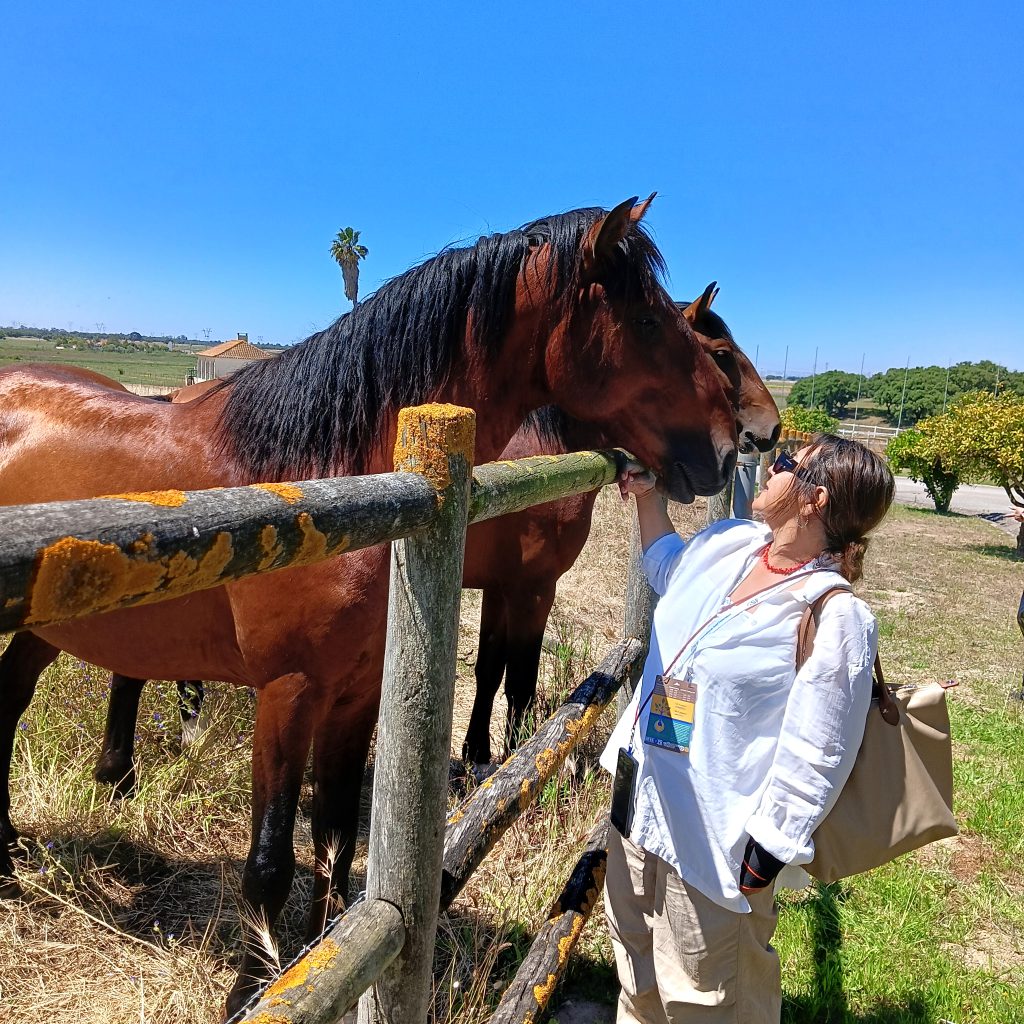
Foals stay with their mothers for six months before being separated. The separation is done by by fence only, so contact continues if the foal wants it. By nine months they’re fully independent and get moved to a separate section of the property, the Lusitânia site, where they run free until they’re three or four years old. Only then do they come back to the boxes and paddocks to begin training. They are old enough, and gentle enough as a breed, that Sandra says the estate lets children as young as four ride fully grown adult horses.
The breed’s history is older than most European nations. For a long time it was assumed the Lusitano descended mainly from Arabian bloodlines; the round-headed, thick-necked conformation that makes these horses so good at dodging a charging bull, and made them prized as war horses centuries ago, actually reflects a separate lineage, distinct from the more Arabian-influenced horses bred just across the border in Spain.
Coat colour has its own hierarchy. Brown and grey-white are the classic, most sought-after colours. Bayo, a honey-gold coat with black mane and tail, has become fashionable in recent years, something Sandra puts down partly to trends rather than tradition. Rarest of all is Isabelline: pale cream coats, blonde manes, startling light-blue eyes, produced by recessive genes that are difficult to breed for on purpose. Isabelline horses are also unusually sensitive to sunlight, which makes them poorly suited to fieldwork.
Why Cork Takes Fifty Years To Mature
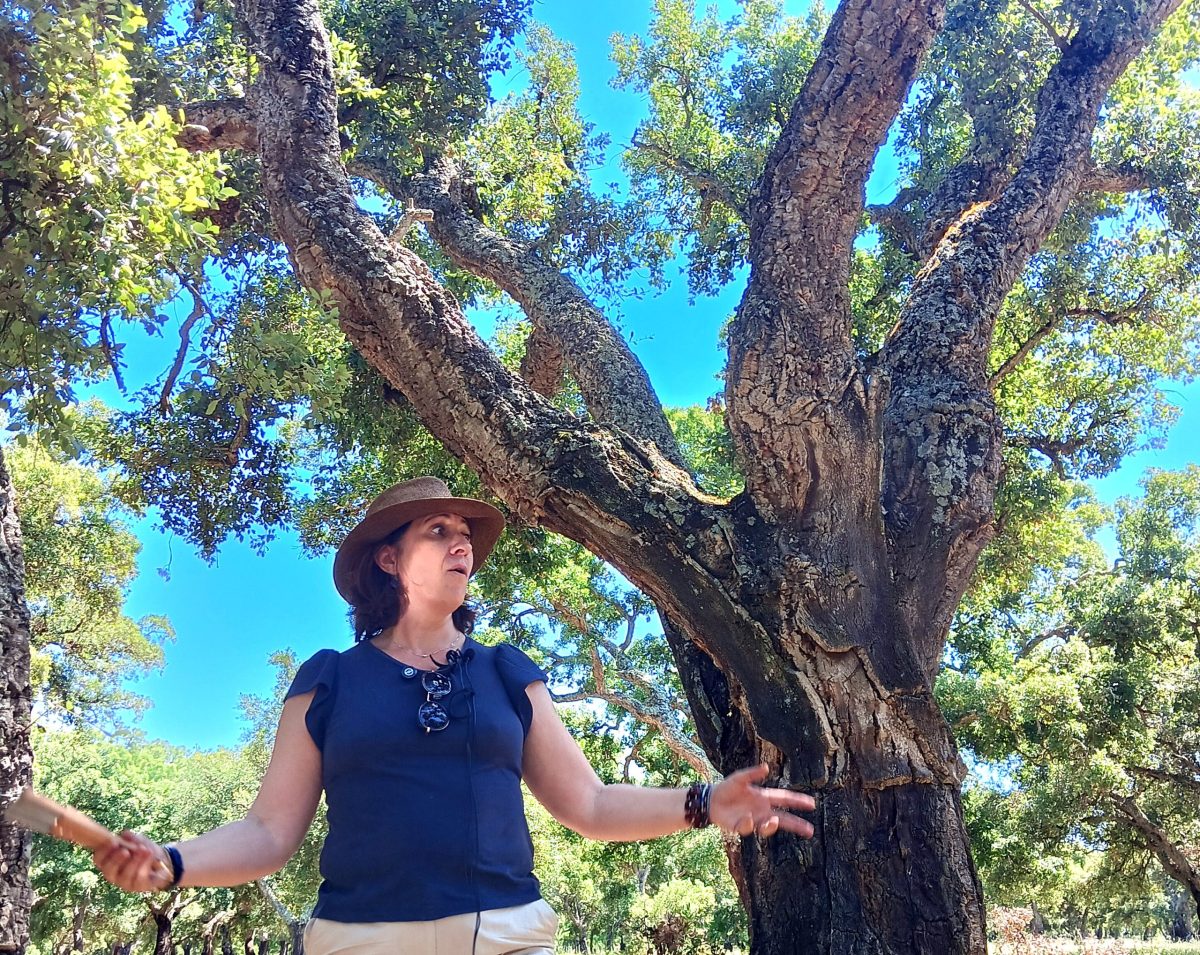
Cork is tree bark, specifically the thick, spongy outer bark of one particular oak, Quercus suber. Portugal holds the largest cork oak forest on Earth, close to a third of the world’s total. Companhia das Lezírias alone holds roughly 6,800 hectares of it, the single largest continuous stretch of cork oak forest under one owner anywhere in the world. Larger cork operations exist, but only by combining scattered plots under different ownership across the Alentejo region.
You can strip bark from a cork oak without killing the tree, which is the entire reason the industry exists, but the margin for error is thin. Sandra explains it through the image of peeling an orange. You score the bark in a rectangle, cut laterally with a curved hatchet, and lift the panel free. Just beneath it sits a thin membrane, the layer that actually regenerates the cork. If by any chance you nick that membrane, the tree will never produce bark on that patch again. Also, if you get the timing wrong, you can’t remove the bark cleanly at all, because for most of the year the tree’s cells lock together “like a roof.” There is exactly one window, May through August, when the tree is growing fast enough that its cells stay loose and disorganized enough to cut.
It’s a trade passed down inside families, not taught in schools. “If our grandpa knows how to do it, he will teach us,” she says. The craft of debarking the cork oak pays extraordinarily well by local standards:about 150 euros a day against a national minimum wage of around 900 euros a month, which is why people who know the skill take their annual holiday to go do it.
Even done perfectly, the wound takes decades to close, and you can still see the tunnels bored by insect larvae in cork harvested years earlier, evidence of how easily an imperfect cut becomes an entry point for pests. Sandra points out two beetles in particular that threaten the trees here; cerambycid longhorn beetles (more of a problem in the Alentejo region than on this estate) and the platybus borer, which the estate actively monitors using pheromone traps designed to attract only that species, counting catches season over season to track whether the population is climbing.
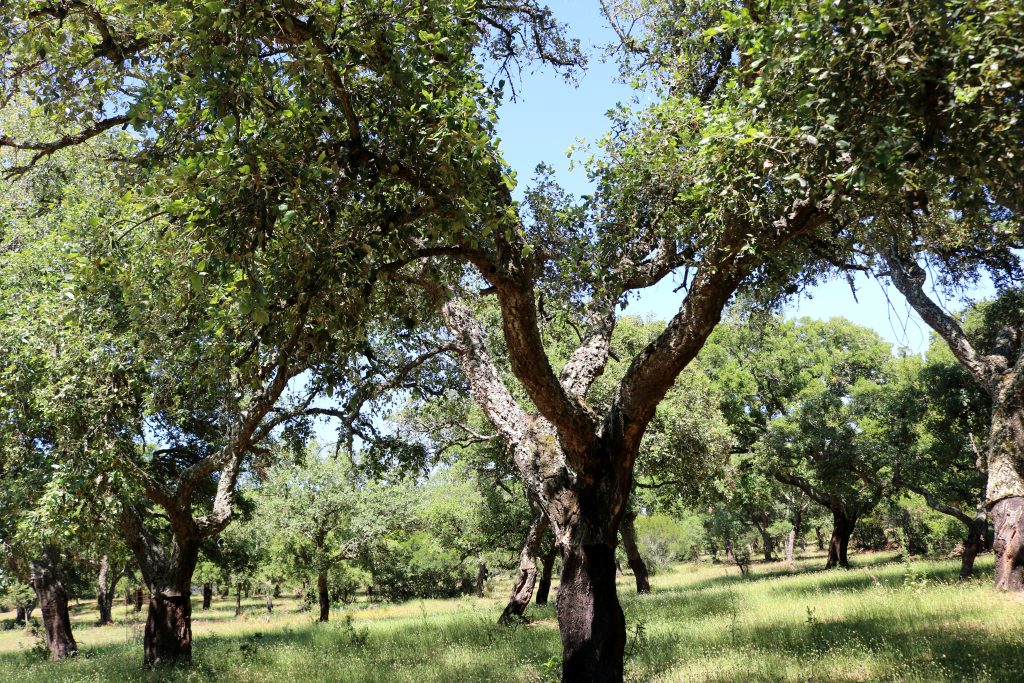
And then there’s the wait itself. The first bark a tree produces, around age 25, is thin, cracked, and useless for anything but the roughest applications. The second harvest, nine years later, is still too porous. Only the third strip, the amadia cork, roughly fifty years after planting, has the density and elasticity to seal a wine bottle properly, letting the wine breathe slowly inside the bottle over years. Sold by the arroba, an old unit equal to fifteen kilograms, the rough early cork fetches ten to twelve euros; the good amadia cork can go for forty to fifty euros, depending on the year’s quality and, increasingly, on how much wine the world is still drinking.
There’s a saying Sandra returns to more than once, because it functions less as folklore and more as an operating manual: “The eucalyptus is for me, the pine wood is for my son, the cork oak tree is for my grandson”. Global wine consumption has fallen by roughly a tenth over the past decade, driven mostly by younger drinkers moderating or switching to spirits and low-alcohol alternatives. Sandra connects this trend to countries cutting off wine imports to Russia after the invasion of Ukraine, one of the industry’s largest former buyers. Less wine sold means less demand for stoppers, which means less incentive to keep an expensive, slow-growing forest standing at all.
A Landscape That Only Exists Because People Keep Farming It
The cork forest here isn’t wild in any conventional sense. It’s part of the montado, Portugal’s name for this specific kind of open, savanna-like oak woodland, grazed by livestock for centuries, found almost nowhere outside the western half of the Iberian Peninsula (Spain calls its version the dehesa). Ecologists rank it among roughly three dozen global biodiversity hotspots, in the same company as the Amazon. The catch is that the montado depends on continued human use to survive. “If we stop working in this ecosystem, naturally, it will regenerate and evolve again to the Mediterranean forest. It’s not bad, but we will lose a lot of biodiversity”
Managing that balance takes constant intervention. The estate fences off patches every few years specifically to let cork oak seedlings establish without cattle trampling them, and protects individual young trees with more than 60,000 physical guards against grazing animals, cattle, but also wild boar and deer, both of which damage saplings while foraging. Every five or six years, workers cut back shrub overgrowth in the same patches, without pulling roots, leaving the cut material on the ground to decompose into the sandy soil. When the estate wants to densify a bare patch of montado, they dig a full metre down before planting, deep enough to reach groundwater and loosen soil compacted by decades of cattle traffic. They then shade each seedling with garden mesh for its first two or three summers, since young cork oaks scorch without shade. All the seeds used come from inside the property itself, selected from trees the estate already knows produce strong offspring, rather than introducing outside genetic stock.
Between 2008 and 2021, the estate partnered with the CETRECHE laboratory at the University of Lisbon on a long-running biodiversity survey, tracking nearly every species on the property, mapping the green wildlife corridor the estate began building in 2009 to connect isolated pockets of forest, and monitoring animal diet and health. Badgers were a particular focus because the estate needed to know whether badgers moving through the new corridor could be carrying disease that might spread to cattle. Otters, genets, and pine martens have all returned to the property since the corridor project began, evidence, Sandra says, that the restoration work is measurably improving the health of the whole ecosystem.
Red squirrels are the corridor’s most improbable success story. They vanished from Portugal roughly five centuries ago, drifted back in from Spain over recent decades and stabilized in the north of the country, until wildfires in 2017 burned through that habitat and pushed them south. In 2018, for the first time in five hundred years, they arrived at Companhia das Lezírias. Sandra treats their arrival almost affectionately. “The squirrel is one of the best friends of the forest because it keeps seeds, putting seeds on the ground so we will have a lot of natural regeneration.”
Rice, Cattle, and the Arithmetic of Restraint
The estate also grows rice, 1,500 hectares of fields in total, though only 300 are actively farmed today, all of it now on the property’s other section, closer to the Tagus River, where water is drawn directly from the river itself. That wasn’t always the arrangement. Until 2020, rice was grown on the fields nearer the estate’s original core, irrigated by an internal dam capable of holding water up to eleven metres deep at full capacity. Then came 2015: by August, every pond on the property that had never dried out before had gone dry, and the dam itself dropped to five metres and never recovered. By 2020, the estate abandoned rice production on that patch of land entirely.
Rice has a fragile economic history here. Portuguese households eat it daily, and production used to be cheap and reliable, until costs began rising in the 1990s and smaller landowners started abandoning their fields. Companhia das Lezírias responded by organizing an enterprise, Orizava, that pooled neighboring rice growers together to share seed distribution and cut costs, selling everyone’s rice under a single shared label, Bom Sucesso. It functions like a cooperative without formally being one.
The most recent rice season brought its own reminder of how unstable the weather has become. An unusually wet, at points catastrophic year that forced the estate to open the dam’s gates on the 23rd of December, and even then floodwater reached a road roughly 14 kilometres away, closing routes across the region through February and March.
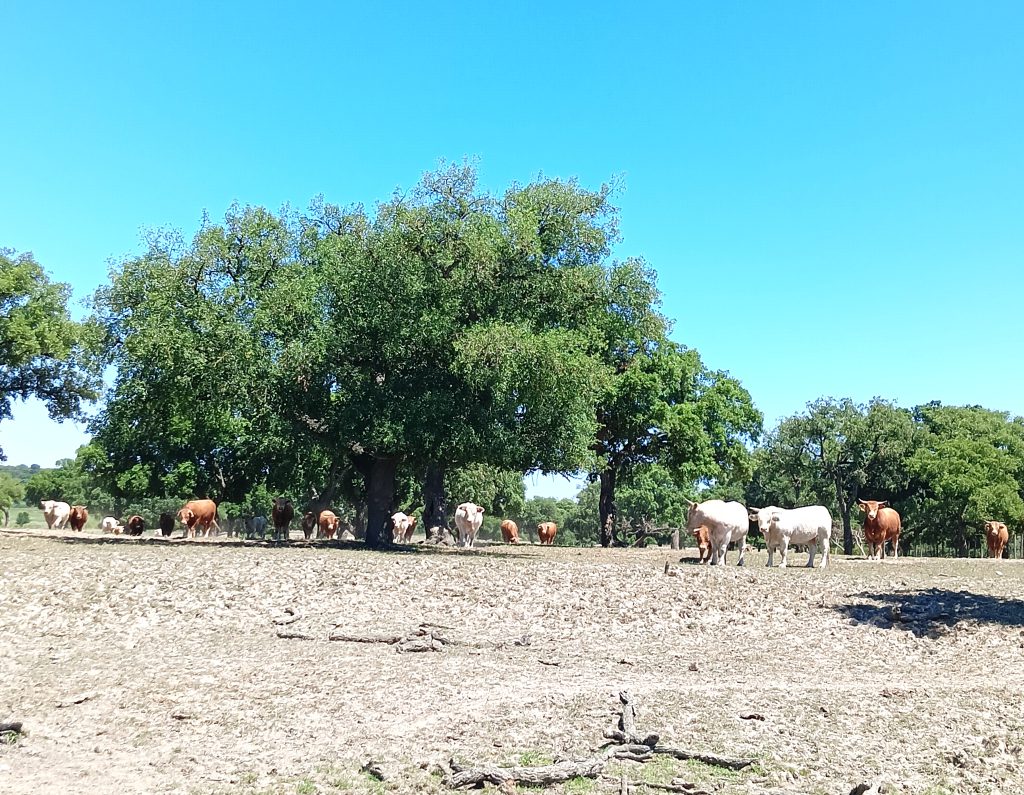
Cattle tell a parallel story of deliberate restraint. Until 2008, the estate’s combined operations ran as many as 4,500 head. But montado grazing has a hard ceiling, roughly 0.6 animals per hectare before cork oaks start to suffer from overgrazing, and the estate had to choose between maximizing cattle numbers and protecting the forest. It chose the forest, cutting the herd nearly in half, to the 2,300–2,500 animals it runs today, split between roughly 4,500 hectares of grazing land on the home property and 3,500 hectares on the estate’s other section, where cattle spend summers on richer pasture before returning for winter calving. The herd is now certified as low-carbon-emission production, the estate’s term for offsetting the emissions its cattle generate through the carbon its forests and soils absorb. In addition, because the numbers dropped so much, the whole operation now qualifies as organic, a designation that would have been financially impossible to sustain at the old scale.
Even pest control on the estate’s crops follows the same logic of restraint over convenience. Portugal’s rules classify this as “integrated agriculture”, chemical treatment is allowed, but only within strict concentration limits, and only once a set damage threshold is crossed. Sandra offers an example: “If twenty percent of a vineyard shows signs of insect damage, the estate can’t spray immediately. It has to wait until damage reaches around twenty-five percent”, because insect populations passing through on migration often move on within a week or two once conditions shift, and spraying too early means using chemicals on a problem that was about to solve itself.
Combating Forest Fires
Given how much of the estate’s value sits in trees it can’t quickly replace, fire prevention is treated as close to non-negotiable. The estate currently maintains somewhere between 40 and 50 kilometres of cleared firebreaks running through its forested land, designed to stop a fire in one section from spreading into the next. Forestry machinery is only permitted on site between October and April; after that, no machinery goes near the trees at all, specifically to reduce ignition risk during the dry months. Two internal patrol vehicles carry first-response equipment and are typically first on scene if trouble starts. The estate pays the fire brigade in the neighboring village to keep a dedicated vehicle watching the external roads that cut through the property; three separate roads divide this section of land, while a separate contracted team handles internal vigilance. On top of that, there’s a standing arrangement with the national police to staff the estate’s fire-watch tower around the clock.
It’s a level of institutional caution that only makes sense once you understand what’s actually at stake: cork oaks that took fifty years to become productive, montado habitat that took over a decade to rebuild, a wildlife corridor eight years in the making. None of it comes back quickly if it burns.
Sandra didn’t set out to be the person telling this story. She backed into it. Born in 1976, she joined the estate in 2008 as a young field biologist with a modest proposal to study its mammal populations, half-convinced no one would fund it. “It’s an agroforestry property,” she remembers thinking. “Nobody’s going to pay us to do research here.” She submitted the proposal anyway. The following week, the estate said yes, and for the next sixteen years, through the CETRECHE partnership with the University of Lisbon and beyond, the property became, in her words, more familiar to her than her own neighborhood. “So for 16 years, this has been my house. I know better the roads of this enterprise than what I have at home,” she says.
It wasn’t until 2021 that she moved from research into communications and tourism, taking on the estate’s public image, its visitor programs, and its equestrian demonstrations. She’s candid about the fact that this isn’t a purely idealistic operation. “We need to make money, we are an enterprise, we need to think about the economical amount at the end of the year,” she says.





LEAVE A COMMENT
You must be logged in to post a comment.