

|
LISTEN TO THIS THE AFRICANA VOICE ARTICLE NOW
Getting your Trinity Audio player ready...
|
Nairobi Senator Edwin Sifuna spent five months fighting his removal from ODM’s top job, and lost anyway. The loss looks like the best thing that happened to his political career.
Kenya heads toward a 2027 election that will test whether a fractured opposition can unite behind one candidate strong enough to beat President William Ruto. For a diaspora watching Kenya’s democracy strain under economic pressure and youth unrest, the answer matters beyond Nairobi. It will shape how the country’s next government treats remittances, diaspora voting rights and the young population driving Kenya’s protest movements. Sifuna’s rise from party outcast to genuine contender is one of the clearest signals yet of where that fight is heading.
A Purge That Freed Him
The Orange Democratic Movement’s National Executive Committee voted to remove Sifuna as secretary-general on February 11, 2026, citing his conduct and his refusal to back the party’s cooperation deal with Ruto. Sifuna immediately challenged the decision at the Political Parties Disputes Tribunal, which blocked the removal while it reviewed the case. In June, the tribunal ruled that ODM had denied him a fair hearing, but it did not permanently shield him. It cleared the party to restart the process on proper footing, and ODM did. On July 9, the Office of the Registrar of Political Parties upheld his removal for good. Six days later, he lost his Senate leadership post as well. His legal fight over the registrar’s decision continues, with a fresh hearing set for August 18.
Framed as a five-month losing streak, the story misses what actually happened. Sifuna was punished for refusing to endorse Ruto’s re-election even as his own party moved toward a governing arrangement with the president. He is now free to lead the more popular half of a party split in two. A May 2026 TIFA Research survey found 73 percent of ODM supporters back Sifuna’s Linda Mwananchi faction, against 24 percent for the rival Linda Ground camp aligned with acting party leader Oburu Oginga. Among ODM supporters who oppose the government cooperation deal, the split runs even sharper, with 90 percent backing Sifuna’s camp against just 47 percent supporting it. He did not choose to lose his title. He chose, once he lost it for good, to claim what came next.
A Party Without Raila
Raila Odinga died of a heart attack on October 15, 2025, while receiving treatment in India, leaving ODM without the figure who built it and, for years, shielded Sifuna from internal rivals. His brother, Oburu Oginga, stepped in as acting leader and steered the party toward continued cooperation with Ruto. Sifuna refused to follow, and the two camps have spent 2026 holding rival rallies, competing conventions and dueling claims to Raila’s legacy.
That legacy question, not a live alliance, now defines Sifuna’s relationship to Raila. Former Chief Justice David Maraga joined the Linda Mwananchi camp in July, a signal that Raila’s old coalition partners see Sifuna’s faction, not Oburu’s, as the movement’s true heir. Sifuna has said he will not serve as secretary-general “under mediocrity,” casting his fight as a battle over who legitimately carries ODM’s founding mission forward.
The Gen Z Bet
Sifuna’s break with ODM’s leadership tracks closely with his defense of Kenya’s youth protest movement. He invoked the death of Gen Z demonstrator Rex Masai to condemn a 2025 police order to shoot rioters in the leg, and he has repeatedly opposed government spending programs he calls wasteful. His Linda Mwananchi faction organized opposition to the 2026 Finance Bill alongside Embakasi East MP Babu Owino, warning lawmakers who backed it would face public pressure at home.
No polling firm has yet measured Sifuna’s support specifically among Gen Z voters as distinct from ODM supporters generally. What exists instead is a pattern of alignment, consistent rhetoric and visible presence at youth-led events that reporters and analysts have described as an emerging third force in Kenyan politics.
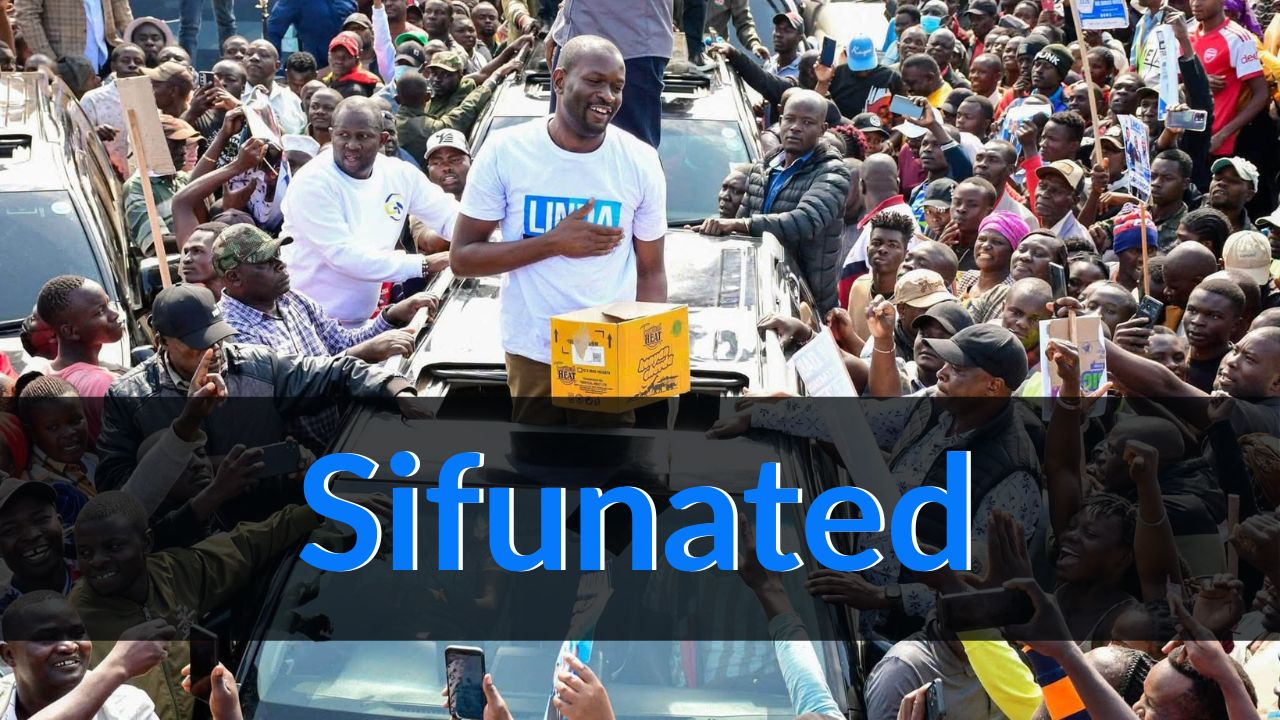
That pattern shows up most clearly at the rallies themselves. Linda Mwananchi events have drawn large, energetic crowds across the country this year, from Kakamega to Nakuru, often running in parallel with Gachagua’s own competing tour, a sign Sifuna’s movement has built organizing capacity that stretches well beyond ODM’s traditional base. The rallies have produced their own rallying cry. “Sisi ni Sifuna,” Swahili for “we are Sifuna,” began as a chant at faction events and has since become shorthand for loyalty within the movement itself. The Star described the phrase in April as not simply a chant of support but a declaration of identity, tied to members’ sense that their faction, and its independence from ODM’s leadership, was under threat.
That energy faces its first real financial test now. This week, Sifuna’s team says small donations pushed a new fundraising paybill past two million shillings in roughly a day and a half, before the service went offline. Sifuna has blamed Safaricom for the outage; the company has not publicly confirmed why the disruption happened. True or not, the fundraising drive itself signals a movement testing whether it can out-hustle a well-funded incumbent with little money and volume.
Tribal Math, Tested and Untested
Kenyan politics has long rewarded candidates who can consolidate a home ethnic base before reaching outward. Sifuna, a Luhya politician from Western Kenya, starts there. A May 2026 TIFA survey placed his strongest support in Western Kenya, though even there he trails Ruto’s regional numbers. A later Infotrak poll found similar results, with Sifuna’s base holding at roughly 26 percent in Western Kenya and negligible support in Central Kenya or the Rift Valley.
Whether Kenyans broadly want a president from outside the Gikuyu and Kalenjin communities that have dominated the presidency since independence is a real question in Kenyan political conversation. No pollster has directly surveyed that appetite as a standalone question, however, and the claim should be treated as informed analysis rather than measured fact until such data exists. What the numbers do show is a nationally fragmented field, with support spread thin across Sifuna, Fred Matiang’i and Rigathi Gachagua rather than consolidating around any single non-incumbent challenger.
The Coalition Math
Kenya’s opposition cannot beat Ruto divided. Two competing polls this year tested pairings meant to unite it. TIFA’s May survey found a Kalonzo Musyoka and Matiang’i ticket leading at 31 percent, with Kalonzo and Sifuna close behind at 28 percent and a Kalonzo and Gachagua pairing at 25 percent. Infotrak’s June survey reversed the order, putting Kalonzo and Sifuna ahead at 23 percent against Kalonzo and Matiang’i at 16 percent.
Sifuna has publicly pledged that his movement “will not be used to split the opposition vote” and says he intends to work toward a single ticket with Matiang’i. Kalonzo has not ruled out pairing with him, and polling keeps testing the two as a leading combination. Inside Linda Mwananchi itself, alignment is not total. Babu Owino has said he would want any Linda Mwananchi presidential winner to serve a single term before handing power to him in 2032, an early marker of ambition inside a coalition still being built. James Orengo, the Siaya governor and senior Linda Mwananchi figure, has downplayed talk of internal wrangling, though claims of deeper friction within the faction remain unconfirmed and should not enter reporting without independent corroboration.
Gachagua’s Wall, and Kindiki’s Problem
No single figure poses a bigger obstacle to opposition unity than Rigathi Gachagua. The former deputy president, now leading the Democracy for Citizens Party, commands the largest single opposition bloc in national polling and has vowed to reduce Ruto’s Mt. Kenya vote share to near zero in 2027, down from the 87 percent Ruto won there in 2022. His campaign, built around a message targeting politicians he calls traitors to the region, scored a decisive proof of concept in July when his party’s candidate won the Ol Kalou parliamentary by-election with roughly 85 percent of the vote, defeating the ruling party’s candidate by nearly seven to one. It was the opposition’s first parliamentary by-election win of the cycle, after a string of ruling-party victories elsewhere. Health Cabinet Secretary Aden Duale moved quickly to downplay the result, noting the ruling party still held six of ten recent by-election contests nationally.
That win complicates Ruto’s calculus around Deputy President Kithure Kindiki, who polling shows as the clear favorite to remain his running mate, at 59 percent in TIFA’s survey and 34 percent in Infotrak’s. Kindiki is Mt. Kenya-adjacent but not from the Kikuyu heartland bloc Gachagua has organized. Retaining him may not resolve the risk Ol Kalou exposed, since Gachagua is contesting the region on opposition to Ruto’s government generally, not opposition to Kindiki specifically. Whether that translates into a genuine vote split in 2027, or fades as an isolated local upset, remains an open question analysts will be testing further by-elections and polling between now and the vote.
For Sifuna, Gachagua is simultaneously the biggest threat to opposition unity and a bloc he cannot simply outflank. Gachagua has publicly courted Sifuna’s Linda Mwananchi faction, urging him to abandon his ODM court fight and align directly with Mt. Kenya’s opposition energy. Whether that courtship becomes a formal alliance, or Gachagua insists on leading any joint ticket himself, will likely decide whether the opposition enters 2027 as one coalition or three.
Ruto’s Strongholds and His Weak Points
Any opposition strategy has to reckon with where Ruto remains strong. Infotrak’s June survey placed his national standing at 32 percent, up from 21 percent in August 2025, with his highest regional support in North Eastern Kenya at 59 percent, the Rift Valley at 46 percent and Nyanza at 40 percent. TIFA’s earlier survey found a lower national figure of 24 percent, with similar regional strength in Northern Kenya and Nyanza, but just 9 percent support in his own Mt. Kenya home region.
The Nyanza number stands out. It is traditional ODM territory, and Ruto’s inroads there reflect the broad-based government arrangement that Sifuna has spent the year rejecting. If Sifuna’s opposition faction can hold that ground while Gachagua erodes Ruto’s position in Mt. Kenya, the president’s 2022 coalition looks considerably more fragile than his current national polling suggests.
Kenya’s opposition has spent a generation failing to unite behind a single figure strong enough to beat an incumbent. Sifuna’s path to becoming that figure runs through a fractured party, an untested youth alliance and a rival, in Gachagua, who may prove impossible to fully absorb into any ticket that is not his own. None of that guarantees him the presidency. It does mean the senator who fought and lost a five-month battle for his party title enters 2027 with something rarer in Kenyan opposition politics than a job. He has real, visible momentum, crowds, cash, and a party fight won on the ground even after it was lost in the courts, and he appears determined to use it.


LEAVE A COMMENT
You must be logged in to post a comment.