

|
LISTEN TO THIS THE AFRICANA VOICE ARTICLE NOW
Getting your Trinity Audio player ready...
|
For 2,500 years, the marathon has asked: how fast can a person run? And for all those centuries, the answer kept creeping forward by seconds, sometimes by minutes, always just out of reach of the one number that sounded like a dare: two hours.
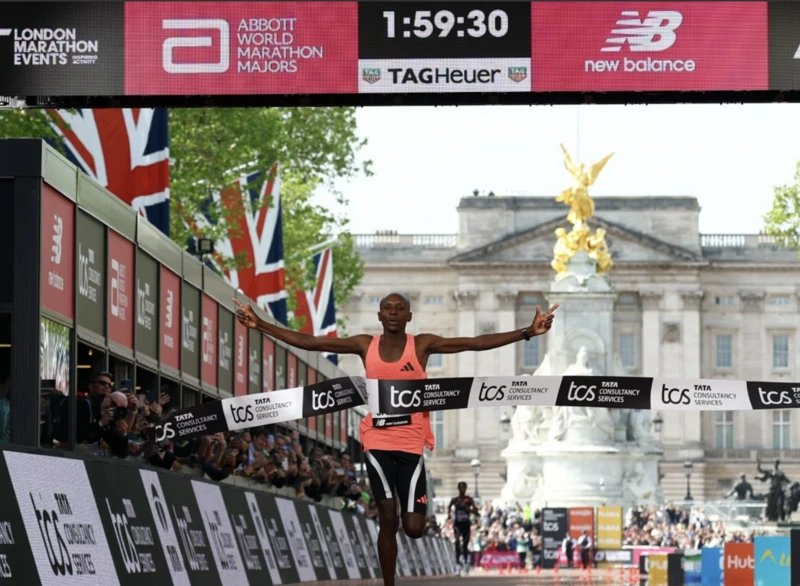
On a sunny Sunday, April 26, 2026, the clock finally surrendered.
A 30-year-old former mathematics teacher from a Kenyan village without electricity, a father who sees his wife and son twice a month, ran 42.195 kilometres faster than any human being ever has under legal race conditions. And then, to ensure nobody mistook his feat for a fluke, another man did it too, eleven seconds behind him.
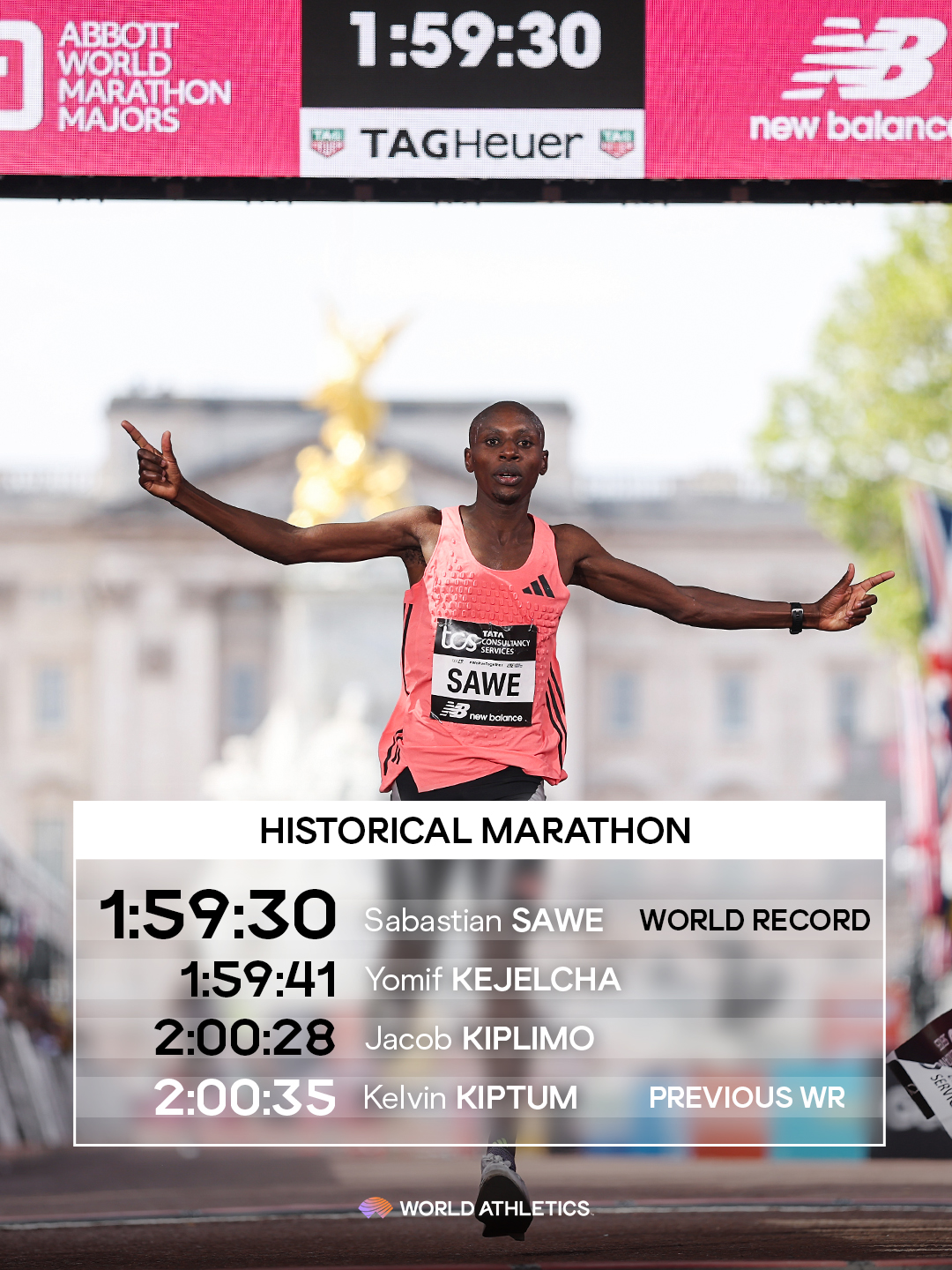
Sabastian Sawe of Kenya crossed the London Marathon finish line on The Mall in 1 hour, 59 minutes and 30 seconds. According to The Associated Press, that shaved an astonishing 65 seconds off the previous men’s world record, a margin so vast in marathon terms that it belongs to another sport entirely.
Ethiopia’s Yomif Kejelcha, running his first ever marathon, finished in 1:59:41. Uganda’s Jacob Kiplimo took third in 2:00:28, which itself was seven seconds faster than the old world record held by Kenya’s late Kelvin Kiptum.
As the BBC put it on air, with the kind of understatement reserved for genuine astonishment: “What have we just witnessed?”
The Village Without a Grid
To understand Sawe, you must first understand Cheukta.
Cheukta is a highland village in western Kenya’s Rift Valley. It has no streetlights. However, in July 2025, Kenya’s ministry of energy began connecting the villages in Uasin Gishu County, which were lacking electricity connection. Cheukta was among them. It is from this landscape of dirt roads and altitude-thin air that the world’s most improbable athletic dynasty emerges, not despite the hardship, but because of it.
Sawe was raised largely by his grandmother. His mother, a former sprinter who won a Kenyan national primary school gold medal, never turned professional. But she planted something. An uncle, Abraham Chepkirwok, ran the 800 metres at the 2008 Beijing Olympics.
However, Sawe did not leap straight from village to podium. He became a mathematics teacher first. In a rural school, he taught equations while running on the side. According to Pulse Sports Kenya, a local teacher once told him: “Running is not just talent, it’s your fortune and your future.”
He seems to have listened.
His marathon debut at Valencia in December 2024 produced a staggering 2:02:05, the second-fastest debut in history, trailing only Kiptum. He won London in 2025. Then Berlin. Then, after four months of dedicated preparation in a modest training camp in Kapsabet; where he shares a room and rises before dawn, he arrived at this year’s London Marathon as defending champion, but not as favourite.
The pre-race talk, according to World Athletics, had centred on breaking Kiptum’s course record of 2:01:25. No serious person was whispering about two hours.
The Crucible
The conditions were almost unreasonable in their perfection: a flat London course, temperatures hovering in the 15 degrees Celsius, a mostly sunny sky. Running physiologists call this the Goldilocks zone; not too hot, not too cold, just right for the human engine to operate at maximum fury.
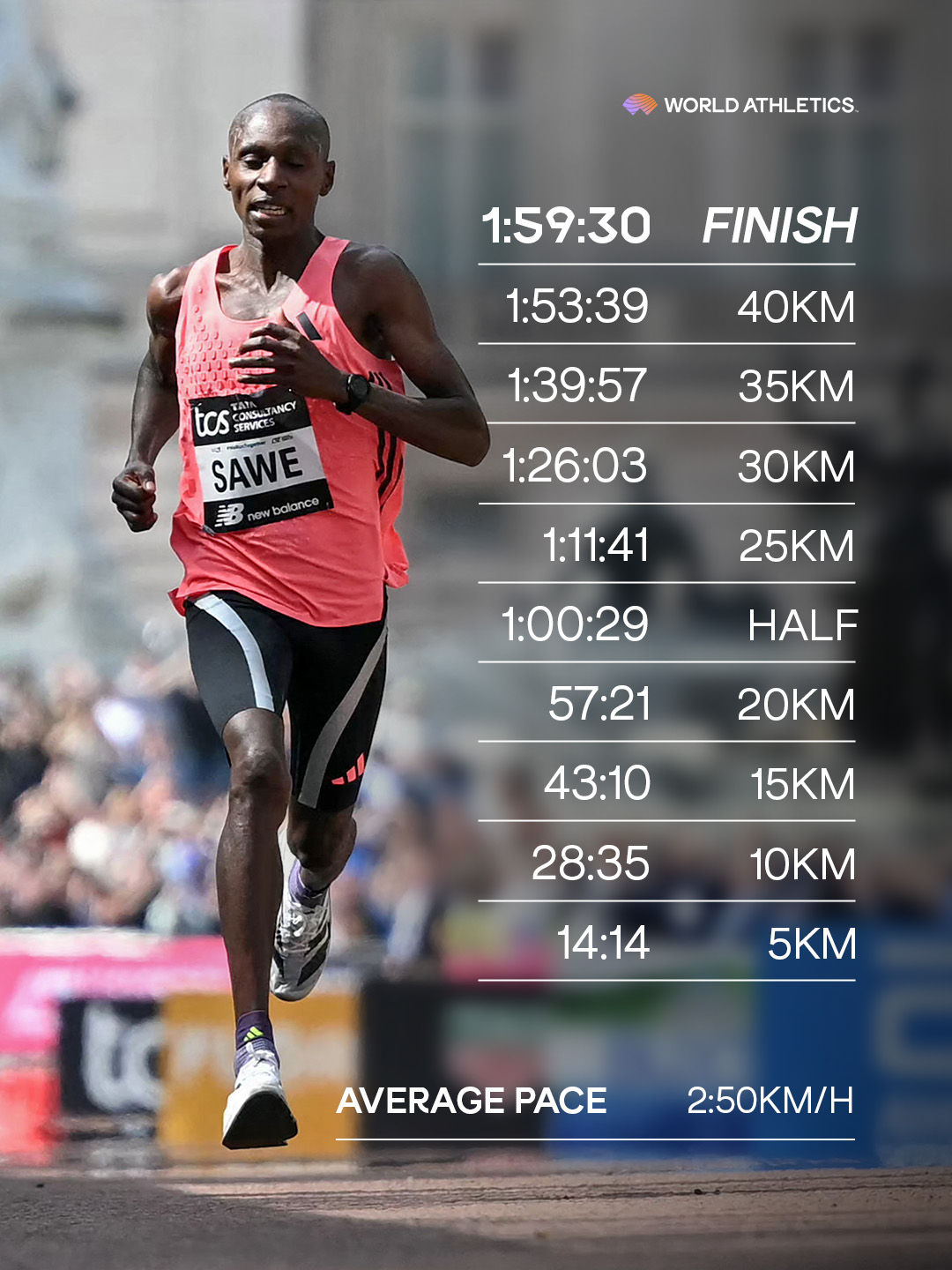
Sawe ran a negative split–his second half (59:01) was faster than his first half.
He and Kejelcha broke clear after 30 kilometres (about 18.5 miles). Then, in the final two kilometres, Sawe detached himself from the Ethiopian.
The official London Marathon race report noted that fans showered him with cheers as he sprinted toward the finish, a sound he later described as propulsion.
“I want to thank the crowds,” Sawe told BBC Sport immediately afterward. “They help a lot. You feel so happy and strong and pushing. What comes for me today is not for me alone but all of us in London.”
The Shoes and the Skeptics
Sawe wore the Adizero Adios Pro Evo 3, a shoe that weighs 97 grams (3.4 ounces) in a men’s size 9, less than half the weight of an average running shoe. According to The Wall Street Journal, Adidas launched the shoe only days before the race. Patrick Nava, general manager of Adidas running, told the Journal: “When you give them the box, they think it’s a joke. They think the box is empty.”
The debate over whether such technology amounts to “mechanical doping” has raged for years. But every elite runner in the field had access to the same or similar technology. Only three broke two hours. Only one won.
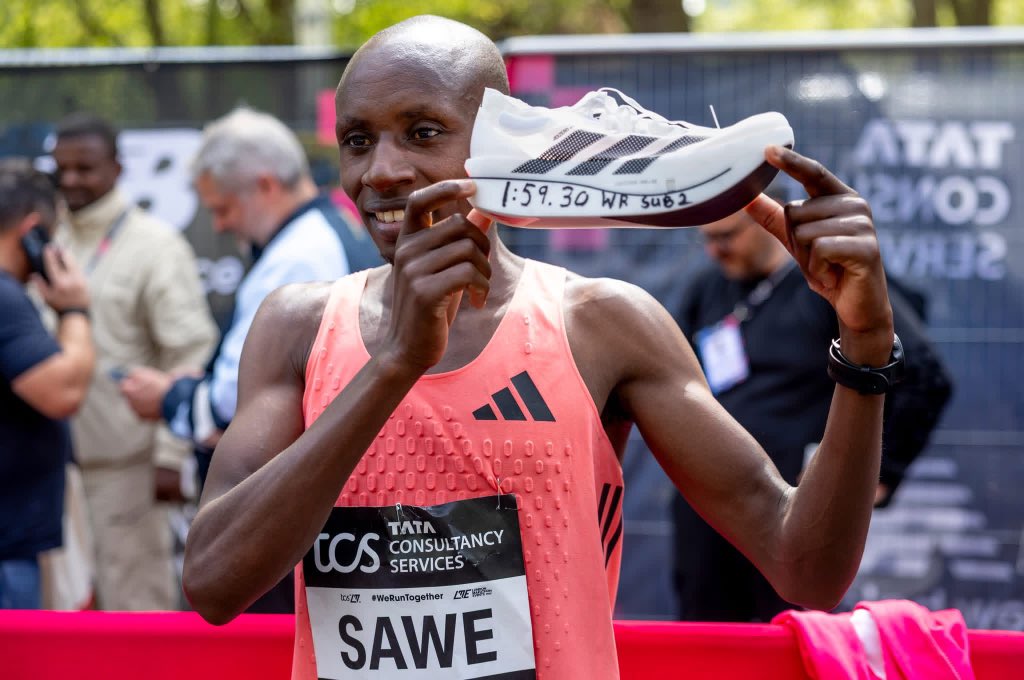
And in the months leading up to London, Sawe voluntarily submitted to 25 out-of-competition drug tests conducted by the Athletics Integrity Unit (AIU). The Telegraph reported that his motivation was unambiguous: “The main reason was to show that I am clean, and I am doing it the right way.”
‘No Human Is Limited’
Perhaps the most moving reaction came from the man who first proved that two hours was possible, though not, in his case, legal.
Eliud Kipchoge, a marathon superstar and the two-time Olympic marathon champion, ran 1:59:40 in Vienna in 2019 as part of the “INEOS 1:59 Challenge.” But that performance was never ratified as a world record because it was staged on a 6-mile loop with 41 rotating pacemakers and optimal drafting; conditions that bear little resemblance to a city marathon.
Kipchoge took to social media on Sunday to congratulate his successor. He wrote on his Facebook page: “During the INEOS 1:59 Challenge, we showed the world that it was possible, and it has always been my hope to see another athlete continue with this belief and break this magical barrier in a city marathon.”
“Seeing two athletes break the magical two-hour barrier at the London Marathon is proof that we are just at the beginning of what is possible… Let this achievement inspire the next generation and remind everyone in the world that No Human Is limited.”
Those last four words have become Kipchoge’s signature. On Sunday, they ceased to be philosophy and became fact.
The Weight of History
The marathon’s distance, legend holds, traces back to a Greek soldier’s run from Marathon to Athens to announce a military victory. That soldier, we are told, collapsed and died upon arrival. For most of modern history, the two-hour barrier felt similarly fatal, a line in the sand that the human body simply could not cross.
The first sub-2:30 marathon came in 1925. The 2:15 barrier fell 38 years after that. At the turn of the millennium, the men’s world record stood at 2:05:42, set by Khalid Khannouchi in Chicago in 1999. Khannouchi broke his own record by four seconds in 2002, the previous last time the fastest men’s marathon was run in London.
From that 2:05:42 mark, a lineage of Kenyan and Ethiopian greats; Gebrselassie, Kipsang, Kipchoge, Kiptum, chipped away at the impossible. They shaved seconds, then minutes. But the two-hour mark held.
Until Sunday.
Guinness World Records has already certified the performance. The official confirmation, shared on their social media channels, read: “Couldn’t catch him! Congratulations to Sabastian Sawe on his fastest marathon (male) at 1:59:30. He also beats Eliud Kipchoge’s fastest marathon distance.”
A Nation Celebrates, and Invites
In Nairobi, the reaction was swift and presidential. William Ruto, Kenya’s President, issued a statement: “You have not only claimed a historic victory; you have redrawn the limits of human endurance, smashing the world record and breaking the two-hour barrier with extraordinary resolve.”
Ruto also acknowledged Kenya’s podium presence in the women’s race; Hellen Obiri second in 2:15:53, Joyciline Jepkosgei third in 2:15:55, behind Ethiopia’s Tigst Assefa, who won in 2:15:41. Assefa told reporters afterward, that she screamed when she finished because “I knew I was breaking the world record.”
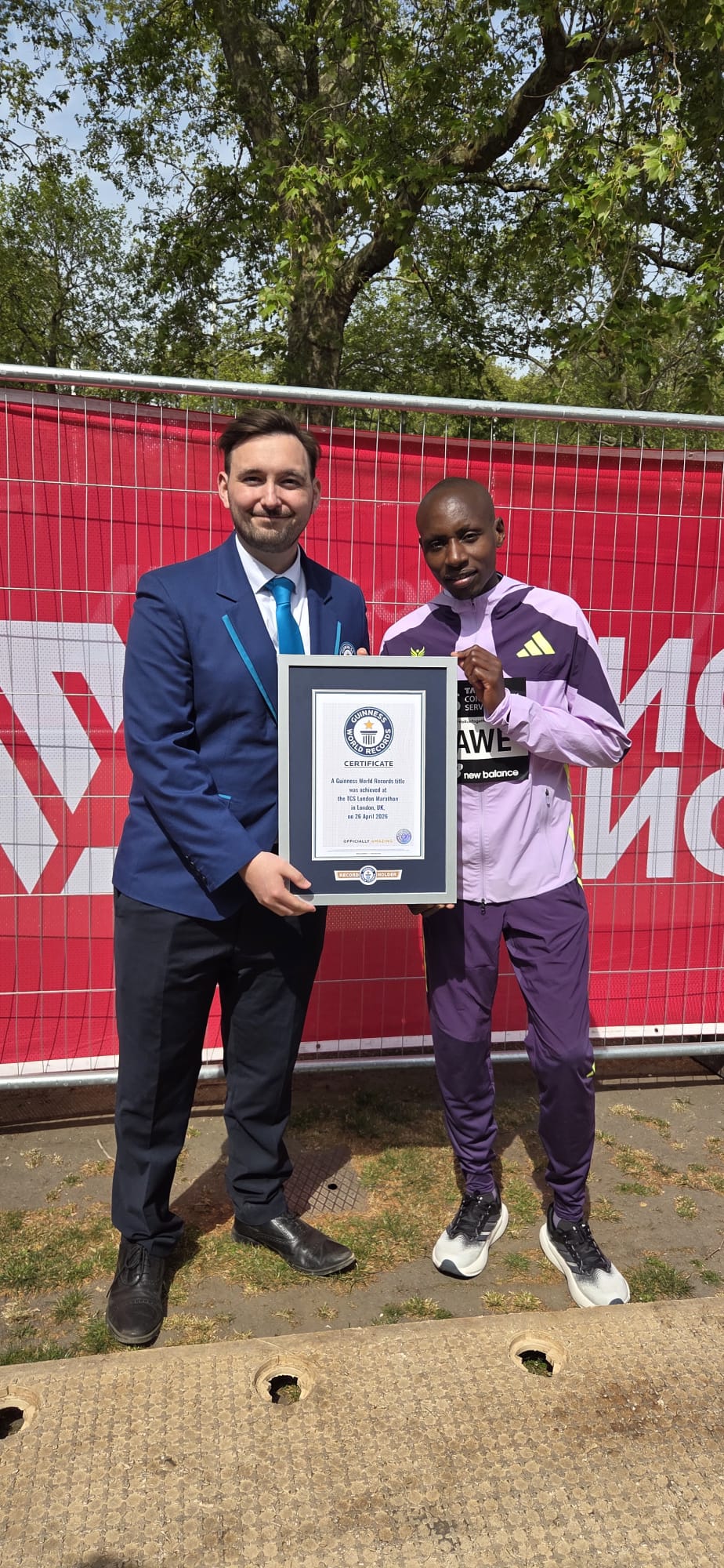
But perhaps the most strategic note came from Kenya’s Tourism Cabinet Secretary, Rebecca Miano. In a statement that doubled as an invitation, she said: “As we celebrate this world record, we invite the world to visit the land that breathes athletics. From the high-altitude training grounds of Iten to the finish lines of the world’s greatest cities, Kenya’s spirit is unbeatable.”
It was a reminder that for Kenya, distance running is not merely a sport. It is soft power. It is diplomacy. It is the country’s most reliable export.
The Finish Line
Sawe stood at the finish line on The Mall, breathing hard, watching the clock freeze at 1:59:30. He had run the equivalent of a 4-minute-33-second mile, repeated 26.2 times without stopping.
He told BBC Sport: “I’ve made history today in London, and for the next generation I’ve shown them that nothing is impossible. Everything is possible, with a matter of time.”










LEAVE A COMMENT
You must be logged in to post a comment.