

|
LISTEN TO THIS THE AFRICANA VOICE ARTICLE NOW
Getting your Trinity Audio player ready...
|
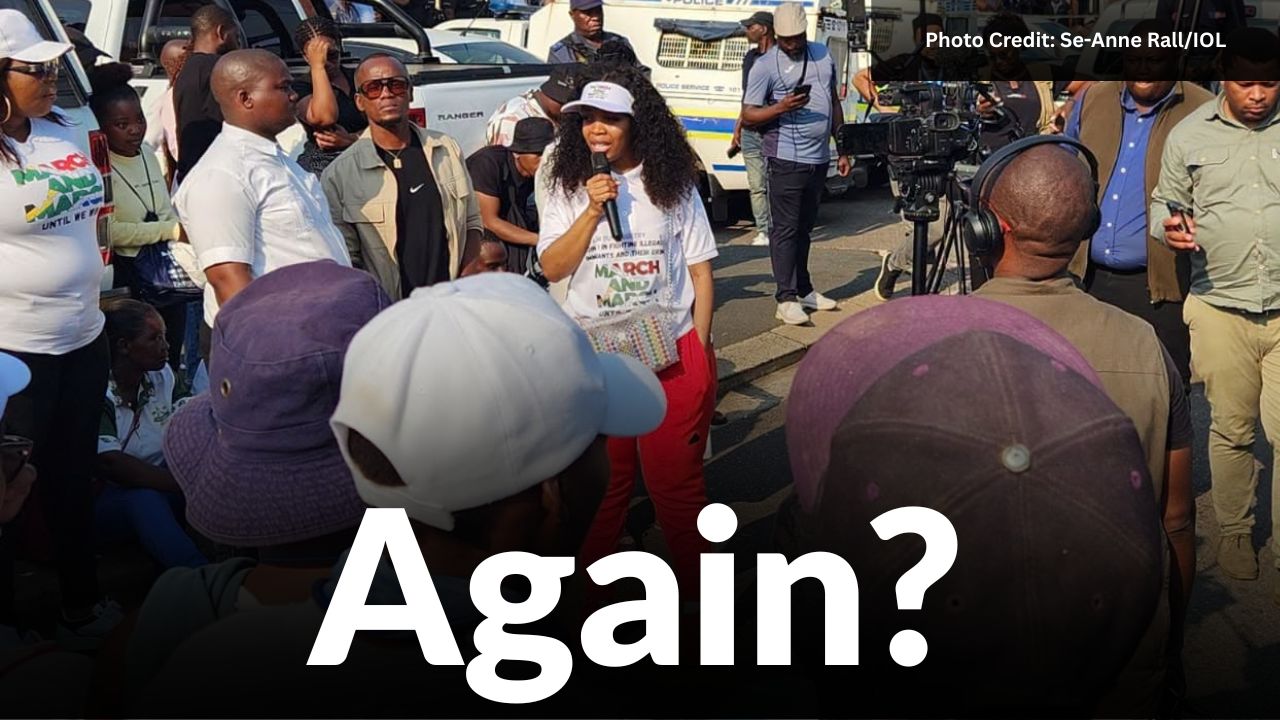
South Africa’s March and March movement has set Sept. 30 as its new date for deporting undocumented foreigners.
Pretoria rejected the group’s first deadline in June, yet tens of thousands of people left anyway.
Most came from other African countries, including Malawi, Zimbabwe, Mozambique, Ghana and Nigeria.
The Africana Voice has covered the campaign as Afrophobia, meaning hostility toward Africans from other countries.
Sept. 30 arrives as the movement shows strain, with a public split and thinner weekly marches.
March and March Wants Governments to Collect Their Citizens
Jacinta Ngobese-Zuma, who leads March and March, announced the date on Aug. 17 outside the Southern African Development Community summit in Durban.
Marchers used a slogan telling regional leaders to fetch their people.
National spokesperson Sandile Dube said the movement wants heads of state to prepare for mass deportations by Sept. 30.
Only the state can deport anyone, so the demand lands on Pretoria and on regional capitals.
Its other demands include stricter visa controls, an asylum policy review and action against employers who hire undocumented workers.
March and March says its campaign targets government failure, not foreign nationals.
Ngobese-Zuma rejects the xenophobia label, saying “it is not xenophobia.”
On her verified Facebook page, Ngobese-Zuma posted a flyer branding Sept. 30 “Men March,” captioned “30 September we remind the World that South African men will defend this country.”
The image itself is AI-generated, according to a Facebook label on the post.
In a Sept. 20 media statement, March and March confirmed Sept. 30 as a formal day of action, calling on men in Katlehong, Gugulethu, Soweto, Mdantsane and townships nationwide to march against gender-based violence, crime and what it called the “hostile take over of our Country.”
“Let all men rise and defend South Africa, it’s either now or never,” the statement said.
The framing folds gender-based violence and the anti-migrant campaign into a single day of action.
Human Rights Watch reported in May that demonstrations the group organized turned violent, with attacks on African and Asian foreign nationals drawing little apparent police response.
The Africana Voice profiled the campaign’s leaders in July.
A Public Split and Thinner Marches Test March and March Before Sept. 30
On July 27, March and March suspended its working relationship with Ngizwe Mchunu, who led a June 30 demonstration in Johannesburg, pending an investigation.
March and March said politicians and businesspeople were trying to capture it, and it has not publicly produced evidence, according to Inside Politics.
Mchunu replied that “we cannot march forever” and called Ngobese-Zuma and activist Nkosikhona Ndabandaba his juniors.
He has also vowed to keep fighting undocumented immigration.
The Africana Voice reported on July 1 that the rift was already visible after President Cyril Ramaphosa met Mchunu and Ndabandaba but not Ngobese-Zuma.
Durban’s June 30 march drew thousands, Daily Maverick reported.
IOL reported about 100 supporters at a Sept. 3 march on a Durban refugee camp, and GroundUp reported about 200 a week later.
Sunday Times described dozens at a Sept. 17 protest.
Those were weekly marches, not national days of action, so the comparison is imperfect.
On Aug. 18, Ngobese-Zuma met AfriForum, a mostly white Afrikaner group founded by the Solidarity trade union in 2006, to learn from its advocacy methods.
AfriForum has spent much of its history opposing affirmative action, Black economic empowerment and land reform, and it has campaigned internationally on claims of targeted farm murders that fed a “white genocide” narrative during the Trump administration, claims South African courts and police data have not supported.
The meeting drew mixed reactions, according to Briefly News, as a Black-led movement sought guidance from a group whose signature campaigns have run against Black economic advancement.
Ngobese-Zuma said the meeting did not mean the groups agree on everything.
Police Spent Millions on June 30 and Face the Same Test Again
Acting Police Minister Firoz Cachalia set aside 600 million rand for security on June 30.
He later told Parliament police had spent about 306 million rand, with some claims still outstanding.
Statements from Mozambique, Nigeria and South African police add up to at least 17 African nationals killed across the wider unrest, by The Africana Voice’s count.
Pretoria has published no consolidated toll, according to that reporting.
For Sept. 30, national police spokesperson Brigadier Athlenda Mathe said the South African Police Service is monitoring developments with the National Joint Operational and Intelligence Structure, and called it premature to give a cost figure.
The clip below shows Mathe briefing on SAPS readiness ahead of the earlier June 30 deadline.
Official Counts Show About 90,000 Repatriations, and Other Counts Run Higher
Border Management Authority Commissioner Michael Masiapato told Parliament the agency had recorded 89,936 repatriations by Aug. 7.
Malawians made up 54,474 of them, Zimbabweans 27,920 and Mozambicans 2,303.
Masiapato also reported just under 10,000 deportations through border law-enforcement operations.
Malawian media reported more than 56,000 returns by early August, close to the agency’s figure for Malawians.
Zimbabwe’s state-owned Chronicle put its returnees at 129,000 by early September, far above the agency’s 27,920.
Dates and methods differ, and some returnees may have left on their own.
Masiapato’s briefing also listed more than 5,000 people declared undesirable, including repeat offenders and visa overstayers, and it remains unclear whether that status applies broadly to people who left under the June deadline.
Malawian gardener Kaunga Nyirenda told CNN that two men warned him to leave or return in a coffin, and he went home after 16 years in Johannesburg.
Migrants Who Stayed Report Pressure From Officials as Well as Vigilantes
XenoBarometer, a Viewfinder reporting project, interviewed 13 community leaders and activists after June 30.
Gaby Bikombo of Refugee Social Services said documented immigrants driven from Durban trading sites remain unable to return to work.
Claude Kayitare of the Southern Africa Network for Immigrants and Refugees said citizens tied to the movement still stop people in Marshalltown, Johannesburg, and demand documents.
Lumumba Chia of the South African Refugee-Led Network said he has received reports of frozen bank accounts, adding, “Some want to return home, but their money is frozen.”
On Aug. 17, the KwaZulu-Natal High Court ordered Mayor Zama Sibisi of Alfred Duma Municipality to unlock migrant-owned shops padlocked in June.
A community leader who asked not to be named said March and March closed the town’s shops again after two days.
South African Data and Courts Have Already Weighed the Movement’s Claims
The Africana Voice tested the six most common anti-migrant claims against South African data in August.
Statistician General Risenga Maluleke has estimated the migrant population at nearly 3.1 million, just under 4% of the country.
On Nov. 4, 2025, the Gauteng High Court barred Operation Dudula from demanding identity documents, a power reserved for police and immigration officers.
It also ordered the government to implement its national plan against racism and xenophobia.
Home Affairs Minister Leon Schreiber told Parliament in November 2025 that 4,432,923 South Africans aged 16 and older lack a green ID book or smart ID card.
That figure means an identity check cannot always tell an undocumented citizen from a foreign national.
An Unsolved Case Could Sharpen the Mood Before Sept. 30
Ten women have been found dead in Gauteng since July, nine in Ekurhuleni and a 10th in Soweto on Sept. 20, and police have not confirmed a single killer is responsible.
Two South African women appeared in court Sept. 21 over the death of Jabulile Ntimba, the ninth victim, with police describing a domestic dispute they called a love triangle and saying the case isn’t necessarily tied to the broader series.
A separate suspect remains in custody over the first killing, in July, and police have not released his identity.
Gauteng police commissioner Fred Kekana has cautioned against concluding the cases are linked.
March and March joined a Sept. 17 protest over the killings, and Ngobese-Zuma stopped short of blaming a foreign national, saying, “I don’t want to create a perception that we are here to protest against a foreign national.”
Its Sept. 20 statement placed responsibility on men broadly, calling the killings confirmation that women in the country are not safe, without naming a suspect’s nationality.
A Fractured Movement Does Not Mean a Changed Public Mood
Afrobarometer found that 69% of South Africans see immigrants’ economic impact as negative.
Its survey also found 83% want the government to admit fewer foreign job seekers or none.
Statistics South Africa put joblessness at 33.6% in the second quarter, up from 32.7% in the first.
Local elections are due in November.
Ramaphosa has said South Africans are “deeply ashamed that people from other countries have suffered ill-treatment,” and that threats drove some to leave.
The Africana Voice reported that his June 7 address did not name either movement.
Sept. 30 will show whether the movement can muster June 30’s energy again, or whether it fizzles into irrelevance.






LEAVE A COMMENT
You must be logged in to post a comment.