

|
LISTEN TO THIS THE AFRICANA VOICE ARTICLE NOW
Getting your Trinity Audio player ready...
|
America’s immigrant detention system has never held more people, and its operators have never earned more.
In July 2026, ICE held more than 66,000 people on an average day, after a mid-January peak of more than 73,000.
Since January 2025, ICE has awarded $8.4 billion to more than 1,100 companies, according to The Appeal’s analysis of federal spending data.
Behind that money stands a long line of beneficiaries: prison operators, construction firms, gear makers, software companies, airlines, county jails and foreign governments.
Immigrant families from Mexico to Haiti to Somalia pay the other side of the ledger, in bonds, legal fees, lost wages and lasting trauma.
Record Detention Has Become Record Revenue
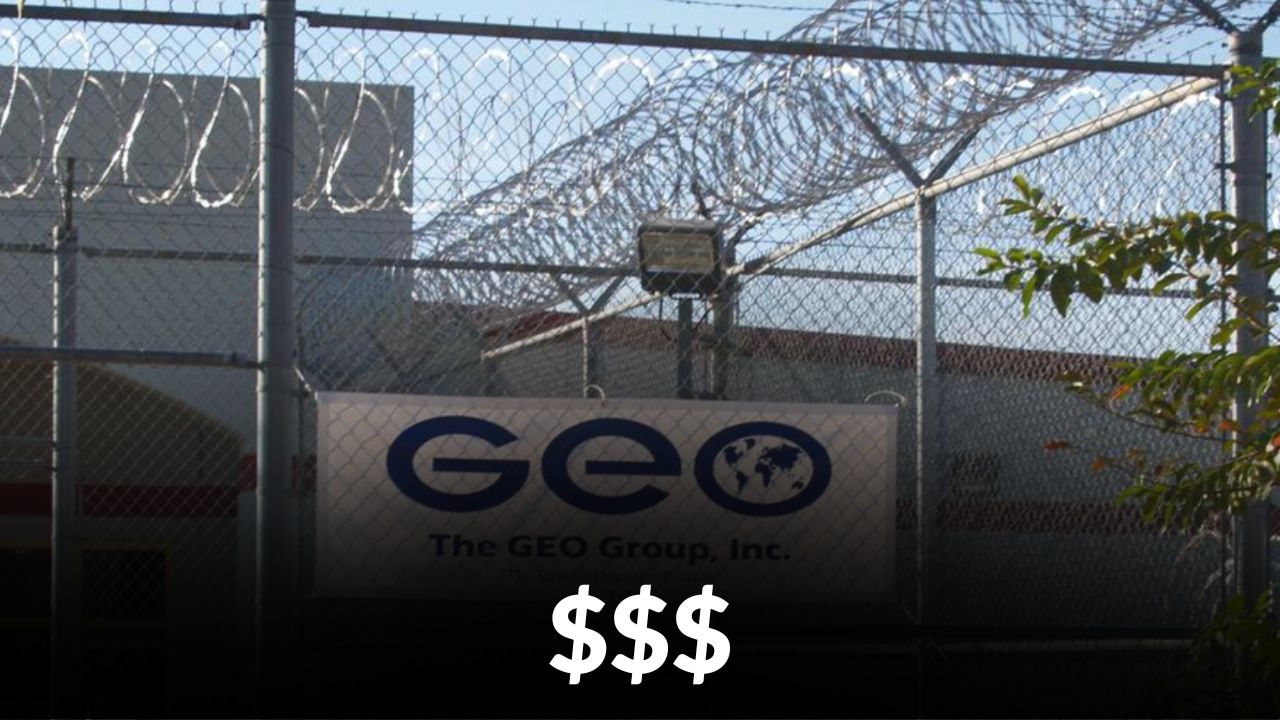
GEO Group reported second-quarter revenue of $732.1 million, up 15 percent from a year earlier.
Net income climbed 63 percent over the same period, to $47.5 million.
According to company slides, GEO now runs about 24,000 active ICE beds across 23 facilities, making it the largest private operator in immigration detention.
Rival CoreCivic is growing even faster. Its ICE revenue rose more than 50 percent in the quarter, the Tennessee Lookout reported, as it held more immigrants and negotiated higher daily fees.
By June 30, CoreCivic held 16,197 ICE detainees, up nearly 60 percent since early 2025.
Congress supplies the money.
The 2025 reconciliation law set aside $45 billion for ICE to expand its detention system.
That money comes from taxpayers. The profits go to shareholders.
Investors noticed. CoreCivic stock has gained more than 60 percent this year, inewsource reported.
Political ties run deep. CoreCivic reported in a lobbying disclosure that it gave $500,000 to the Trump-Vance inaugural committee in December 2024, ABC News reported.
CoreCivic also spent $1.77 million on federal lobbying in 2024, according to OpenSecrets.
On his first day back in office, President Donald Trump reversed a Biden order that had ended Justice Department contracts with private prisons.
Washington Buys the Buildings, but Private Companies Keep the Keys
Most detainees sleep in private hands. As of early 2025, about 90 percent of people ICE detained were held in facilities owned or operated by private contractors, according to Human Rights Watch.
Ownership is now shifting, but control is not.
In July and August, CoreCivic sold four facilities to DHS for about $2.2 billion, more than seven times their reported book value, inewsource found.
The four are Otay Mesa in San Diego, California City in Kern County, the Prairie Correctional Facility in Appleton, Minnesota, and the Midwest Regional Reception Center in Leavenworth, Kansas. CoreCivic expects to keep running day-to-day operations under its existing ICE contracts.
The gap was widest in California City. DHS paid $732.6 million for a facility CoreCivic’s 2025 annual report valued at about $71 million, Times of San Diego reported.
Book value reflects what a company paid minus depreciation, not what a property would sell for. CoreCivic said independent appraisers set the prices at fair market value.
CoreCivic CEO Patrick Swindle said the sales “were conducted at a fair valuation for both parties.”
Critics See a Company Paid Twice
Grisel Ruiz, an attorney with the Immigrant Legal Resource Center, told CalMatters the deal lets CoreCivic profit from the sale and again from ongoing management fees.
Otay Mesa and California City operate over the state of California’s objections.
California banned private detention centers in 2019. In 2022, a federal appeals court ruled the state could not apply that ban to ICE detention.
State oversight continues where it can. A May 2026 California Department of Justice report found overcrowding at Otay Mesa was limiting detainees’ access to prompt medical care and basic necessities.
California passed a law in 2024 allowing local health officers to conduct surprise inspections of detention facilities. San Diego County sued in March after supervisors and a health inspector said they were turned away at Otay Mesa, and a judge later ordered CoreCivic to allow the inspection.
Federal ownership could end that access. GEO chief George Zoley laid out the logic on a May earnings call. As some blue states consider more oversight, he said, “the logical solution to much of that is federal ownership of the facilities.”
A DHS spokesperson blamed “sanctuary politicians” for the purchases, TIME reported.
Washington plans more purchases like these. ICE intends to buy detention facilities from private prison companies it already contracts with, The New York Times reported.
A warehouse plan was supposed to go further.
Under former Homeland Security Secretary Kristi Noem, DHS drew up a $38.3 billion plan to convert warehouses into detention centers, including mega-centers that would hold 7,000 to 10,000 people each.
ICE spent about $1.07 billion on 11 warehouses before the plan stalled.
Sellers came out ahead. DHS paid 11 to 13 percent above market for the warehouses, buying from firms including Rockefeller Group, Fundrise, Blue Owl Capital and PCCP, Bisnow reported.
Contractors still stand to gain from the sites that remain. In Surprise, Ariz., DHS bought a warehouse for $70 million and awarded GardaWorld Federal Services a $313.4 million contract to convert it, a deal that could reach $704 million with options.
Work in Surprise is on hold pending an environmental review after Arizona sued.
Local governments profit too.
As of Aug. 5, ICE had detained 104,800 people in 303 county and city jails this year, triple the number held in local jails over the same stretch of 2024, Vera Institute of Justice found.
Struggling towns often welcome the contracts.
CoreCivic says its California City facility will bring about 500 jobs and more than $2 million in property taxes to the city.
Crowding Is Built Into the Plans
Even contractors raised alarms about the warehouse blueprint. One told NBC News that any detention facility holding more than 1,500 people would be risky.
GEO and CoreCivic also pushed back, calling ICE’s timeline too aggressive, PBS NewsHour reported.
Camp East Montana shows what that scale looks like.
Built on the Fort Bliss Army base in El Paso, Texas, the tent camp is the country’s largest immigration detention center, with room for up to 5,000 people.
In July 2025, the Army handed the contract to Acquisition Logistics, a small firm with no listed experience running a correctional facility. The AP reported that it had never won a federal contract worth more than $16 million.
Its contract to run the camp was worth about $1.26 billion.
Within the camp’s first 50 days, ICE’s own inspectors found more than 60 violations of federal standards.
Human Rights Watch found pods holding up to 72 people each, with six toilets and six showers per pod.
Detainees described beatings by guards, weeks without sunlight and meal portions too small for adults.
Most people HRW interviewed came from Latin America, including Mexico, Guatemala, Honduras, Cuba and Venezuela.
On Jan. 3, 2026, Geraldo Lunas Campos, a 55-year-old Cuban father of four, died after guards restrained him in solitary confinement. The El Paso County medical examiner ruled his death a homicide.
ICE ended Acquisition Logistics’ contract in March. Amentum, a Virginia-based contractor that had worked at the camp as a subcontractor, took over under a no-bid deal.
Business is good for Amentum. In August, CEO John Heller told investors that strong operating performance produced higher-than-anticipated profitability across the company, and he named securing the border among its growth drivers.
Advocates told the Texas Observer that conditions have not improved under the new operator.
Critics argue the harshness is deliberate. Human Rights Watch found evidence of punitive enforcement practices at the camp, including cruel, degrading and inhumane conditions.
Communities Are Saying No, and Deals Are Collapsing
Resistance has cost the detention economy real money.
In Kansas City, Missouri, the City Council passed a five-year moratorium on permits for detention facilities not run by the city.
Days later, the local port authority cut off land talks with Platform Ventures, the developer negotiating to sell a 920,000-square-foot warehouse to the government.
Platform Ventures then walked away, saying the deal no longer met its fiduciary requirements for a timely closing.
“Our priority is building businesses, homes, and schools that strengthen and grow our community,” Mayor Quinton Lucas said.
Opposition crossed party lines.
In Oklahoma City, an out-of-state owner ended talks with the federal government after bipartisan pushback.
Republican Mayor David Holt, president of the U.S. Conference of Mayors, noted that plenty of law-and-order voters still do not want a jail next to their homes.
Mississippi’s Republican Sen. Roger Wicker persuaded DHS to look elsewhere after local officials objected to a warehouse in Byhalia.
Owners Elsewhere Refused to Sell
A real estate company in Hutchins, Texas, said it would not sell or lease any buildings to DHS for detention.
Across the northern border, a Canadian firm dropped a planned sale of a Virginia warehouse after Canadian politicians and businesses called for a boycott.
In Merrillville, Indiana, owner Opus Holding said it was not negotiating with federal officials after the town raised concerns.
Salt Lake City’s Ritchie Group said it had no plans to sell a warehouse ICE reportedly wanted for 7,500 people.
Where ICE did buy, towns fought back.
Social Circle, Georgia, locked the water meter on a $128.6 million warehouse slated to hold 7,500 to 10,000 people.
Salt Lake City and Salt Lake County sued over a second warehouse ICE had already purchased. In August, DHS told a federal court it would not use that site for detention.
Not every community said no. One Maryland county passed a resolution expressing full support for ICE’s interest in a local warehouse.
Pressure worked anyway.
Days after Markwayne Mullin became Homeland Security secretary in April, DHS paused new warehouse purchases and began reviewing contracts signed under Noem.
ICE now plans to sell or transfer at least seven of the 11 warehouses it bought, The New York Times reported. Four sites, in Texas, Arizona and Maryland, are still moving forward, though a federal judge has blocked work on the Maryland site.
Companies further up the chain have felt pressure too.
Citizens Bank helped GEO and CoreCivic access more than $2.5 billion in financing, according to the De-ICE Citizens Bank Coalition.
In July, on the eve of planned nationwide protests, the bank said it would cut ties with both companies, citing changed commercial circumstances.
Workers at the architecture firm DLR Group pushed their company to stop designing ICE detention facilities. It agreed but kept its existing contract with CoreCivic, Mother Jones reported.
Policy Choices Keep the Beds Full
A business paid by the occupied bed needs a steady flow of people, and policy decides who flows in.
Most people detained and deported come from Latin America. Mexicans made up 38 percent of deportees in fiscal 2025, and people from Guatemala, Honduras and El Salvador made up another 37 percent, according to Deportation Data Project figures compiled by OpenImmigration.
Changes in legal status further widen the pool.
The administration has ended, or tried to end, Temporary Protected Status for 13 countries, affecting an estimated 1 million people, Vera found.
After the Supreme Court cleared the way in June, protections for about 334,900 Haitians and 6,100 Syrians ended on July 27.
Weekly detention bookings of Haitians then more than tripled, from about 48 a week earlier in the year to 153, according to Vera.
Somalis followed.
DHS announced in January that it would end TPS for Somalia, weeks after launching Operation Metro Surge in Minneapolis.
A federal judge paused the termination in March. After the Supreme Court’s June ruling in the Haitian and Syrian case, she lifted the pause, and Somali TPS ended Aug. 14.
Birthright citizenship is the longest-running fight.
On June 30, the Supreme Court ruled 6-3 that children born in the United States to parents here unlawfully or temporarily are citizens at birth. A federal judge in Maryland has since blocked much of a narrower order Trump signed in August.
Had the first order stood, researchers at the Migration Policy Institute and Penn State projected that about 255,000 babies born on U.S. soil each year would have started life without citizenship.
Every rule that strips legal status adds people ICE can detain. For companies paid by the occupied bed, that means more business.
Company leaders have said as much. In November 2024, then-CoreCivic CEO Damon Hininger told investors the company was working on a plan to “activate and make available every single bed that we’ve got.”
Every Step Has a Vendor
Finding people is a business.
ICE paid Palantir about $30 million, without competitive bidding, to build ImmigrationOS, a system meant to pick arrest targets and track self-deportations in near real time.
Palantir has signed more than $81 million in ICE contracts since January 2025, according to a shareholder proposal filed with the Securities and Exchange Commission.
GEO profits from finding people too.
ICE hired its subsidiary, BI Inc., for “skip tracing,” a service that tracks down immigrants on ICE’s nondetained docket, meaning people with open immigration cases who are not in custody.
Contractors confirm where those people live using government files, commercial data and in-person checks such as photographing homes and workplaces, the American Immigration Council reported.
GEO values its two-year contract at up to about $121 million, and ICE split roughly $1.2 billion in skip-tracing work among 13 companies.
Deporting People Is a Lucrative Business
CSI Aviation, the prime contractor for ICE flights, has been paid more than $560 million to date, according to federal spending records cited by WHYY, Philadelphia’s public radio station.
Miami-based GlobalX handled more than half of DHS charter flights in 2025, according to Human Rights First’s ICE Flight Monitor.
Avelo Airlines, a budget carrier, pulled out of deportation work in January after protests.
Even Calls Cost Immigrants Money
Staying in touch is a business too.
ICE contracts with Talton Communications for detainee calls and tablets. ICE monitors and records all calls except privileged legal calls.
Even attorneys pay 21 cents a minute for video visits with clients, with no free option, according to an ICE guide.
Families fund most of it. Relatives typically deposit money through platforms such as JPay or TouchPay, which charge transaction fees, to cover commissary food, soap and phone credits, one immigration law firm’s guide explains.
Release does not end the business.
GEO’s ISAP contract monitors people outside detention, and the company reports a steady shift toward pricier devices such as ankle monitors.
Gear Makers Arm the Operation
ICE’s shopping list now includes electric shocks.
In August, ICE signed a $16.7 million no-bid contract with Kentucky-based Compliant Technologies for 6,000 pairs of gloves that deliver electric shocks.
Each glove costs $2,495. An officer flips a switch on the wrist to send up to 380 volts of electrical pulses on skin contact.
ICE says officers would use the gloves to control detainees and protesters who resist.
Sixteen Democratic senators, led by Catherine Cortez Masto of Nevada, had urged the agency to cancel the purchase.
Robot dogs may be next. ICE has signaled plans to spend $1 million to $2 million on Boston Dynamics’ Spot robots, which it says would inspect dangerous places before officers go in.
A senior DHS official told NBC News the robots will not be used to make arrests. Boston Dynamics says it will not partner with anyone who wants to use its robots as weapons.
Restraints come through the same pipeline.
ICE has awarded about $154 million for combat training, weapons and related items such as handcuffs, leg restraints and belly chains, according to The Appeal’s review of federal spending records.
Atlantic Diving Supply, the largest recipient of that weapons spending, has received nearly $100 million.
Detainees feel those chains on every transfer. “I was chained from head to toe and forced to get on a plane,” Sebastian R., a student from Oaxaca, Mexico, told Human Rights Watch.
Detained Workers Kept a GEO Facility Running for $1 a Day
Detained people also do much of the daily work.
From 2005 until a 2021 jury verdict, GEO paid detained workers at its Tacoma, Washington, facility $1 a day to cook, scrub showers and do laundry, sometimes paying in extra food instead.
Lead plaintiff Goodluck Nwauzor, a Nigerian-born asylum seeker, cleaned showers for $1 a day during eight months in detention before winning asylum.
A jury awarded the class of more than 10,000 detained workers more than $17.2 million in back pay, and a judge ordered GEO to pay the state $5.9 million in unjust gains.
In January 2025, the 9th U.S. Circuit Court of Appeals upheld the verdict.
In February 2026, the U.S. Supreme Court ruled 9-0 that GEO could not immediately appeal a judge’s denial of its immunity claim in a similar $1-a-day suit brought by detainees in Colorado.
An Old Theory Explains a New Boom
Scholars and journalists have a name for this arrangement.
In a December 1998 cover story for The Atlantic, journalist Eric Schlosser called it the “prison-industrial complex.”
He described it not as a conspiracy but as a mix of interests: politicians, poor rural towns that leaned on prisons for jobs, and companies that treated corrections spending as a market.
That same year, Angela Davis sharpened the critique in ColorLines. She argued that private corporations profit as more people of color are locked up, while prisons drain wealth from the communities they target.
Her essay named immigrants among those swept up. “Prisons do not disappear problems, they disappear human beings,” Davis wrote.
Zambian-born legal scholar E. Tendayi Achiume carries the argument across borders. Her research holds that national borders, in a world order still shaped by empire, are racial by design. Achiume served as UN special rapporteur on contemporary forms of racism from 2017 to 2022.
Applied to 2026, the theory predicts what earnings calls now show: full beds mean higher profits. GEO told investors in August that 4,500 idle beds could add about $250 million a year at full capacity.
ICE’s own numbers show who fills those beds.
As of July 11, 46,436 of 65,765 people in detention had no criminal conviction, according to ICE figures tracked by Syracuse University researcher Austin Kocher.
A Cato Institute review found that 56 percent of people on DHS’s “Worst of the Worst” list had no violent charge or conviction.
Border czar Tom Homan draws no such line. “When you enter this country illegally, you have committed a crime,” he told Fox News in November 2024.
For people who crossed without inspection, he is partly right. A first improper entry is a federal misdemeanor punishable by up to six months, and returning after deportation is a felony.
Simply living in the country without status is not a crime. The Supreme Court ruled in 2012 that, as a general rule, it is not a crime for a removable noncitizen to remain in the United States.
Many people without status entered legally and overstayed a visa, a civil violation. Others lost Temporary Protected Status when the government ended it, which is also a civil matter.
Most people Human Rights Watch interviewed at Camp East Montana said they held valid work permits when they were arrested.
Collateral arrests widen the net further. When agents find a target alongside others without status, Homan has said, “they’re coming too.”
Beds fill either way, and the contracts pay.
Families Pay for Freedom Before Any Judge Rules
Money leaves immigrant households long before any judge decides a case.
Median bond amounts set by immigration judges rose from $6,000 in 2025 to $7,500 in early 2026, one analysis of court data found. Winning bond at all has grown harder, with 2026 posting the lowest grant rate on record.
George Pappas, a former immigration judge fired in 2025, told Michigan Public he sees a purpose behind the pressure.
“It is an intention of cruelty to force these people to self-deport,” Pappas said.
Lawyers make a large difference. Detained immigrants were three times as likely to win bond with an attorney, 42 percent versus 14 percent, according to a Transactional Records Access Clearinghouse analysis of 2023 immigration court records.
Winning the case itself follows the same pattern. A 2026 Vera Institute of Justice study found that detained people represented by one legal program were 366 percent more likely to win relief than those without its lawyers.
Unlike criminal defendants, people in immigration court have no right to a government-paid lawyer. Most must find and pay for their own.
Lost Wages Ripple Through Whole Communities
Detention drains paychecks and savings.
Studies have documented families losing 40 to 90 percent of their income within six months of a parent’s immigration arrest, detention or deportation.
More than 145,000 U.S. citizen children have had a parent detained since January 2025, according to evidence cited by the Immigration Research Initiative.
Brookings estimates that about 4.6 million citizen children live with at least one parent who lacks firm legal status.
Losses spread to neighbors.
Fear of ICE is keeping even some green card holders and citizens away from work and other daily activities, a chilling effect roughly double that of the Obama-era deportation campaign, the Immigration Research Initiative found.
Landlords lose renters, property values can fall, and local businesses suffer when large numbers of people are detained, one researcher told Stateline.
Detention Leaves Scars No Invoice Captures
Some costs never appear on a balance sheet.
At least 52 people died in ICE custody between Jan. 20, 2025, and June 4, 2026, according to Human Rights Watch and Physicians for Human Rights.
The groups’ report questioned the health care ICE and its contracted staff provided.
Edwin Lopez-Cornejo, 41, of El Salvador, died Aug. 1 after being held at Delaney Hall in Newark, New Jersey. GEO owns the facility and values its 15-year ICE contract there at about $1 billion.
ICE records show seven apparent suicides in the first year of the current administration, compared with one in 2024.
Solitary confinement remains widespread in ICE detention, Physicians for Human Rights reports.
UN human rights chief Volker Türk raised alarm about its use in June. Isolation beyond 15 days is a form of torture under a standard the UN has long applied, one set out in rules named for Nelson Mandela.
Families often cannot even find their relatives.
ICE stopped listing detainees with final removal orders in its online locator on Sept. 15, The Associated Press reported in an exclusive. The unannounced change has made it far harder for lawyers and relatives to find detainees, the AP reported.
Nearly 16,000 people booked into detention in July had final removal orders, more than a third of all bookings, the AP found.
Among those who vanished from the system were eight Somali men held at Guantánamo Bay, according to their ACLU attorney.
Harm reaches every community in detention, and Latin Americans make up most of the people held.
Within that system, Black migrants report abuse at a rate far above their numbers. A 2022 report by Freedom for Immigrants and the Black Alliance for Just Immigration found that Black migrants made up about 6 percent of people in ICE detention but 28 percent of abuse reports to a national detention hotline from 2016 to 2021.
Nana Gyamfi, executive director of the Black Alliance for Just Immigration, has said Black migrants face “discrimination at every turn.”
Foreign Governments Have Joined the Take Line
Detention no longer ends at the U.S. border.
Fourteen African governments, 17 nations across the Caribbean and Latin America, and Mexico, which has no formal agreement, have accepted deportees who are not their citizens, The Africana Voice reported.
Mexico has taken roughly 20,000 non-Mexican nationals since January 2025, more than 40 times the total sent to every African nation combined.
Across 31 countries, the State Department has pledged at least $410 million for these deals, The Washington Post found.
For scale, that is less than half of 1 percent of the roughly $113 billion ICE has to spend through 2029.
About $81 million goes directly to governments. More than $300 million goes to the International Organization for Migration and the U.N. Refugee Agency for refugee and infrastructure projects in the receiving countries, money that people familiar with the deals called “sweeteners.”
Per person, the price can run high. Senate Foreign Relations Committee Democrats found that Rwanda’s $7.5 million deal worked out to about $1.1 million for each of the seven people it received.
Eswatini agreed to take up to 160 people for $5.1 million. It holds the 32 who arrived at Matsapha, a maximum-security prison, without charges.
In Equatorial Guinea, authorities held 66 arrivals in a hotel owned by the president’s family.
Distance itself has become a threat. Detained Cuban and Guatemalan asylum seekers reported officers warning them of “a jail cell in El Salvador or Africa,” according to documentation cited by Refugees International.
Pretoria-based Institute for Security Studies found that nearly all public knowledge of the African transfers came from journalists and NGOs, not governments.
Some capitals refused.
Burkina Faso’s foreign minister, Karamoko Jean Marie Traoré, called a U.S. visa pause “blackmail,” and Nigeria turned deportees away.
CoreCivic says it has begun early talks with ICE about selling more facilities.
Once a government owns a 2,560-bed prison, empty beds become a budget problem.
Every name on the take line depends on one input: people to hold, move, and send away.
Towns that turn away warehouses and governments that turn away deportees hold the same kind of leverage.
Every refusal limits how far the detention market can reach.
Methodology note
For this report, The Africana Voice drew on federal contract records, company filings and earnings calls, court rulings, DHS planning documents, and detention data analyzed by the Vera Institute of Justice. Reporting drew on African and diaspora institutions, including the Institute for Security Studies and the Black Alliance for Just Immigration, alongside Human Rights Watch field research, state and local government actions, and coverage by the Associated Press, The Washington Post and The New York Times. Figures on foreign deportation agreements match The Africana Voice’s Sept. 23 special report.










LEAVE A COMMENT
You must be logged in to post a comment.