

|
LISTEN TO THIS THE AFRICANA VOICE ARTICLE NOW
Getting your Trinity Audio player ready...
|
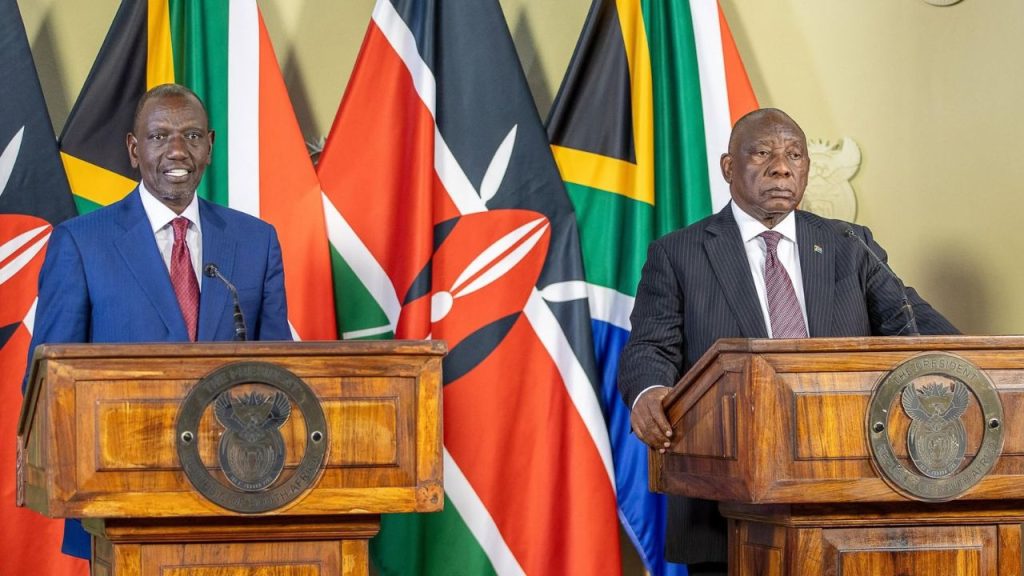
Standing beside South African President Cyril Ramaphosa in Johannesburg on June 4, President William Ruto delivered his defense of a decision that had already killed two of his citizens. “It would be most unfortunate if on one request by the Americans to set up a facility at their cost, we would refuse,” Ruto said. “We would look very inhuman.”
Five days later, a third Kenyan was shot dead in Nanyuki. The planes were still landing at Laikipia Air Base. The court order telling them to stop remained in force. The Kenyan government had just missed its own court-ordered deadline to disclose the terms of the deal it signed.
When The Africana Voice first reported this story on May 31, the central outrage was procedural: Kenya had agreed, in secret, to host a quarantine facility for Americans exposed to Ebola in the Democratic Republic of Congo, and Kenyans found out from journalists. That outrage stands. But the story has since expanded into something larger. Kenya is one of 28 African countries that have signed or are negotiating health agreements with the United States under the Trump administration’s America First Global Health Strategy, most of them without public disclosure of the full terms. Ghana rejected its deal. Zimbabwe walked away. Zambia pushed back. Kenya signed, said nothing, and is now burying its dead.
This piece follows The Africana Voice’s May 31 report, “Kenyans Erupt Over Secret Ebola Deal With The US: ‘You Cannot Dump Your Risk on Us,'” which documented the secret agreement, the Katiba Institute’s court petition, the KMPDU strike notice, and the first wave of public opposition. That report is available at africanavoice.com.
Why Kenya and Not the Congo?
The Ebola outbreak at the center of this crisis is in Ituri Province, in the northeastern Democratic Republic of Congo. The Bundibugyo strain driving it is rarer than the more familiar Zaire variant and has no approved vaccine or targeted treatment. By late May, more than 1,000 suspected and confirmed cases and at least 241 deaths had accumulated across the DRC and Uganda. WHO Director-General Tedros Adhanom Ghebreyesus, landing in Kinshasa on May 28, warned the outbreak was “outpacing the response.”
Kenya shares no border with either country. Nanyuki, where the facility now stands inside Laikipia Air Base, sits roughly 1,500 miles from the epicenter. Kenya has recorded zero Ebola cases. The State Department told NPR in an emailed statement that Kenya was selected “due to proximity, airports in the region having limited capability, and to ensure Americans can be evaluated and receive assistance in a timely matter.” That explanation does not account for why Uganda or Rwanda, both of which border the DRC, were not considered. It does not explain why the DRC itself was passed over.
The proximity argument also collapses in light of what the U.S. actually did with its first wave of exposed citizens. An American missionary doctor confirmed as the first U.S. Ebola case was evacuated to Germany. A second went to the Czech Republic. Seven Ebola-exposed U.S. citizens in total were sent to Europe, not to Kenya, and not home. The pattern reveals the actual logic of the Nanyuki arrangement. Germany and the Czech Republic received American patients because they have the infrastructure. Kenya received the facility because Washington needed somewhere that would say yes.
There is a further detail that has received insufficient attention. The facility is designated only for Americans who have been exposed to the virus but remain asymptomatic. Any patient who develops symptoms would be transferred to another country for care. Kenya is not the treatment destination. It is a waiting room, built on African soil, for a disease that is not in Africa, to manage a risk that Washington has decided it will not accept at home. The State Department has not, on the record, named the countries that would receive symptomatic patients.
“If the United States believes the 12-hour medevac flight back to Washington is too dangerous for its citizens, by what logic is it safe to fly exposed individuals into Kenyan airspace?” — Dr. Davji Bhimji Atellah, KMPDU
The System America Built and Abandoned
After the 2014 West Africa Ebola outbreak killed more than 11,000 people and briefly reached U.S. soil, the American government built a domestic biocontainment network: 56 Ebola Treatment Centers and 10 Regional Ebola and Special Pathogen Treatment Centers, designed to receive and treat American health workers exposed to dangerous pathogens abroad. The network existed so the United States would never again need to improvise when one of its own came home sick.
The Trump administration’s cuts to CDC and USAID funding, including a stop-work order on the NIH Centers for Research in Emerging Infectious Diseases Network in June 2025, dramatically reduced that capacity. Dr. Craig Spencer, who survived Ebola in 2014 after treatment at Bellevue Hospital in New York, wrote: “We have that system. I survived Ebola and am here today partly because of it. But we are choosing not to use it.”
A June 1 open letter to Congress, organized by the Infectious Diseases Society of America and signed by former CDC Deputy Director Debra Houry and former CDC Principal Deputy Director Anne Schuchat, confirmed that the domestic network “cannot be recreated in a matter of days or weeks through the rapid establishment of an overseas facility.” The letter accused the administration of diverting resources toward “ad hoc quarantine infrastructure overseas rather than directing urgently needed resources toward controlling the outbreak at its source.”
In a Cabinet meeting, Secretary of State Marco Rubio said what drives the arrangement. “We cannot and will not allow any cases of Ebola to enter the United States.” KMPDU Secretary General Dr. Davji Bhimji Atellah quoted that line directly back at President Ruto: “If it is too dangerous for America, it is too dangerous for Kenya.”
A Court Said Stop. The Government Missed Its Own Deadline.
Justice Patricia Nyaundi of the Milimani High Court in Nairobi acted on May 28, hours before the facility was due to open. She issued an emergency conservatory order barring the Kenyan government from establishing, operating, or permitting any Ebola-related quarantine arrangement under the disputed deal. The Katiba Institute, whose petition produced the order, argued that Kenya lacked the required biosafety infrastructure. Ebola management demands a Biosafety Level 4 facility. Kenya’s highest-rated facilities reach Level 3.
At the June 2 hearing, Justice Nyaundi extended the injunction for three further weeks and ordered the Kenyan government to submit all agreements, financial arrangements, biosafety evaluations, and operational guidelines within seven days. That deadline fell on June 9. It passed without compliance. The Kenyan government offered no comment. Katiba Institute lawyer Joshua Malidzo confirmed the deadline had expired unfulfilled. The next hearing is set for June 23.
None of this stopped construction. Satellite imagery reviewed by Reuters showed approximately 11 acres inside Laikipia Air Base had been cleared and developed since May 27. The U.S. military built the facility, and the U.S. Public Health Service Commissioned Corps confirmed it was deploying a team of officers to Kenya to support care, monitoring, and quarantine of American citizens departing the DRC. Roughly 20 flights delivering medical supplies and specialized personnel arrived at the base after the court order was issued. U.S. military planes continued to ferry in staff and equipment following subsequent court orders, according to U.S. and diplomatic sources and flight-tracking data, with several aircraft expected to land this week.
The U.S. Embassy stated it was “aware of the court action” and “working with the Kenyan government to resolve any objections.” No Kenyan official has stated on the record that the United States is in contempt of a Kenyan court. No formal contempt application has been filed as of this writing.
“Laikipia is not a dumping site and our voices must be heard.” — Priscilla Imani, Nanyuki protester
Three Dead, But Planes Keep Landing.
Madaraka Day, June 1, is Kenya’s national holiday marking internal self-governance. Hundreds of Nanyuki residents chose it to march toward Laikipia Air Base. Police deployed tear gas. Then came live ammunition. Two people were shot dead. Charles Mang’aro Mwangi, 27, was identified by his family. They said he was not among the protesters. He was on his way to visit a friend when he was killed. The second victim from June 1 has not been publicly identified.
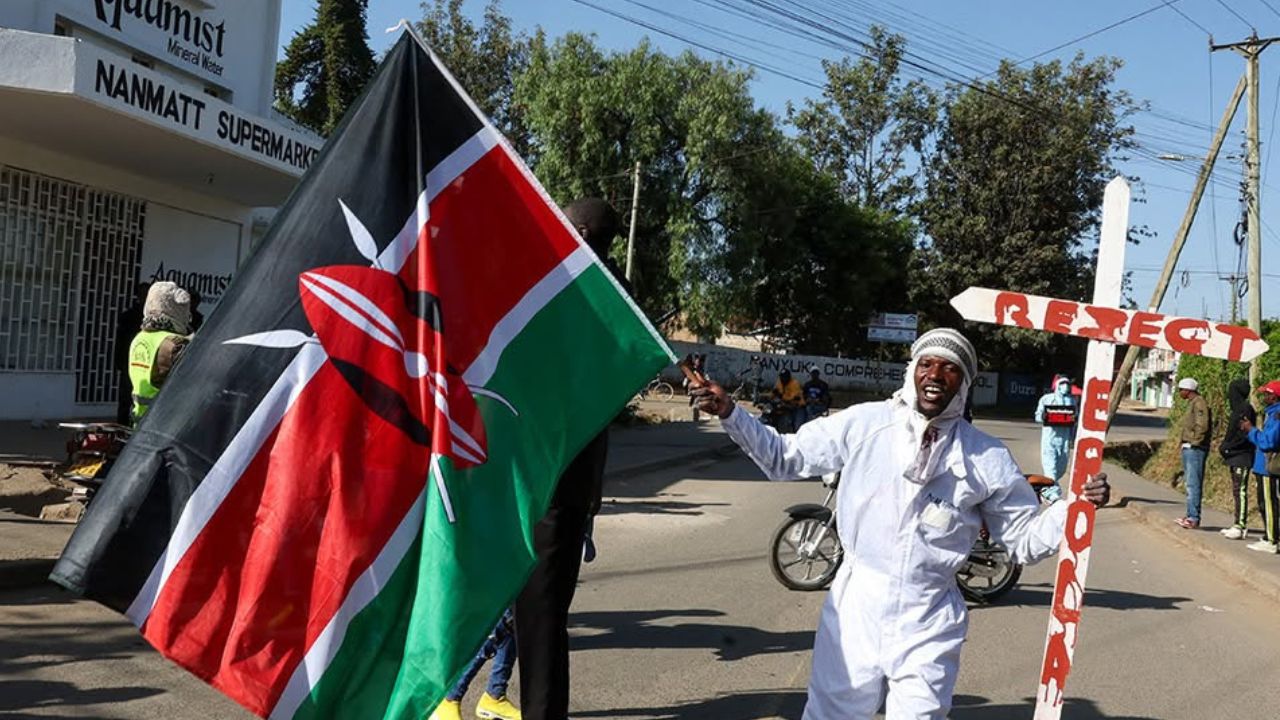
On June 9, protests resumed. Hundreds of demonstrators gathered again in Nanyuki, some waving Kenyan flags, one carrying a white cross marked with the words “Reject Ebola.” Police fired tear gas and water cannon. Officers detained at least 10 protesters, a Reuters witness confirmed. A third person was then shot dead. Protest organizer Patrick Wahome and multiple eyewitnesses confirmed the death. The man died from a gunshot wound to the head. Two Reuters reporters on the scene saw the body in the back of a police van.
A police spokesperson said he had no information about the incident. That is the same formulation Kenya National Police spokesperson Michael Muchiri used after the June 1 killings, when he said he was “not aware of any fatalities.” Three families are now aware.
Protester Priscilla Imani told Reuters the facility’s presence was scaring away tourists who come to climb Mount Kenya or visit the nearby rhino conservancy. “My message is this: Laikipia is not a dumping site and our voices must be heard,” she said. Laikipia County Governor Joshua Irungu had already delivered the same verdict in Kiswahili. “Tumekataa.” We have refused. Construction continued.
The Institutions That Moved
Kenya’s institutional response has been broad and sustained. The Kenya Medical Practitioners, Pharmacists and Dentists Union, representing more than 10,000 doctors, issued a 48-hour ultimatum demanding full public disclosure of the deal’s terms and warned of a nationwide strike. The Law Society of Kenya filed a constitutional petition challenging the arrangement’s legal validity. The Katiba Institute’s emergency petition produced the court injunction the U.S. has since disregarded.
Former Justice Minister Martha Karua addressed Health Cabinet Secretary Aden Duale directly in a formal statement on May 30. “In whose interest are you acting, Bwana CS? Is it for wenye nchi?” For the owners of the country. No answer has been given. Health Committee Chairman James Nyikal told a parliamentary session that the bilateral health agreement “does not obligate the government to put an Ebola unit,” a significant admission that the facility’s inclusion was discretionary, not contractual.
A section of leaders from Ruto’s political base publicly opposed the facility. One said, “I would rather America withdrew all its aid to this country than we expose Kenyans to the risk of Ebola because we were treating American citizens.” National Assembly Speaker Moses Wetang’ula described Rubio’s public statement that no Ebola cases would be allowed into the U.S. as “a very irresponsible statement.” Minority Whip Millie Odhiambo added that Kenyans were not opposed to the facility itself but to what Rubio’s words revealed about who the arrangement actually protected.
What Congress Heard and What Rubio Would Not Concede
On June 2, Secretary of State Marco Rubio testified before the Senate Foreign Relations Committee during a hearing on the Trump administration’s fiscal year 2027 foreign affairs budget. Senator Cory Booker of New Jersey went directly to the center of what this story is about.
“We cut early detection when it comes to infectious diseases on the continent, factually. This is not an opinion. We cut early warning systems on the continent,” Booker said. Rubio interjected: “It had nothing to do with the Ebola outbreak.” Booker had told Rubio he heard directly from State Department personnel that the U.S. was “less prepared for global outbreak than we were before.” Rubio responded: “I don’t agree with that assessment. I don’t know who told you that at the State Department.”
Rubio denied that funding cuts had harmed early detection efforts, claimed the U.S. had contributed more than $200 million through U.N. partners to the Ebola response, and said the administration was considering appointing an “Ebola czar.” He did not address the status of the domestic biocontainment network built after 2014, nor explain why it was not being used for American patients. The domestic system exists. The U.S. is choosing not to use it. Kenya is absorbing the consequences of that choice, in blood.
Washington’s 28 Secret Deals Mostly with African Nations
The United States has negotiated 28 international health agreements, most of them with African countries, while refusing to disclose their full terms, the Washington Post reported in April 2026. The agreements are part of Washington’s America First Global Health Strategy, led by the State Department following the dismantling of USAID. As of early February 2026, 16 African nations had already signed, with a combined financial envelope of approximately $17.9 billion over five years. The deals move American health assistance away from the looser programmatic model of PEPFAR and toward a contractual structure with fixed benchmarks, timelines, and written consequences for nonperformance.
Ghana rejected $109 million in U.S. health aid in April 2026 after its Data Protection Commission found that clauses would have granted U.S. entities access to national health records and backend dashboards that went “far beyond what would typically be required.” Zimbabwe walked away from a $367 million deal in February, with President Emmerson Mnangagwa citing sovereignty concerns in a formal letter to his own foreign ministry. Zambia pushed back after reports that Washington was linking health funding to access to critical minerals, a linkage Zambian officials called “unconscionable.”
Africa CDC Director-General Dr. Jean Kaseya voiced significant concerns about data security across the agreements, saying that pathogen and health data sharing must be equitable and respect African ownership. Kaseya was among the few institutional continental voices to speak on the record. The African Union Commission has issued no formal statement on the Kenya-US facility, on U.S. defiance of the Kenyan court order, or on the pattern of opaque bilateral health deals that are driving resistance across the continent.
“These deals are done in secret, signed in secret, announced in the language of partnership and generosity. By the time the public finds out, the ink is already dry.” — Sandra Babu-Boateng, PanaGenius
A Pattern That Predates the Ebola Crisis
Sandra Babu-Boateng, host of the PanaGenius channel on YouTube, which focuses on African issues, placed the Nanyuki facility within the broader architecture of these agreements. “America cut its own health funding to Kenya, came back, offered a smaller package, attached a biocontainment facility for American citizens to it, and called it partnership,” Babu-Boateng said.
The bilateral health agreement Kenya signed in December commits $1.6 billion for 2026-2030, a reduction of roughly $423 million from previous funding levels, according to KFF, a health policy research organization. The Ebola quarantine facility was embedded inside that broader arrangement, not announced separately, not debated publicly, and not subjected to parliamentary ratification before it was activated.
“These deals are done in secret, signed in secret, announced, if they are announced at all, in the language of partnership and generosity,” Babu-Boateng said. “By the time the public finds out, the ink is already dry.” The gap between countries that refused and Kenya is not one of health infrastructure or geopolitical weight. It is a gap in what governments believe their citizens are owed before a deal is done in their name.
The Cable Washington Did Not Intend Kenya to Read
On June 2, the U.S. Embassy in Nairobi sent a diplomatic cable to Washington. Reuters confirmed its contents through two U.S. officials. It was not a policy memo. It was a political autopsy.
“In agreeing to host the bio-isolation facility, President Ruto may have underestimated the depth and intensity of public opposition,” the cable said. It added that “the continued work on the facility, despite a court injunction halting construction, has further fuelled criticism.” American diplomats were telling Washington, in writing, that their own government’s defiance of a Kenyan court was deepening the crisis for the president they were counting on to hold the arrangement together.
The cable also flagged that anger over the Ebola facility was compounding pressure from rising fuel prices and the approaching anniversary of the June 2024 Gen Z uprising, which killed dozens of Kenyans. The U.S. State Department has not responded to requests for comment. No senior Kenyan official has publicly acknowledged the cable.
Ruto told Johannesburg he was doing the right thing. His closest American partners had already written, in a diplomatic cable, that he had miscalculated. A third Kenyan family is now making funeral arrangements. The court date is June 23. The disclosure deadline has passed. The planes are still landing.



LEAVE A COMMENT
You must be logged in to post a comment.