

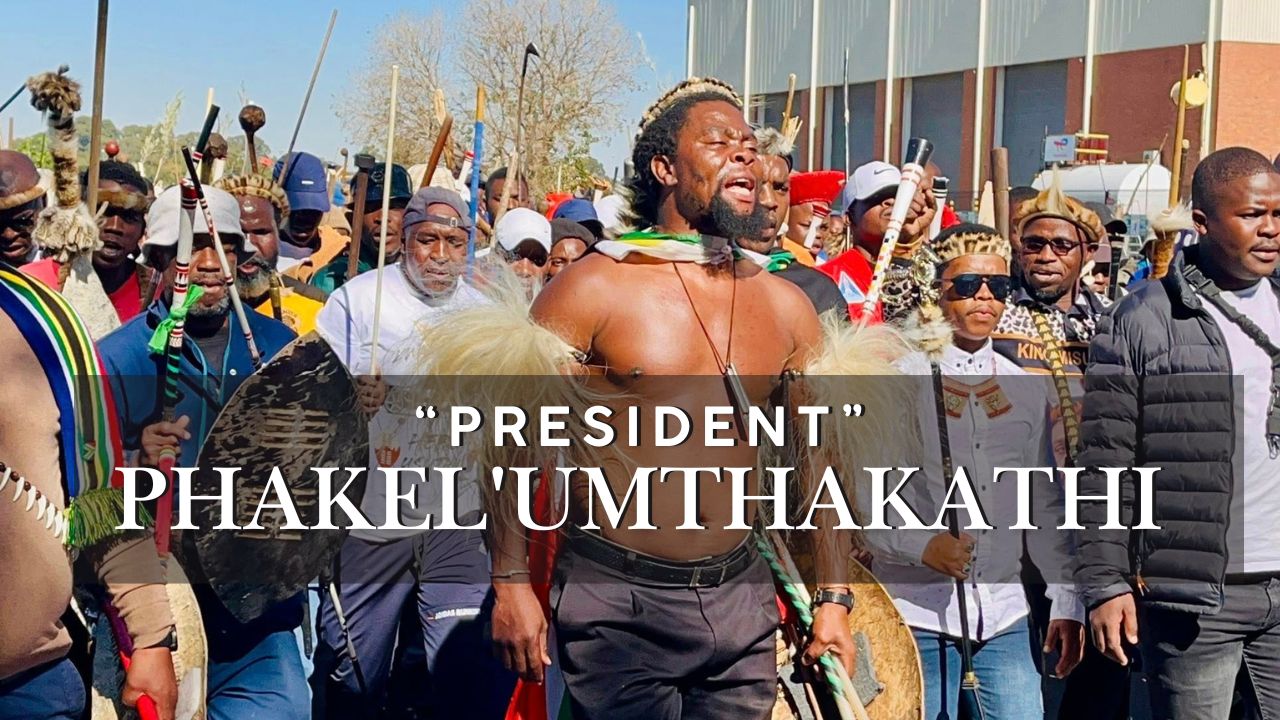
|
LISTEN TO THIS THE AFRICANA VOICE ARTICLE NOW
Getting your Trinity Audio player ready...
|
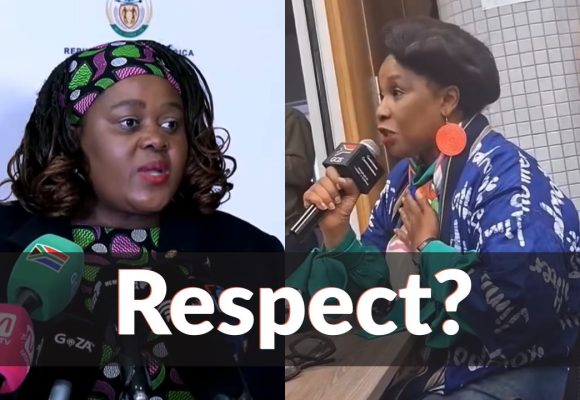
“Look at them. When they speak to White people, they are very respectful, they show manners. When they speak to a Black person, they are violent,” Julius Malema, on South Africa’s Afrophobic protest leaders.
Every nationalist movement has its self-appointed patriots. History knows what they produce. South Africa has four of them. Between them, they have generated 17 confirmed deaths, the largest forced departure of African nationals since 2008, and a continental crisis. Not one has been charged.
Four People, No Charges, a Country on Fire
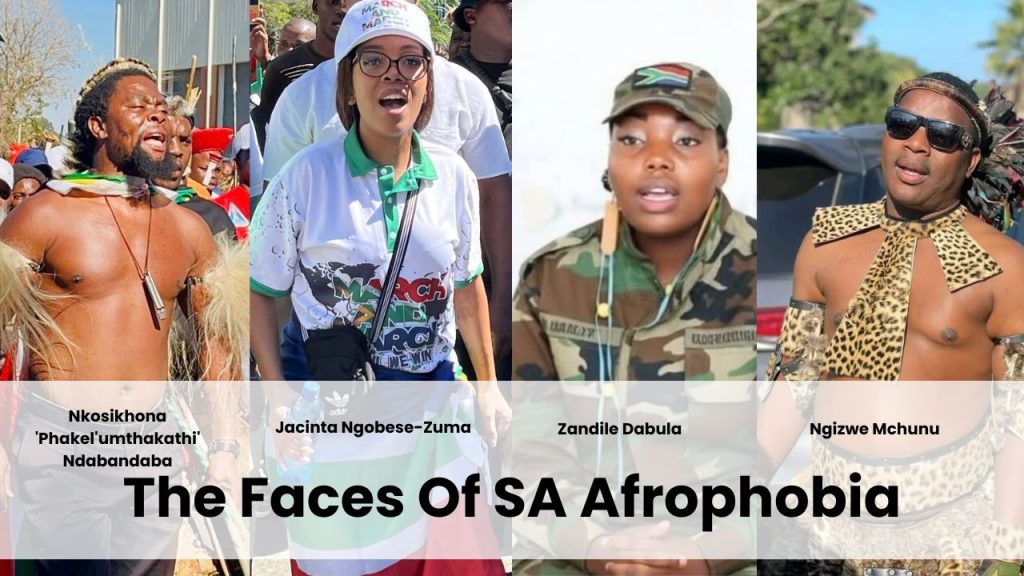
Before the marches, before the deportations, before a single Malawian boarded a bus at Beitbridge, four people built the infrastructure of South Africa’s 2026 Afrophobia campaign. None of them holds elected office. None has been charged with a crime in connection with that campaign. All of them used media platforms to convert mass followings into a political force that has reshaped South African immigration enforcement, fractured its governing coalition, and driven the largest forced departure of African nationals since the 2008 pogrom.
Their campaign rests on three claims. African migrants take South African jobs. They commit crimes. They overburden public services.
Statistics South Africa, the World Bank, GroundUp, and the Institute for Security Studies have each disproved all three.
Only 18,000 of South Africa’s 544,000 prison inmates are immigrants, according to former Police Minister Bheki Cele. The World Bank found that migrants and South African workers perform complementary rather than competing roles in the labour market. Moreover, GroundUp’s analysis of census data concluded that migrants are, on net, creating jobs, not taking them. None of those findings has appeared in a March and March press release.
Named by a Former Minister
Former South African Minister of International Relations and Cooperation, Dr. Naledi Pandor, named this campaign with greater precision than any sitting cabinet minister. In a Borderlines YouTube show interview, she said: “Firstly, let me say it’s a tragedy that we don’t have a sufficient pan-Africanism spurt within our country. And that this is Afrophobia and not xenophobia because we’re not treating Europeans etc the same way.”
Pandor made the same argument to foreign diplomats in Pretoria in September 2019. She told them the violence stemmed from deeply enshrined feelings of the poorest of the poor who retaliated against fellow Africans for their own poverty, according to the Daily Maverick’s confirmed reporting. She named it Afrophobia seven years before Ramaphosa used the word publicly for the first time.
The Language That Comes Before the Violence
Before the marches, before the arrests, before the deportations, there is always the language. South Africa has a documented vocabulary of dehumanization applied exclusively to Black African migrants.
Makwerekwere, also written as amakwerekwere, is the most pervasive slur in that vocabulary. It derives from the onomatopoeic mockery of how African languages unfamiliar to Zulu and Nguni speakers were perceived to sound, essentially reducing the languages of an entire continent to noise. Sociologist David M. Matsinge has documented the term’s function as a tool to dehumanize Black Africans and make them seem less human than South Africans, according to Wikipedia’s entry on the term, which draws on peer-reviewed linguistic research.
Two further slurs appear in academic literature on Afrophobic language. Amagrigamba is a general derogatory label for African migrants. Abelokufika, meaning roughly “those who just arrived,” frames migrants as permanent newcomers with no right to belong regardless of how long they have lived in South Africa.
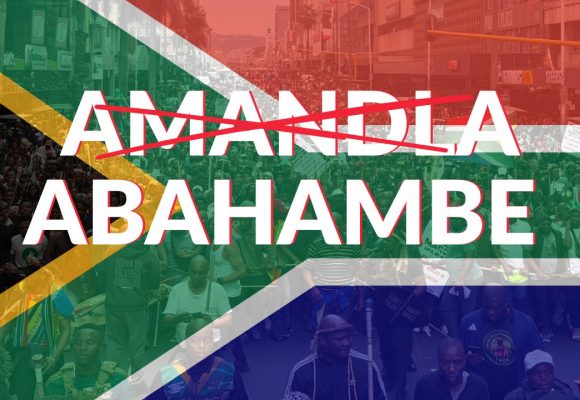
A peer-reviewed chapter published by IGI Global documents all three, concluding that the daily articulation of these labels perpetuates xenophobic hatred and becomes the basis for the reinforcement of oppressive and violent tendencies. Abahambe, the movement’s own slogan meaning “they must go,” adds a fourth term to that arsenal.
Together, these words do not describe a policy position. They perform an expulsion before it happens. None of them is applied to white Europeans living in South Africa without documentation.
The language is racially targeted. It always has been.
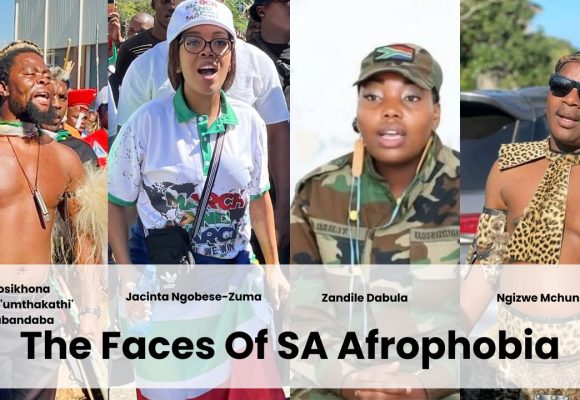
Jacinta Ngobese-Zuma: The Woman Who Made It Personal
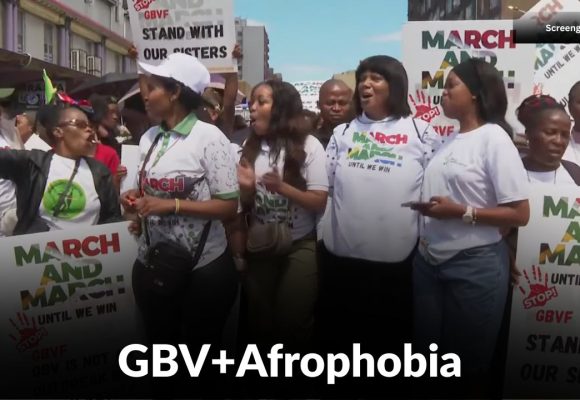
Jacinta Ngobese-Zuma founded March and March and remains its most recognizable face. She is Zulu, born in KwaMashu near Durban, and her surname comes from marriage, not bloodline. She is not related to former President Jacob Zuma. Her motivations, by her own account, are rooted in a single family wound.
In an on-camera interview, Ngobese-Zuma said her mother discovered through Home Affairs that a Nigerian man had fraudulently married her using a false identity. “Maybe I am a bitter person, who knows,” she said. “Maybe it’s a childhood trauma, who knows. But at the end of the day, it is what’s driving me.”
One man’s fraud became the organizing principle of a campaign targeting 300 Nigerians at a Durban repatriation center, 900 Ghanaians at OR Tambo International Airport, and tens of thousands of African nationals across nine provinces. The leap from one person’s crime to a continent-wide targeting campaign is only possible within a preexisting frame that portrays Nigerians as inherently dishonest. Without it, a mother’s painful experience remains what it was: one family’s encounter with one fraudulent individual.
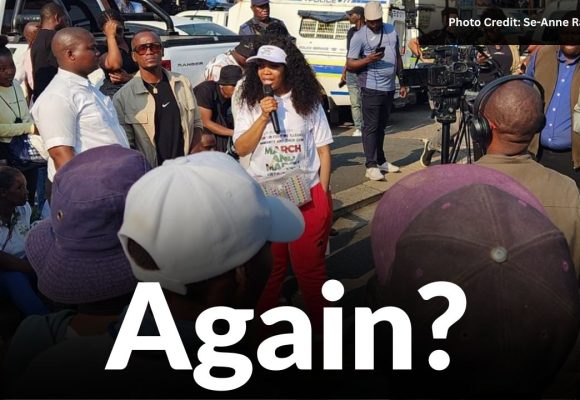
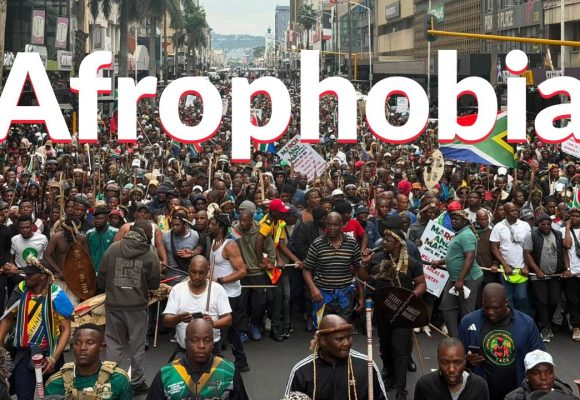
On June 30, Ngobese-Zuma marched in Durban at the head of a column of roughly 1,000 people, arriving late and visibly uncomfortable. She told reporters, “From building to building, they must go.” When asked what comes after the June 30 deadline, she refused to say. “You will know when we get there.”
The King She Misquoted
She also quoted Martin Luther King: “In the end, we will not remember the harsh words of our enemies but the silence of our friends.” The man she quoted was arrested 29 times for demanding that Black people be treated as human beings regardless of which side of a border they were born on. He would not have recognized himself in her mouth.
The Snub She Found Out About on Social Media
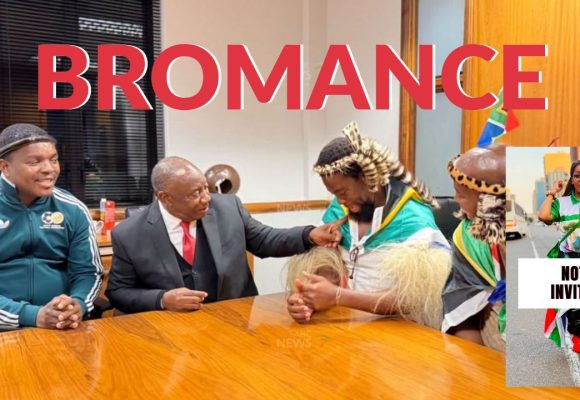
The most revealing moment of June 30 for Ngobese-Zuma came not from the marches but from her phone. The night before the protests, Phakel’umthakathi and Mchunu attended a private meeting with President Ramaphosa at the Union Buildings. Nobody told her. She found out from social media posts circulating after the fact.
“I just saw it now on social media, angazi lutho,” she told a Facebook user who asked about her absence, according to the Zambian Observer. Angazi lutho means I know nothing.
The snub was not isolated. She told reporters on June 30: “We’ve sent several requests to meet with the president. He hasn’t responded to any of them.” She added: “Well, if he wanted to meet us, he would have done it by now. But I guess it’s the Zuma surname,” according to YEN.com.gh.
The woman who founded the movement that set the national agenda had been requesting a presidential audience for months. The men who joined it got one the night before the marches.
Phakel’umthakathi’s public explanation for her exclusion was brisk. The meeting was last-minute, he said, and the call came late in the evening. He was due to see her the following morning anyway.
According to Briefly News and MSN, he added that he was not carrying Ma Ngobese on his back and that different organizations attend different meetings. Online allegations that he had been financially compromised by the presidential meeting were dismissed directly, with his farm and livestock cited as proof of independence.
Undisclosed Sources of Funds
The bribery allegations did not stick. But the broader funding question remains open. Ngobese-Zuma told IOL in June 2026 that March and March is sustained by crowdfunding, merchandise sales, and one anonymous business donor she refused to name, saying the company did not want publicity.
She offered to release bank statements. None have been published.
Professor Loren Landau of the University of the Witwatersrand told Radio France Internationale (RFI), “These are not simply grassroots movements supported by unemployed South Africans. There is external funding.” A movement that sustained coordinated marches across nine provinces, deployed organizers in multiple cities simultaneously, and produced professional media operations for over a year says it is funded by T-shirt sales and one anonymous donor it will not name. Who is actually paying for the campaign that has displaced tens of thousands of Africans from the country those Africans helped set free remains, for now, unanswered.
Weekly marches every Thursday followed Ngobese-Zuma’s June 30 announcement. Whatever the internal fractures, she has made clear the campaign is not over. The movement that started with her mother’s pain now runs every Thursday until she says otherwise.
Nkosikhona “Phakel’umthakathi” Ndabandaba: The Actor Who Dreamed of Dubai
Nkosikhona Ndabandaba, known publicly as Phakel’umthakathi, was born on June 28, 1980, in Nongoma, KwaZulu-Natal, the historic seat of the Zulu royal house. A decade in print journalism preceded his public identity in entertainment. His role as Mahlabeni in Shaka iLembe, the acclaimed historical drama about the founder of the Zulu nation, made him nationally known. He also leads amabutho, traditional Zulu warrior regiments, at official royal events.
Phakel’umthakathi announced the June 30 deadline to his 1.7 million Facebook followers and told CNN he was its architect. In one documented video, he approached a Congolese man standing by the roadside, did not ask whether the man held legal status, and told him to leave. “June 30 is the deadline, but you don’t have to wait until then,” he said. “Leave now.” He then added that after Tuesday, he would no longer be able to control the people of South Africa.
When asked why migrants should take the deadline seriously, Phakel’umthakathi’s answer was not about law or policy. He said he controlled the masses. He said the government could not protect people from what he had set in motion.
That is not the language of a concerned citizen petitioning the state. It is the language of someone who has decided he is the state.
The Spaza Shop Argument and Its Contradiction
Phakel’umthakathi’s campaign against foreign-owned spaza shops rests on a legal argument he states publicly. South African law requires foreign nationals to deposit R5 million before operating a business under a formal Business Visa, per Section 15 of the Immigration Act. He argues spaza shops should be reserved exclusively for South Africans, and that violators should be deported with their own deposited funds.
A Kenyan returnee interviewed by KTN said he operated a tire repair shop with one South African employee. His business had no local competition, he said, and it filled a service gap his neighborhood needed.
The law Phakel’umthakathi cites is real. However, it applies to formal Business Visa applicants, a category that most township spaza shop operators do not fall under. The majority operate on asylum-seeker permits, refugee permits, or other visa categories that do not carry an R5 million requirement.
Demanding a formal Business Visa from a Zimbabwean asylum seeker running a corner shop is like demanding a truck license from a cyclist. The categories do not match. The march goes where people are visible and vulnerable. It does not go where the law is being broken by people with lawyers.
The Corruption the March Never Confronts
The corruption argument beneath the documentation question runs deeper still. Lawyers for Human Rights and Human Rights Watch have documented a pattern in which foreign nationals apply for the correct permits, pay the required fees, and then wait years for processing because Home Affairs officials demand bribes for timely service.
Some of the people Phakel’umthakathi targets as undocumented are not undocumented by choice. They are waiting for papers that a corrupt department has held hostage. The movement demanding their expulsion has never once marched to the Department of Home Affairs to demand that officials process applications without demanding bribes. Instead, South Africans are holding immigrants accountable for a documentation backlog created by the same government corruption they refuse to confront in their own institutions.
Dreaming about Dubai
Phakel’umthakathi’s political vision extends that logic into governance. He has publicly stated that South Africa has enough national wealth to pay every citizen R1 million per year for the rest of their lives.
“We don’t even need to work,” he said, according to YEN.com.gh. “We can have these legal immigrants come to South Africa to work for us, like in Dubai. In the UAE, only foreigners are working. Arabs aren’t working.”
The model he describes, without naming it, is Dubai. In the United Arab Emirates, citizens receive subsidies and state benefits funded by hydrocarbon wealth. Meanwhile, a migrant labor force, nearly 90 percent of the UAE’s total population, performs almost all physical and service work in conditions human rights organizations have documented as exploitative.
Phakel’umthakathi wants South African citizens to occupy the citizen class. He wants the labor class expelled.
The Math That Does Not Work
He has not explained who builds the houses, runs the shops, collects the waste, and harvests the mines after the expulsion. His economic vision requires the very workforce he is marching to remove.
The arithmetic is also impossible. Paying R1 million annually to each of South Africa’s roughly 61 million people would require approximately R61 trillion per year. South Africa’s entire GDP in 2025 was roughly R7.5 trillion.
At his press conference after June 30, Phakel’umthakathi announced the movement would target what he called “problem buildings” in eThekwini. He argued that those buildings should be repurposed for KwaZulu-Natal flood victims. He denied being bribed after his private meeting with Ramaphosa and pointed to his farm and livestock as proof of financial independence. What was discussed in that meeting has not been disclosed.
Additionally, the Ministry of Land Reform and Rural Development has instructed lawyers to take legal action against Ndabandaba over public claims about Minister Mzwanele Nyhontso and alleged farm abuses. The ministry described the claims as false, unfounded, and damaging, according to YEN.com.gh.
Ngizwe Mchunu: The Radio Star Who Called It Civilizational
Ngizwe Mchunu was born in Nkandla, KwaZulu-Natal, the same rural town as former President Jacob Zuma. He built his public identity as a practicing sangoma and radio personality on Ukhozi FM, the SABC’s isiZulu-language station with more than seven million weekly listeners. Calling himself Inkosi YamaBhinca, King of the Bhinca, he leads the Amabhinca Nation movement.
South African authorities arrested Mchunu in July 2021 and charged him with incitement to commit public violence. The charges arose from an address he gave in Johannesburg calling on crowds to support Zuma during the civil unrest that followed Zuma’s jailing for contempt of court. That unrest killed more than 350 people, the vast majority of them South Africans, and caused an estimated R50 billion in economic damage. The Randburg Magistrate’s Court acquitted him of all charges in November 2023, finding the evidence insufficient.
A Checkered Legal Record That Extends Further
His legal troubles extend beyond the 2021 incitement charge. Courts found him guilty of hate speech against LGBTQ people and ordered him to pay a R250,000 fine. Separately, a court found him guilty of violating an order barring him from repeating defamatory claims that Nigerian crime lords had paid Julius Malema, according to YEN.com.gh.
He has lost in court twice. He has not faced court once for the Afrophobia campaign itself.
What distinguishes Mchunu from the other three is his framing of the campaign as a civilizational project rather than a policy dispute. He has explicitly called for Zulu-Xhosa unity against African migration, positioning it as a Nguni people’s movement. The loudest refrain at the Durban march on June 30, confirmed by TimesLIVE reporters on the ground, was not “Mabahambe,” the movement’s official slogan meaning “they must go.” It was “Zulu! Zulu! Zulu!”
Julius Malema identified the pattern at his May 1 rally in Rustenburg. “The same provinces where Blacks were killing Blacks during apartheid, sponsored by the apartheid government, are the same provinces where Blacks are beating Blacks today,” Malema said. “The script is the same. The writer of the script is the same.”
Mchunu sat with Ramaphosa at the Union Buildings on the night of June 29, alongside Phakel’umthakathi, without informing Ngobese-Zuma. No explanation has been provided for why the March and March founder was excluded.
At the conclusion of the Johannesburg march, Mchunu addressed the police directly. “Thank you for handling yourselves well,” he said, according to TimesLIVE. “Till we meet again.” The man whose movement the government spent R600 million deploying police to contain publicly thanked those officers at the end of the day.
Zandile Dabula: The TV Host Who Turned Deportation Into Entertainment
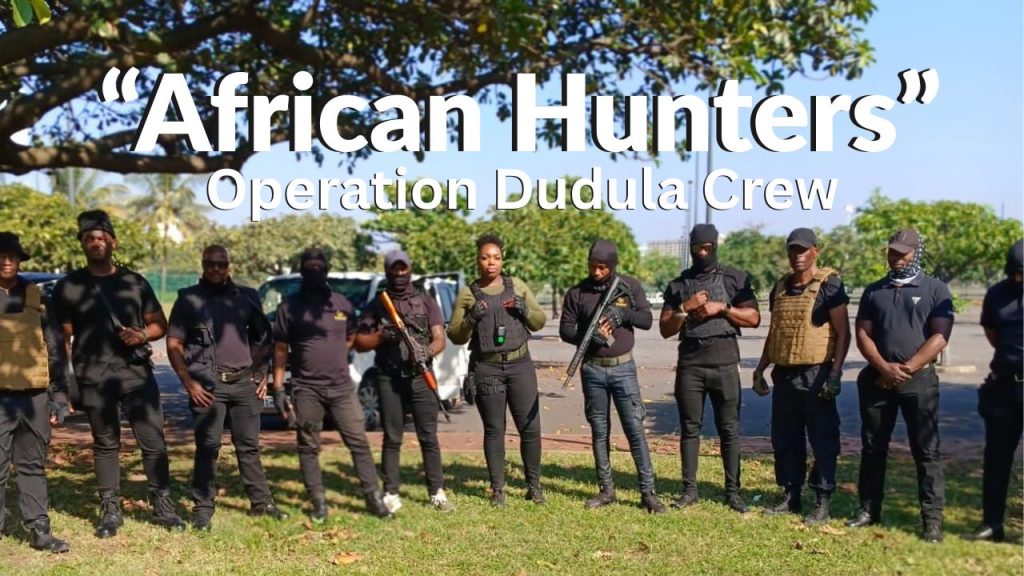
Zandile Dabula leads Operation Dudula, the Soweto-based anti-immigrant organization that predates and helped lay the groundwork for March and March. Operation Dudula was founded in June 2021 by Nhlanhla “Lux” Dlamini. He first gained public attention defending Maponya Mall, the 65,000-square-meter shopping center in Pimville that the late businessman Richard Maponya spent 28 years fighting the apartheid government to build, from looters during the July 2021 unrest.
Within months, Lux pivoted to leading Operation Dudula against African migrants in those same Soweto streets, before departing in July 2022 after internal disagreements. Dabula inherited the leadership and expanded its reach nationally before resigning to join ActionSA.
She identifies publicly as a South African citizen born in Diepkloof, Soweto.
Registered Party, Absent Disclosure
Under Dabula’s leadership, Operation Dudula registered as a political party with the IEC in September 2023. Registration made it legally subject to disclosure requirements under South Africa’s Political Party Funding Act. Registered political parties must disclose donations above R200,000 to the IEC quarterly. Yet Operation Dudula does not appear in the IEC’s published Q4 2025/26 funding declaration report.
Furthermore, Dabula cited concerns about IEC compliance as one of the reasons for her resignation in May 2026, according to TimesLIVE. She stated that many within the movement believed it had built a stronger influence as a civic organization rather than a political party. A registered political party whose leader resigned partly over compliance failures and that does not appear in published quarterly funding declarations has questions to answer that the IEC has not yet compelled it to address.
Wikipedia’s entry on Operation Dudula, drawing on academic and journalistic sources, describes the organization as widely recognized as fascist and xenophobic. Dabula has denied the characterization.
The documented record tells a different story. In 2025, Operation Dudula members blocked a mother from accessing a clinic in Johannesburg. The child died.
Africa Check confirmed the incident. Dabula and the organization denied responsibility.
She then announced that Operation Dudula would station members at public schools to block foreign children from enrolling. In a Deutsche Welle interview, she described Black African foreigners as “the most problematic ones” and “easier to catch,” while denying the group specifically targets Black migrants.
Prime Time Persecution
In March 2025, Moja Love, DStv channel 157, partnered with Dabula to launch X-Deport, a reality television show that aired in Season 1 from May 2025, confirmed by Bona Magazine. According to Bona, the show follows Dabula as she seeks documentation from foreign business owners from across the world, including Asian and African nationals. The show’s status after Dabula’s resignation from Operation Dudula in May 2026 had not been publicly confirmed at the time of publication.
The footage shows Dabula approaching foreign nationals in their shops and homes, demanding to see their documents, questioning them about their legal status, and restricting their movement while awaiting police. She performs these functions with the authority of a law enforcement officer. She holds none.
Under South African law, only a sworn immigration officer or a police officer has the authority to demand identity documents from a private person. The November 2025 Johannesburg High Court confirmed this explicitly. Dabula has never been authorized to conduct document checks, detain persons, or facilitate arrests. She does all three on camera for prime-time entertainment.
The show operates overwhelmingly in townships and informal settlements. Civil society organizations noted in their petition to the SAHRC that its targets are predominantly Black African migrants, a pattern that reflects the broader Afrophobia campaign the show serves.
A State That Has Stepped Aside
What X-Deport broadcasts is not immigration enforcement. It is the spectacle of a private citizen exercising state power over vulnerable people who have no immediate legal recourse while the cameras roll. The South African state spent R600 million on a police operation for June 30. It has not spent a single rand prosecuting Dabula for conducting unauthorized detention and document checks on national television for over a year.
Civil society organizations petitioned the South African Human Rights Commission and the Independent Communications Authority of South Africa to investigate the show for violating Section 10 of the Constitution, which guarantees dignity for all persons within South Africa’s borders. Neither ICASA nor the SAHRC has confirmed a formal investigation at the time of publication.
That silence is not incidental. It is the clearest evidence that the South African state has effectively ceded ground-level authority to vigilante organizations.
Dabula holds no badge. She holds a camera crew and a broadcast slot. In the absence of state enforcement, that has been sufficient.
In a live television interview that circulated nationally, Dabula was asked to name the Frontline States. She could not answer. The host rephrased the question three times. Another guest eventually intervened, according to The South African.
Frontline States, among them Tanzania, Zambia, Mozambique, Angola, and Zimbabwe, were African nations that sheltered ANC exiles, hosted liberation camps, and absorbed South African military raids rather than abandoning the people fighting to end apartheid. Dabula did not know what they were. The host rephrased the question three times. Another guest eventually stepped in to clarify, according to The South African, which reported the incident on October 20, 2025.
The woman who built a television show around demanding papers from African migrants did not know which African countries made South Africa’s freedom possible.
Dabula has since resigned from the Operation Dudula presidency and joined ActionSA, Herman Mashaba’s explicitly anti-immigrant party, where she is reportedly seeking elected office ahead of the November 2026 municipal elections.
How They Manufactured the Evidence
The campaign these four people built does not rely only on ideology. It relies on incidents, real and alleged, seized before investigations are complete and embedded in public consciousness before corrections arrive.
In 2022, Nhlanhla Lux Dlamini stood before a crowd and declared, “We are here because of Kgotso Diale, a South African who was shot and killed by illegal foreigners,” according to the Al Jazeera Media Institute’s documented research. No police investigation had been completed. No nationality had been confirmed. The accusation preceded the evidence by days.
In late 2024, approximately 22 South African children died from food poisoning. Health Minister Aaron Motsoaledi confirmed they died from organophosphate poisoning after eating snacks from local spaza shops, specifically Terbufos, a pesticide sold illegally in townships for rat control. Investigations found the contaminated pesticide came from illegal informal traders, not from the foreign shop owners themselves, according to The Conversation and HSRC peer-reviewed analysis. Nevertheless, the movement used the children’s deaths to campaign against foreign-owned spaza shops.
A Tale of Two Crises
When the Facts Arrive Too Late
The contrast with an earlier crisis is striking. The 2017 to 2018 South African listeriosis outbreak killed 216 people. Investigators traced it to Enterprise Foods, a subsidiary of Tiger Brands, a South African corporate company. Tiger Brands reportedly knew about listeria in its products eighteen days before the government recall, according to Wikipedia’s confirmed reporting on the outbreak.
No march targeted Tiger Brands. Its executives faced no ultimatum. No spaza shop campaign followed a South African corporate food company killing 216 people. Yet 22 children dying from illegal pesticides supplied through an informal supply chain became the foundation for a national campaign against foreign-owned informal shops.
In April 2026, the disappearance of Vosloorus spaza shop owner Mazwi Mpumelelo Kubheka became the movement’s most powerful mobilizing case. He went missing on April 2 after allegedly refusing to hand over his business to foreign nationals. March and March and ActionSA both organized around his disappearance. When Kubheka was found alive on May 2, Gauteng Premier Panyaza Lesufi revealed that a group comprising South Africans, Ethiopians, and Malawians allegedly held him, and that the suspected mastermind was personally known to the victim, according to African Times.
The movement had already built its campaign. That correction arrived after the damage was done. Consistently, incidents are amplified before investigation, contradictory findings are minimized, and African migrants are the frame regardless of the evidence. When victims are African, as Elvis Nyathi was, the Zimbabwean national killed by a South African mob in Diepsloot in April 2022, their deaths generate far less movement attention than South Africans allegedly targeted by foreigners.
What It Looks Like on the Ground
The distance between a protest and a pogrom is measured in police response time. On June 30, 2026, that distance was near zero.
In Germiston, Siyafana Sonke Action Campaign monitors confirmed that marchers were conducting citizens’ arrests of people they suspected were undocumented immigrants, directly in front of police officers, and handing them over for processing. Police accepted the handovers without objection. Siyafana Sonke, a coalition of 160 civil society organizations, issued a formal statement noting police in some areas stood by while homeless people’s belongings were set alight, windows were broken, and foreign nationals were intimidated, according to Jacaranda FM’s confirmed reporting.
In Yeoville, marchers threw objects and damaged residential buildings believed to be rented by foreign nationals. Pregnant women and children were dragged from their homes in Germiston, monitors confirmed.
In Hillbrow, shots were fired, and police and ambulances were called. In Kliptown, the army deployed after widespread looting. Journalists were attacked and footage forcibly deleted.
Police Standing By
Our City News documented a Cameroonian migrant being struck over the head during the Johannesburg CBD march with police present. No arrest was made.
The International Commission of Jurists, in its submission to the Kopanang Africa Against Xenophobia case, used the word “colluding” to describe the relationship between South African police and the Department of Home Affairs on one side and Operation Dudula on the other. That is not an activist characterization. It is the language a respected international legal body uses in a formal court submission.
Julius Malema named the racial logic beneath the police conduct at his May 1 Rustenburg rally. “Look at them,” he told the crowd. “When they speak to white people, they are very respectful, they show manners. When they speak to a Black person, they are violent.”
Malema has lost votes defending African migrants. He has said more clearly than any sitting cabinet minister what is happening and who is responsible. The man who commands the South African Defense Force has not said their names. The man who lost the last election named them at a Workers’ Day rally.
The Ghost of Operation Marion
When CNN asked Ndabandaba why migrants should take the June 30 deadline seriously, his answer was not about law. It was not about policy. He said he controlled the masses. He said the government could not protect people from what he had set in motion.
That is not the language of a concerned citizen. It is the language of someone who believes he holds authority the state no longer has.
That claim carries deep historical weight in KwaZulu-Natal. The province where the June 30 marches were heaviest, where the movement’s three primary leaders were all born, and where the Zulu royal house sits, is also the province where the apartheid government ran its most sophisticated Black-on-Black violence program in South African history.
Operation Marion: What the Records Show
Operation Marion, launched in 1986, saw the South African Defense Force spend at least R19.5 million in its first financial year alone training and arming Inkatha Freedom Party militants at secret bases in the Caprivi Strip, according to ISS researcher Hennie van Vuuren’s 2006 analysis of SADF documents placed before the TRC. That single-year figure does not include the R1.5 million that the SAP Security Branch paid directly to Inkatha’s trade union arm, UWUSA, as confirmed by Law and Order Minister Adriaan Vlok’s own public statement on July 30, 1991. It does not include the monthly SADF salaries paid to each of the approximately 200 Caprivi trainees, confirmed by TRC Volume Three findings.
It does not include the tens of millions in Pretoria homeland grants, between 68 and 81 percent of KwaZulu’s total annual revenue, that flowed through the homeland government, the TRC found, was institutionally indistinguishable from Inkatha itself. The apartheid state destroyed approximately 44 metric tons of National Intelligence Service records alone before the 1994 transition. Nevertheless, the total amount of apartheid covert Secret Services Account between 1978 and 1994 exceeded R2.75 billion, as confirmed by the Auditor-General’s report to the TRC.
The TRC’s Finding
The IFP under Buthelezi’s leadership was the “primary non-state perpetrator of violence” in KwaZulu-Natal, responsible for approximately 33 percent of all violations reported to the commission, according to the Mail and Guardian’s confirmed reporting. Buthelezi went to court in 2002 to suppress those findings. He was never prosecuted. The IFP is now inside Ramaphosa’s Government of National Unity and sent representatives to the June 30 marches.
Malema named the pattern directly: “The same people who made us fight each other during apartheid are doing the same today. The same provinces where Blacks were killing Blacks during apartheid, sponsored by the apartheid government, are the same provinces where Blacks are beating Blacks today. The script is the same. The writer of the script is the same.”
The Funding Question
South African political analysts have argued that today’s Afrophobia campaign draws on the same political networks that funded IFP violence during apartheid. That claim is not yet established by documentary evidence in the public record. What is established is this: Daily Maverick and AmaBhungane reported in June 2026 that two company directors behind March and March’s organizational structure move within former President Jacob Zuma’s family network through a connection to the late Thokazile Jennifer Mbambo, who served as a company director alongside Zuma’s late brothers.
The movement has not disclosed its funding sources. Professor Loren Landau of the University of the Witwatersrand told RFI directly: “These are not simply grassroots movements supported by unemployed South Africans. There is external funding.” Who is providing it and in what amounts remains undisclosed.
An Unfinished Reckoning
The Khampepe Commission, established by Ramaphosa in May 2025 to investigate why TRC prosecutions were suppressed, has been extended to December 2026. Its report will arrive after the November 4 municipal elections. Whatever it finds will land in a changed political landscape.
Men trained in the Caprivi Strip are still alive. Networks that funded them were never fully dismantled because the men who ran them were never prosecuted. All of this is playing out in 2026 in the same province where it played out in 1986.
The script is the same. The question is whether the writer is too.

LEAVE A COMMENT
You must be logged in to post a comment.