

|
LISTEN TO THIS THE AFRICANA VOICE ARTICLE NOW
Getting your Trinity Audio player ready...
|
Many people around the world have never heard of Eswatini.
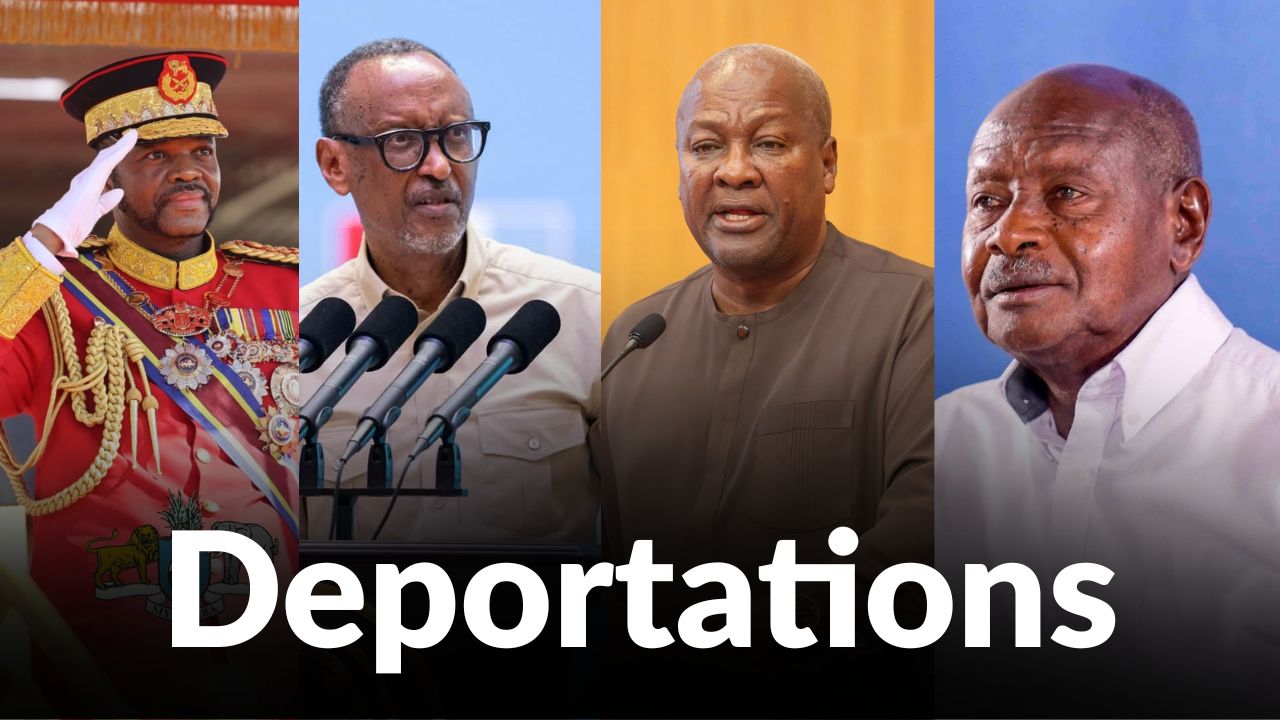
The tiny southern African kingdom is now holding at least 30 people deported from the United States.
That is part of a widening web of deals that has paid African governments more than $32 million to take migrants Washington cannot send home.
The unfamiliarity is not entirely the world’s fault.
King Mswati III renamed the country from Swaziland to the Kingdom of Eswatini on April 19, 2018, marking 50 years of independence from Britain.
A Quiet Deal Finds Willing Partners
Eswatini was among the first African governments to accept the offer.
According to Reuters, Eswatini learned through the US embassy that Washington was seeking African partners.
Prime Minister Russell Dlamini met American officials soon after, moving quickly on terms that were still taking shape.
The kingdom has received four confirmed batches since July 2025.
Five people arrived in July, 10 in October, four in March 2026, and 11 in July 2026, bringing the total to at least 30.
A Human Rights Watch review of the agreement found Eswatini committed to accepting up to 160 deportees in exchange for $5.1 million.
Finance Minister Neal Rijkenberg confirmed that figure in parliament, adding that his own ministry had been kept in the dark throughout the negotiation.
At least eight African governments now have confirmed agreements or arrivals.
They include Eswatini, South Sudan, Ghana, Rwanda, Uganda, Equatorial Guinea, Cameroon and the Central African Republic.
A smaller transfer has also been confirmed to the Democratic Republic of the Congo.
South Sudan received the first group, eight men held for weeks at a US military base in Djibouti before a Supreme Court ruling cleared their transfer.
Rwanda agreed to take up to 250 people under a June 2025 memorandum.
Only seven have arrived to date, all in a single August 2025 flight.
Uganda’s first and only confirmed transfer, eight people, landed at Entebbe International Airport in April 2026.
The Price of Saying Yes
The dollar figures are no longer in dispute.
A Senate Foreign Relations Committee minority staff report published in February 2026 tallies more than $32 million paid to five countries.
Equatorial Guinea and Rwanda each received $7.5 million, Eswatini received $5.1 million, El Salvador received $4.76 million and Palau received $7.5 million.
That $32 million is a rounding error next to Washington’s own immigration enforcement spending.
ICE’s budget for the current fiscal year runs close to $77 billion, the largest of any federal law enforcement agency in the country.
The total payout to all five countries combined is less than half a percent of that single-year figure.
Government confirmation exists for both African payments separately.
Rwandan spokesperson Yolande Makolo confirmed the $7.5 million figure in August 2025.
That was corroborated by a Department of Homeland Security court declaration filed the following spring.
Equatorial Guinea’s identical sum was confirmed through a Senate letter citing State Department sources.
That payment came from a fund Congress apportioned for refugee resettlement, not deportation.
Senator Jeanne Shaheen called the diversion highly unusual, given Equatorial Guinea’s documented history of corruption under President Teodoro Obiang Nguema Mbasogo, in power for 46 years.
Not every government has taken cash.
Ghana has framed its arrangement as tied to visa concessions rather than a direct payment.
Uganda has disclosed no financial terms at all.
Kampala’s officials describe their motivations around restored African Growth and Opportunity Act trade eligibility, tariff relief and resumed visa processing.
Those benefits trace back to the fallout from Uganda’s 2023 Anti-Homosexuality Act and subsequent USAID funding cuts.
No wire service, government statement or tracker has reported a specific dollar figure for Uganda.
Not Even Their Own Citizens
The money looks even smaller once you ask who is actually being sent.
Not all of the deportees are African.
Eswatini’s first group of five included citizens of Vietnam, Jamaica, Cuba, Yemen and Laos.
South Sudan’s group of eight included citizens of Cuba, Laos, Mexico and Myanmar, alongside South Sudanese nationals.
Neither country has any historical, linguistic or diplomatic connection to most of the people it accepted.
Rwanda has not disclosed a single nationality among its own arrivals.
Equatorial Guinea’s deportees have been described only as unnamed East Africans too afraid of retaliation to give their countries.
Ghana and Uganda are the exception, taking in mostly West and East African nationals under regional free-movement justifications.
Eswatini and South Sudan received no such justification, because there was none available.
They took in strangers from four continents because Washington could not find anywhere else to put them.
Eswatini was paid $5.1 million for that.
Rwanda and Equatorial Guinea were paid $7.5 million each, some of it for citizens of their own neighboring countries, some of it for people with no tie to Africa at all.
Set against ICE’s $77 billion annual budget, the entire arrangement reads less like a negotiated partnership and more like African governments accepting Washington’s overflow at a discount rate Washington itself would never accept.
Ghana Says 14. Others Say Closer to 100.
Ghana’s government has publicly acknowledged accepting 14 deportees in September 2025, including several Nigerian nationals and one Gambian.
President Mahama has said relations between Accra and Washington are tightening even as his government cooperates.
Independent monitors describe a wider gap.
Advocacy groups tracking the arrangement, including Asian Americans Advancing Justice, Democracy Hub and the Global Strategic Litigation Council, put Ghana’s true cumulative total closer to 70 to 100 people.
Accra has not addressed that estimate publicly, and The Africana Voice could not independently confirm it through government or wire sources.
A Reuters investigation published in January found a more troubling pattern behind the numbers.
Lawyers in Ghana and the US identified more than 30 third-country nationals deported to Ghana across several flights since September 2025.
At least 22 of them were sent home to their countries of origin, despite holding US court orders explicitly protecting them from that outcome.
One case became public through video rather than official disclosure.
Rabbiatu Kuyateh is a 58-year-old Sierra Leonean nurse who had lived in Maryland for nearly three decades.
A US immigration judge had granted her protection against removal to Sierra Leone, citing fear of torture tied to her father’s political activities.
She was deported to Ghana on November 5, held in an Accra hotel for six days, then forced onto a flight to Freetown.
Ghana Immigration Service officers dragged her across the hotel floor to a waiting van, an incident captured on video and confirmed by her family.
She has since fled Sierra Leone again for a neighboring country she has declined to name, citing safety concerns.
Why the Court Orders Don’t Follow Them
The mechanism behind cases like Kuyateh’s is legal, not accidental.
A US withholding of removal order binds only the US government.
It prohibits American immigration authorities from sending someone back to a country where a judge found they would likely face persecution or torture.
It does not bind Ghana, Eswatini or any other third country.
Once a person is physically deported to Accra or Mbabane, US courts have no authority over what that government does with them next.
Federal Judge Brian Murphy called this out directly in a February 2026 ruling that struck down the broader third-country removal policy as unlawful.
He wrote that the practice extinguishes valid legal challenges by removing people before they can be raised.
The Trump administration has maintained it acted in full compliance with every court order on the books.
That defense holds up under a narrow reading of what the orders actually say.
An order barring removal to Sierra Leone does not, on its face, bar removal to Ghana followed by Ghana’s own decision to send someone home.
Whether that is a legitimate reading of the law or a deliberate workaround is still being fought out in federal court.
Not Every Government Said Yes
Nigeria and Burkina Faso showed that refusal was possible, even at a cost.
Burkina Faso turned the arrangement down outright.
Foreign Affairs Minister Karamoko Jean-Marie Traoré confirmed in October 2025 that his government declined a US proposal to accept migrants from other countries.
Washington responded by suspending visa issuance for Burkina Faso.
Traoré did not back down quietly, publicly questioning whether the retaliation amounted to blackmail.
Nigeria also declined to participate, choosing not to take on other nations’ deportees despite similar pressure from Washington.
Both governments held their position while smaller economies elsewhere on the continent signed on for a fraction of what ICE spends in a single week.
South Sudan sits between the two positions.
It received deportees in July 2025, despite its foreign ministry insisting months later that no formal agreement existed, describing the arrangement only as bilateral engagement.
Who Actually Holds the Leverage Here
The open question is not whether Washington needed African partners.
It clearly did, after courts and diplomatic refusals closed off easier options elsewhere.
The real question is whether African governments used that leverage to extract lasting value.
Or whether a handful of cash transfers and visa concessions bought Washington a solution to a domestic political problem at a discount.
Burkina Faso and Nigeria proved refusal carries a price, and paid it anyway.
Ghana’s undisclosed real numbers, paired with its repatriation record, suggest quiet cooperation without full accountability may be just as common as either outright refusal or open disclosure.
Eswatini’s High Court dismissed a constitutional challenge to its agreement in February 2026 on narrow standing grounds.
It declined to rule on whether the deal needed parliamentary ratification.
That question now sits before the Supreme Court on appeal.
How it rules may set the template other governments watch before signing the next deal.
The Africana Voice contacted Ghana’s Ministry of Foreign Affairs and Ministry of the Interior, and Eswatini’s government, in writing ahead of publication.
None had responded by the time this report was published.
This report will be updated if responses are received.





LEAVE A COMMENT
You must be logged in to post a comment.