

|
LISTEN TO THIS THE AFRICANA VOICE ARTICLE NOW
Getting your Trinity Audio player ready...
|
Haven’t read Part 1 yet? Start with “The History of Afrophobia in Africa, Part 1: How the Pattern Was Built,” which traces the slave trade through Ivory Coast’s 1994 citizenship law.
Part One of this series traced Afrophobia from the transatlantic slave trade through Ghana and Nigeria’s expulsion cycle, Kenya’s Wagalla massacre, and Ivory Coast’s 1994 citizenship law, a law that helped trigger two civil wars and left more than 4,500 people dead.
Every case shared the same underlying choice: Africans with power siding with a foreign buyer, a foreign administrator, or a foreign-drawn border over their own neighbors, and other Africans going along with it.
Part Two follows that same choice into the twenty-first century, and ends with what actually stops it.
North Africa Sells What West Africa Merely Expelled
If Ghana and Nigeria show governments expelling fellow Africans, and Ivory Coast shows a government redefining who counts as a citizen, North Africa shows something closer to the trade this essay opened with, revived rather than remembered.
CNN correspondent Nima Elbagir and her team filmed an undercover slave auction near Tripoli in October 2017, footage that aired that November and showed sub-Saharan migrants sold for a few hundred dollars each to Libyan buyers.
Libyan authorities announced a formal investigation within days, and the United Nations Security Council sanctioned six identified traffickers the following year.
A joint United Nations and Libyan human rights investigation published in February 2026 found the exploitation model documented in 2017 has continued largely unchanged, describing a “brutal and normalized” system in cities including Sabha and al-Zawiya that still includes, in the investigators’ own words, the sale of human beings akin to slavery.
Algeria and Tunisia have chosen expulsion and rhetoric over auction blocks, but the underlying logic is familiar.
Monitoring group Alarme Phone Sahara documented more than 34,000 people deported from Algeria across the desert crossing into Niger in 2025 alone, often abandoned in the Sahara with little food or water.
Tunisian President Kais Saied told his country’s National Security Council in February 2023 that irregular sub-Saharan migration was part of a deliberate plan to alter Tunisia’s demographic makeup.
German broadcaster DW’s own fact-check of that claim, citing Tunisian civil society data, found the actual sub-Saharan population in Tunisia at the time was closer to 21,000, a fraction of the “one million” figure Saied’s rhetoric implied.
That claim nonetheless preceded a documented wave of evictions and street violence against sub-Saharan residents.
Fifteenth-century slave ports and twenty-first-century Tripoli are connected by more than metaphor.
It runs through the same coastline, uses the same logic of treating African life as expendable cargo, and in Libya’s case, uses nearly the same transaction.
Congo’s Tutsi Minority Still Carries a Colonial Label
Belgium’s manufactured categories did not stay inside Rwanda’s borders, and eastern Congo shows how far the damage traveled.
Belgian administrators ran a colonial labor scheme starting in 1937, moving Hutu and Tutsi workers from Rwanda into eastern Congo’s plantations and mines.
Many settled permanently in South Kivu, where their descendants became known as Banyamulenge.
Congolese law recognized their citizenship under a 1972 statute signed by then-president Mobutu Sese Seko, but then reversed course in 1981, when parliament revoked it and left the community effectively stateless in the only country most of them had ever known.
That statelessness has outlasted several wars, and the current one is escalating.
A resolution the United Nations Security Council adopted unanimously in December 2025 condemned an M23 rebel offensive in South Kivu that it said operates with the direct support of the Rwanda Defense Forces, and demanded Rwanda withdraw those forces from Congolese territory.
Rwanda’s Ministry of Defense disputed responsibility for specific killings in an April 2026 briefing, attributing them instead to Congolese militia and allied forces.
A ceasefire verification mission involving the Congolese government, the M23-aligned AFC coalition, and regional observers was deployed to the town of Minembwe in August 2026, though fighting has continued in surrounding areas.
Human Rights Watch has independently documented killings and displacement in the region, while broader casualty figures cited by Banyamulenge advocacy groups reflect community accounts rather than independent United Nations verification.
Colonial mapmaking created the Banyamulenge’s outsider status, and a series of independent Congolese governments have kept it alive, using citizenship the same way Ivory Coast once did, as a tool that can be granted or withdrawn to suit whoever holds power in Kinshasa.
South Africa Gave the Pattern a Name
Post-apartheid South Africa inherited a continental reputation as the country that beat back racial domination through decades of sacrifice.
It has spent much of the past two decades building a different, harder reputation among fellow Africans.
Nationwide attacks on foreign nationals in May 2008 killed more than 60 people, among them South Africans mistaken for foreigners alongside Mozambican, Zimbabwean and Somali victims.
A further wave in April 2015 killed at least seven people in Durban and Johannesburg, days after Zulu King Goodwill Zwelithini told a gathering in Pongola that foreigners should “take their baggage and be sent back,” a remark South Africa’s Human Rights Commission later found was hurtful and harmful, though it stopped short of ruling that it incited the violence that followed.
September 2019 brought a further outbreak in Johannesburg that killed at least a dozen people, prompted Nigeria to boycott a major economic conference in Cape Town, and triggered retaliatory looting of South African-owned businesses in Lagos and Abuja.
University of South Africa theologian Rothney Tshaka has researched the phenomenon since 2008 and argues the term xenophobia understates what is happening, since it targets one outsider specifically, the Black African migrant from north of the Limpopo River.
Pandor made nearly the same argument in a Borderlines interview and again to foreign diplomats in Pretoria in September 2019, telling them the violence stemmed from the resentment of South Africa’s poorest citizens rather than any rational calculation.
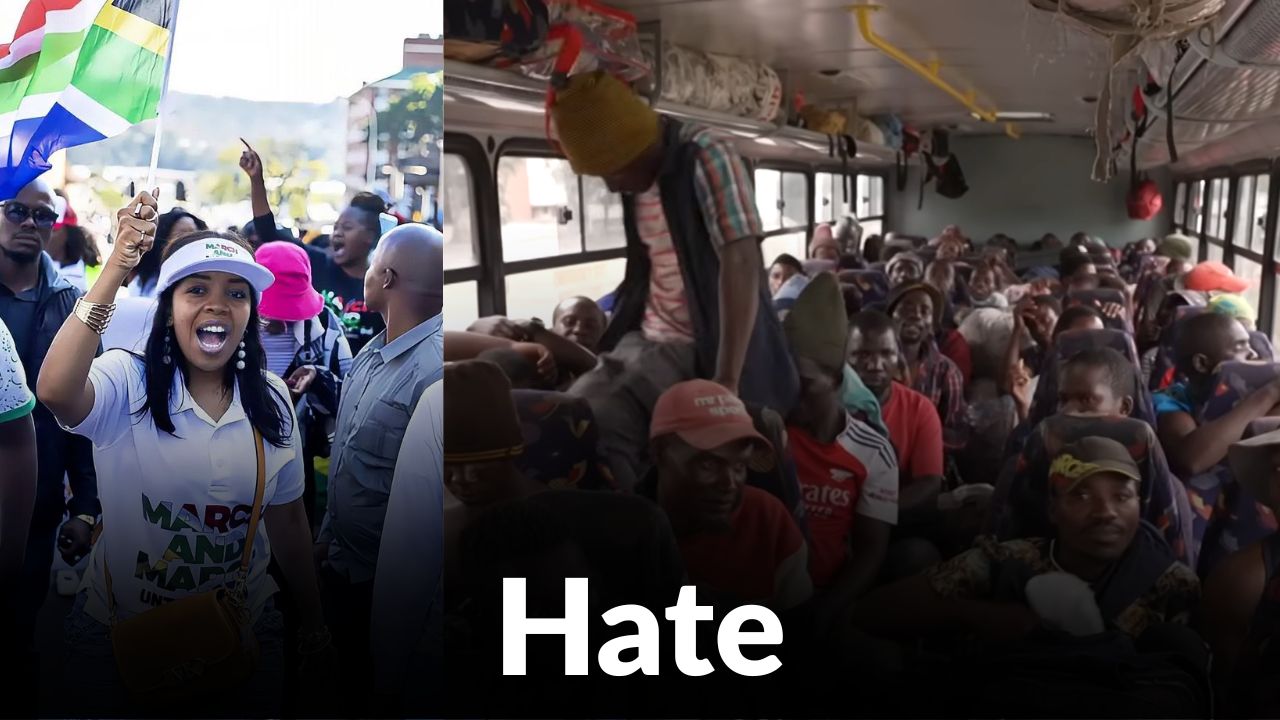
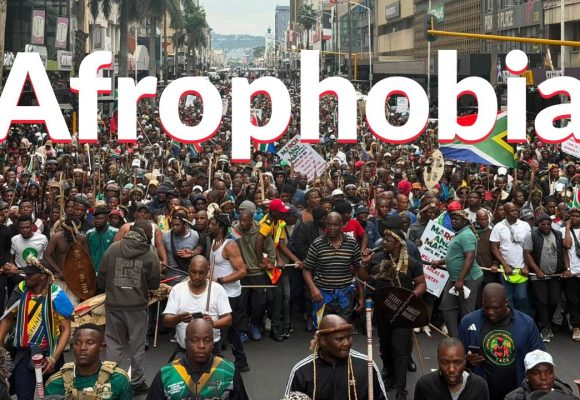
Human Rights Watch documented a fresh wave of vigilante activity in 2026 under a movement calling itself March and March, following earlier groups including Operation Dudula, whose Zulu name translates roughly to “force out.”
The Choice Was Always Someone’s to Make
A single thread connects Dahomey’s raiding parties, Belgium’s identity cards, Busia and Shagari’s expulsion orders, Bedie’s electoral code and Operation Dudula’s marches.
In every case, the people doing the excluding rarely captured the wealth that exclusion promised.
Dahomey’s rulers profited from selling captives, but the broader Atlantic economy that made those captives valuable was built and controlled from Europe.
Belgian administrators profited from a docile, divided colony, not the Tutsi elite they temporarily elevated, who were discarded the moment demographics shifted against Belgian interests.
Nigerian politicians facing a collapsing oil economy in 1983 did not fix the oil price by expelling Ghanaians, they simply survived one election cycle, the same trade Busia had made fourteen years earlier in Accra.
South African vigilante leaders have not solved unemployment by attacking Zimbabwean and Mozambican shopkeepers, they have mainly generated headlines and, in some documented cases, deaths that remain unprosecuted.
None of that removes responsibility from the people who made the call.
Dahomey’s rulers could have declined the trade the way Afonso eventually did, and some coastal states did resist it at real cost to their own treasuries.
Busia and Shagari could have found a domestic answer to unemployment and oil-price collapse instead of an imported one, and other leaders facing similar pressure have.
Vigilante organizers in South Africa today are choosing a target, not reacting to an uncontrollable force of nature.
Researchers who study South Africa’s own violence describe a pattern worth sitting with.
Much of the aggression documented since 2008 comes from poor South Africans directed at poor migrants, not from anyone positioned to actually benefit from tighter borders or fewer competitors for entry-level work.
Academic Steven Gordon, whose research is widely cited in South African xenophobia studies, links the pattern to socioeconomic desperation that political leaders have consistently avoided addressing, choosing a foreign scapegoat over a harder domestic fix.
Poverty and colonialism created conditions where that choice became tempting.
Neither one made the choice for anyone.
Every era supplies a fresh explanation for African-on-African hostility, tribal loyalty, colonial classification, national sovereignty, economic self-defense, demographic anxiety.
Strip away the explanation of the moment and the underlying decision looks identical across five centuries.
A ruler, a colonial administrator, an elected politician or a self-appointed organizer decides to turn a shared African identity into a hierarchy of insiders and outsiders, and decides to use the resulting suspicion for personal or political gain.
That is a decision made by a named, identifiable person in every single case examined here, not a force that descends on people from outside their control.
Treating it as a decision, and holding the people who make it accountable, is what pan-African responsibility actually requires.
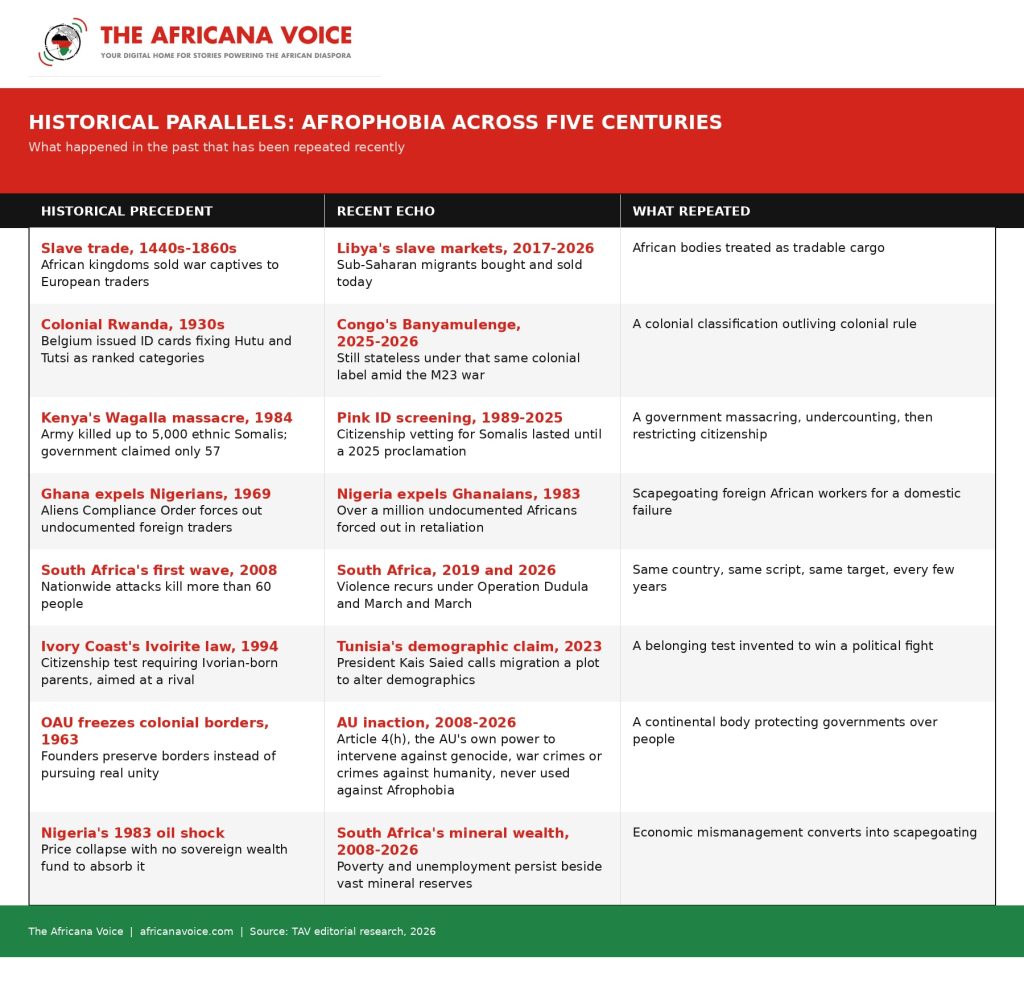
TABLE OF PARALLELS
Resource Wealth Could Fund a Different Choice
Nearly every case in this history has an economic trigger sitting underneath the political one.
Nigeria’s 1983 expulsion followed a collapse in oil prices that a well-managed sovereign wealth fund could have cushioned, the same tool Norway built from its own oil boom in the same decade.
Congo’s eastern provinces sit on some of the planet’s richest cobalt and coltan deposits, yet the revenue from those minerals has funded competing armed groups more reliably than it has funded Banyamulenge citizenship papers or anyone else’s development.
South Africa holds some of the world’s largest reserves of platinum, gold, chromium and manganese, and still produces enough poverty and unemployment to make a Zimbabwean shopkeeper look like a threat to a poor South African’s next meal.
Libya’s oil reserves, among the largest in Africa, did not prevent the state collapse that turned migrant smuggling routes into an outright slave market.
None of these countries were poor in resources.
They lacked the institutions needed to turn resource wealth into shared prosperity, and that gap gave every leader in this history a ready-made excuse to blame a neighbor instead of fixing a budget.
A continent that captured more value from its own minerals, oil, and agricultural exports, and distributed that value more broadly, would have far less economic desperation available for politicians and vigilantes to weaponize.
That is a domestic policy problem with domestic solutions, revenue transparency, sovereign wealth funds, processing minerals at home instead of exporting them raw, and regional trade integration under the African Continental Free Trade Area.
None of those solutions require permission from a foreign government.
Pan-Africanism Has Always Been the Counterargument
Treating this history as one-directional would erase the Africans who fought the pattern at every stage.
Afonso I resisted the trade that first enriched his kingdom.
Kwame Nkrumah built Ghana’s independence movement partly on the argument that African unity was strategic rather than sentimental, and pushed for a continental government rather than a collection of separate flags.
Founders of the Organisation of African Unity settled for far less in 1963, choosing to preserve colonial borders rather than redraw them, a compromise that arguably locked in some of the very divisions this history describes.
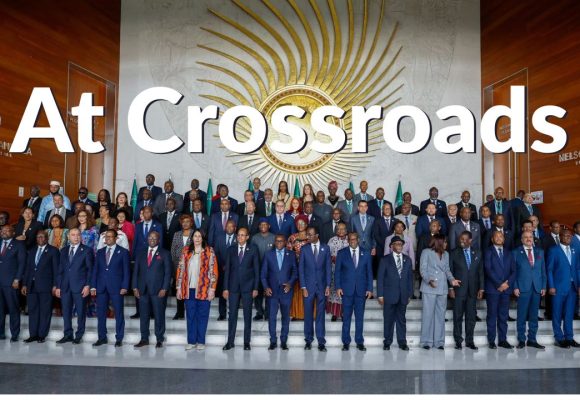
A stronger successor, the African Union, replaced that weaker body in 2002, built specifically to fix what the OAU could not.
Article 4(h) of the AU’s Constitutive Act grants the Union the right to intervene inside a member state to stop genocide, war crimes, and crimes against humanity, without waiting for that state’s permission, a power legal scholars called unprecedented for any regional bloc anywhere.
TAV documented in an earlier report, “How the AU Has Failed Africa,” how rarely that mandate gets invoked even when the threshold is met, including the Union’s refusal to formally censure Rwanda over the M23 offensive detailed earlier in this piece.
That same pattern covers Afrophobia directly.
Ghana petitioned the AU in 2026 to place South Africa’s attacks on foreign nationals on the agenda of a continental summit, and South Africa’s own government called the move regrettable and proposed countering it with an agenda item on migration’s push and pull factors instead.
An institution founded specifically to stop Africans from being killed by their own governments and neighbors has a mandate built for exactly the pattern this essay traces, and has yet to use it that way.
West African governments themselves later tried to undo part of that compromise, adopting the Economic Community of West African States’ Protocol on Free Movement of Persons in 1979 to keep the same borders that produced Ghana Must Go from hardening any further.
Cameroonian historian Achille Mbembe, speaking on the African Renaissance Podcast in 2026, argued that genuine pan-African unity cannot be built nation by nation, and pointed instead to reviving regional bodies like ECOWAS and the Southern African Development Community as a starting point, provided that cooperation becomes political and intellectual rather than purely economic.
He traced the limits of that project back to the same 1963 decision to freeze colonial borders in place, arguing it traded genuine integration for short-term stability.
Modern civil society organizations across South Africa, including groups that shelter displaced foreign nationals after each wave of violence, represent the same counterargument in real time.
So do the ordinary South Africans who opened their homes to Mozambican and Zimbabwean neighbors during the 2008 and 2015 attacks, gestures that rarely make headlines the way the violence does.
Young Congolese Banyamulenge have made the identical argument in a very different country and a very different war.
“Our diversity is our wealth,” 22-year-old Heritier Muhimpundu told The EastAfrican newspaper, rejecting the idea that his community’s origins make it less Congolese than any other.
Naming a five-century pattern does not excuse any single actor inside it, and it does not flatten the very different stakes of a slave raid, a colonial census and a Johannesburg mob.
What naming the pattern does is take away the easiest excuse available to anyone profiting from the next round of division, the claim that this is simply how Africans have always treated each other.
It is not how Africans have always treated each other.
In every era examined here, specific people with the standing to choose otherwise chose division instead, and pan-Africanism has always meant naming those people rather than blaming whoever happened to profit from the division.
Ending the pattern will take more than naming it, though.
It will take African governments capturing and sharing the value of Africa’s own resources well enough that no leader ever again finds it easier to expel a neighbor than to fix a budget.
METHODOLOGY NOTE
This analysis draws on the Trans-Atlantic Slave Trade Database at Emory University, peer-reviewed journals including the Journal of African History and Past & Present, United Nations Security Council resolutions and Human Rights Watch investigations, French-language academic sources on Ivory Coast and Rwanda, and contemporaneous reporting from CNN, Daily Maverick, The EastAfrican and regional West and North African outlets.
Figures for the transatlantic slave trade, the 1969 and 1983 West African expulsions, and current Banyamulenge casualty counts reflect ranges rather than single fixed numbers, given incomplete records or disputed sourcing, and the text presents them as such.
The essay’s central argument, that internal African disunity created the conditions foreign actors exploited, and that better management of Africa’s own resource wealth is the internal remedy, reflects an editorial framing decision rather than a single sourced claim; the resource figures cited (Nigeria’s oil dependence, Congo’s mineral wealth, South Africa’s mineral reserves, Libya’s oil reserves) are independently verifiable and noted in the source log below.




LEAVE A COMMENT
You must be logged in to post a comment.