

|
LISTEN TO THIS THE AFRICANA VOICE ARTICLE NOW
Getting your Trinity Audio player ready...
|
The contrast does not require interpretation. It requires only a reading of the record.
In the span of two months, two institutions confronted the same history and reached opposite conclusions. One asked for forgiveness. Three others could not bring themselves to sign a non-binding declaration. For African and diaspora communities from Accra to Kingston to Chicago, those two facts sit side by side, unresolved, and demanding an answer to a question that keeps returning: when does acknowledgment become justice?
The Apology, and What Was Buried Inside It
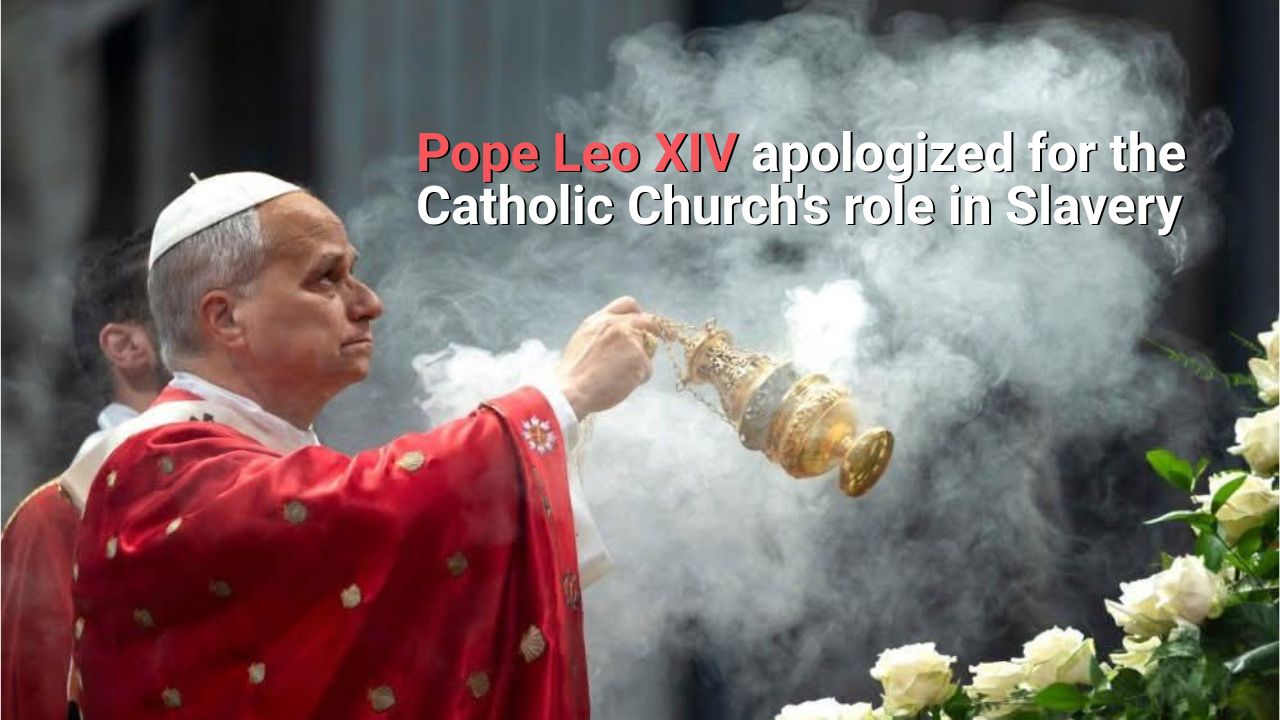
Credit where it is due. On May 25, 2026, Pope Leo XIV became the first pope in history to acknowledge that the Holy See itself, not merely individual Christians, had issued explicit legal and theological authority for the conquest, subjugation, and enslavement of Africans and Indigenous peoples. “For this, in the name of the Church, I sincerely ask for pardon,” Leo wrote in his encyclical Magnifica Humanitas, calling the Vatican’s record “a wound in Christian memory, one from which we cannot consider ourselves detached.”
That is a specific and historically significant admission. Past popes apologized for the involvement of individual Christians. None had named the institutional papacy until now.
But the delivery invites scrutiny. Magnifica Humanitas is a 42,000-word document about artificial intelligence.
But the delivery invites scrutiny. The encyclical’s full title is Magnifica Humanitas of His Holiness Pope Leo XIV, On Safeguarding the Human Person in the Time of Artificial Intelligence. Its primary subject is AI regulation, technological ethics, and the future of humanity. The slavery apology appears in chapter four, inside a section on modern forms of digital trafficking, where Leo connects the Vatican’s 1452 authorization of African labor extraction to today’s unregulated cobalt mining in the Democratic Republic of Congo for AI chips. The framing is intellectually coherent, and the connection to contemporary exploitation is worth making. The question communities are asking is different: why did the most consequential papal reckoning with 574 years of institutional complicity arrive as a subsection of a document about algorithms?
An institution seeking maximum accountability would have led with it. Instead, the apology was positioned where it could be received as forward-looking, a warning about the present rather than a reckoning with a specific historical crime. Leo gets full credit for saying what no pope before him said. The architecture of where he said it is a separate matter, and the record should note both.
Historian Shannen Dee Williams of the University of Dayton called it “a monumental step toward the kind of essential truth-telling and reparation that many Catholics have prayed and worked to witness,” adding that “the Catholic Church has never been an innocent bystander in the history of white supremacy.” Anthea Butler, senior fellow at the Koch History Center at Oxford University, said Leo needed to acknowledge institutional complicity to credibly address contemporary exploitation. “For descendants of enslaved persons, this is once again a much needed apology from the pope,” Butler said.
What the Apology Still Does Not Do
The historical record Leo confronted is not ambiguous. On June 18, 1452, Pope Nicholas V issued Dum Diversas, a formal papal decree carrying the full legal authority of the Catholic Church. In the 15th century, such a decree from Rome was the equivalent of a binding executive order backed by the most powerful institution in the Western world. It authorized King Alfonso V of Portugal to “invade, search out, capture, vanquish, and subdue” non-Christians and to “reduce their persons to perpetual slavery.” Romanus Pontifex, a second decree issued in 1455, extended and codified those permissions. Both were confirmed or renewed by three subsequent popes through 1514. Priests in slave forts along the western African coast forcibly baptized captive Africans before their shipment across the Atlantic. The Church was not a passive witness. It was a co-architect.
The Vatican repudiated the Doctrine of Discovery in March 2023, stating the bulls “did not adequately reflect the equal dignity and rights of Indigenous peoples.” But that statement did not rescind, abrogate, or cancel the bulls themselves. Leo’s encyclical now provides the explicit moral accounting that the 2023 statement avoided. What it still does not do is formally cancel those authorizations. The paper is technically still on file. Historians and Black Catholic advocates say rescission remains an open and necessary question, and communities across Africa and the Caribbean are watching to see whether this moment produces a follow-up document or stands alone.
The man delivering this apology carries its weight personally. Leo XIV has Afro-Creole ancestry on his mother’s side, including both enslaved ancestors and ancestors who themselves enslaved others. The institution that authorized slavery is now led by a man whose own bloodline was shaped by it.
123 to 3: A Vote That Cost Nothing and Still Failed
On March 25, 2026, Ghana’s President John Dramani Mahama addressed the UN General Assembly on behalf of the 54-member African Group. “Today, we come together in solemn solidarity to affirm truth and pursue a route to healing and reparative justice,” Mahama told the chamber. “Let it be documented that when history called upon us, we acted rightly.”
Resolution A/80/L.48, backed by the African Union and CARICOM, declared the transatlantic slave trade the gravest crime against humanity and called for reparatory justice and the return of cultural artifacts. The vote was 123 in favor, 3 against, 52 abstentions, and 15 absent. The resolution was non-binding. No country was being asked to pay anything, create a tribunal, or change a single law. It was a declaration.
The abstentions included the United Kingdom, Germany, France, Canada, Australia, and all 27 EU member states. Among the 15 absent nations were two African countries: Benin and Madagascar. Benin’s absence was particularly striking. The territory of the former Kingdom of Dahomey was one of the most active slave-trading states on the continent for over two centuries. As the Kenyan outlet Eastleigh Voice noted, on a resolution so bound to African historical memory, “even silence can echo loudly.” Neither country offered a public explanation.
Three Dissents, One Failure of Logic
Each dissenting government offered a rationale. Each collapses under examination.
The United States, represented by Deputy Ambassador Dan Negrea, stated Washington “does not recognize a legal right to reparations for historical wrongs that were not illegal under international law at the time they occurred.” The resolution created no legal obligation, no payment mechanism, and no enforcement regime. Washington was not being asked to accept liability. It was being asked to affirm that 400 years of forced African enslavement constituted a crime against humanity.
That position looks worse beside a domestic precedent Washington prefers not to mention. In 1988, the U.S. paid $20,000 and issued a formal apology to Japanese Americans incarcerated during World War II. The same year, Rep. John Conyers introduced H.R. 40, asking Congress to merely study whether the same principle applied to the descendants of enslaved people. The bill has been reintroduced every session since. It has never passed.
Israel’s position was the most self-contradictory. The Israeli Embassy in Ghana said it “cannot accept language that effectively establishes a hierarchy among crimes against humanity,” warning it risked diminishing the Holocaust. From 1952 to 1965, West Germany paid Israel and Jewish survivors hundreds of millions of dollars in reparations. Germany did not argue that acknowledging Jewish suffering created a hierarchy among victims. It accepted guilt and paid. That Israel would use the logic of competing victimhood to block a non-binding resolution, while its own founding was partly funded by the reparations principle it now opposes, is not a legal position. It is a moral contradiction.
As Ghana’s Foreign Minister, Samuel Okudzeto Ablakwa said after the vote, the resolution was not ranking suffering. It was documenting a historical fact.
Argentina, under President Javier Milei, offered no substantive public explanation. Buenos Aires aligned itself with Washington and Jerusalem in what was, in effect, a statement of ideological solidarity against any framework of historical accountability.
A Pattern Governments Have Not Noticed, or Are Choosing to Ignore
Leo’s encyclical did not arrive alone. Eight days earlier, on May 17, 2026, the Church of Scotland issued a formal apology at its General Assembly in Edinburgh, declaring it was “grieved beyond telling” for the suffering inflicted. It acknowledged that Kirk members provided theological justifications for chattel slavery, that early trustees in Jamaica were plantation owners, and that it committed to reparatory next steps by 2027. The Church of England had already pledged up to 1 billion pounds to address what its independent advisory group called the “scale of the moral sin and crime.”
Major Western Christian institutions are moving toward accountability. Western governments are moving in the opposite direction. CARICOM governments welcomed the UN vote and have pressed for the reparatory justice framework to advance. African Union Commission Chairperson Moussa Faki Mahamat issued a statement welcoming the adoption of the resolution and commending Ghana’s leadership. The institutional groundwork for a serious multilateral process is in place. What is missing is the political will of the governments with the most to account for.
Where This Leaves the Diaspora
Leo XIV’s apology carries moral and symbolic weight. It is not accompanied by any formal reparative mechanism. The bulls have not been rescinded. The encyclical frames the Church’s failure as a warning about the present. Warnings are not restitution.
The UN resolution now records the formal position of 123 nations: that the transatlantic slave trade was a foundational crime whose consequences continue to shape the world. Secretary-General Antonio Guterres said the prosperity of numerous Western nations was “founded on stolen lives and stolen labor.” That is the declared consensus of the United Nations, over the objections of Washington, Jerusalem, and Buenos Aires.
For Black Catholics seeking a genuine reckoning, for diaspora Africans in London, Toronto, and New York watching their governments abstain, for communities in Haiti, Jamaica, and across West Africa still living inside the economic consequences of that crime, the question is the same one it has always been. Not whether history will be acknowledged. Whether acknowledgment, in the absence of political will, constitutes justice, or simply marks where justice should have been.
References for the nerds
Papal Apology: Holy See, Magnifica Humanitas, May 25, 2026. vatican.va | AP/PBS NewsHour, May 25, 2026. pbs.org | National Catholic Reporter, May 25, 2026. ncronline.org | America Magazine, May 26, 2026. americamagazine.org
Historical Decrees: Papal Decree Dum Diversas, Nicholas V, June 18, 1452. sourcebooks.fordham.edu | Papal Decree Romanus Pontifex, Nicholas V, Jan. 5, 1455. sourcebooks.fordham.edu | Vatican Statement on Doctrine of Discovery, March 30, 2023. vatican.va
UN Resolution: Resolution A/80/L.48, UN General Assembly, March 25, 2026. undocs.org | UN press release, March 25, 2026. press.un.org | UN News, March 25, 2026. news.un.org | UN Ghana country office, March 25, 2026. ghana.un.org | ISHR statement, March 25, 2026. ishr.ch | EU Explanation of Vote, EEAS, March 25, 2026. eeas.europa.eu | AU Commission statement, March 26, 2026. au.int | Eastleigh Voice (Kenya), March 26, 2026. eastleighvoice.co.ke
Church of Scotland and Church of England: Church of Scotland apology statement, May 17, 2026. churchofscotland.org.uk | Church of Scotland Legacies of Slavery report, May 2026. churchofscotland.org.uk | AP via VOA Africa, Church of England reparations fund, March 4, 2024. voaafrica.com
Reparations Precedents: Civil Liberties Act of 1988, Public Law 100-383. govinfo.gov | Heath, Dreisen. H.R. 40 Congressional testimony, Feb. 17, 2021. hrw.org






LEAVE A COMMENT
You must be logged in to post a comment.