

|
LISTEN TO THIS THE AFRICANA VOICE ARTICLE NOW
Getting your Trinity Audio player ready...
|
For generations of basketball players in Kenya, and across much of Africa, the dream has been clear. Make it to America. Reach college basketball. Reach the pros. Prove that your talent belongs on the biggest stage.
Madina Okot has steadily walked that path with grit and resilience, stamping her place in the basketball world.
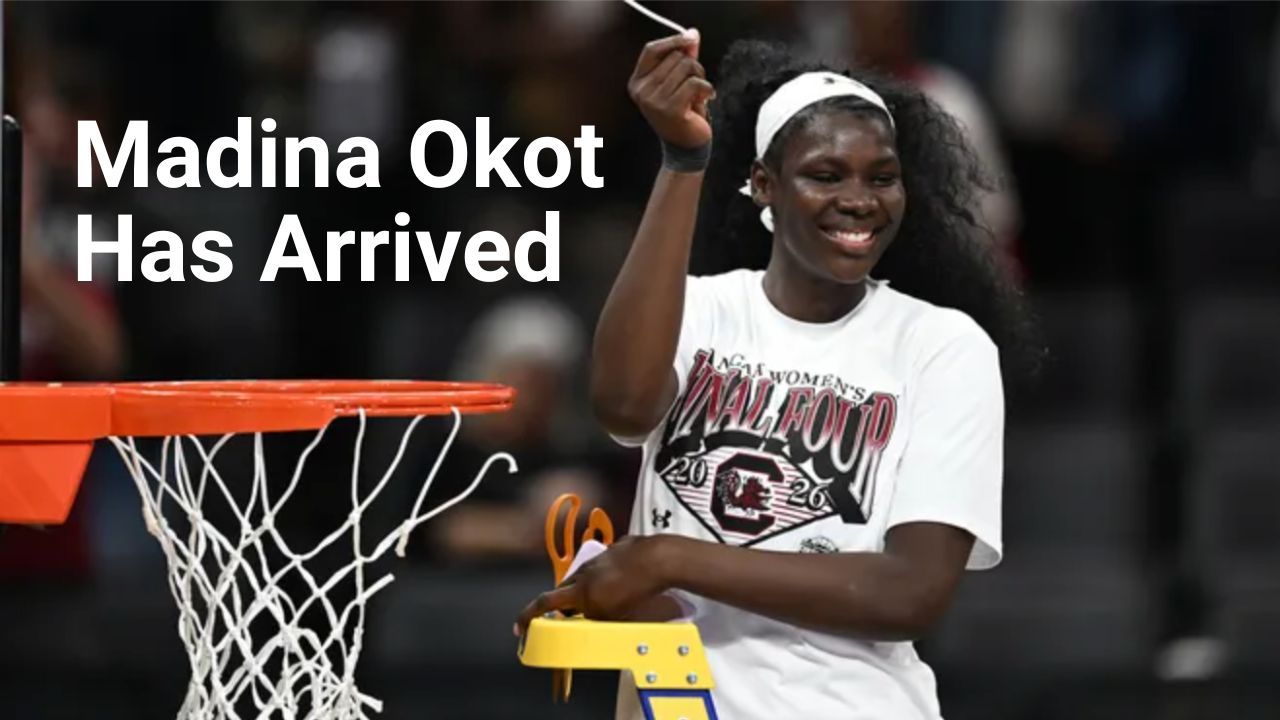
On Sunday, the 6-foot-6 South Carolina center will play for an NCAA national championship after the Gamecocks beat UConn 62- 48 in the Final Four. It is the latest leap in a rise that has carried her from western Kenya to the summit of women’s college basketball.
For Kenya, the moment feels larger than one game. Okot is not simply another player who made it abroad. She is among the most accomplished Kenyan basketball players ever to enter the American college system, and quite possibly the most accomplished to reach this stage.
That is why this title game matters. It is not only about South Carolina. It is about what Okot represents to young players in Kenya, Africa, and beyond. She is proof that the dream can survive delay, bureaucracy, and distance.
She came late to basketball, but rose fast.
Okot’s story does not begin in an elite academy. It begins with late discovery.
South Carolina’s official bio says she picked up basketball at Kaya Tiwi Secondary School in Kenya’s coastal region and has played for Kenya’s national teams since 2022. Before that, she was a volleyball player, not a polished basketball prospect.
Reporting in The Athletic, a New York Times company, adds a striking personal detail. Okot did not even start dribbling until she was 16. She initially had little interest in basketball, but later fell in love with it after getting into the gym and learning the basics.
That late start makes her rise even more remarkable. She is still, in some ways, a new student of the game. Yet she has already become a force in the SEC and a central piece of a national title contender.
The road to America was full of closed doors.
The easy version of this story would say that talent found its way.
The truth is harsher.
Okot’s path to the United States was slowed by repeated visa denials. Reporting from The Athletic says she was denied four times before finally succeeding on her fifth attempt. That process left her discouraged and emotionally drained, and at one stage, she wanted to stop trying altogether.
Those details matter because they reveal the emotional cost behind the breakthrough. Okot was not a player smoothly ushered into the American system. She was a player repeatedly told to wait, then told no, then forced to begin again.
The same reporting adds another layer of sacrifice. Okot, the fifth of eight children, left home in August 2024 and went a long stretch without seeing her parents or siblings, relying instead on calls and messages from Kenya as she adjusted to life in the United States.
That distance sits at the center of her story. Ambition took her abroad. Love stayed behind.
Kenya keeps producing talent, but the path stays hard.
Okot’s rise should inspire celebration. It should also provoke reflection.
Kenya has talent. What it has too often lacked is a reliable system for moving that talent into stable, well-supported pathways. Players emerge. Opportunities flicker. Momentum gets lost in poor structures, weak investment, and administrative disorder.
But the broader truth is difficult to miss. Too many gifted Kenyan players spend years fighting for exposure, paperwork, and support that players in richer systems often take for granted.
That is what gives Okot’s story such force. She did not come through a smooth conveyor belt. She came through resistance.
First Mississippi State, then Dawn Staley
When America finally opened its doors, Okot wasted no time.
At Mississippi State, she played in and started all 34 games, averaging 11.3 points and 9.6 rebounds while leading the SEC in field-goal percentage at 64.9 percent.
Then she moved to South Carolina, where legendary Coach Dawn Staley took her under her wing after spotting early on what so many others now see: a raw, fast-improving post player with size, touch, and major upside. South Carolina announced her addition in April 2025, and the Gamecocks roster lists her as a senior from Mumias, Kenya.
This is where the story turns from persistence to arrival.
In South Carolina, Okot found the kind of program Kenyan players dream about when they imagine America. She found elite coaching, elite expectations, and a legitimate route to the WNBA. She also found a coach in Staley who understands how to develop bigs and how to protect players while demanding more from them.
Reporting in The Athletic described how South Carolina teammates and staff helped Okot through a difficult adjustment period, including homesickness and the challenge of settling into one of the toughest environments in women’s college basketball.
That support matters. Raw talent may get a player noticed. It takes structure to turn that talent into a future.
A title game, and something bigger
Now, Okot stands one win from a national championship.
South Carolina, back in the title game for the fourth time in five seasons, will face UCLA with another banner on the line.
But for Okot, the game carries a meaning that extends beyond a single trophy.
In Kenya, making it to America has long been the benchmark. Getting to the NCAA is success. Reaching the professional ranks is the dream beyond the dream. Okot has already pushed that horizon further. She has shown that a Kenyan player can move from local obscurity to the center of the American game, even after four visa denials, months-long separations from family, and a late start in basketball.
She is not only living her own breakthrough. She is expanding the imagination of what Kenyan basketball can produce.
Madina Okot has arrived.












LEAVE A COMMENT
You must be logged in to post a comment.