

|
LISTEN TO THIS THE AFRICANA VOICE ARTICLE NOW
Getting your Trinity Audio player ready...
|
Pull up the Round of 32 bracket and read it differently.
Not by confederation or seeding, but by heritage.
South Africa faced Canada, a team whose captain was born in a Ghanaian refugee camp to Liberian parents. Morocco faced the Netherlands, a squad that includes 14 players of African descent, the second-most among nations at this tournament, second only to France. Senegal faces Belgium, a team built in significant part from players whose parents came from the Democratic Republic of Congo and Ghana. DR Congo faces England, a squad that includes players born to Nigerian, Angolan, and Congolese parents. Ivory Coast faces Norway, where Antonio Nusa, born in Belgium to Congolese parents, plays.
In every single Round of 32 fixture involving an African nation, the opposing team also carries African heritage in its squad. Not as a background color. As first-choice starters, captain’s armband holders, and match-deciding scorers.
Africa did not merely qualify for the knockout stage in record numbers at this World Cup. Africa populated the tournament.
According to Flashscore, 310 players at the 2026 FIFA World Cup are representing a country other than the one in which they were born, nearly one in four of all 1,248 players across 48 squads. According to Bolavip, 99 of those 1,248 players were born in France. Only 23 of the 99 wear French blue. The remaining 76 carry the flags of nations that France once governed, colonized, or drew its immigrant communities from. Algeria has 13 French-born players, the most of any single non-French nation at this tournament. Morocco has 20 of its 26 players born entirely outside the country.
The pieces of Africa are everywhere at this World Cup. What follows is a continent-wide accounting of where those pieces sit, who chose which flag, and what it tells us about the game’s future.
Three Models, Three Political Choices
Not all nine African nations at this tournament made the same bet. Their squad compositions fall into three distinct models, each representing a different answer to the same question: what does a national football team owe to the nation that produced it?
South Africa chose the most unambiguous answer.
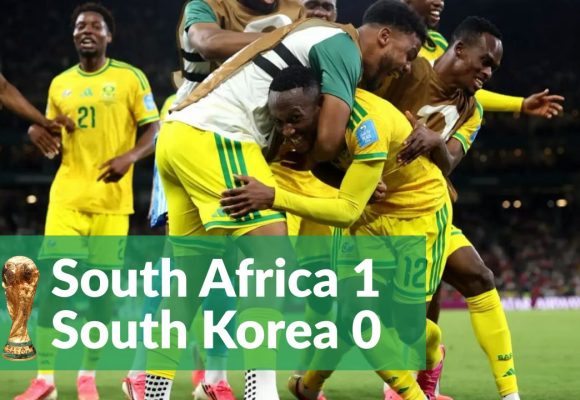
According to Flashscore, all 26 players selected by coach Hugo Broos were born in South Africa, making Bafana Bafana one of only eight squads at the entire 48-team tournament with a fully homegrown roster. According to worldcuppass.com, 19 of those players compete in the domestic Premier Soccer League, with Mamelodi Sundowns and Orlando Pirates each contributing eight players. No recruiting visits to European cities. No FIFA eligibility switches. No diaspora negotiations at the presidential level. South Africa built its squad from what it produced and qualified for the knockout stage for the first time in the country’s World Cup history.
Morocco and Algeria made a different, equally deliberate choice. According to Bolavip, 20 of Morocco’s 26 players were born outside the country, the highest proportion of any African side at this tournament. The squad’s spine, goalkeeper Yassine Bounou, born in Montreal, captain Achraf Hakimi, born in Madrid, and midfielder Sofyan Amrabat, born in the Netherlands, is composed entirely of players developed in European club academies before committing to the Atlas Lions. Morocco’s federation president, Faouzi Lekjaa, personally visited Ayyoub Bouaddi, an 18-year-old born in Senlis, France, who had captained France’s under-21 team as recently as March 2026, to persuade him to switch allegiance to Morocco weeks before the tournament. According to Soccer Magazine, Morocco became the first national team in World Cup history to field an entire XI of foreign-born players simultaneously, doing so through second-half substitutions in their opening 1-1 draw with Brazil.
Algeria’s model runs even deeper into the diaspora. According to Bolavip, 13 of Algeria’s 26 players were born in France, the most France-born players of any single non-French nation at this tournament. The most visible symbol of that pipeline is goalkeeper Luca Zidane, 28 years old, born in Aix-en-Provence, son of Zinedine Zidane, grandson of Algerian immigrants from the Kabylie region. According to BBC Sport, he represented France at youth level up to the under-20s before FIFA approved his switch to Algeria in September 2025. He is one of thirteen.
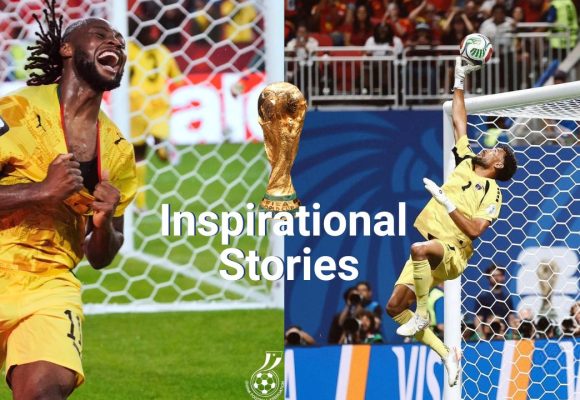
Senegal, Ivory Coast, Ghana, and DR Congo occupy the hybrid ground between those two poles. Senegal retains its African-born majority, with Sadio Mané, Idrissa Gana Gueye, and Ismaila Sarr providing the connective tissue, while drawing on 10 French-born players for European club depth. According to Bolavip, Ivory Coast has nine foreign-born players, eight of them born in France, alongside 17 born on Ivorian soil. Ghana’s Iñaki Williams was born in Bilbao, Spain, to Ghanaian parents who crossed the Sahara on foot as refugees before his birth. He played a senior friendly for Spain in 2016 before switching to Ghana in 2022. According to BBC Sport, Williams explained his decision directly: “Despite being born in Europe, I have my African roots and Ghanaian blood. I didn’t forget Ghana. Ghana is special to me because my family and parents are here, my blood is here.”
Egypt stands closest to South Africa in orientation. The squad is anchored by players from Al-Ahly, Zamalek, and Pyramids, with Mohamed Salah and Omar Marmoush as the European club names at the top. The overall profile is that of an Egyptian football ecosystem producing its own senior players with minimal dependence on the diaspora.
Cape Verde represents the logical extreme of the diaspora model, and arguably its most honest articulation. According to The Guardian, 15 of 26 players were born outside Cape Verde, with six squad members born in Rotterdam, more players than were born in the country’s own capital, Praia. The squad was drawn from 25 clubs across 14 countries. Defender Roberto Lopes, born in Limerick, Ireland, was recruited via a LinkedIn message from the Cape Verdean federation. For a nation of 500,000 people with limited domestic football infrastructure, the diaspora is not a supplement to the national team. It is the national team.
When Africa Plays the World, Africa Is Already There
The Round of 32 matchups make the structural argument visible in a way statistics alone cannot.
South Africa faced Canada at SoFi Stadium in Los Angeles, carrying a squad whose African heritage is foundational rather than incidental. Canada’s captain, Alphonso Davies, was born in the Buduburam refugee camp near Accra, Ghana, to Liberian parents fleeing the Second Liberian Civil War. He moved to Edmonton at age five through Canada’s resettlement program and became the youngest player in Canadian senior team history upon receiving citizenship in 2017. According to the UNHCR, he now serves as a Global Goodwill Ambassador. He was eligible to represent Ghana or Liberia. He chose Canada, the country that resettled his family.
Richie Laryea, Canada’s fullback, was born in Toronto to parents both born in Accra. He grew up speaking Ga alongside English. Tani Oluwaseyi was born in Abuja, Nigeria, and moved to Mississauga at age ten. He told Sportsnet: “It was all my parents. They wanted to give us options. I’m forever grateful for them for doing that because who knows if I’m here without that move.” Ismael Kone was born in Ivory Coast and chose Canada over the Elephants. Jonathan David, born in Brooklyn to Haitian parents and raised in Ottawa, was eligible for France through his developmental pathway in Belgian academies. He chose Canada. “I think this is the country I feel the most attached to,” he told CTV before the tournament. “For me it was really a no-brainer.”
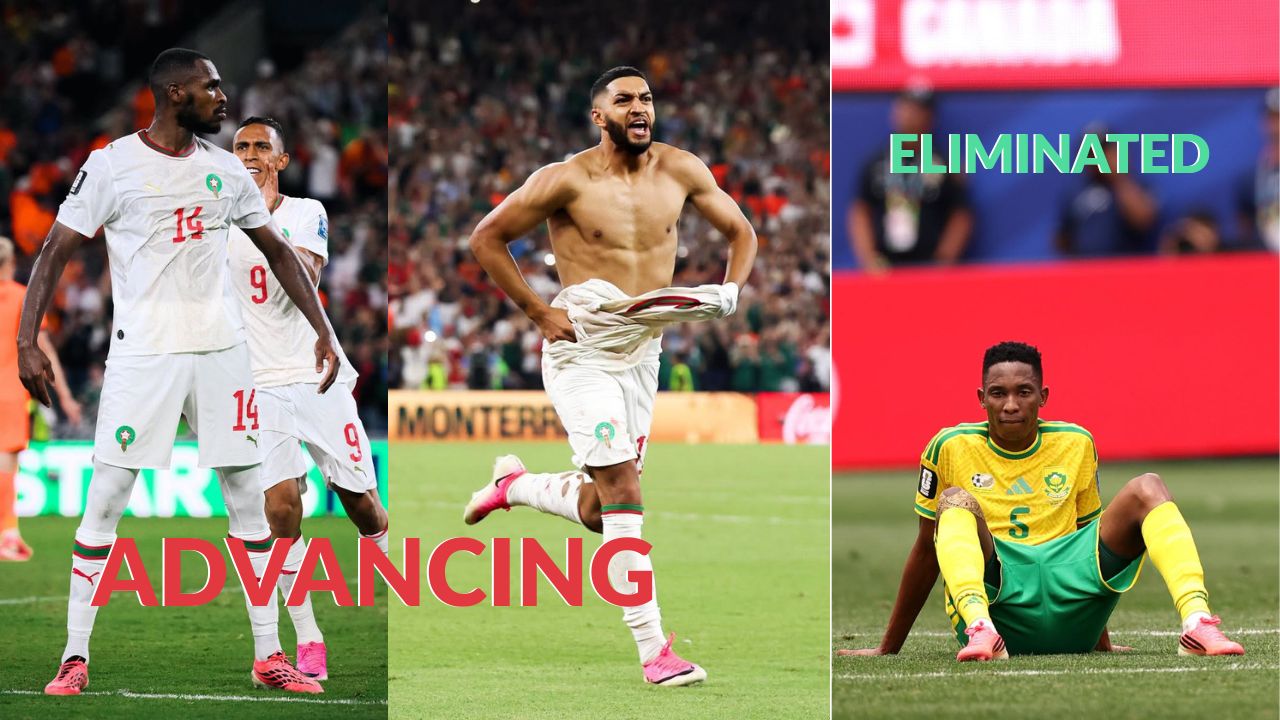
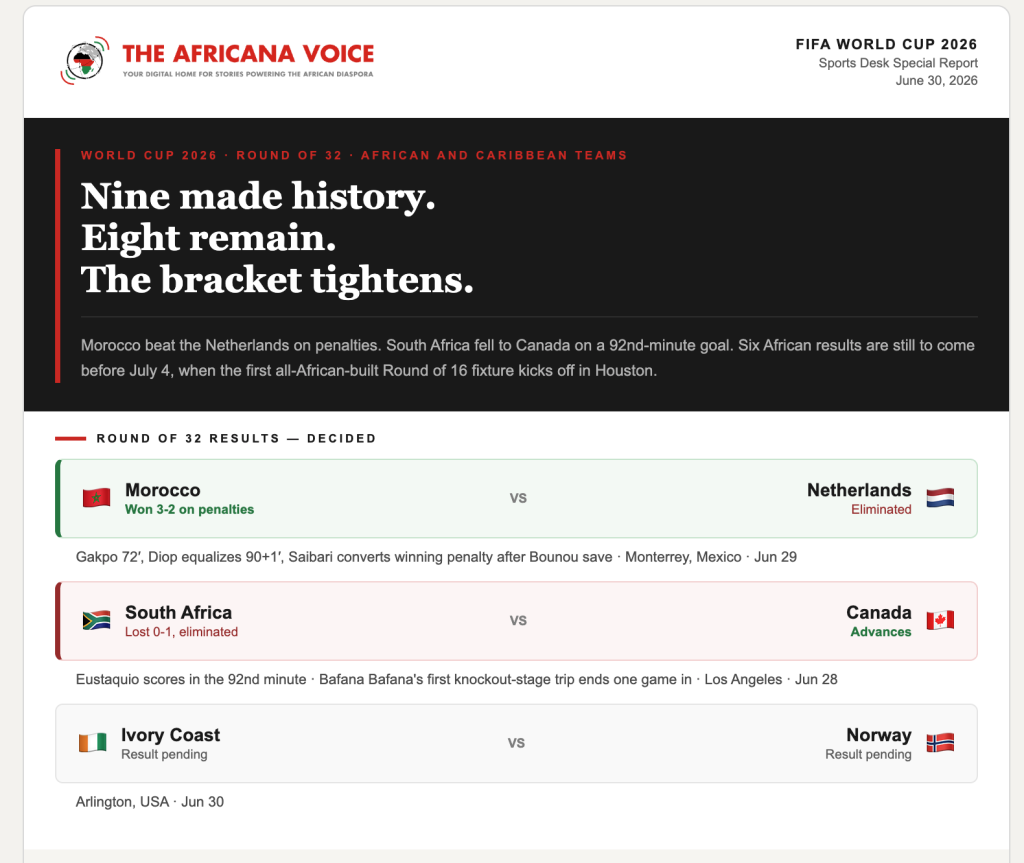
Canada and South Africa played out exactly the kind of match the compositional irony deserved. South Africa controlled long stretches, Bafana Bafana’s homegrown squad pressing a team of immigrants and refugees, and with seconds remaining, it looked destined for extra time. Then Stephen Eustáquio, born in Portugal and raised in Canada, scored from the edge of the box. According to FIFA’s official match report, the goal came in the 92nd minute. The final score was Canada 1, South Africa 0. According to CBC, Alphonso Davies, born in a Ghanaian refugee camp to Liberian parents, made his first appearance of the tournament as a substitute in the 75th minute, having missed the entire group stage with a hamstring injury. He arrived at the moment of his country’s greatest World Cup result, carrying the biographical coordinates of two African nations.
South Africa went home. Canada, a team Africa largely built, advances. The irony does not diminish Bafana Bafana’s achievement. A fully homegrown squad, built without diaspora recruitment, without eligibility switches, without presidential-level federation lobbying in European cities, reached the World Cup knockout stage for the first time in the country’s history and was eliminated by a goal scored in the second minute of stoppage time. That margin is not a verdict on the model. It is a reminder of how fine the line is.
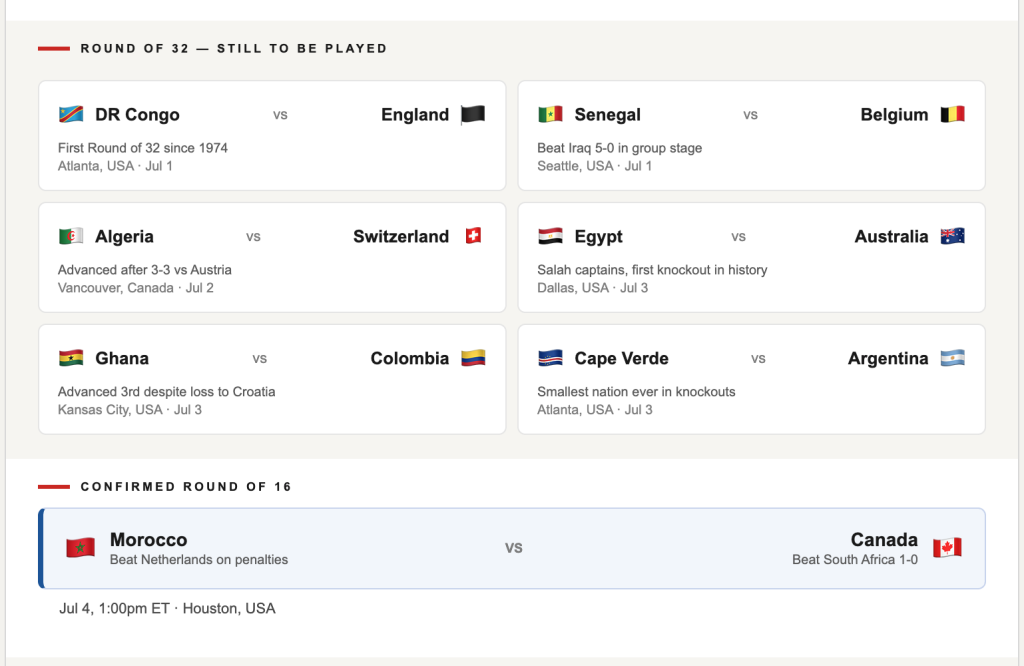
Belgium faces Senegal with surnames that echo the Congo. Romelu Lukaku’s parents came from DR Congo. Jérémy Doku’s heritage traces back to Ghana. Loïs Openda carries Moroccan and Congolese heritage. Meanwhile, Senegal’s squad includes 10 players born in France, the product of a footballing pipeline built through the same colonial relationship that shaped Belgium’s historical connection to Central Africa. The Belgium-Senegal fixture contains three simultaneous colonial echoes: Belgian Congo heritage in the Belgian squad, French colonial development in the Senegalese squad, and a match between a former colonial power and a former French colony.
England faces DR Congo with Bukayo Saka, born in London to Nigerian parents, in midfield alongside Kobbie Mainoo, whose heritage traces to Ghana, and Marc Guéhi, who was born in Abidjan. DR Congo’s squad includes Aaron Wan-Bissaka, born in Croydon, who represented England at under-21 level before switching allegiance to the Leopards in August 2025. He spent four years at Manchester United. The DR Congo-England match features players who share Premier League histories, club networks, and in some cases family geography, wearing opposite colors.
Morocco faced the Netherlands carrying three of its own Dutch-born players: Sofyan Amrabat, born in Haaksbergen; Noussair Mazraoui, born in Leiderdorp; and Anass Salahdin, born in Amsterdam. According to Reuters, the tie carried a societal subtext linked to the large Moroccan diaspora in the Netherlands, a community whose sons were competing against their country of birth.
The match itself became one of the tournament’s defining knockout-stage moments. Cody Gakpo gave the Netherlands the lead in the 72nd minute. Morocco appeared headed for elimination until defender Issa Diop rose to head in an equalizer in the first minute of stoppage time, sending the match to extra time. Neither side found a winner across two additional periods, and the tie went to penalties. Dutch goalkeeper Bart Verbruggen kept his side in the contest with a string of saves, but misses from Justin Kluivert and Quinten Timber proved decisive. Morocco goalkeeper Yassine Bounou saved a spot kick from Crysencio Summerville, and Ismael Saibari converted the winning penalty, sending Morocco through 3-2 on penalties and into a Round of 16 meeting with co-host Canada in Houston on July 4.
The result deepened rather than resolved the match’s underlying irony. The Netherlands squad that Morocco eliminated is itself one of the most African-rooted at this tournament. By birthplace alone, only one of the Netherlands’ 26 players was born outside the country: PSV midfielder Guus Til, born in Zambia, where his father was working at the time, who also spent part of his childhood in Mozambique before the family relocated to the Netherlands when he was three. But heritage tells a fuller story than birthplace. A review of player backgrounds places the Netherlands second only to France among nations at this World Cup in total players of African descent, with 14 on Ronald Koeman’s 26-man roster.
The names carry the history. Forward Brian Brobbey was born in Amsterdam to Ghanaian parents and developed through the Ajax academy; his brother, Derrick Luckassen, played for Ghana’s national team at this same tournament, the two brothers representing opposite sides of the same diaspora story at the same World Cup. Defender Denzel Dumfries was born in Rotterdam to an Aruban father and a Surinamese mother. Defender Nathan Aké’s father is from the Ivory Coast. The Dutch national team has drawn significant talent from its former colonial holdings in the Caribbean and South America for generations, a pattern visible across decades of Oranje squads from Clarence Seedorf and Jimmy Floyd Hasselbaink, both born in Paramaribo, Suriname, through to the 2026 squad that Morocco defeated on penalties.
Morocco eliminated a team built substantially by the same diasporic forces that built Morocco’s own squad. Three Dutch-born players wore Moroccan red. Fourteen players of African descent wore Dutch orange. The match distilled the piece’s central argument into 120 minutes and a penalty shootout: there was no version of this fixture in which Africa was not present on both sides of the pitch.
The French Pipeline
The French dimension is not a background. It is the structural argument.
Of 99 players born in France at this tournament, 76 are representing nations other than France. According to Africa Soccer, 43 of those 76 play for five nations that were French colonies or protectorates until 1956 to 1962: Algeria, Morocco, Ivory Coast, Senegal, and Tunisia. The Seine-Saint-Denis département in greater Paris produced players competing at this World Cup for at least four different national teams. Senegal’s Pape Gueye and Algeria’s Rayan Aït-Nouri were both born in Parisian suburbs within miles of each other, representing different flags at the same tournament.
The pipeline has a precise historical origin. Algeria’s legendary 1982 World Cup squad, the one that produced the greatest upset in tournament history by defeating West Germany 2-1 before being eliminated by the Disgrace of Gijón, was composed entirely of players born and raised in Algeria. Forty-four years later, 13 of 26 Algerian players were born in France. That shift did not happen by accident, nor without African agency.
Before 2003, FIFA’s eligibility rules fixed players to the first national team at any level they represented in official competition. European federations routinely recruited African-heritage children into their youth academies, capped them in youth internationals, and thereby foreclosed their options to represent their parents’ or grandparents’ nations at the senior level. African-heritage players raised in France, developed by French clubs, and selected for French youth teams had no legal route to represent Algeria, Senegal, or Morocco at the senior level.
Mohamed Raouraoua, then president of the Algerian Football Federation, went to FIFA in 2003 and changed that. According to Sports Illustrated, Raouraoua explained his motivation plainly: “We didn’t think it was fair that players of African origin were being selected for junior teams of European countries and then never getting a chance to play at full international level. Our proposal was to give liberty and freedom to these players to have the right to choose.” The 2003 reform allowed dual-national players to switch associations provided they had not appeared in a senior competitive match. Algeria returned to FIFA in 2009 and removed the age limit entirely. In 2020, FIFA extended the change further, allowing players with up to three caps before age 21 to switch allegiance. Each reform unlocked another wave of African-heritage players who had been previously trapped in European youth systems.
The man who built the regulatory architecture that made Luca Zidane’s path to Algeria’s squad possible was an Algerian federation official. African institutional agency wrote the rules the world now plays under. That is a different story from the talent drain narrative, and both deserve to be told in full.
The drain argument still has force, but it operates at a different level. According to scholars Paul Darby, Gerard Akindes, and Matthew Kirwin, writing in the Journal of Sport and Social Issues, football academies in Africa function primarily as talent-export mechanisms. West Africa remains the primary source of migrating African players to European leagues. When an African-born player is recruited by a European academy at age 12 to 14, before the senior eligibility clock starts, the African federation that produced the environment in which that player grew up receives no solidarity payment tied to his eventual career. Solidarity payment mechanisms under FIFA regulations apply to club-to-club transfers. They do not apply to the originating national football federation.
Jonathan David moved from Ottawa’s youth system through Belgian academies to Lille, then to Juventus in a transfer worth approximately €30 million. Tani Oluwaseyi moved from Nigerian grassroots football to Canadian immigration, then to Villarreal in a deal reportedly worth over $8.5 million. Neither the Nigeria Football Federation nor the Haitian Football Federation developed these players for senior international purposes. The financial architecture offers them no compensation for the environments that made those players possible.
Argentina and the Exception That Proves the Argument
Argentina’s squad demands specific attention because of the contrast it creates at this tournament.
Multiple squad profiles confirm that Argentina’s 26-man roster reflects the country’s demographic reality: a population shaped by the largest European immigration wave in the Americas between 1880 and 1930, primarily Italian and Spanish. The squad surnames, Martínez, Romero, Otamendi, Molina, Tagliafico, Mac Allister, De Paul, Fernández, Messi, Álvarez, map entirely onto that history. Afro-Argentines constitute between 0.37% and 1% of the general population, a figure that reflects the near-total erasure of the Afro-Argentine population through wars, disease, and social exclusion across the 19th century. No player of African or non-European descent has been identified in Argentina’s 2026 squad across multiple sources, though heritage is not always publicly documented and this characterization has not been confirmed by an institutional source.
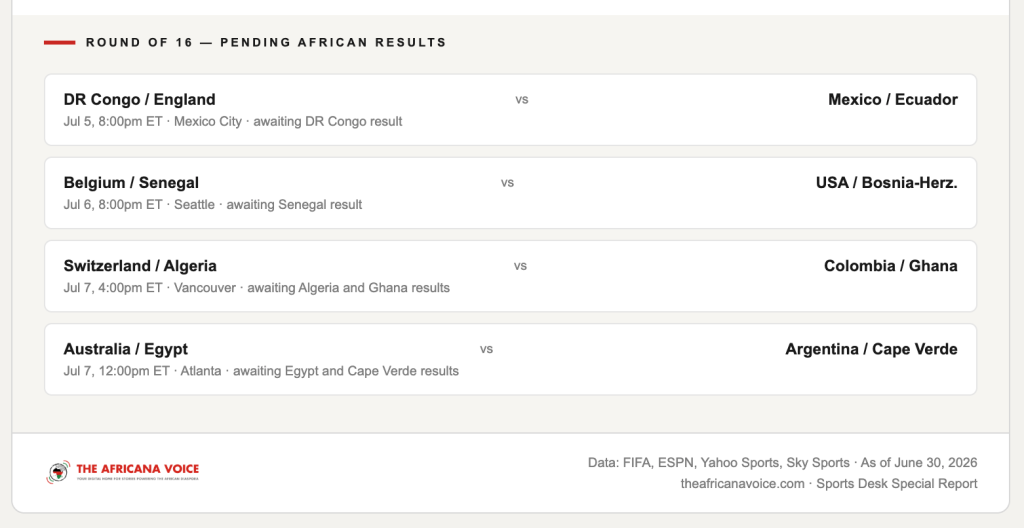
Cape Verde vs Argentina is therefore the tournament’s starkest compositional contrast. On one side: six players born in Rotterdam, a goalkeeper recruited through the Inter Miami academy in the United States, a defender from Limerick recruited via LinkedIn, a squad drawn from 25 clubs in 14 countries, representing a nation of 500,000. On the other side: a squad drawn almost entirely from the Southern European immigration wave of a century ago, fielded by the defending world champions.
Africa at its most dispersed, facing South America at its most concentrated. Both paths produced teams at this World Cup. Only one of them built nine nations into the knockout stage simultaneously.
What Comes Next
Nine of ten African nations qualified for the Round of 32. According to Fox Sports, before 2026, only six African countries had ever qualified for the knockout stage in World Cup history, with 11 appearances by African teams at that stage. At this single tournament, nine qualified simultaneously. Four of those nine, South Africa, Ivory Coast, DR Congo, and Cape Verde, reached the knockout stage for the first time in their histories.
DR Congo forward Yoane Wissa, who scored three goals in the group stage, including the decisive strikes in the Leopards’ comeback win over Uzbekistan, placed the moment in its proper frame. According to ESPN, Wissa said, “Now every African team can dream big. The last World Cup, Morocco has been to the semifinal. Now I think it’s eight teams. What’s coming next is good for the African teams, and we can see that now the youngest players come earlier.”
What comes next depends in part on which model African football chooses to build on. South Africa’s argument that a fully homegrown squad built from domestic players can qualify for a World Cup knockout stage for the first time in the country’s history was made and validated before a 92nd-minute goal ended the journey. Morocco’s argument that diaspora recruitment executed with federation discipline and presidential-level commitment can take an African team to a World Cup semifinal and build from there is equally valid and equally African.
South Africa’s elimination, 1-0 to a stoppage-time goal in a match they deserved more from, does not diminish what the continent produced. It sharpens the argument. A homegrown squad fell to a team of African immigrants. The jersey changed. The talent, the heritage, the story, all of it remained African.
The pieces of Africa were everywhere at this tournament. The question the continent’s federations, academies, scholars, and players will spend the next four years debating is not which model is more African.
Which model is more sustainable, more equitable, and more likely to produce the first African World Cup winner?



LEAVE A COMMENT
You must be logged in to post a comment.