


|
LISTEN TO THIS THE AFRICANA VOICE ARTICLE NOW
Getting your Trinity Audio player ready...
|
South Africa lost its opening 2026 FIFA World Cup match against co-host Mexico 2-0 on June 11, with two players sent off, leaving Bafana Bafana to finish the game with nine men. The result, and the circumstances around it, became immediate fodder for a wave of mockery directed at South Africa from across the African continent; mockery that was about far more than football.
Within hours, the South African government issued two statements. One addressed the match. The other addressed a deepening Afrophobia crisis that has been building for weeks, and that carries its own deadline: June 30, the date set by the anti-immigration movements Operation Dudula and March and March for foreign nationals to leave South Africa.
Together, the two statements offer the clearest picture yet of how Pretoria is managing, or attempting to manage, one of the most damaging episodes in the country’s post-apartheid continental relations, with that deadline now nineteen days away.
The Match and the Social Media Reaction
The fixture at the Estadio Azteca was a rematch of the 2010 World Cup opener, a fact loaded with symbolism. In 2010, South Africa hosted the tournament on home soil, and the continent rallied behind Bafana Bafana as its own team.
On June 11, 2026, the reaction across much of Africa was the opposite. Large numbers of users across Nigerian, Ghanaian, Kenyan, Zimbabwean, and Mozambican social media platforms publicly declared support for Mexico. The sentiment was directly linked to ongoing Afrophobic violence in South Africa that had, in recent weeks, resulted in the repatriation of nationals from several African countries. As TAV reported separately, comments on Bafana Bafana’s own Facebook page repeatedly invoked the June 30 deadline directly at South African users, turning a football thread into a flashpoint for the wider crisis.
The scale of the reaction, coordinated by no single party but unified in its message, suggests South Africa’s standing among its continental neighbors has taken a significant hit.
Statement One: On Bafana Bafana
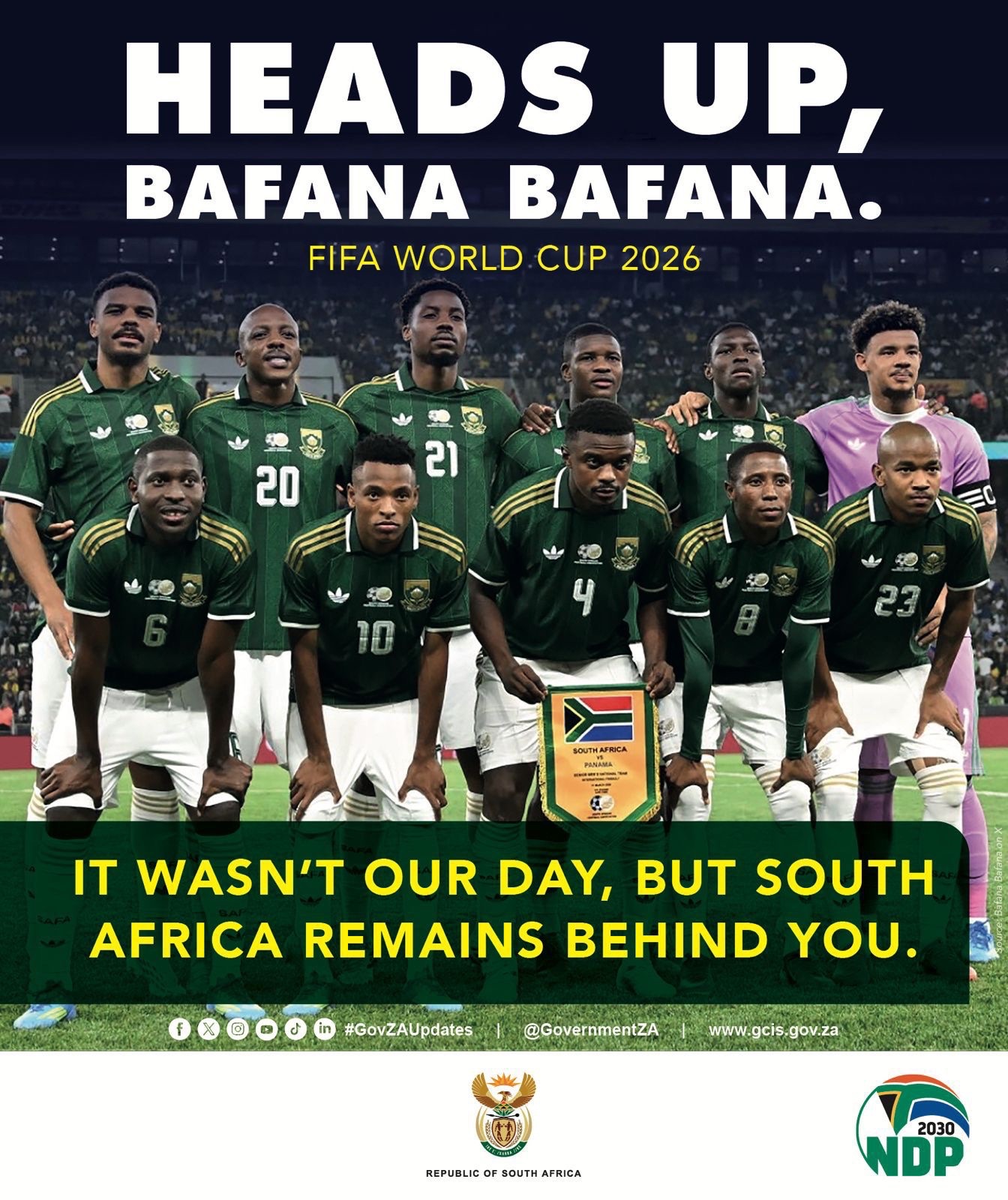
The Government Communication and Information System released its first statement on the afternoon of June 11. It was brief.
“Government commends Bafana Bafana for their spirited performance in their opening match against Mexico in the FIFA World Cup,” the statement read. “While the final score was not what the nation had hoped for, the team represented South Africa with unity, determination, and a sense of pride on the world’s biggest stage.”
The statement made no reference to the red cards or the manner of the defeat. It encouraged South Africans to “rally behind our boys,” wear green and gold on “Bafana Fridays,” and urged the team to “remain focused and confident” ahead of the remaining group stage matches.
It closed: “ALL OF US. ALL IN. KAOFELA.”
The statement was issued under the name of Acting Government Spokesperson Nomonde Mnukwa.
Statement Two: On Immigration
The second statement, considerably longer and issued the same day, addressed the Afrophobia crisis directly. It was framed as South Africa’s response to Ghana’s formal petition to the African Union requesting a continental debate on what Accra described as Afrophobic attacks against African nationals in South Africa.
The government anchored its position in remarks President Cyril Ramaphosa made on Freedom Day, April 27, 2026, which it presented as the clearest expression of its official stance.
“We did not walk alone into freedom,” Ramaphosa said. “We were carried by a tide of solidarity from the nations of Africa, among many others. These countries opened their borders to our liberation fighters. They shared their bread and their homes. They spoke for us when we could not speak for ourselves. The leaders and people of Africa kept our struggle alive. It cannot be, and it must never be, that we trample into the dust the African fellowship that made our freedom possible. We are a people who live the value of ubuntu. We should never allow the legitimate concerns of our communities about illegal migration to breed prejudice towards our fellow Africans.”

The government detailed Foreign Minister Ronald Lamola’s direct engagements with his counterparts in Ghana and Nigeria following the outbreak of violence. Lamola, according to the statement, “reaffirmed South Africa’s commitment to protect the rights of nationals, residents and visitors in line with the rule of law, and to strengthen bilateral cooperation.”
On whether Ghanaian or Nigerian nationals were killed during the unrest, the government was direct. “There is no credible evidence to draw this conclusion at this stage,” the statement read, attributing conflicting claims to “manipulated footages and divisive narratives including fake videos that have been circulating on various social media platforms.”
Rather than public diplomatic escalation, Lamola invited his counterparts to work through the Bi-National Commissions that operate at presidential level between South Africa and both Ghana and Nigeria. The government said it “has called for the upholding of diplomatic decorum, mutual respect, transparency, and fraternity” in all its engagements, and that it “welcomes the initiative of countries that have directly reached out to seek clarity.”
South Africa’s Migration Record
The statement made a case for South Africa as a responsible host nation. The country is home to approximately three million migrants, the government said, 90 percent from the African continent, making it “the largest host of African immigrants in the world.” It noted that South Africa has ratified the 2005 SADC Protocol on the Facilitation of Movement of Persons, one of only seven of the sixteen SADC member states to have done so.
Pretoria acknowledged directly that “South Africa’s history of migration and its diverse foreign-born population have intersected with economic anxieties around unemployment and service delivery, contributing to periodic tensions between some locals and foreign nationals most of whom lack a legal immigration status.”
On enforcement, the government said the Border Management Authority has deported 500,000 people since April 2023, and that six major land ports of entry are being rebuilt through a public-private partnership. It also outlined a forthcoming White Paper on Migration intended to “align with international best practices,” including a points-based visa system, an Intelligent Population Register, adoption of the “First Safe Country” principle for asylum seekers, and bilateral migration agreements with regional partners.
Pretoria drew a pointed comparison of its own. “Some of the proposed measures are similar to some of the legislative measures recently adopted by Ghana,” the statement said, citing Ghana’s GIPC Act, which reserves certain economic sectors for Ghanaian citizens, as a parallel to South Africa’s proposed economic protection measures. The comparison appeared designed to pre-empt criticism from Accra specifically.
The AU Petition: South Africa’s Counter-Move
On Ghana’s decision to escalate the matter to the African Union, the government did not mince words. “South Africa finds Ghana’s decision to escalate concerns about irregular migration to the African Union regrettable,” the statement said.
It did not stop at registering displeasure. South Africa announced a counter-strategy. “Should the AU deem it appropriate to place the matter on the Agenda, South Africa will also propose an agenda item on the push and pull factors of migration, including good governance, rule of law, and democracy, in accordance with the Constitutive Act of the AU,” the statement read.
It closed with a direct quote from Lamola. “South Africa will continue to lead with a Pan-African heart,” he said. “Our commitment is to solidarity, the rule of law, and the safety of all who reside within our borders. Migration must be managed through cooperation, compassion and continental responsibility.”
The Context the Statements Did Not Address
The government’s statements were issued against a backdrop of documented events that several of South Africa’s neighbors consider inadequately addressed, and that the June 30 deadline has made urgent.
Mozambique has confirmed the deaths of five of its citizens as a direct result of the attacks. More than 700 Mozambican nationals were repatriated from the Western Cape. Nigeria flew out an initial group of 260 citizens, with more flights planned. Ghana repatriated approximately 300 nationals on a chartered flight on May 27, with up to 800 expected to return in total. More than 3,000 Malawians, including children, were gathered in a makeshift camp on an open field in Durban as of June 10, the day before the World Cup match, awaiting evacuation.
Human Rights Watch, in a report published May 20, documented attacks by groups affiliated with the March and March movement on foreign-owned businesses and on individual migrants, and called on South African authorities to “intensify efforts to address anti-immigrant sentiments and violence.”
Ghana’s AU petition is scheduled for consideration at the Eighth Mid-Year Coordination Meeting of the African Union, set for June 24-27 in El Alamein, Egypt, just days before the Operation Dudula deadline takes effect. South Africa has indicated it will attend and contest the framing of the debate.
The El Alamein summit will test whether the AU acts on Ghana’s petition and whether South Africa’s counter-proposal gains traction, all before the June 30 deadline arrives. The outcome will determine whether the Afrophobia crisis remains a bilateral dispute between Pretoria and Accra or becomes a formal continental matter with a deadline already in motion.
Presidential spokesperson Vincent Magwenya, in public statements preceding the government’s formal releases, described the anti-immigrant incidents as “pockets of protest, which is permissible within our constitutional framework,” language that several African governments and civil society groups have publicly disputed.
With nineteen days remaining before the deadline, those “pockets of protest” have set for themselves, and the gap between that description and the situation on the ground is the story the AU summit will have to confront.








LEAVE A COMMENT
You must be logged in to post a comment.