

|
LISTEN TO THIS THE AFRICANA VOICE ARTICLE NOW
Getting your Trinity Audio player ready...
|
Her farm in Kiambu is what many of her peers would call a farmer’s paradise.
There, Gertrude Ngugi rears cows, sheep and chicken. She grows vegetables, raises earthworms and experiments with black soldier fly larvae as a protein source for her chicken.
Cow manure feeds the worms. Fruit and vegetable waste feeds the larvae. She sells some of the worms and uses the manure they produce on the farm. She is also working on a vertical gardening and hydroponics project.
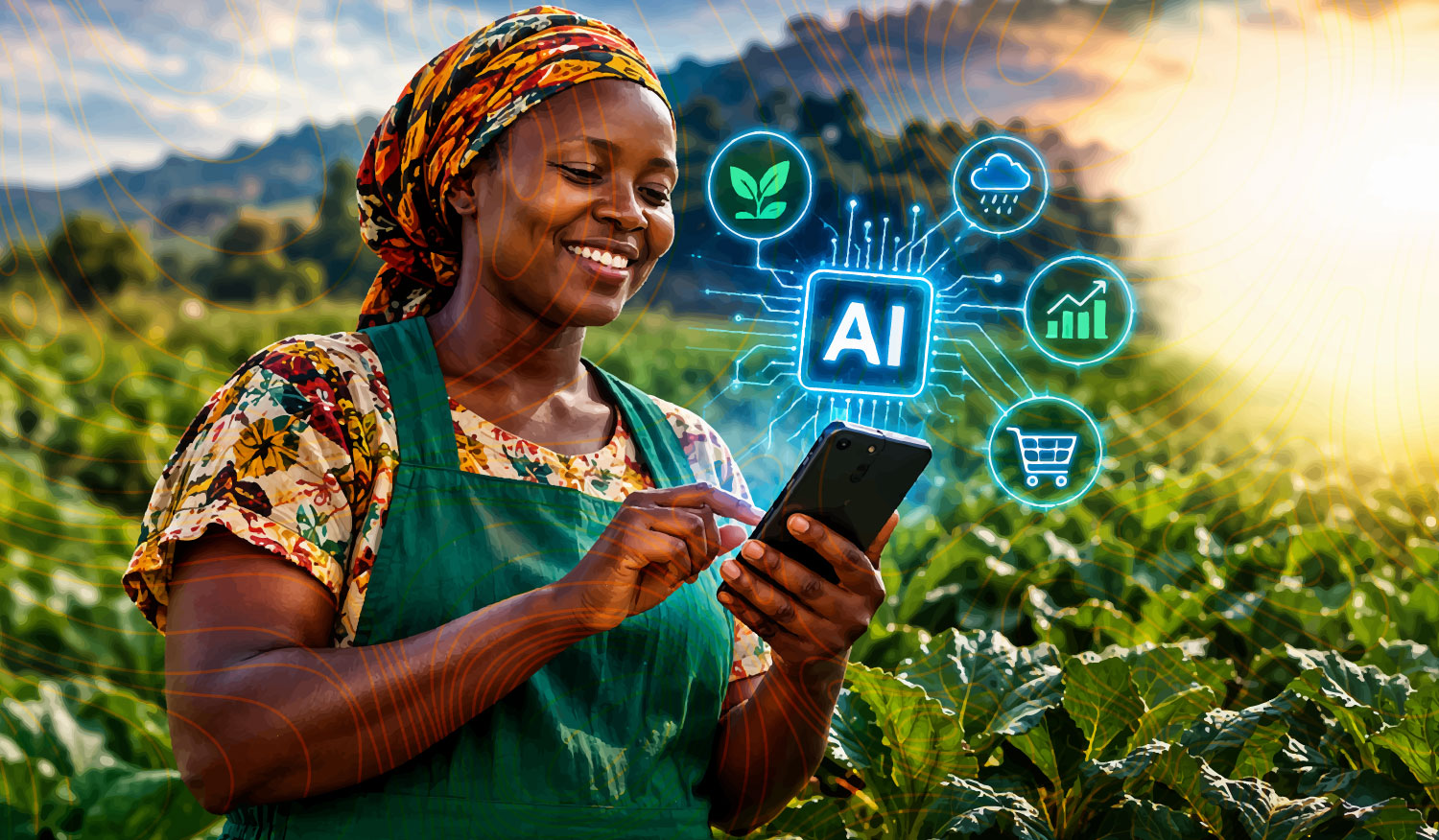
Increasingly, Ngugi is turning to artificial intelligence to answer some of the questions that come with running the farm. What is wrong with a crop? How much organic material should she use for the black soldier fly larvae? Which nutrients does a plant need? The answers, she says, are available on her phone.
One of the first agricultural problems where she saw AI as useful involved maize. Some crop symptoms, she says, can be difficult to identify by sight.
Plantix, an app that uses image recognition to identify crop diseases, pests and nutrient deficiencies, helped her make sense of what she was seeing. She took a picture of an affected leaf and uploaded it to the app, which returned a diagnosis and information on possible treatment.
Ngugi uses AI to work out how much organic material her black soldier larvae need and how to maximise returns. She also uses AI to find information on feeding her earthworms.
“Some organic materials, including onions and citrus, can kill them,” she explains.
“Sometimes, you don’t have to call a vet or an agronomist to your farm. You just use AI,” she adds.
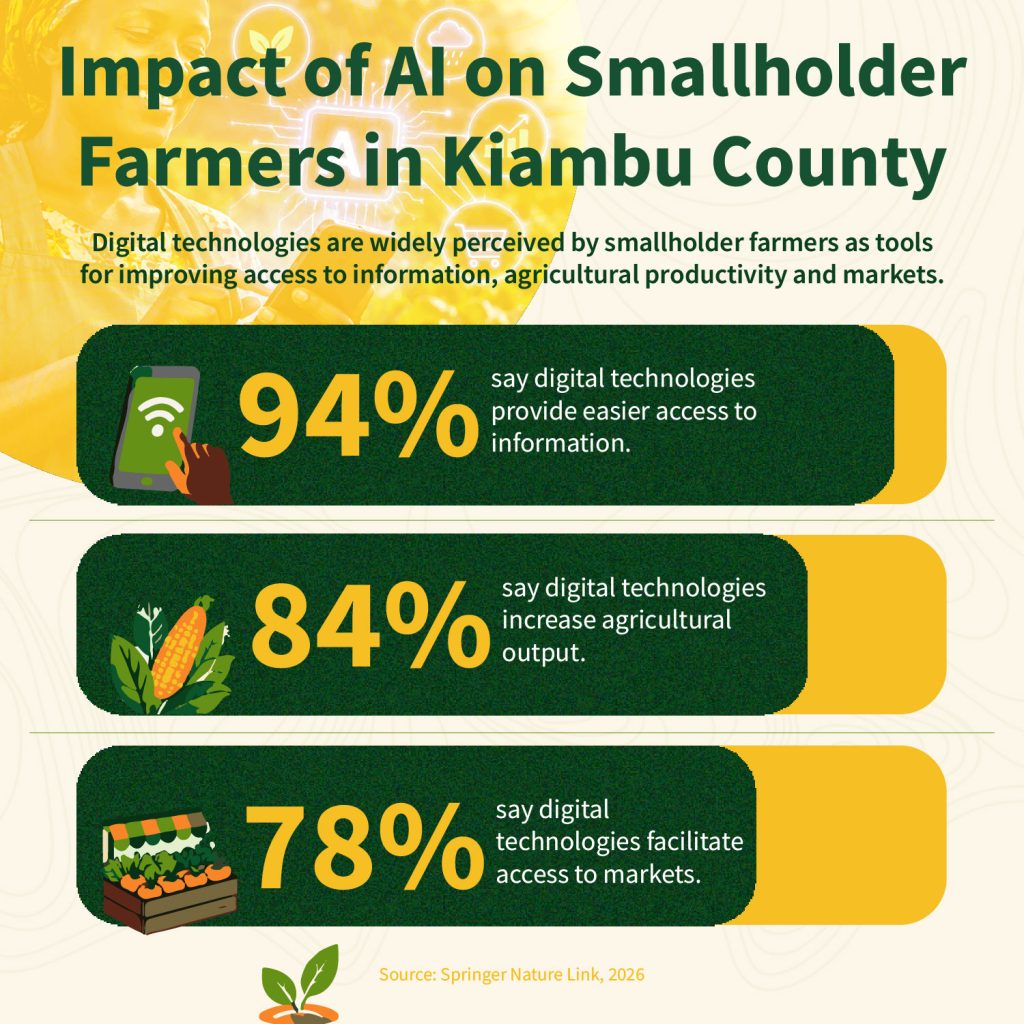
A 2026 study of smallholder farmers in Kiambu County, most of them women, found that 62% were aware of artificial intelligence, but marital status, land size and education level influenced the adoption of AI and other digital technologies.
Diana Kerubo, another farmer using AI, manages a farm with 80 head of cattle and about 3,000 birds. Until recently, she relied largely on phone calls, handwritten records and years of experience. Now, she often turns to artificial intelligence.
Most days, she moves between the poultry houses, checks feed records, monitors animal health and makes dozens of decisions that keep the farm running.
When milk production drops unexpectedly, Kerubo feeds data on her herd’s feeding schedules, weather records and herd health into Large Language Models (LLMs) like ChatGPT to help her troubleshoot.
When poultry deaths rise, she uses the tools to work through possible causes before calling a veterinarian.
“It helps me first to understand what could be happening,” she says. “Then I know what I need to check.”
“Sometimes you don’t have to wait for someone to come and tell you what you already need to know. You can just ask,” she says of her use of AI.
With thousands of birds and dozens of cattle, small changes can become costly.
“If you are not careful, you can lose a lot before you even realise there is a problem,” she says.
For Kerubo, who manages a large farming operation, access to information is particularly useful.
“People expect you to know everything because you are the one in charge,” Kerubo says. “But you cannot know everything. Agriculture keeps changing. So you also have to keep learning.”
Still, she does not treat an AI-generated recommendation as a final answer.
A feeding programme may not account for the feed available locally. A disease diagnosis may still require laboratory confirmation.
“AI can tell you what might be wrong,” she says. “But you still have to go to the farm and see.”
Sometimes, the answer on the phone and what is happening on the farm are not the same.
“Sometimes the computer will tell you one thing, and when you go there, you see something else,” she says. “So you have to use both.”
Kerubo, who has used both Plantix and PlantVillage+, says the apps help her determine whether a plant is healthy from a photograph.
However, both are limited when it comes to indigenous leafy vegetables like the African nightshade (managu), amaranth (terere), and jute mallow (mrenda), all of which she grows on a large scale for local sale.
“When I upload beans, tomatoes, and maize, the results are very reliable. The app spots the symptoms, gives me a diagnosis, and recommends products or solutions. It also lists the characteristics of a healthy plant.”
The apps also allow users to save information on pests, diseases or pesticides. That takes the pressure off having to remember when she applied agricultural chemicals. Plantix also connects users to an online community where they can share tips and ask questions.
When AI Gets it Wrong
Samson Mwangi, an agronomist specialising in crop protection, says one of the advantages of these tools is speed. If there is a disease or pest outbreak, information can be updated and distributed through an app faster than through printed pamphlets and brochures. However, inaccurate AI advice could lead farmers to make inappropriate decisions.
Mwangi recalls a farmer who tried to diagnose a problem with his crops.
“He used an app and found an answer that pointed him towards a different disease from the one he actually had. The farmer began buying products based on the information he found.”
Fred Agutu, a livestock specialist working with the Kenya Agricultural and Livestock Research Organisation (KALRO), cautions farmers not to treat AI-generated advice as automatically reliable. AI tools draw on information that may be incomplete, and agricultural conditions can change from one situation to another. Advice that works in one case may not necessarily apply to another.
Agutu also raises a question of accountability. When advice comes from a professional, he says, a farmer knows who gave it and can seek clarification or correction if something goes wrong. With an AI tool, responsibility can be less clear.
For Agutu, that does not mean AI has no place in agriculture. Its value, he says, lies in giving farmers a wider range of information to consider. But that information still needs to be assessed against the farmer’s actual situation.
Mwangi adds that AI cannot replace the person who understands what is happening on the ground. A digital tool may tell a farmer how much maize to expect from an acre, he says, but that calculation may not account for depleted soil or other conditions on the farm.
“Factors are never constant,” Mwangi says. “And the problem is not only accuracy. It is also geography.”
“Many agricultural AI tools are developed in Europe and the US and may have limited information about tropical diseases, tropical soils and climatic conditions in Africa. A tool may therefore suggest a solution that is appropriate somewhere else but unavailable or unsuitable for a Kenyan farmer.”
His recommendation is not to keep farmers away from AI, but to make the technology more local.
Whose Needs Does AI Serve?
The issue of relevance extends to gender.
A 2025 study by the Accelerating Impacts of CGIAR Climate Research for Africa (AICCRA) project tested AI-generated agricultural advice with 120 farmers in Kiambu, Kakamega, Meru and Nakuru, including women and youth.
The farmers rated the advice relatively well for clarity, scoring it 1.58 out of two. But they raised concerns about its cultural fit and gender inclusivity, particularly the lack of localised examples and culturally sensitive references.
Many were also sceptical about the credibility of AI-generated advice and said they trusted extension officers and local radio more.
A separate study of smallholder farmers in Kiambu County found that while the farmers – mostly women – viewed digital technologies positively, 21% strongly disagreed that AI and digital technologies consider the challenges that women farmers experience. The researchers called for measures to promote AI adoption without widening existing gender, economic and technological gaps in agriculture.
Access is another challenge.
In Nakuru, Michael Wachira, an agronomist, works with a network of about 12,850 smallholder farmers through the Sustainable Agricultural Foundation. The farmers are organised into groups and hubs where they can access inputs, advisory services and other support.
Wachira says farmers in the network use AI to identify crop diseases and pests, get weather updates and seek advice on what to do when something goes wrong in the field. He sees value in the technology where farmers cannot easily reach agricultural officers.
“We don’t have enough staff from the Ministry of Agriculture, so it helps us identify the diseases and pests in the villages,” he says. But there is an immediate problem with relying on an app in the village: not everyone has a smartphone.
If more AI tools could work offline, he says, more farmers would be able to use them.
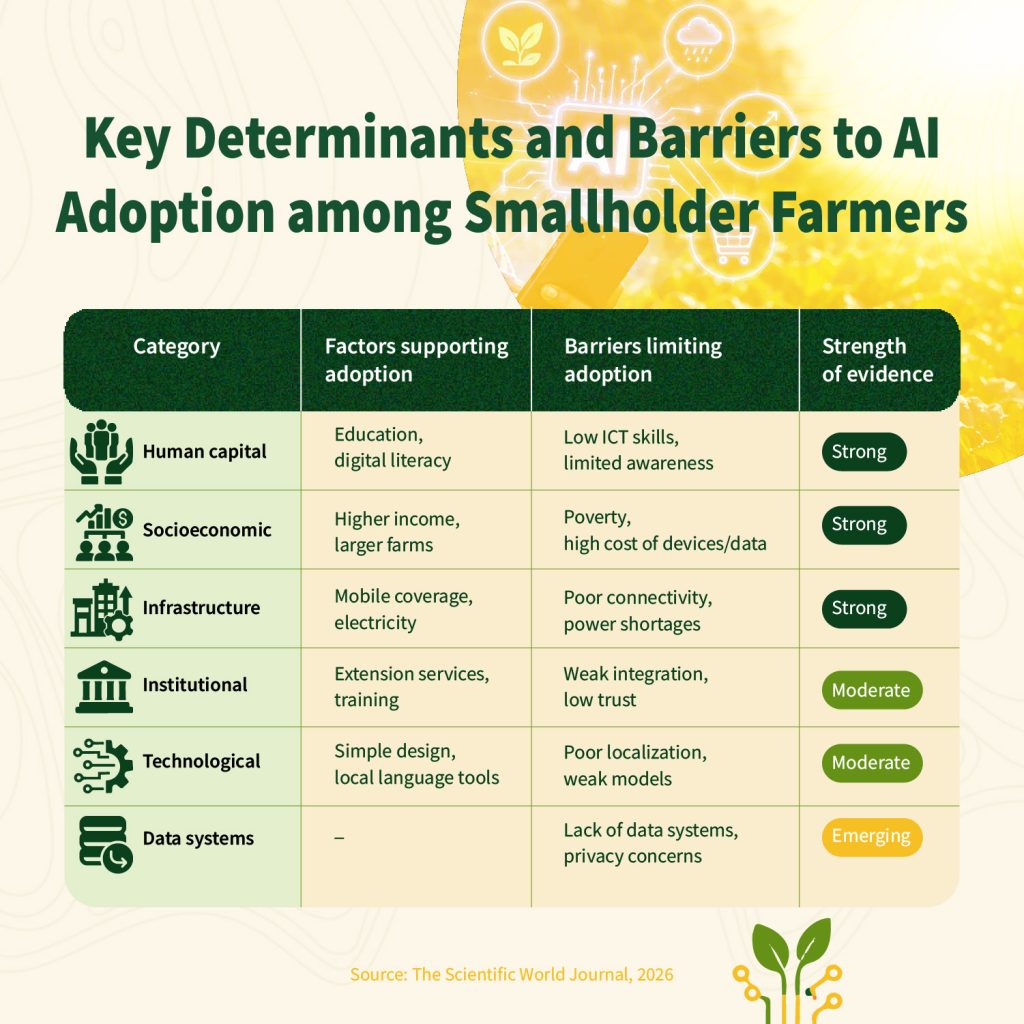
A study conducted in Kenya and Uganda found that women and older farmers were more likely to report low digital literacy and the cost of internet and mobile devices as barriers to using digital extension services. The researchers recommended combining digital services with face-to-face extension rather than relying on a single channel.
Addressing the Gaps
The challenges farmers face in accessing timely agricultural advice are not new, and in Nakuru, the county government is trying to address them.
In May 2026, the county recruited 98 agricultural extension officers and said it was developing a policy to revitalise extension and advisory services. County officials acknowledged that farmers had raised concerns about inadequate access to these services.
They attributed part of the problem to limited resources for personnel, training, transport and information and communication technology. The county said the new officers would be expected to link farmers with research and innovation and provide practical, localised agricultural advice.
While AI can provide information quickly, that advice is not always accurate or suited to local conditions. For women farmers, the cost of devices and internet access, limited digital skills, and advice that fails to reflect their needs creates additional barriers.
As farmers adopt AI and other digital technologies, they will need resources and support to act on the advice they receive. The value of these tools will depend not only on their ability to bridge information gaps, but also on whether their advice is reliable, locally relevant, and complements support from agricultural extension officers.
This article was produced as part of the Gender+AI Reporting Fellowship, with support from the Africa Women’s Journalism Project (AWJP) in partnership with DW Akademie.








LEAVE A COMMENT
You must be logged in to post a comment.