

|
LISTEN TO THIS THE AFRICANA VOICE ARTICLE NOW
Getting your Trinity Audio player ready...
|
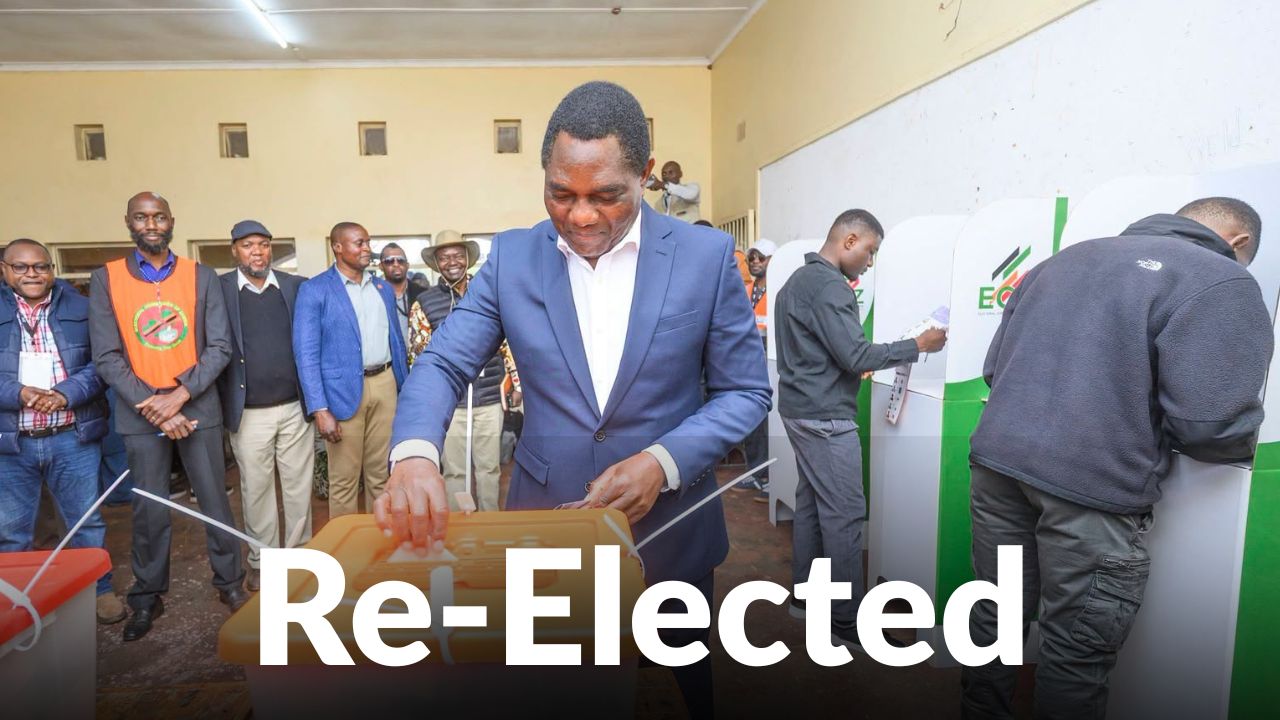
Zambia’s general election, which barely registered across the continent when it was held on August 13 and prompted some to call it the boring election, just escalated to 100.
After certifying the results for all 226 constituencies, the Electoral Commission of Zambia declared President Hakainde Hichilema the decisive winner.
Hichilema took 2,967,326 votes, about 60.5 percent of the 4,902,050 ballots counted.
Opposition leader Brian Mundubile finished second with 1,856,217 votes, roughly 37.9 percent.
Commission chairperson Mwangala Zaloumis confirmed Hichilema as president-elect on August 18.
No runoff was required.
Hichilema struck a conciliatory note in his victory statement, reaching out directly to those who backed his opponent.
“We hear you,” he said, addressing supporters of the losing side, according to the Associated Press.
His pitch rests on a real economic record.
Zambia defaulted on its debt in 2020, and Hichilema’s government has since restructured those payments, curbed inflation and stabilized the currency.
He has pledged to more than triple copper production to 3 million tons a year by 2031.
Critics counter that ordinary Zambians have yet to feel those gains, pointing to a high cost of living and persistent electricity shortages.
It was a clear mandate, earned in a vote most of the continent barely noticed.
Opposition allegations of rigging have pulled the race into a continental conversation.
A looming court petition is adding to that pressure.
So is the killing of a former Cabinet minister.
That conversation matters well beyond Lusaka.
A contested mandate weakens Hichilema’s hand at exactly the moment he needs investor confidence to hit that copper target.
It also weakens his hand on public legitimacy.
A vote that came and went quietly
Continental observers who watched the actual voting described a calm day.
The African Union and the Common Market for Eastern and Southern Africa deployed a joint mission of 93 observers.
Those observers were drawn from 27 countries.
The mission found voting was conducted in a generally peaceful and orderly environment.
A separate mission from the Southern African Development Community reached similar conclusions.
It reported that counting proceeded without interruption at 15 of the 17 polling stations it monitored.
The European Union’s mission struck a more cautious note.
It said the broader process unfolded in “an environment that limited fundamental freedoms.”
The suspension in counting prompted the army to deploy to parts of Lusaka, an unusual move for one of Africa’s more stable democracies, according to the Associated Press.
That should have been the end of the story.
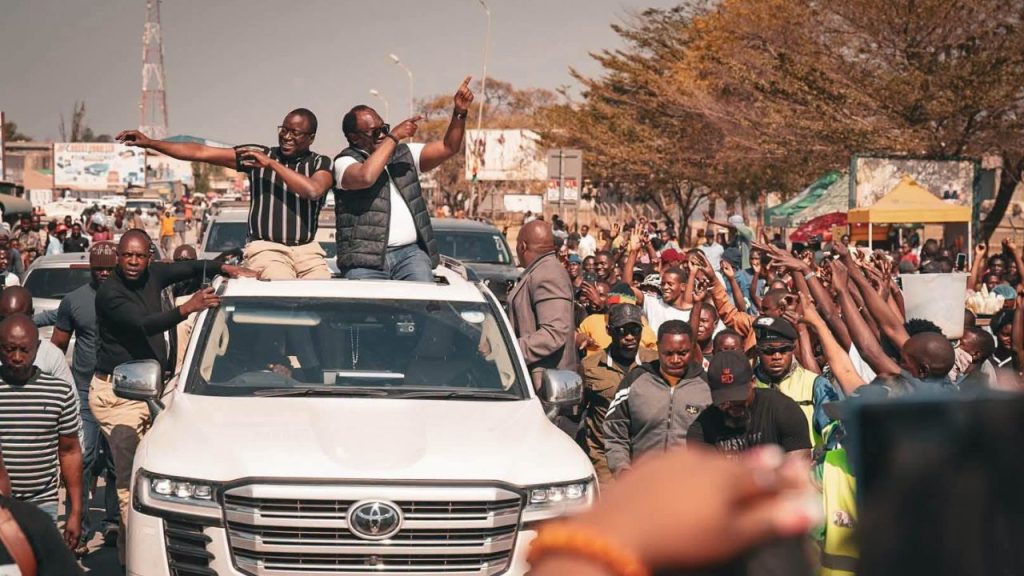
Then a former minister turned up dead
Counting had already been suspended for hours on election night.
Officials cited reports of violence at polling stations and stolen ballot papers.
A day after the vote, a joint security task force raided a Lusaka property linked to Mundubile.
Police say they were met with gunfire.
Officers returned fire, according to that same account.
Eleven people were arrested.
The government accused those detained of possessing “high-grade military weapons, ammunition and other materials for use in armed insurrection,” calling them a national security threat, according to the Associated Press.
Mundubile called the raid an attempt on his life and denied his officials were part of any militia.
Investigators confirmed on August 19 that a man fatally wounded in that raid was Mutotwe Kafwaya.
Kafwaya was a former transport minister and sitting opposition member of parliament.
“In the process one unidentified male person was fatally wounded, and the firearm was recovered,” police said in a statement.
Mundubile, who has gone into hiding, called the insurgency allegations total fabrications.
He said he had no information about Kafwaya’s presence at the property before the shooting.
United Nations human rights chief Volker Türk urged Zambian authorities to end arbitrary arrests.
He also called for due process for those detained.
Opposition splits over how to fight back
Mundubile ran under the National Reconciliation Party for Unity and Prosperity.
That party was fielded by the wider Tonse-Pamodzi Alliance.
He has rejected the results outright.
His campaign says it documented serious irregularities in how votes were counted, transmitted and declared.
Alliance spokesperson Emmanuel Mwamba went further.
He alleged serious interference at tallying centers nationwide.
EU observers documented related incidents in two locations.
An armed group attacked a totaling center in Lusaka’s Makeni area on August 15, removing nearly all the polling station result forms.
Alleged UPND cadres raided two of three totaling centers in Kabwe, Central Province, the following day, disrupting tabulation there.
Mwamba’s claim of military involvement specifically has not been independently corroborated.
Not every opposition figure agrees with the courtroom strategy.
NRPUP president Ezra Tembo has accepted the commission’s results.
Tembo says his party will instead serve as official opposition in the National Assembly.
The split exposes a real disagreement inside Mundubile’s coalition.
At issue is whether a legal fight or a parliamentary one better protects what the opposition gained.
State House spokesperson Clayson Hamasaka said Mundubile has every constitutional right to petition the results.
He added that Mundubile must bring evidence to support the claims.
Under Article 103 of Zambia’s constitution, Mundubile has seven days from the declaration to file that petition.
The Constitutional Court would then have 14 days to rule.
No inauguration date has been formally announced.
Government crews are racing to finish repairs at National Heroes Stadium in Lusaka, the venue used for Hichilema’s first inauguration in 2021.
A petition would do more than delay that ceremony on paper.
Zambian law states the inauguration cannot take place until the case is resolved.
Edgar Lungu’s 2016 swearing-in was pushed back for weeks after Hichilema himself challenged the result, and proceeded only after the Constitutional Court dismissed the case.
If Mundubile files and the case runs its course, Hichilema’s own inauguration could face a similar wait.
What Zambia does next will echo beyond its borders
A transparent, evidence-driven hearing would give Hichilema’s second term a legitimacy this dispute has so far denied it. A rushed or opaque one would give critics of African electoral institutions fresh ammunition.
This continent’s courts have disproven that argument before.
Zambia’s Constitutional Court has heard presidential petitions in past cycles. It has a real chance to show its work this time.
Hichilema now governs with a clear numerical mandate. He also carries an open legitimacy question he did not face in 2021.
How Lusaka handles the arrests will help decide which one defines his second term.
So will how it handles the unresolved raid and Mundubile’s expected petition?






LEAVE A COMMENT
You must be logged in to post a comment.