

|
LISTEN TO THIS THE AFRICANA VOICE ARTICLE NOW
Getting your Trinity Audio player ready...
|
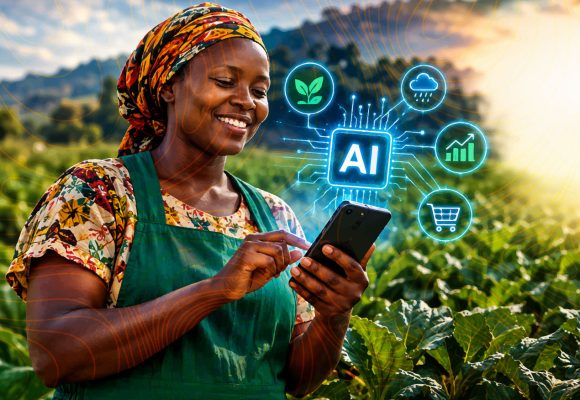
Running a small business often means making choices about where to spend money. For Winifred Mbatha, promoting her natural juice parlour in Nairobi is one of them. “When you’re asking a person to design a poster for you, it’s very expensive,” she says. Mbatha explains that hiring someone to design an advertising poster costs between Sh1,000 and Sh5,000, depending on the designer and the work involved. Now, she turns to artificial intelligence (AI). Using free versions of AI tools, she generates promotional posters and drafts messages to customers. She enters an idea and sees what the tool produces.
The results are not always what she wants. Sometimes the image is wrong, or the design is unclear. When that happens, she changes the prompt, tries again or opens another tool. “AI can’t do everything for you,” she says. “You also have to command it to give you what you want.”
AI has given her a way to produce promotional material without paying someone else to design every poster. A task that once required finding a designer, agreeing on a price and waiting for a draft can now fit between other business activities.
How Women Are Using AI
Mbatha is part of a larger shift. A 2026 report by the Cherie Blair Foundation for Women found that 82% of women business owners surveyed across 66 low- and middle-income countries, including Kenya, were using AI in their businesses, up from 38% in 2024. The report, Adopted, not embedded: AI, productivity and uneven gains for women entrepreneurs, draws on responses from 3,072 women entrepreneurs, who were generally well educated and digitally connected.
Marketing is among the most commonly reported uses of AI, alongside learning, design and communication. Sixty per cent of respondents used AI for marketing, while 54% used it for design. For many of the women surveyed, the technology has become part of the daily work of running a business: drafting a caption, designing a flyer, answering a customer or explaining something they do not yet understand.
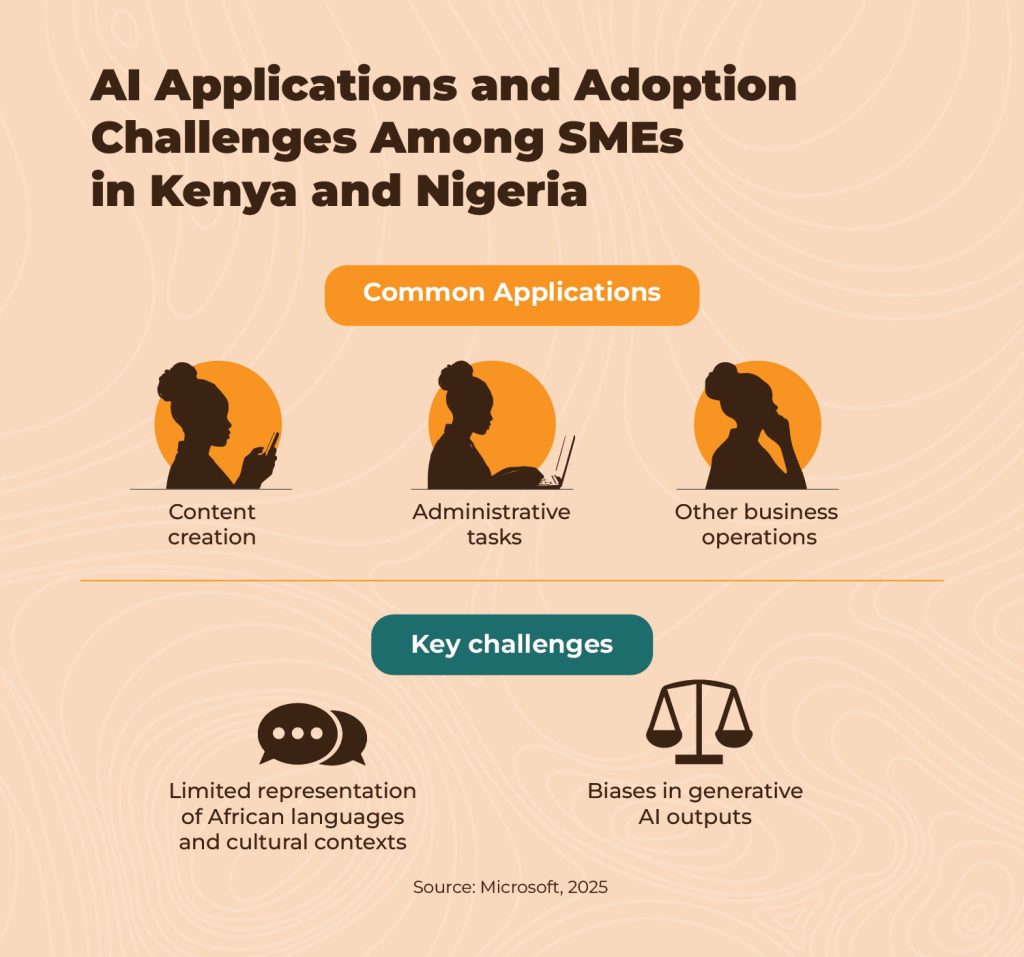
The gains, however, are uneven. Nearly seven in ten respondents, or 69%, said AI saved them time, while only 18% reported cost savings. In Kenya, Mastercard reported that 65% of women surveyed regularly used AI tools in their businesses, while 66% said the technology had helped them save significant time and costs.
Mary Ndanu, who sells women’s clothes online, says using AI has changed the overall quality of her pictures. Her two-year-old business largely operates on WhatsApp, where she shares photographs of dresses and occasional posters announcing sales. “Having varied backgrounds that do not compete with the dresses I sell is always important,” she says. “I use ChatGPT to change my background.”
Previously, she posted photographs as they were, without text or additional design. Now, she says, more people are responding to her advertisements and eventually buying her products. She says AI offers a way to present her products and create advertisements that look more polished, without having to commission a designer for every promotional image.
She is, however, cautious about experimenting with AI-generated video. She has seen clips that feel detached from reality and does not want that in her business.
Designers Face a Changing Market
Angela Bosibori, a freelance graphic designer who also runs a cyber café on the outskirts of Nairobi, is experiencing this shift from the other side. She believes AI has reduced the number of clients coming to her. “In the past, I could get 15 to 20 clients a week seeking simple designs such as event posters, menus or flyers and brochures. These days I barely get 10.”
“There is a huge difference between AI-generated and human-made posters,” she says. “Most AI posters lack the creative touch a human being brings. And others look almost identical.”
Some clients now arrive with AI-generated images and ask her to recreate them. Others assume that, because a poster can be easily generated, she should charge less for her work. Bosibori pushes back. Her work still takes time, skill and judgement. When clients prefer AI-generated content, she works with them to refine prompts and improve the results. AI has also made it faster for her to complete simpler designs.
For more complex work, such as logos, she avoids AI altogether. She wants the final product to be distinctive. She charges less for AI-assisted work than for designs she creates herself. Even then, she checks meticulously for errors, ensures originality and asks clients for consent before feeding their images or contact details into an AI tool.
Bosibori’s experience illustrates how generative AI is changing creative work. A 2025 brief by the International Labour Organization (ILO) on generative AI in the media and culture industry warned that the technology could reduce demand for some traditional creative roles, resulting in revenue losses and job displacement. However, it also noted that AI could complement human work, increasing the importance of skills such as creativity, critical thinking and ethical judgement.
Concerns About Authenticity
For entrepreneurs like Beatrice Mwikali, AI-generated posters raise concerns about authenticity and consumer trust. She owns a cosmetics business, an industry built on appearance, trust and personal recommendation. After a few attempts at prompting AI tools for posters, she kept running into the same problems: jumbled words, contact details with missing information, fonts that clashed or designs that failed to align with the brand she wanted to project.
Her concern, however, goes deeper than bad design. Mwikali sometimes posts client testimonials for skincare or makeup products. If customers begin to suspect that her posters are AI-generated, she worries they may start to doubt the testimonials too. “If someone thinks you use AI for your posters, then they may think that your testimonials are also fake or AI-generated,” she says. “That would affect my sales.”
In industries where credibility matters, a polished but generic poster may cost more in lost trust than it saves in production costs. Concerns about authenticity also feature in research on AI-generated advertising. In 2025, researchers from the University of California, Berkeley examined consumer perceptions of AI-generated advertisements. They found that participants correctly identified whether an advertisement was AI-generated or human-made 64% of the time. Advertisements perceived to be human-made received higher ratings across measures of effectiveness, regardless of their actual origin.
Gender Gaps in Usage
There are also concerns about accessibility and who gets to benefit from AI. A Harvard Business School working paper, Global Evidence on Gender Gaps and Generative AI Over Time, synthesising findings from 76 sources across more than 100 countries, estimated that 48% of men used generative AI, compared with 39% of women. Although the gender gap had narrowed over time, researchers said it remained persistent, with institutional, organisational and social barriers potentially contributing to the difference.
Access to the technology required to participate in the AI economy also remains unequal. GSMA’s 2026 Mobile Gender Gap Report found that women in low- and middle-income countries were 12% less likely to use mobile internet than men. In Africa, the gap was wider at 26%.
As more women entrepreneurs turn to AI to market their businesses, the technology is creating new opportunities while reshaping existing livelihoods. For Mbatha, AI has made it easier to produce promotional material, but for Bosibori, the same technology has changed demand for her services and what clients are willing to pay.
While the ability to produce marketing content is becoming easier, the benefits are not shared equally. Access to the technology should translate into meaningful business opportunities without overlooking the livelihoods of those whose work it is changing.
This article was produced as part of the Gender+AI Reporting Fellowship, with support from the Africa Women’s Journalism Project (AWJP) in partnership with DW Akademie.








LEAVE A COMMENT
You must be logged in to post a comment.