

|
LISTEN TO THIS THE AFRICANA VOICE ARTICLE NOW
Getting your Trinity Audio player ready...
|
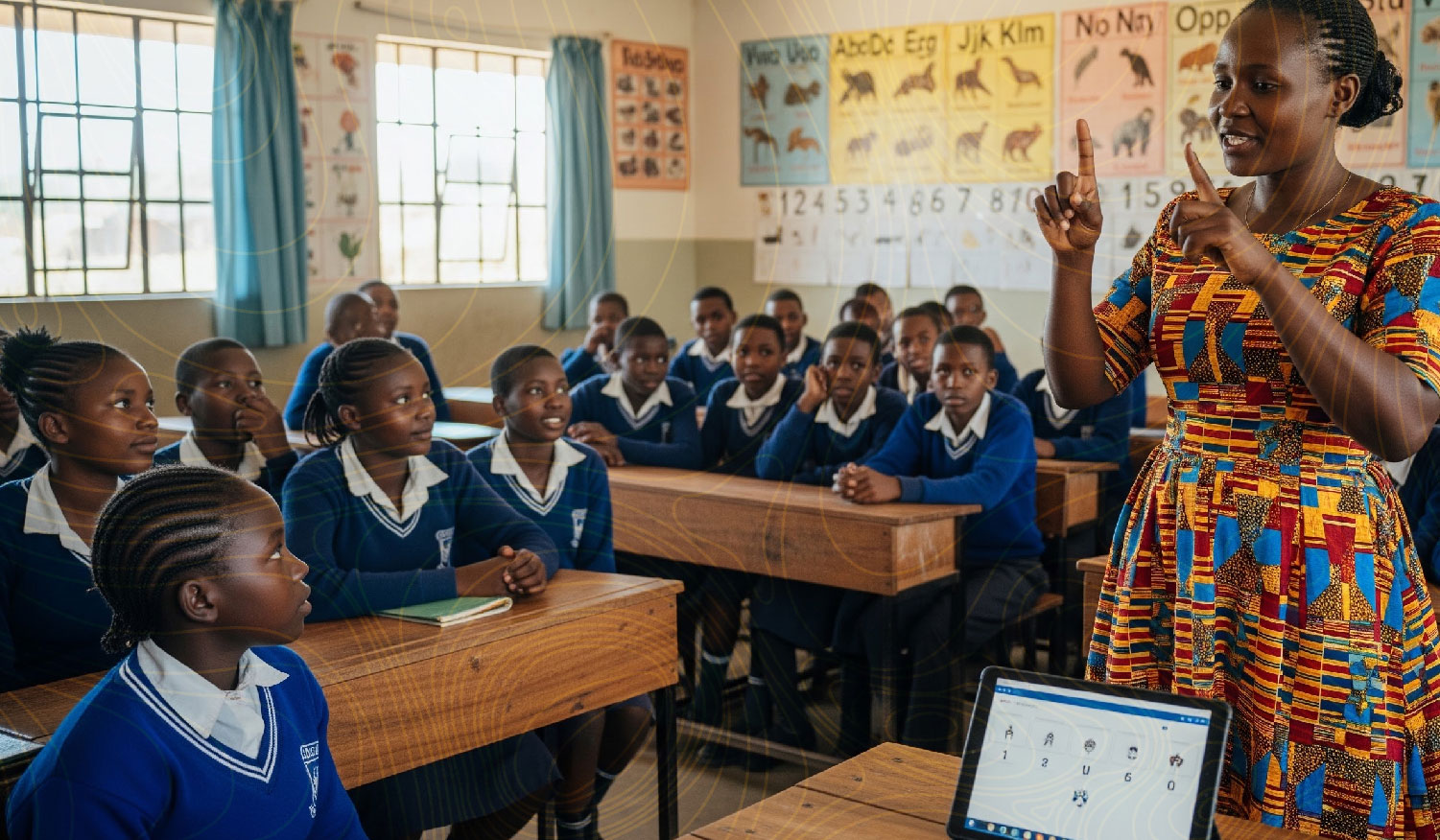
Education for deaf learners in Kenya is often shaped by a simple reality: there are not enough teachers fluent in Kenyan Sign Language (KSL). This is even more pronounced in tertiary institutions, where deaf students learning alongside hearing students rely on a limited number of interpreters to follow lessons.
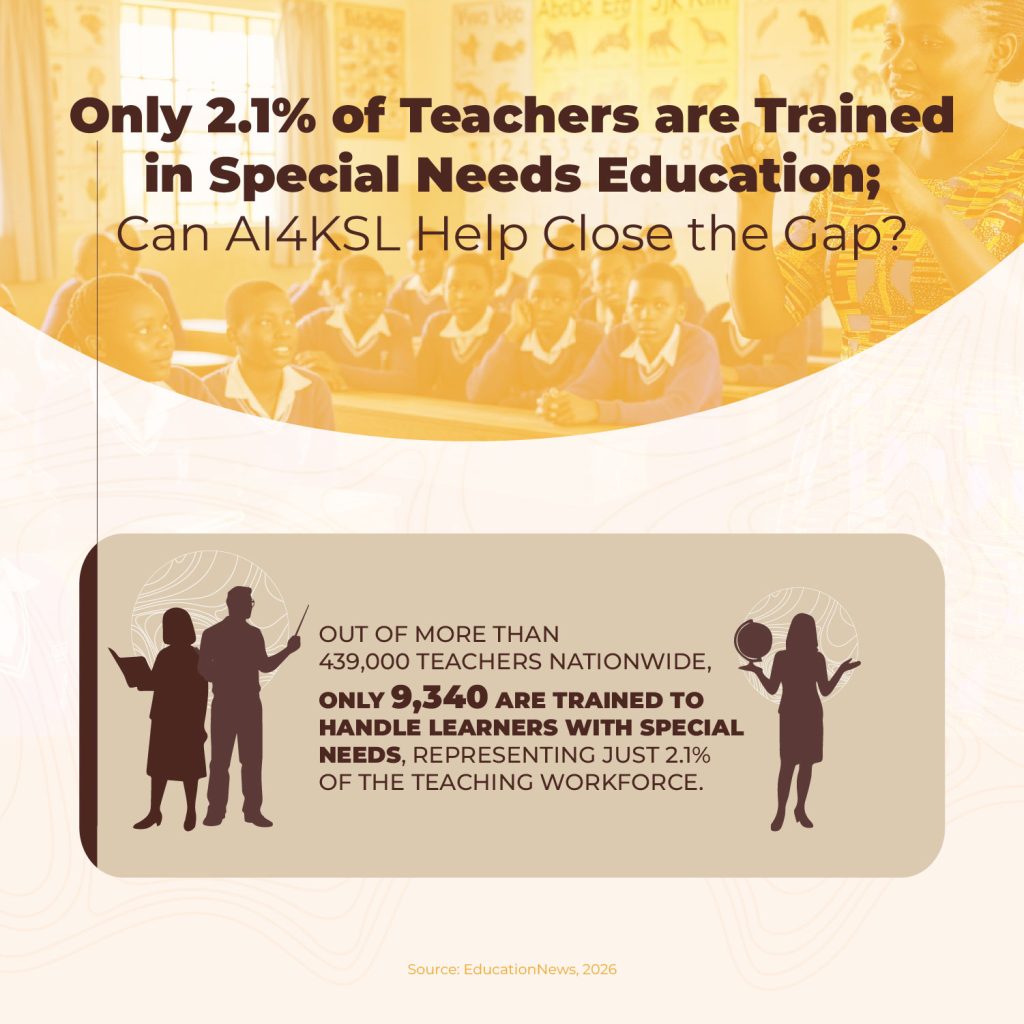
While no publicly available data shows how many teachers are fluent in KSL, the Teachers Service Commission says that out of more than 439,000 teachers nationwide, only 9,340 – about 2.1% of the teaching workforce – are trained to handle learners with special needs, according to Education News.
Researchers are exploring whether artificial intelligence could bridge the gap for deaf learners.
At Maseno University, computational linguist Dr Lilian Wanzare and her team are developing AI4KSL, a system designed to translate spoken English into KSL using a digital signing avatar. The AI4KSL project has brought together deaf learners, teachers and non-teaching staff to build a large dataset of KSL recordings that can be used to train and develop the technology.
“We have a huge database of recordings of different signs, capturing variations because we know people have different ways of signing,” said Wanzare during a webinar.
The database was built from contributions by 400 deaf participants and 48 teachers and tutors, resulting in approximately 20,000 signed videos and 14,000 English-KSL sentence pairs—one of the largest documented KSL datasets developed for AI research.
A subsequent publication by the AI4KSL team reported gender differences in the way deaf learners used KSL. Girls articulated more fluent signs than boys, and non-manual signals such as facial expressions were more evident among girls.
Wanzare says the distinction matters when developing AI that is expected to understand and generate KSL. The AI4KSL avatar incorporates both male and female gender representations, partly to avoid bias and partly to provide mentorship for learners.
Gender Differences in Classroom Signing
Nela Jebet, a teacher of geography and Christian religious education (CRE) at Ngala Secondary School for the Deaf, has also noticed differences in the way her students sign. She says that girls sometimes produce signs more easily, while boys may take longer to formulate their responses.
The AI tool she would most like to have is practical: one that could translate speech into KSL in real time.
“You just talk to it; it signs,” she says.
Such a tool, she believes, could save teachers time and energy.
How Teachers Are Using AI
Aaron Mutembei, a deaf teacher who teaches at the same school, has heard of the avatar project under development, but has not used AI in that way yet.
However, he says the usefulness of AI is already visible, even without specialised AI designed for deaf education.
Mutembei uses AI chatbots like ChatGPT and Copilot to expand ideas, prepare lessons and schemes of work, and find information that may not be readily available in textbooks. He also uses AI-generated images. His students, he says, are happy and interested when such materials are used.
“The biggest sense of learning for a deaf student is their eyes,” he explains.
He believes technology could eventually translate spoken language into KSL, but says it would need enough examples of KSL to translate signs accurately.
While some teachers like Mutembei are using AI chatbots to enhance their lessons, KSL-specific AI remains experimental and largely absent from schools.
At Rev Muhoro School for the Deaf in Nyeri County, Simon Kaiga, a teacher, says exposure to AI-powered sign-language tools has been limited.
“We haven’t embraced it that much,” he says.
The closest encounter has come through transcription software occasionally used during meetings involving deaf teachers.
Growing Debate
Not everyone working within the deaf community is convinced that artificial intelligence can easily overcome the complexities of sign language.
For Alexis Bosire, a KSL tutor and founder of the Africa Centre for Disability Studies, sign language is fundamentally different from the kinds of tasks AI is already transforming in other sectors.
“Sign language is sign language,” he says. “Either you know the language, or you don’t.”
Bosire argues that successful interpretation requires more than translating words. Sign language has its own grammar and structure, often expressing ideas differently from spoken English.
Pointing to the work of skilled interpreters, he notes that spoken sentences are frequently condensed and reorganised to fit natural sign language patterns.
The challenge, he argues, is not simply recognising words but understanding how meaning is constructed within KSL itself.
Even so, Bosire is not entirely dismissive of AI’s potential. He believes that animated video avatars might make learning better and more enjoyable for deaf students or those who hope to learn KSL.
Variations in Sign Language
While Kaiga believes AI could eventually prove useful, his concern is whether the technology adequately reflects the realities of sign language education.
Signs can vary across regions and communities, creating challenges for any system attempting to interpret or generate language at scale.
“The first thing that needs to be done, in my view, is harmonisation of those terms across the country,” he says. “So that if it’s a term, it’s known like this everywhere.”
He also notes a debate within the deaf community on whether to use ‘Signed Exact English’, where words are signed exactly as they would appear in sign language, or the more popular KSL, which has its own unique sentence structure and grammar. This, Kaiga says, would influence how sign language is translated or understood.
That problem is familiar to Mutembei. He says the signs used in one part of Kenya may differ from those used elsewhere.
“We have different sign languages of different places, like regions,” he says, pointing to places such as Mombasa and the Rift Valley. Teachers and students can also develop their own signs when there is no established sign for a particular word.
“It is a big challenge indeed if AI were to be trained for KSL,” he says.
Can AI Assess Signing?
The debate goes beyond translation.
When asked about the use of AI for KSL assessment, the teachers are both hopeful and cautious.
Mutembei is open to the possibility, but says accuracy would depend on extensive training.
Kaiga is more cautious.
“I wouldn’t advocate for AI to be involved, especially at this stage,” Kaiga says. “You don’t know what is working behind it, or what it’s thinking.”
Perhaps the biggest obstacle, Kaiga suggests, is not technological but human. He believes that for AI to fully benefit students, there would need to be proper teacher training. Across the profession, he sees a digital divide between teachers who readily adopt new technologies and those who struggle with even basic digital tools.
“It’s a good thing, and it can even increase the productivity of teachers,” he says. But awareness and training will be essential before widespread adoption can occur.
Representation in the data
For developers working on sign language technology, data is the biggest challenge, says Lincence Boge, Business Development and Partnerships Lead at Signvrse, a company developing AI-powered sign language translation technology.
“For AI to function, it needs data,” he explains. Unlike widely spoken languages with extensive digital resources, KSL remains underrepresented online, forcing developers to collect much of the training data themselves.
Boge adds that successful development depends not only on technology but also on involving deaf communities throughout the process.
Gender differences and other variations in signing also underscore the need for inclusive representation in AI data and design.
In a deaf unit at a school in Baba Dogo, Nairobi, KSL interpreter Faith Wahu uses AI chatbots to simplify learning materials and adapt explanations for learners at different levels.
For Wahu, and others, AI4KSL remains a work in progress, far removed from the daily reality of the classroom.
Teachers emphasise that for the technology to work, it has to be trained not just on the signs themselves, but on the variations in KSL across communities, regions and gender.
For now, the technology may be advancing, but in many classrooms with deaf students, the tools themselves remain largely unseen.
This article was produced as part of the Gender+AI Reporting Fellowship, with support from the Africa Women’s Journalism Project (AWJP) in partnership with DW Akademie.





LEAVE A COMMENT
You must be logged in to post a comment.