

|
LISTEN TO THIS THE AFRICANA VOICE ARTICLE NOW
Getting your Trinity Audio player ready...
|
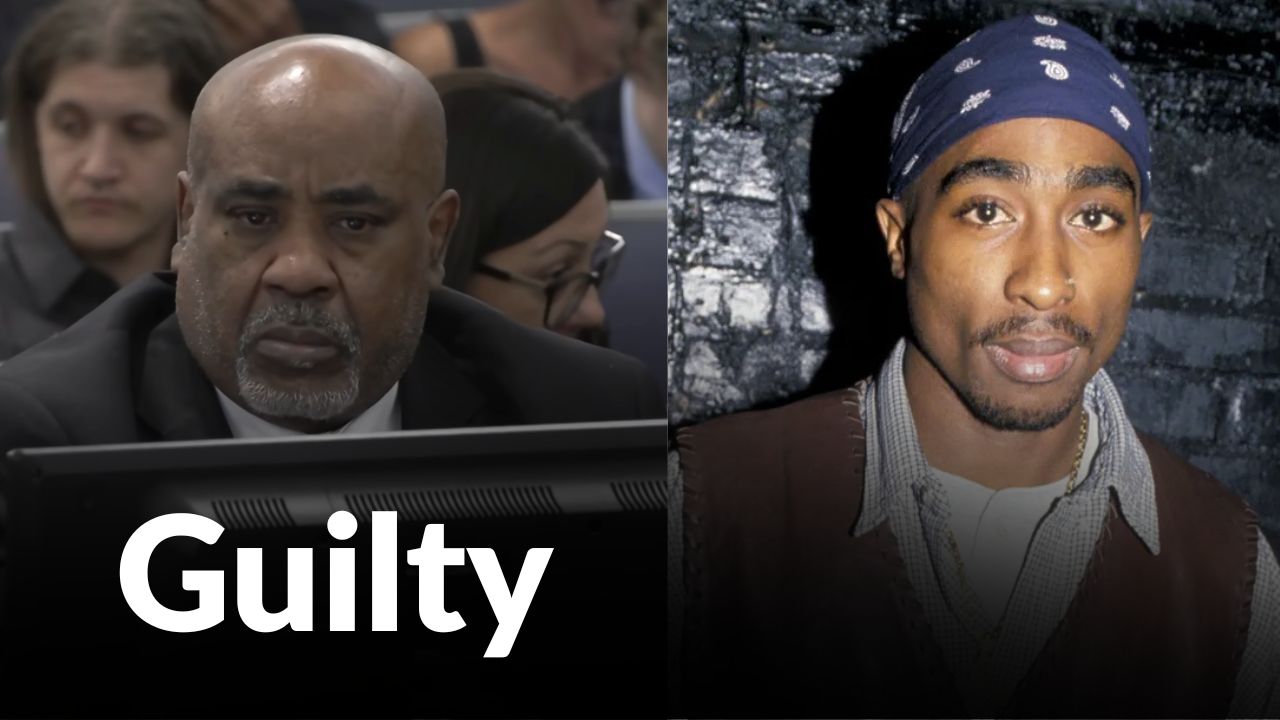
LAS VEGAS, NEVADA- A Las Vegas jury took less than three hours to convict Duane “Keffe D” Davis of first-degree murder on Monday.
The verdict closed a case that had haunted hip hop for nearly 30 years.
Davis, 63, was found guilty of orchestrating the September 1996 drive-by shooting that killed rapper Tupac Shakur.
Shakur was only 25 years old.
Davis faces life in prison without parole and is scheduled to be sentenced on October 13.
Clark County District Court Judge Carli Kierny polled the jury member by member after the verdict was read.
It took several calls on juror number one to affirm the verdict, a brief pause during which Davis appeared to perk up hopefully before his expression shifted as the juror’s answer confirmed the verdict, according to courtroom video of the hearing.
After Kierny ordered Davis held without bail pending sentencing, he raised his hand and addressed the judge directly, speaking for himself rather than through his attorney.
“I’d like to have my stuff back, all the computers, all the phones, everything,” Davis said.
“And I’ll be appealing this matter,” he added, pointing downward at the table in front of him to emphasize he was talking about his case.
Kierny told him an appeal would follow sentencing.
The conviction arrives two weeks before the 30th anniversary of Shakur’s death.
It is the first and only time anyone has been held legally responsible for one of American music’s most consequential killings.
Shakur had already survived one attempt on his life, a 1994 robbery and shooting at Quad Studios in New York that was never solved.
For an industry built on the mythology of the unsolved, the verdict offers something rare.
An imperfect answer.
A Confession Told Seven Times Over
Prosecutors built their case almost entirely on Davis’ own words.
Chief Deputy District Attorney Binu Palal told jurors that Davis admitted his role in the killing seven or eight times over three decades, Time reported.
He did so in police interviews, television appearances, podcasts and a 2019 memoir titled “Compton Street Legend.”
Jurors heard a 2008 recording in which Davis described the shooter’s mindset in his own words.
“He rolled down the window, popped ’em,” Davis said, according to Rolling Stone’s trial coverage.
That included a 2018 appearance on BET’s “Death Row Chronicles,” where he said the murder weapon came from the back seat but declined, citing “the code of the streets,” to name who fired it, Variety reported.
Davis said he did not fire the shots that killed Shakur, an account prosecutors did not dispute, CNN reported.
Prosecutors said Davis was the “shot caller” who arranged the killing to avenge an attack on his nephew, CNN reported.
Selling a memoir about that role, Palal argued, amounted to Davis profiting from murder.
Defense attorney Michael Sanft called his own client a liar who fabricated details for fame and money.
He pointed to inconsistencies in Davis’ many public accounts.
He also raised the lack of physical evidence, noting no murder weapon, DNA or fingerprints tied Davis to the scene.
Neither Marion “Suge” Knight nor Sean “Diddy” Combs testified, despite appearing on witness lists, according to CNN.
None of it moved the jury, whose youngest member was born nearly a decade after Shakur died.
Who Is Keffe D, and Why Did He Want Tupac Dead
Davis aka “Keffe D” was a former leader of the South Side Compton Crips, a Los Angeles street gang with deep roots in the city’s decades-long gang conflicts.
Prosecutors described him as running a multi-million-dollar, multi-state drug operation at his height, giving him real standing on the street even though he held no position in the music industry itself, Complex reported.
His entanglement in Shakur’s death began hours before the shooting, not years.
On the night of September 7, 1996, minutes after Mike Tyson knocked out Bruce Seldon in a title fight at the MGM Grand, Shakur and members of his entourage assaulted Orlando “Baby Lane” Anderson, Davis’ nephew, in the hotel lobby.
Hotel surveillance captured the beating, which was itself retaliation for an earlier altercation.
Anderson was a member of the same Crips set.
Davis said the attack could not go unanswered.
Hours later, Davis said his group recognized Shakur waving to fans from a passenger window and ordered their driver to make a U-turn to follow, according to The Root.
Four men, including Davis, were packed into the Cadillac that night.
The Cadillac pulled up beside Shakur’s car at a red light near the Las Vegas Strip, where he was riding with Suge Knight, then the CEO of Death Row Records.
A gunman firing from the Cadillac’s back seat, not Davis, hit Shakur multiple times, with one bullet piercing his lung, The Root reported, citing Davis’ own memoir.
Shakur died six days later at a Las Vegas hospital.
Prosecutors said Davis supplied the gun and directed the operation from inside the Cadillac.
Anderson was long suspected of pulling the trigger, but he denied involvement and was never charged.
Anderson was killed in an unrelated shooting two years later, and every other occupant of the car besides Davis has since died.
That left Davis as the last living witness, and eventually, the only person ever charged.
The feud traced back further than one night in Las Vegas.
It reflected a broader war between the Crips and the Mob Piru, a Compton set of the Bloods with ties to Death Row Records, The Source reported.
That underlying gang rivalry, prosecutors argued, gave Davis both motive and means, according to CNN and The Root.
The Label That Built and Broke Gangsta Rap
To understand why Shakur was riding with Suge Knight that night, it helps to understand what Death Row Records had become by 1996.
Knight, Dr. Dre, The D.O.C. and Dick Griffey founded the label in 1991, built on Knight’s street connections and Dre’s ear for sound.
Its early releases, especially Dre’s 1992 album “The Chronic,” introduced a West Coast sound known as G-funk.
That sound carried a young protégé named Snoop Dogg to national fame.
Backed by Interscope Records, the label helped push gangsta rap from a regional subculture into a dominant force in American mainstream music.
Knight ran the label with a reputation for intimidation that became inseparable from its brand.
He was widely described as Death Row’s enforcer as much as its executive, a businessman who blurred the line between the music industry and the street politics it drew from.
Signing Shakur in 1995, after paying to secure his release from a New York prison, was Knight’s most consequential move.
Shakur’s 1996 album “All Eyez on Me” became the label’s biggest seller and cemented his status as gangsta rap’s defining figure.
It also tied his fate directly to Death Row’s volatile culture.
A Rivalry That Turned Fatal
For three decades, the loudest theories about Shakur’s death pointed inward at hip hop’s own biggest names, not outward at a Compton street enforcer.
Fans, documentarians and podcasters speculated for years that Christopher Wallace, known as Biggie or The Notorious B.I.G., Knight or Combs played some hidden role, feeding what The Root called an ecosystem of theories that turned Shakur’s death into as much a cultural obsession as a cold case.
What prosecutors actually proved traces the killing to gang retaliation from outside that circle.
Davis has separately alleged that Combs offered money for a hit on Shakur and Knight, an accusation The Root reported the trial never resolved.
Combs has repeatedly denied any involvement, has never been charged, and prosecutors did not accuse him of wrongdoing in the case against Davis.
Combs is now serving a federal sentence on prostitution-related charges unrelated to Shakur’s death, Rolling Stone reported.
Knight is serving 28 years for an unrelated manslaughter conviction.
Shakur’s final months were defined by an escalating feud with Wallace, a rapper he had once considered a friend.
The two had been close in the early 1990s before the November 1994 shooting at Quad Studios, the same attack that nearly killed Shakur two years before his death, left him wounded and suspicious of his former friend.
Shakur came to believe, without ever proving it, that Wallace and his label, Bad Boy Records, had prior knowledge of the attack.
What followed was a very public war of words between Death Row and Bad Boy, amplified through diss tracks, interviews and magazine covers.
It hardened into what became known as the East Coast-West Coast rivalry, a feud that reshaped hip hop’s regional identity and its business rivalries alike.
Wallace was killed in a still-unsolved drive-by shooting in Los Angeles six months after Shakur’s death.
No one has ever been charged in that case.
The parallel killings, six months and a continent’s cultural divide apart, marked the end of an era in which rap’s biggest stars were also its most visible casualties.
What the Verdict Cannot Undo
Reaction to Monday’s verdict moved quickly through the industry Shakur helped define.
Radio host Charlamagne Tha God said on “The Breakfast Club” that Davis’ own public bragging built the case against him, arguing that years of interviews and a memoir amounted to a confession in installments, Complex reported.
Shakur’s family, in a statement released through their attorney, said they were relieved by the verdict but made clear it does not close the book on his legacy, CNN reported.
The verdict resolves who ordered the killing.
It does not resolve who fired the fatal shots.
Prosecutors never named the shooter in court, a gap The Root noted fueled debate among fans online after the verdict.
The Root argued the conviction forces hip hop to confront an uncomfortable chapter of its own history, even as the music, activism and mythology Shakur left behind keep shaping the culture that outlived him.
Shakur’s killing and Wallace’s remain twin bookends of an era when gangsta rap’s commercial rise and its body count moved at the same pace.
Thirty years on, only one of those deaths has a name attached to it in a court of law.








LEAVE A COMMENT
You must be logged in to post a comment.