

|
LISTEN TO THIS THE AFRICANA VOICE ARTICLE NOW
Getting your Trinity Audio player ready...
|
Ruth Bonareri had been vibe coding way before she knew the term for it.
Using Figma and Lovable, she was impressed by “what AI could do for a tech novice.” Bonareri says building an application manually can take months. With AI tools and her coding knowledge, she can build one in a matter of days.
“I started vibe coding because it was fun,” she says. “It was very fast.”
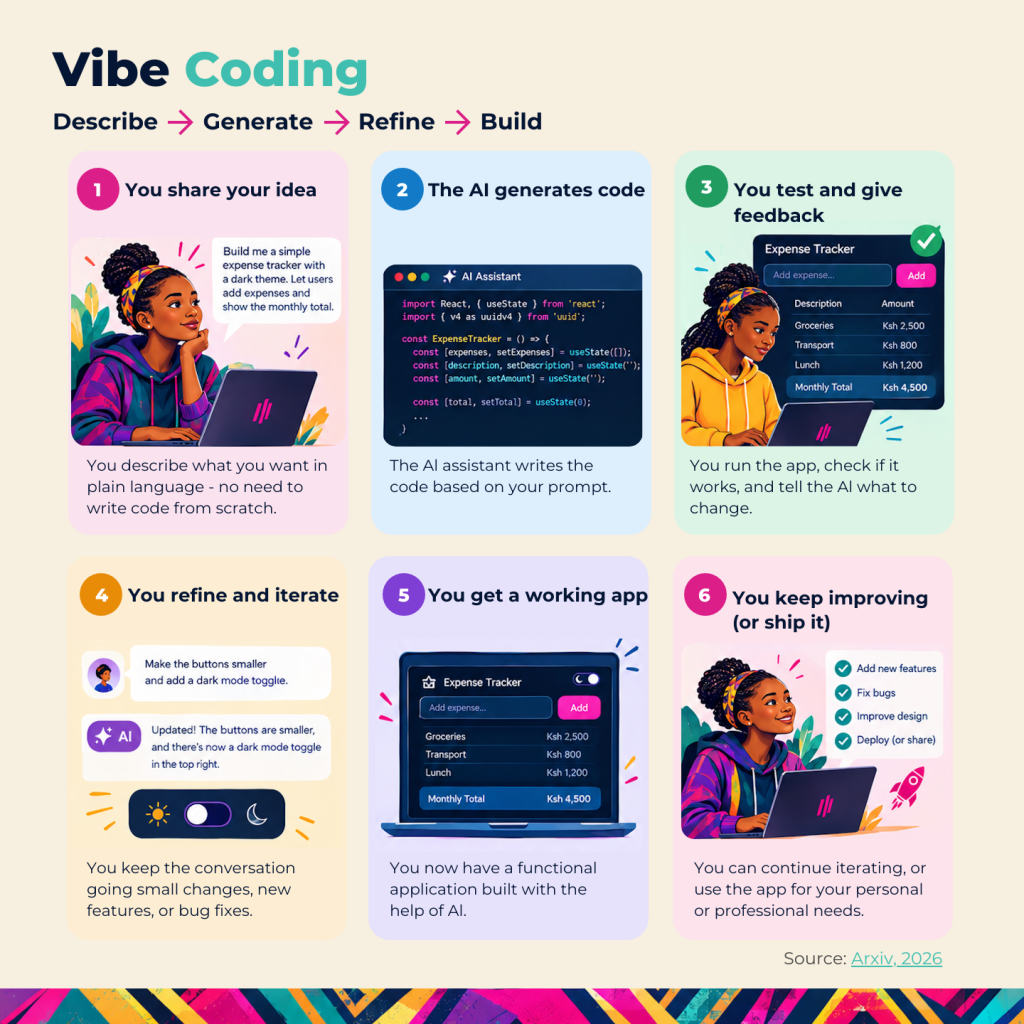
Vibe coding is a way of creating software through natural-language instructions. Instead of writing every line of code manually, a person describes what they want and uses artificial intelligence to generate, modify and troubleshoot the code.
Barriers to coding
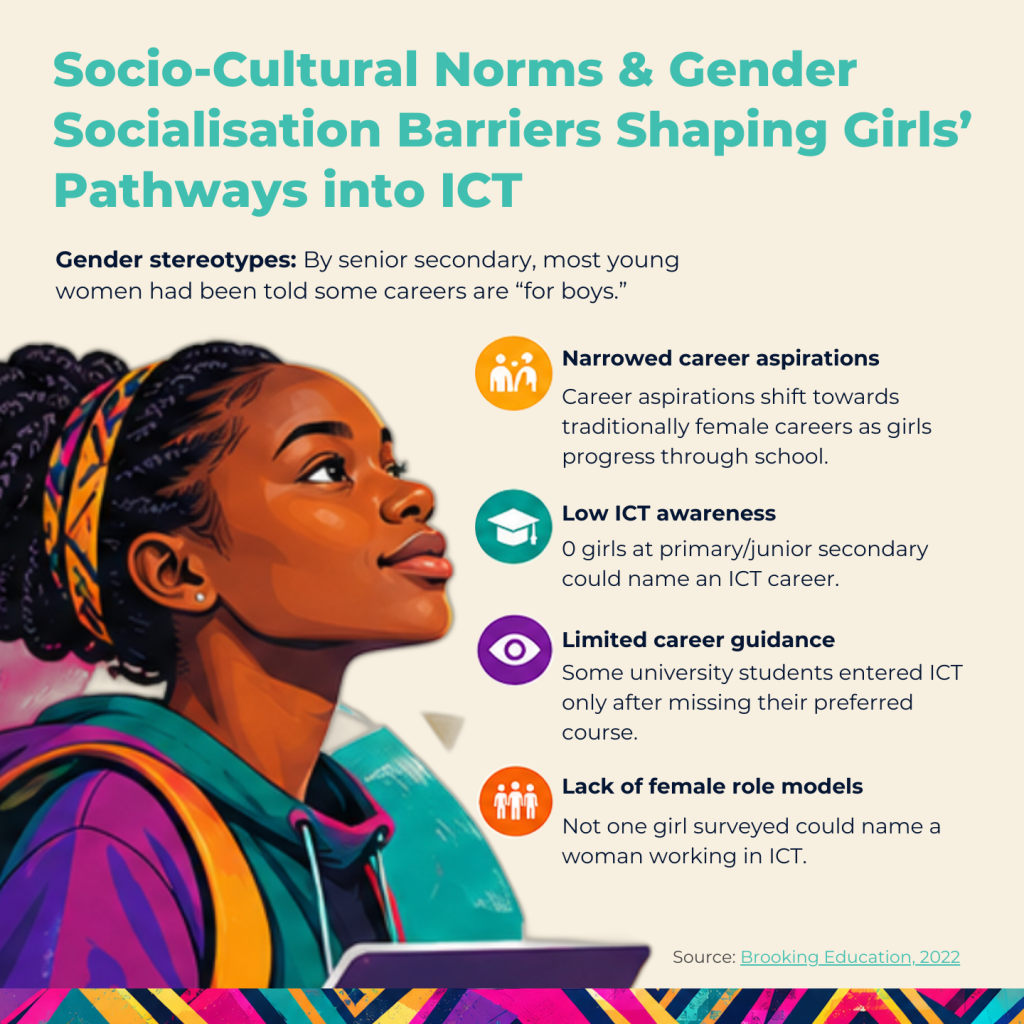
For many Kenyan girls and young women, the barriers to coding start before they ever write a line of code. A 2023 Brookings policy brief based on research in four Kenyan counties found that gendered expectations, poor career guidance and a lack of visible women role models discouraged girls from pursuing technology courses. Limited electricity, computers, internet and lack of trained ICT staff created further barriers, particularly in rural schools.
These inequalities extend beyond the classroom. A 2025 report by the Communications Authority and the Kenya National Bureau of Statistics (KNBS) found that among Kenyans aged 18 to 34, 55% of women used the internet, compared with 62% of men.
Vibe coding cannot remove these gaps. But for someone with a computer and internet, it can make the first step easier: users can generate an initial version of an application without having to master the underlying code.
Early research suggests that AI-assisted coding can speed up prototyping, although evidence about long-term security and maintenance remains limited. A separate study found that generative AI tools supported rapid prototyping among people without programming backgrounds. However, it did not establish whether women benefited equally; about three-quarters of survey participants were men.
But getting started is not the same as becoming a software developer. Bonareri is studying traditional coding to understand what AI is producing. “So when there is a bug, I won’t have to delete the whole code and start afresh. I’ll just know which code is wrong and I’ll debug it directly without wasting time.”

Building with AI
One of her projects, GrantsMatch, helps users find grants. Bonareri used Figma to design the display and user interface and Lovable to generate and test the first working version. AI helps her find grant opportunities, extract key details and draft descriptions, which she checks before publishing. She maintains the site herself.
Her projects have strengthened her portfolio, led to invitations to attend technology conferences and helped her secure a technology internship.
AI has also changed the order in which she learns. Instead of waiting until she has mastered programming languages, she can build a minimum viable product, put it in front of users and learn from what breaks.
As a first-year software engineering student, Bonareri says she could not have built some websites without AI. She has earned money by creating websites for small businesses. But the vibe coding tools come with costs. Paid plans for tools such as Claude and Replit can cost between $20 (Sh2,599) and $100 (Sh12,995) a month. When she reaches a free usage limit, she has to wait hours for it to reset, even with looming deadlines.
Valeria Bosibori took a different route into the field. She began her career in accounting before moving into software development. Although she studied Business Information Technology and completed a bootcamp at Moringa School, she recalls how intense the transition was.
“It was a six-month programme, which compressed years of programming concepts into an intensive period of study.”
That experience is why she sees vibe coding as significant: it reduces the need to master programming syntax before communicating an idea to a computer.
“It has made communication between humans and computers easy. So then that makes the entry easier for you,” she says.
Fundamentals still matter
But easier entry does not mean the fundamentals disappear.
Bosibori says users still need to understand how a product is structured and how the different parts, front end and back end, work together.
“Most of these vibe coding platforms give you a solution so fast, and they’ve coded by themselves,” she says. “So, if you have a case of debugging, and you don’t really understand the foundational concepts, you might struggle.”
Bosibori co-founded Tech Sisters Kenya, which she says has reached more than 1,800 women through training, mentorship and networking. Its work is based on the recognition that entry into technology is not determined by talent alone. Some women lack reliable electricity, internet access or computers, she says; others lack exposure to technology or useful networks that could help them enter the field.
Some young women also believe they must understand everything before beginning.
“You don’t have to have figured it all out,” she says.
What AI can, and cannot, do
After learning to use AI coding tools, turning an initial version into a reliable product can require technical expertise that beginners may not yet have.
Lewis Nduati, a data analyst and chief executive of an education technology company, says AI is particularly useful for creating the interface, layout and flow of a website or an application. The more complicated work, however, often happens underneath.
“When it comes to logic,” he says, “most of the time you need human help.”
Consider an e-commerce website accepting M-Pesa payments. An AI tool can generate much of the code, but Nduati says you cannot “really trust a web coding tool 100%” with an integration such as M-Pesa. A website may appear to work while still containing problems with payments, databases or security.
Women without a software development background who cannot identify or fix problems in the code may still need an experienced developer to move beyond the prototype. Vibe coding can help build an initial version quickly, he says, but maintaining, securing and expanding it is another matter.
From idea to product
Joylizza Mwangi understands these limitations. For her, the value of vibe coding lies less in becoming a programmer than in being able to turn an idea into something tangible.
Mwangi studied criminology before discovering technology through free workshops during the Covid-19 pandemic. She later attended workshops on data science and product design and became largely self-taught. Today, she is the founder and chief executive of Kijiji Labs, a tech-for-social-good innovation hub.
When she has an idea, AI helps her build an early version before handing it to her technical team. That is how she is approaching Nightweave, a nightlife safety platform designed to help people get home safely after attending events. The platform is still under development.
Being able to create an early version herself means she can show her team what she has in mind. But Nightweave also shows where vibe coding stops being enough. APIs, cloud services and the platform’s underlying mechanics become more complicated, she says. AI-generated code can contain errors beginners may miss, while a working platform can still have vulnerabilities. That is why she relies on experienced developers.
Her advice to women interested in technology is simple: start.
“Expose yourself,” she says. “Talk to people, interact, and go to a lot of hackathons.”
And learn the actual code, she adds. The more someone understands what the AI is producing, the more useful the technology becomes.
The experiences of Bonareri, Bosibori and Mwangi suggest that vibe coding can help women test ideas and begin building sooner. For Bonareri, it has also contributed to a growing portfolio and paid work. But it does not remove the cost of devices, connectivity, training and technical support, nor does a quick prototype guarantee paid work or a lasting career. AI may make the first step easier; what comes next still depends on the skills, money and support available to them.
This article was produced as part of the Gender+AI Reporting Fellowship, with support from the Africa Women’s Journalism Project (AWJP) in partnership with DW Akademie.












LEAVE A COMMENT
You must be logged in to post a comment.