Ruto Heads to New York for an Unpredictable Kenyan Diaspora Meeting and UNGA
The Sept. 20 meeting with the diaspora comes a few weeks after his controversial statement banning immigrant hawkers from owning shops in Kenya, a move some in the diaspora view as endangering their lives.
President William Samoei Ruto will meet Kenyans living in the United States in New York, in an engagement confirmed by Kenya’s Embassy in Washington.
Date: Sunday, Sept. 20, 2026
Time: 4 p.m. Eastern
Venue: Convene 30 Hudson Yards, New York, NY 10001
Kenya’s Ministry of Foreign and Diaspora Affairs circulated this flyer confirming President William Ruto will meet Kenyans in New York on Sunday, Sept. 20, at 4 p.m. Credit: Ministry of Foreign and Diaspora Affairs, Republic of Kenya
Kenyans planning to attend can register on the Ministry of Foreign and Diaspora Affairs’ official page: diaspora.go.ke/registration.php.
The gathering falls days before Ruto addresses the 81st UN General Assembly, whose general debate opens Sept. 22 and runs through Sept. 28.
It will also be his first diaspora meeting since former Prime Minister Raila Odinga’s death last October, and the room he steps into may be harder to read than in past years.
Odinga’s passing removed a figure who had, in his final months, brought his party into an uneasy partnership with Ruto’s government, and diaspora Kenyans no longer have that dynamic to measure the president against.
With the 2027 election approaching and questions swirling around a recent policy misstep, Ruto arrives to an audience whose mood is genuinely unpredictable for the first time.
This story is free. Keeping it that way isn't.
The Africana Voice never puts stories behind a paywall. If you'd like to chip in, becoming a supporter starts at $6/month and goes ad-free.
Ruto is not the only man with 2027 ambitions working the diaspora this month.
Former Deputy President Rigathi Gachagua left Kenya on Aug. 26 for what his Democracy for the Citizens Party describes as a roughly 50-day American tour, moving through Spokane and Portland before Kansas, Dallas and Boston.
Former Chief Justice David Maraga, now the United Green Movement’s presidential flag bearer, landed in Washington on Sept. 16 for a three-week tour that includes New York on Sept. 21 and 22, just as UNGA opens.
Jubilee Party candidate Fred Matiang’i is also touring the country, with an itinerary running Sept. 17 to Oct. 5 that includes a New York stop among nine states.
By the time Ruto takes the stage at Hudson Yards, three men hoping to replace him will have already spent days, in Gachagua’s case weeks, listening to the same community he is about to address.
What Kenyans Are Likely to Ask
The diaspora engagement planning team has circulated a questionnaire ahead of the town hall, inviting attendees to submit issues, proposed solutions and what they believe the government and diaspora should each contribute, available at forms.gle/NqMHNe3UfRN1uNg19.
Corruption sits near the top of the likely questions, with many Kenyans abroad frustrated that taxes paid and money sent home seem to disappear into graft the government has done little to stop.
Insecurity is close behind, and Ruto should expect pointed questions about gang activity, sometimes called “goonism” back home, and whether his administration still has a handle on crime in Kenyan cities.
Some are likely to link that violence directly to youth unemployment, which sits near 67 percent for Kenyans aged 18 to 34 and has been named by researchers and officials alike as the engine feeding gangs for hire.
Financial friction runs through several other questions, from double taxation on income and property earned in both countries to remittance fees that eat into what actually reaches families.
Land and property fraud is a recurring complaint, with diaspora members describing plots grabbed or sold out from under them while they were abroad and little recourse once it happens.
Political representation is another sore point, since Kenyans abroad can vote for president but not for a parliamentary seat, despite being called the country’s 48th county.
Consular service is a mixed picture worth acknowledging honestly. Principal Secretary Roseline Njogu’s push for more mobile consular clinics has made passport renewal and document authentication easier in some cities. However, many still describe the process as slow and costly.
Dual citizens are likely to raise gaps in how Kenyan law treats them once they are back home, from property rights to business registration.
Investors in the room may press him on why businesses started from abroad still run into fraud and bureaucratic obstruction with little protection.
A broader frustration threads through nearly all of it, the sense that these engagements ask the diaspora for money and votes but rarely for policy input.
Family safety is likely to come up too, with Kenyans abroad worried about relatives back home and their access to basic services while they are away.
A Policy Widely Called Xenophobic, Then Walked Back
Ruto’s trip follows a domestic episode that rights advocates and commentators across the region called explicitly xenophobic.
On Sept. 2, addressing small business owners at State House, Ruto directed enforcement agencies to shut down foreign-run hawking and small retail businesses, arguing that the investor confidence Kenya had built was meant for major companies, not street-level traders from countries including China.
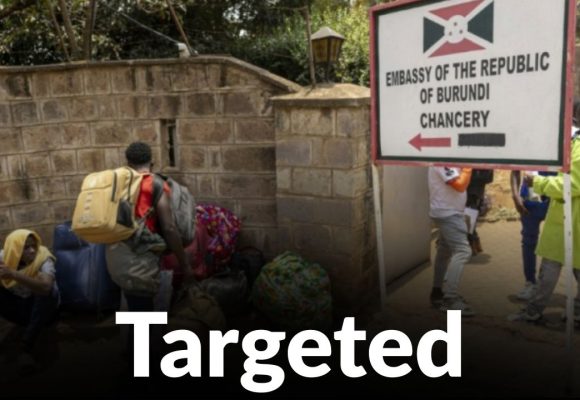
Enforcement began Sept. 7 and hit traders from neighboring countries hardest, and Burundian nationals lined up at their embassy in Nairobi that week seeking emergency travel documents.
Foreign Affairs Principal Secretary Korir Sing’oei apologized to the Burundian community that same week and said Ruto’s remarks had been taken out of context. State House followed on Sept. 8 with a 90-day window for foreign traders to regularize their status through their embassies, while warning Kenyans against taking enforcement into their own hands.
Ruto himself addressed the backlash directly on Sept. 12, assuring citizens of East African Community and COMESA countries that they remained free to work and invest in Kenya within the law, warning that no citizen had a right to take the law into their own hands, and telling the country, “We will continue to be an open society because that is the DNA of Kenya.”
Kenya’s Own Rejection of the Rhetoric Drew Continental Praise
Even before Ruto’s own walkback, Kenyans had already refused to embrace the policy in large numbers.
Musicians including Octopizzo and Bien joined lawyers, civil society figures and ordinary citizens in condemning the directive under hashtags such as “We are not xenophobic.”
Authorities arrested people inciting anti-foreigner sentiment online, and commentators across Africa praised Kenya’s pushback as a model other countries should follow, Citizen Digital reported.
That praise came alongside real harm. Hundreds of Burundians still rushed to their embassy fearing violence, and some migrant-owned businesses were vandalized before the public mood fully turned.
What the Room in Manhattan Actually Needs From Him
Diaspora meetings with sitting presidents usually run on one currency: remittances, framed as patriotism, followed by a pitch to invest rather than send money home.
This one carries a bit more weight.
Kenyans abroad have watched their own compatriots reject a policy their president introduced, watched him walk it back in his own words, and watched three rivals spend weeks building relationships with the same communities Ruto now hopes to reach.
Last year’s UNGA trip offered a small preview of what can go wrong. In September 2025, dozens of Kenyans in Manhattan waited hours for a promised meet-and-greet with Ruto that never happened, leaving the ambassador to address the group instead.
Your digital home for stories powering the African diaspora.
Our journalists bring you trusted, independent news about the African Diaspora on africanavoice.com.
Free access — accept cookies
We and our partners use cookies to improve your experience. Cookies help us personalize content, measure engagement, show relevant ads, and generate revenue to support the cost of producing news content. Accepting cookies gives you free access. You can change this anytime by refusing to accept cookies and not accessing our content. You can also subscribe for an ad-free experience. Click here to see our Privacy Policy.
Subscribe — full access, no advertising cookies
A subscription offers unlimited access across devices, removes advertising cookies, supports independent reporting, and strengthens your privacy settings.
With your consent, we and our partners use cookies to store and process information, including IP addresses and identifiers. Some partners rely on legitimate interest. You may withdraw consent or object by declining cookies.
Support Independent journalism. Subscribe to The Africana Voice and enjoy an ad-free experience













LEAVE A COMMENT
You must be logged in to post a comment.