

|
LISTEN TO THIS THE AFRICANA VOICE ARTICLE NOW
Getting your Trinity Audio player ready...
|
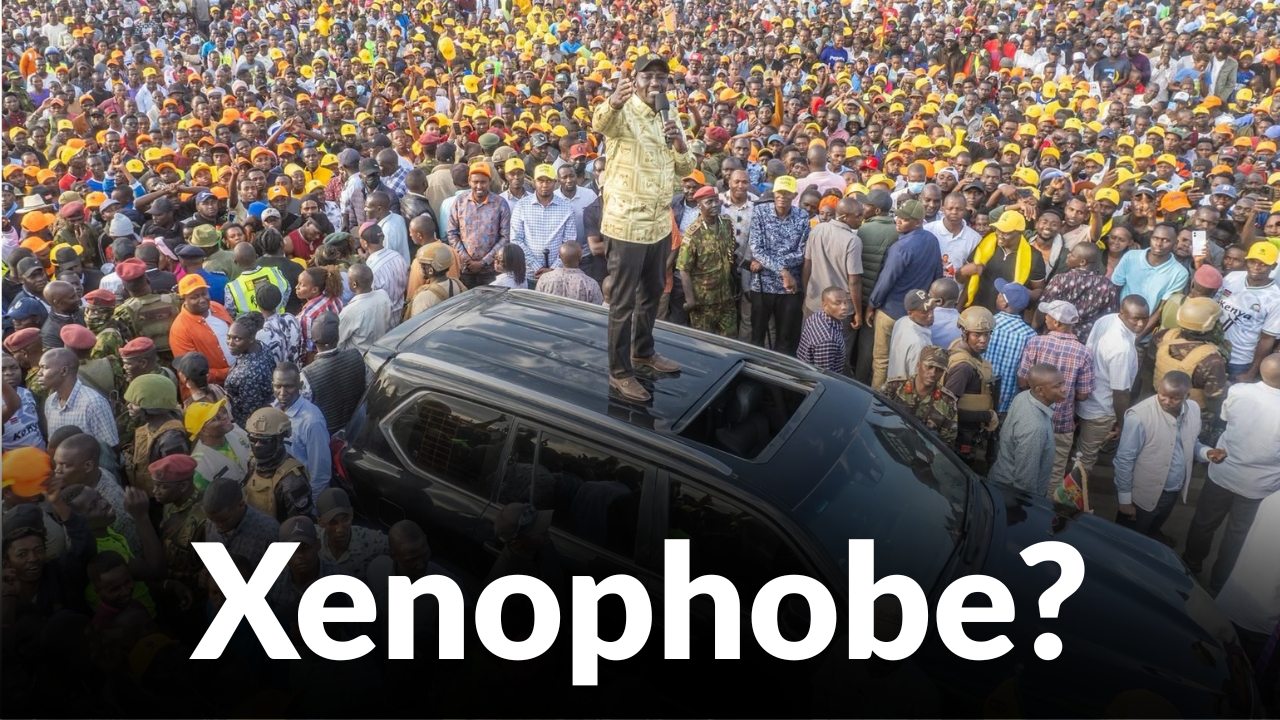
On Sept. 2, President William Ruto ordered a crackdown on foreign nationals running small businesses in Kenya.
He directed the Ministry of Investments, Trade and Industry to begin enforcement as early as Sept. 7.
His remarks singled out hawkers and small shop owners who are not Kenyan citizens, arguing that foreign investors should create jobs rather than compete with Kenyans in low-capital trade.
Six days later, on Sept. 8, State House stepped back, announcing a 90-day window for affected foreign nationals to regularize their immigration status and business operations.
It also promised protection for foreigners lawfully entitled to work and trade in Kenya.
That retreat matters, but it does not erase the original order’s message.
A government that actively sends Kenyans abroad for work should face hard questions when its president paints foreign small traders at home as a threat to local livelihoods.
Ruto Draws a Line Kenyan Traders Cannot Cross
Ruto announced the crackdown while addressing small business owners at State House in Nairobi.
He said Kenya has worked hard to improve investor confidence.
That effort, he said, was not meant to attract hawkers.
Ruto linked the directive to the Local Content Bill, 2025.
That bill would reserve certain trades exclusively for Kenyan citizens.
It has not passed.
Ruto chose to act before it does, ordering administrative enforcement instead of waiting for Parliament.
On Sept. 8, he directed that the bill be expanded to set rules on who can take part in small-scale trade.
A President Who Sends Kenyans Abroad Now Wants Foreigners Sent Home
Ruto has spent much of his presidency doing the opposite of what he now demands of foreign traders.
His government runs Kazi Majuu, a state program that recruits Kenyans for jobs abroad.
On Sept. 16, Diaspora Affairs Principal Secretary Roseline Njogu said 600,000 Kenyans had taken up jobs abroad through the program over three and a half years.
That figure is the government’s own and has not been independently verified.
Official totals have also risen fast, from more than 540,000 cited by Ruto in March to about 583,000 cited by Njogu in late August.
Kenya is now seeking more labor deals with countries such as Germany, with Njogu stressing ethical recruitment and protection for Kenyan workers abroad.
Those are fair standards, and Kenya should apply them to foreign workers and traders inside its own borders too.
Kazi Majuu has also drawn complaints from applicants who took out loans expecting professional placements.
Some were offered cleaning or security work instead.
Ruto has told young Kenyans not to be selective about the work they accept overseas.
He has celebrated diaspora remittances as a top foreign exchange earner for Kenya.
A president who tells Kenyans to take any job abroad is now telling foreigners they cannot take small jobs in Kenya.
Nothing about that contradiction is subtle.
The Crackdown Is a Distraction, Not a Solution
Kenya’s jobs problem cannot be reduced to foreign hawkers.
What matters is whether government policy expands access to reliable work, decent pay and real opportunity for young people.
Kenya produces more than 60,000 university graduates a year from 79 institutions.
Many end up hawking, driving boda bodas, or working informal jobs unrelated to their degrees.
Foreign traders selling vegetables or running kiosks are not the reason those graduates cannot find work.
They are an easy target.
Removing a foreign trader from a street corner does not build opportunity for anyone else.
Blaming struggling migrants for a jobs shortage lets Ruto avoid a harder conversation.
That conversation is about credit access, energy costs and a tax regime that has squeezed small businesses rather than grown them.
None of that gets fixed by shutting down a non-Kenyan vegetable seller in Eastleigh.
A Hustler President Turns on the Hustlers
Ruto built his political brand on the hustler and the mama mboga.
He promised a bottom-up economy that would lift small traders, not squeeze them.
Four years into his term, that promise remains largely unmet.
Scapegoating foreign hawkers is easier than admitting the hustler nation never arrived.
Ruto’s Real Failure Isn’t Foreigners, It’s Impunity
Kenya has a documented crisis of unemployed young men being paid to carry out political violence.
Reporting by The Africana Voice on Kenya’s goon economy traced a rate card of 2,000 to 4,000 shillings per person for hired attacks on rival political convoys.
Researchers have linked that supply of hired muscle directly to joblessness among Kenyan youth.
Ruto’s government should identify, investigate and, where the evidence warrants, prosecute those who finance and organize political violence.
Accountability must reach beyond the people carrying out attacks to anyone paying for or directing them.
That is the standard his government should be judged against.
Instead, it has chosen a target with no political power to fight back.
A foreign vegetable seller cannot organize a rate card or hire enforcers.
Punishing that seller is easier than confronting the politicians and financiers who profit from actual violence.
Kenyans must reject the framing that foreign small traders are responsible for Kenya’s jobs crisis.
They are not.
Kenya Is Borrowing a Script Ruto Once Condemned
South Africa’s anti-migrant movements, Operation Dudula and March and March, built their platform on blaming African migrants for unemployment.
Former Minister Naledi Pandor described this pattern as Afrophobia.
Her term names attacks by South Africans on fellow Africans specifically.
Ruto has criticized that logic before.
His government evacuated more than 400 Kenyans from South Africa in 2026 after xenophobic violence targeted foreign nationals there.
He has called on African leaders to confront xenophobia wherever it appears.
Now he is using a milder version of the same reasoning Operation Dudula uses.
His message to citizens is that foreigners in low-margin trade make opportunity feel scarce.
Numbers do not support that reasoning.
Kenya’s informal sector employed more than 18 million people in 2025, according to the Kenya National Bureau of Statistics.
No government agency has published a count of foreign nationals working as hawkers or small shopkeepers within that number.
By every visible measure, on the streets of Nairobi, Mombasa or Kisumu, they are a small fraction of it.
Removing them will not meaningfully change youth unemployment.
It will change who Kenyans have been told to resent.
Othering people who sell vegetables and secondhand clothes for a living is not economic policy.
It is a shortcut around the harder work of building one.
A Presidential Order Is Also a Signal
Ruto’s directive is not only an enforcement policy.
Words from a head of state carry weight beyond the paperwork.
An order to close foreign-run businesses tells ordinary Kenyans that those businesses are a legitimate target.
Friction over this exact issue existed before Ruto’s directive was even announced.
In July 2026, a video of a Kenyan man confronting a Burundian trader in Nairobi, accusing him of taking local jobs, went viral.
A regional conflict expert from Burundi publicly appealed for the protection of Burundian citizens in Kenya afterward.
Kenya’s own foreign ministry had to step in to reassure East African nationals living in the country.
That was one video, before any government order existed.
A presidential directive naming foreigners as the reason Kenyans struggle raises the stakes considerably.
South Africa shows where that road can lead.
Operation Dudula and March and March built a movement on similar rhetoric, and their supporters have blocked migrants from hospitals and been linked to deaths, including a Malawian infant denied treatment in 2025.
Kenya has its own history with this pattern.
After the 2014 terror attacks, a government crackdown branded as security enforcement led to mass harassment of Nairobi’s Somali community.
Police arrested more than 4,000 people and shuttered businesses on suspicion, not evidence.
Its stated target was terrorism, not trade.
Residents of Eastleigh paid the price anyway, with community leaders reporting business losses of more than 75 percent.
Ruto’s order carries the same risk.
A directive aimed at hawkers and shopkeepers can easily become permission for landlords, county officers or private citizens to harass, extort or attack any foreigner running a small business, whether or not the law actually applies to them.
Kenyan authorities have since issued explicit assurances.
On Sept. 8, State House said no individual or group may harass, intimidate or interfere with foreign nationals or their businesses, and promised legal action against anyone who does.
A day earlier, Foreign Affairs Principal Secretary Korir Sing’oei apologized for how the directive had been presented.
Whether those promises hold is the real test.
On Sept. 10, the Police Reforms Working Group Kenya reported allegations of profiling, extortion and arbitrary arrests of foreign nationals.
Those reports show why enforcement needs independent scrutiny, not just official statements.
Ruto Is Also Gambling With Kenyans Abroad
Kenya’s crackdown, Ruto singled out Chinese traders by name.
China could just as easily retaliate against the thousands of Kenyans hustling in Guangzhou’s African trading district.
Those Kenyan traders depend on the same informal, small-margin hustle Ruto is targeting at home.
A tit-for-tat response would hurt ordinary Kenyans first.
Punishing Poverty Is Not Policy
Kenya’s own vision for the continent rests on free movement and open borders.
Kenya has ended visa requirements for most African visitors.
Ruto has praised that policy as a driver of continental exchange.
Criminalizing informal trade contradicts that vision.
A hawker selling secondhand clothes is not undermining Kenyan sovereignty.
That person is trying to survive.
Hundreds of thousands of Kenyans are doing the same thing in Gulf households and European care homes.
Foreigners working lawfully in Kenya should not face closure orders because their existence is politically convenient.
Kenya cannot ask the world to welcome its migrant workers while telling migrants in Nairobi to pack up and leave.
What Kenya Actually Needs From Its Government
Ruto’s government has real levers it has not pulled hard enough.
Manufacturing incentives, reliable power and accessible credit would do more for Kenyan traders than an eviction order.
So would a tax code that does not punish small enterprises.
So would prosecuting the financiers of hired political violence instead of the vegetable sellers of Eastleigh.
Local sourcing, the Local Content Bill’s core aim, has merit and deserves scrutiny on its own terms.
A bill built to grow local capacity should not be paired with an unrelated crackdown, especially one announced before the law even exists.
Kenya’s economic problems will not be solved by identifying who does not belong.
They will be solved by building an economy large enough that the question stops mattering.
Ruto has the tools to grow jobs at home.
Whether he uses them or keeps finding new groups to blame will define how people remember his presidency.
Updated Sept. 25, 2026, to reflect the government’s 90-day regularization window, its protection assurances, and the latest reported Kazi Majuu figure.









LEAVE A COMMENT
You must be logged in to post a comment.