


|
LISTEN TO THIS THE AFRICANA VOICE ARTICLE NOW
Getting your Trinity Audio player ready...
|
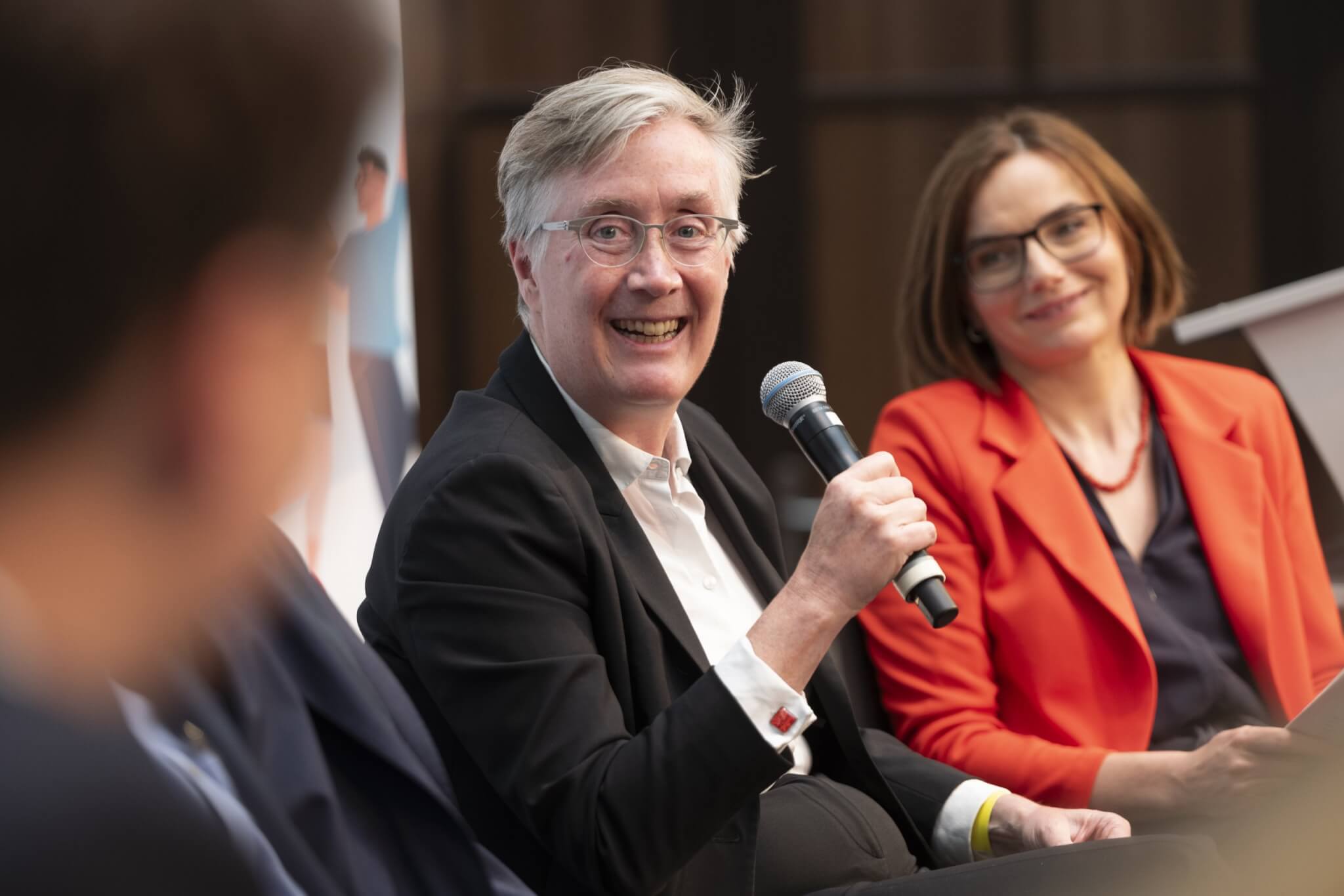
It was one of those Berlin mornings that pressed down on the skin like a heavy blanket in the Kenyan coastal city of Mombasa. The sun was already harsh, though it was barely past ten. I found myself in the courtyard of a quiet building along Winsstraße 58 in Prenzlauer Berg, where broad trees cast scattered shade on the cobblestones. Doves clattered and cooed in the branches above, a chorus that seemed to be a debate of their own. Across from me at a wooden bench leaning against a wall sat one of the most influential voices in the global conversation on artificial intelligence, Professor Joanna Bryson.
Bryson, now Professor of Ethics and Technology at the Hertie School in Berlin, is not your typical AI theorist. She was born in Milwaukee, Wisconsin, has a PhD from MIT’s famed AI Lab, and has lived through almost every wave of artificial intelligence’s rise and fall. She once helped build the first software for LEGO Mindstorms. She has advised governments, contributed to policy debates at the United Nations and OECD, and has watched with both fascination and concern as the world has surrendered itself, sometimes recklessly, to technologies it barely understands.
Sitting in that courtyard, with a warm mug of coffee in her hands, she looked back at her long career with bemusement. “If you look at AI as something completely new,” she told me, brushing a strand of hair from her face, “you lose a lot of the history that could help you understand how to use and regulate it, and what the likely impacts are. I think it’s better to see it from a larger picture.”
A Life Before the Hype
Bryson’s fascination with intelligence, both natural and artificial, dates back to the early 1980s. Her high school offered only one computer class, but even in those rudimentary lessons, she sensed a deeper possibility. “From the beginning,” she recalled, “I wanted to make computers that were more like a person, that could make decisions.”
This was long before ChatGPT, Gemini, or DeepSeek. Back then, AI was mostly an academic experiment, and often the subject of ridicule. Early attempts at machine translation, for instance, assumed that language could be reduced to dictionaries and grammar rules. She couldn’t help but laugh at the memory. “They thought all you needed was to switch word orders around. Of course, that’s not how languages work.”
But the impulse behind those early failures still drives today’s innovations. Alan Turing, one of the fathers of computer science, had once dreamed of creating machines that could mimic the presence of his dead childhood friend. Out of grief and longing, he laid the foundations of artificial intelligence. It’s kind of poetic that the world is still chasing the same ghosts today.
Is Generative AI Magic or Mirage?
Today, the world associates AI with tools like ChatGPT. Generative AI, with its ability to mimic human language and creativity, dominates headlines. However, Bryson is quick to deflate the myth.
“I agree it’s the most widely known,” she said, “but not the most widely used. Search is still the most pervasive AI. Every time you ask a system to pick the right action in a given context, you’re relying on search.”
Generative AI dazzles the public, but beneath the spectacle lies a different reality. It consumes staggering amounts of energy and water to run, while providing answers that are, by design, average. “You’re training off of patterns,” she explained. “At best, you’re getting the 70th or 75th percentile. But real value, whether for an individual or a society, comes from uniqueness. From pushing into the 90th percentile and beyond.”
This tension, between convenience and creativity, efficiency and originality, is at the heart of her unease. Generative AI can smooth communication, translate across languages, and democratize access to information. But it can also flatten cultural diversity, and worse, concentrate power in the hands of corporations and governments that control the infrastructure.
Clouds and Chains
Bryson says the real danger of AI is not the machines themselves, but the monopolies behind them. “There’s so much push to get people to think of ‘the cloud’ as if it were this neutral, magical place,” she said. “But it matters a lot whose cloud you’re in.”
She referred to the war in Ukraine as a point in case. According to her, parts of the country’s military equipment were remotely shut down when geopolitical winds shifted. “It was a signal to everyone,” she said flatly. “If you don’t do what the U.S. says, your systems can be turned off.”
The illusion of autonomy hides deep dependencies. The global AI ecosystem relies on a handful of suppliers, from chip manufacturing to cloud infrastructure, often concentrated in the United States, China, or a few European countries. A single bottleneck, say, a specialized technician who can build a critical part, can determine the fate of entire industries. “That’s why Africa should be thinking seriously about building its own systems,” Bryson argued.
Is Africa A Sleeping Giant?
Her eyes brightened when I asked about Africa’s place in this unfolding drama. “I had always hoped that it would be Africa,” she said. “There are so many smart, diverse people there. That diversity is exactly what you need for innovation.”
For her, Africa holds an overlooked advantage; the necessity of low-power solutions. In a world where energy-hungry AI models dominate, there is a growing demand for technologies that are efficient, lightweight, and resilient. “If you can get people the education and communication they need to pool their ideas,” Bryson said, “Africa could be a goldmine for low-energy computation.”
African countries, Kenya in particular, leapfrogged traditional banking systems across the world with mobile money- the world-famous Mpesa. A similar leap, she believes, could happen with AI, if governments and institutions invest in infrastructure and talent. “You already have a billion people there. That’s a lot of data very fast,” she said.
The Student Dilemma
In classrooms, the temptation for students to outsource their essays and assignments to ChatGPT is growing. Bryson sees this as part of a longer history of automation. “Computers have been better than humans at chess since the 1980s,” she said. “But instead of killing the game, it made chess more popular.”

The real issue, she argued, is not whether students use AI, but whether they understand why they are writing in the first place. “If you just have the machine do it and then go watch Netflix, you have nothing,” she said. “You’ve spent money, but gotten nothing in return.”
The danger is not that AI will make people stupid, but that it will erode the skills that set individuals apart. “Whenever you bring in new automation, some skills become cheap,” she said. “The challenge is to discover the new valuable skills that emerge.”
Of Weeds and Ecosystems
Toward the end of our conversation, I asked her where she thought AI would be in a decade. She rejected the idea of AI as an independent actor, and insisted instead that it was a tool, a resource, one that could either consolidate autocracy or enable resilience.
She borrowed a metaphor from nature. “When you have an earthquake and the land is bare, the first plants to grow are weeds,” she said. “They’re simple. They hold the soil together. But later, a more complex ecosystem develops.”
Right now, she suggested, authoritarian uses of AI are like weeds; crude but effective. But she hopes that, with time, societies will build richer, more sustainable institutions on top of these digital foundations. “I hope we harness it to build resilient governments, solve big questions about distributing resources, and help people thrive,” she said.
For Africa, her message is both cautionary and inspiring. Countries on the continent are already experimenting with AI in agriculture, healthcare, and finance. Kenya, for example, recently ranked among the world’s top users of AI, a fact that sparked debate at home about whether it signals laziness or ingenuity. She dismissed such binary judgments. “It doesn’t matter how much AI you use,” she said. “It matters what you use it for. Intention and consequence, that’s everything.”








LEAVE A COMMENT
You must be logged in to post a comment.