


|
LISTEN TO THIS THE AFRICANA VOICE ARTICLE NOW
Getting your Trinity Audio player ready...
|
On a crisp August Wednesday mid-morning in Berlin, I climbed the steps of the Berliner Dom, the 19th-century cathedral that looms over the city’s historic centre on the eastern edge of Museum Island. Tucked inside its vast stone walls, among echoing corridors that once served faith, now sits a very different kind of mission. EIDU’s headquarters. There, in a modest office overlooking the River Spree, I found Bernd Roggendorf, silver-haired, animated, and quick to laugh, with a laptop seeping with a steady hum.
We sat in a quiet corner and the fifty-something years-old (in his own words) leaned forward to tell me how a trip to Kibera, Nairobi’s largest informal settlement, had convinced him to abandon the world of sound engineering for a much harder challenge of re-wiring how millions of children learn.
In 2013, Roggendorf left the comfort of Berlin’s technology scene with his wife and two young children and moved into Kibera, Nairobi. The co-founder of Ableton, a music software company, wanted to see the world through “the eyes of underprivileged communities”. What he found on the ground were children eager to learn but constrained by under-resourced schools, and teachers working with limited support. This situation set him on a path that would ultimately lead to EIDU, an education technology organization now embedded in Kenya’s public-school system.

“It was an absolutely fantastic experience because pretty much from the first day onwards, we were so connected in the community,” Roggendorf recalled of his months in Kibera. “I learned how complex the world is. Usually there is no easy solution for anything.”
You can listen to the podcast of this story here
The complexity was humbling. However, when he later watched his daughter in Germany teach herself skills by interacting with software, something clicked. “I thought there’s an opportunity here because mobile phones are everywhere, smartphones are coming more and more,” he said. “You could reach children basically, even in very poor environments.”
That idea became EIDU, a Berlin-based but Kenya-born platform built to deliver high-quality, adaptive, and affordable digital learning for children in public schools. A decade later, the programme is operating in thousands of Kenyan schools across 31 counties, supported by teachers, county governments, and the Ministry of Education.
A vision formed in Nairobi
EIDU’s origins are deeply Kenyan. Roggendorf began his prototypes in the informal schools of Kibera, where private providers often filled gaps left by the public sector. With the local teachers, he and his small team co-designed the very first exercises. “We programmed it one day and then we talked to the people locally and they tested it directly with the teachers and the students to get feedback,” he said. “So from the very first moment, it was very integrated into Kenyan life.”
The problem he wanted to solve was stark. International statistics showed that while nearly all children in low-income countries now attended primary school, only about one in ten could read a simple paragraph by age ten. A 2021 joint report by the World Bank and UNESCO Institute for Statistics showed that 53 percent of children in low- and middle-income countries cannot read and understand a simple story by the end of primary school. The report further showed that in poor countries, the level is as high as 80 percent. It warned that the high levels of illiteracy are an early warning sign that SDG 4 for education and all related global goals are in jeopardy.
“The pedagogy is not good enough, teachers don’t have materials, and children learn much slower,” Roggendorf said. “That is basically the mission of EIDU, to fix that.”
How the system works
At the centre of EIDU’s model is a low-cost Android device, often just one smartphone per classroom. On that phone, teachers access daily lesson plans, and children take turns completing short, adaptive exercises in what has become known as the “EIDU Corner.”
“We start with just one device, one smartphone for the whole class,” Roggendorf said. “Typically you have a small table with a chair, and the teacher puts the device there. The kids are using the device one after the other … about half an hour per week per child.”
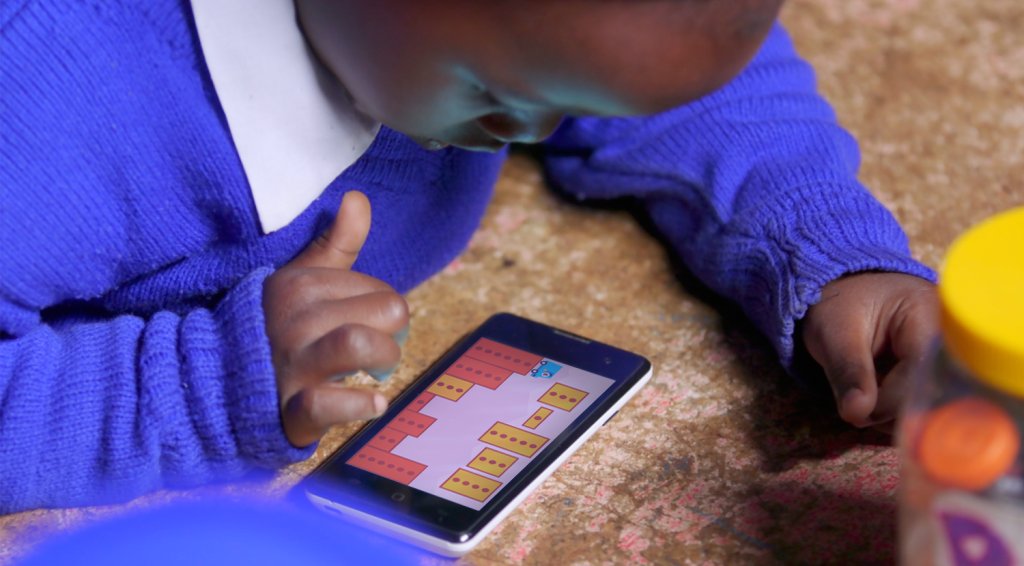
What happens on that device is carefully structured. The software provides lesson plans aligned to Kenya’s competency-based curriculum. For learners, it adapts in real time, and is able to offer easier or harder exercises depending on performance. Built-in assessments allow EIDU to measure progress against international benchmarks like EGRA and EGMA. For teachers, the device doubles as a guide, and suggests pedagogy and activities. And for curriculum support officers and county directors, dashboards show aggregated data to inform training and resourcing.
Fred Seda, EIDU’s Director of Operations in Kenya, calls it a “wholesome experience.” “It’s not just doing a targeted impact on a learner,” he said. “EIDU has appreciated that you need to change the system to be able to impact the learner more meaningfully … impact the teacher, impact the curriculum support officers, impact the decision makers with real-time dashboards.”
Teacher first approach
For all its adaptive software, EIDU is not a child-facing gadget company. From early on, Roggendorf realised that teachers had to be at the centre. “If you help the teacher, then the teacher affects all the children in the classroom, even those that might not want to interact with the software,” he explained. “And so we started focusing on the teacher as well.”
Teachers receive daily lesson plans drawn from programmes like Tayari, a structured pedagogy approach developed in Kenya and recognised internationally. Because EIDU distributes it digitally, what had once been an unfunded pilot can now reach tens of thousands of classrooms at negligible extra cost.
Seda says this focus on retooling teachers is essential. “The teacher is equipped, the teacher is retooled and the teacher is able to integrate technology in their pedagogy and hence again improve the experience of the learner,” he told me. Support officers from the government, who supervise teachers, are also trained to use the system and provide feedback. “They do observations and give feedback to the teacher so the teacher is able to gain competency and be able to leverage technology in the classroom.”
An independent randomized controlled trial (RTC) conducted by EdTech Hub in 2022 and 2023 validated that EIDU’s approach can boost learning to “more than 1.5 years within a single year.” This would essentially place it among the most effective education interventions tested in low- and middle-income countries.
Roggendorf sees this as proof that the small, structured doses of learning time add up. “What they usually learn in three years, they now learn in two years,” he said. “And actually, the data shows that the slowest learners are benefiting from it the most. So we are a bit equalising even within classrooms.”
Collaboration with Kenyan Government
From the outset, Roggendorf knew EIDU had to work with governments. “The vast majority of children around the world are going to public schools,” he said. “We never wanted to create something like a new structure, but actually empower the existing structure; the existing teachers, the existing schools, the existing management structures up to the Ministry of Education.”
That strategy paid off. After seeing results in hundreds of low-cost private schools in Mombasa, Kenya’s government invited EIDU to roll out in public schools as well. “We were not expecting that, but the support from the government from the very first moment was very clearly there,” Roggendorf said.

Seda describes the collaboration as unusually smooth. “It has been embraced in all the counties we are currently operating in,” he said. “Pretty much all the counties have welcomed the programme, and as they embrace, then we’re able to expand into even more counties.” EIDU now reports partnerships with 31 county governments, out of Kenya’s 47 counties.
One reason governments have embraced EIDU is its focus on affordability. The platform is designed to work offline, sync when connectivity is available, and run on inexpensive Android devices. “Because the government has no big budgets … we developed a super low-cost solution,” Roggendorf explained. “It was important that it’s fundable.”
Devices are portable and easy to charge, as a teacher can take one home and recharge it like a normal phone. This flexibility makes it workable even in remote counties with poor infrastructure. “Even if a learner doesn’t get all day online, they would still be able to maximise that opportunity of time,” Seda said. “It’s individual … the system is looking at ‘this person has this challenge, let me take them to focus on that challenge and move them forward as fast as possible.’”
The Kenyan government, recognising the potential, has also raised the question of long-term sustainability. Counties have begun to allocate budget lines to support EIDU, to ensure it doesn’t remain donor-dependent. “The government came to us and said, let’s talk about sustainability because we know that in the long run, you will not get funding forever,” Roggendorf said. “They were so eager to find solutions to continue because they liked the programme.”
Scaling beyond Kenya
Although Kenya remains EIDU’s largest footprint, the platform has begun to expand. During the COVID-19 pandemic, when schools in Kenya closed, EIDU pivoted quickly to Nigeria, and set up operations in 700 schools within three months. The experience proved that the model could travel. Today, EIDU is active in Nigeria and piloting in Pakistan as well.
The ambition is enormous. Roggendorf has set a target of reaching a billion children globally by 2030, a goal that would require scaling by a factor of three each year. “If you look at the last five years, we actually managed to scale by a factor of 2.5,” he said. “So not exactly where we want to be, but it’s an extreme exponential curve if you look at the numbers.”
Roggendorf thanks the government’s agility and receptability for EIDU’s fast growth and expansion. “So far, what I have experienced with the Kenyan government is pretty mind-blowing,” he said. “I was not expecting it to go so fast … in Germany it takes forever. Thinking in decades is really something you have to do. So far, the Kenyan government was super agile and fast and always found solutions.”
Seda, meanwhile, takes pride in how communities have responded. “Working with the governments, especially the county governments … there is a very good collaboration spirit,” he said. “Everybody wants to see improvement in the localities they serve and it’s more of working with them in collaboration with them as opposed to parallel to them.”











LEAVE A COMMENT
You must be logged in to post a comment.