

|
LISTEN TO THIS THE AFRICANA VOICE ARTICLE NOW
Getting your Trinity Audio player ready...
|
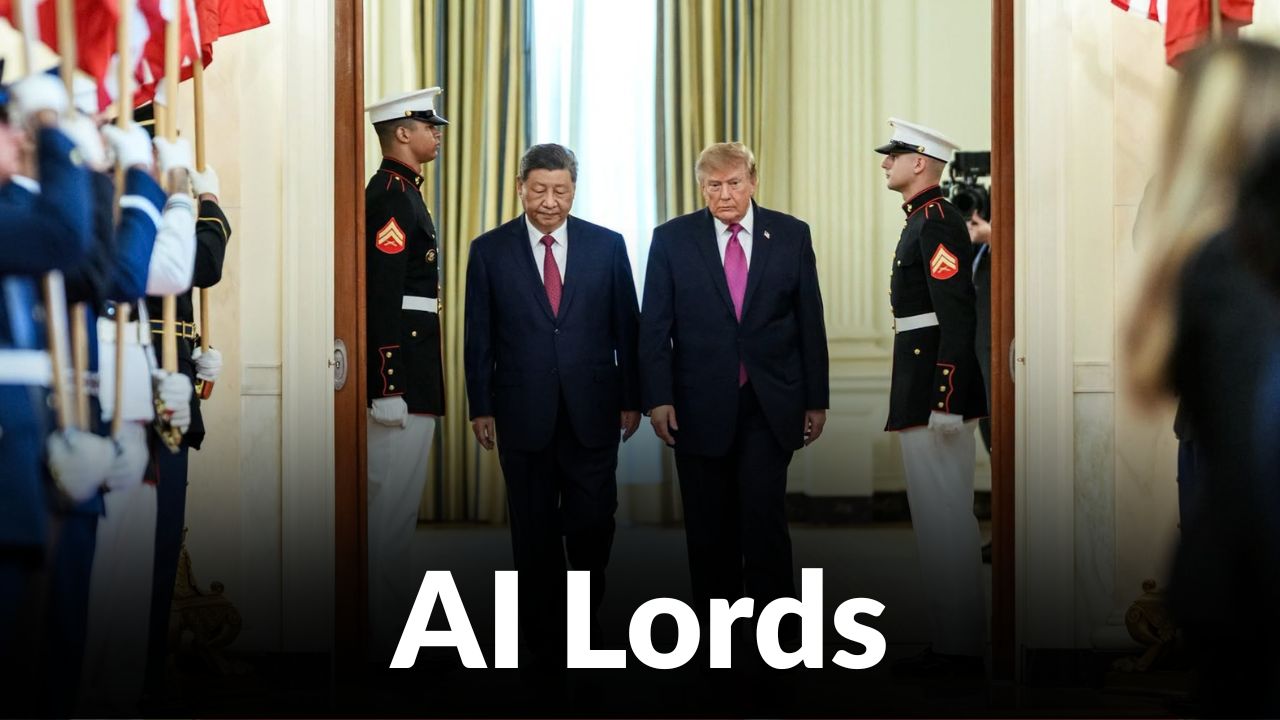
President Donald Trump and Chinese President Xi Jinping walked through the White House together Thursday as leaders of the two nations racing to build the most powerful artificial intelligence. By the end of the state dinner, they had traded toasts and praise, but they announced no public plan to keep that technology safe.
Every person on the planet has a stake in what the two leaders left unsaid.
In June, a U.N. scientific panel warned that AI could cause catastrophic harm, either on its own or through malicious users.
Panel members also found that AI is advancing faster than scientists can understand it and faster than governments can adapt.
Trump and Xi cannot remove that risk alone, but no serious plan to reduce it can work without them.
Warm Words at the White House, but No Public AI Deal
Xi had not visited the White House in more than a decade.
His trip came roughly four months after Trump’s state visit to Beijing in May.
Hours before the talks, Trump played down calls for new AI limits.
In a social media post reported by Reuters, he wrote of superintelligence, “I want to leave it exactly where it is.”
He added that the Justice Department serves as the U.S. guardrail.
Xi struck a different note.
Speaking in the Grand Foyer, he said both nations lead in artificial intelligence and called for the “development of AI, always under human control.”
He also said cooperation may not solve every problem between the two countries, but it is necessary.
At dinner, Xi told guests the two sides had found common ground on many issues, but he gave no details on any new agreements.
Earlier in the week, Washington and Beijing extended a tariff truce by two months without striking a broader deal.
Rivals Have Drawn an AI Safety Line Together Before
Cooperation between these two powers is not a fantasy.
In November 2024, then-President Joe Biden and Xi agreed in Lima, Peru, that humans, not artificial intelligence, should make decisions on using nuclear weapons.
A White House statement said both leaders affirmed the need to “maintain human control over the decision to use nuclear weapons.”
Six months earlier, officials from both governments had met in Geneva for talks on AI risk and safety.
Nuclear rivals built hotlines during the Cold War without ending their rivalry.
Artificial intelligence calls for the same logic.
A Realistic Trump-Xi AI Deal Would Start Small and Still Matter
Nobody expects the two leaders to sign a grand treaty.
Shared definitions and frameworks for the safety of powerful models, along with an emergency channel to discuss incidents, are among the likeliest areas of agreement, analysts told CNBC.
Chris McGuire of the Council on Foreign Relations called such a channel a modest but positive step, while saying a deal to slow AI development is very unlikely.
Rep. Ro Khanna, a California Democrat who represents part of Silicon Valley, went further and urged the leaders to agree to ban self-improving AI.
Both presidents have left the door open.
Xi told a Shanghai AI conference in July that AI must be kept secure and controllable.
Trump, for his part, posted this week that the government will rein things in if it has to.
Turning those separate statements into one shared commitment is the work still undone.
Competition on Price Helps the World, but Competition on Safety Does Not
Rivalry between the two powers has brought real gains to builders elsewhere.
Nigeria-based insurtech Curacel recently added a Chinese model from Beijing’s Zhipu AI alongside models from Western providers.
Chief executive Henry Mascot said the Chinese models delivered comparable results at lower cost on high-volume tasks.
Choice like that is worth protecting.
Businesses and governments everywhere benefit when U.S. and Chinese labs compete on price and access.
Nobody benefits when they compete by cutting safety testing to ship faster.
Trump and Xi can keep one race going and end the other.
A shared incident channel, common testing standards and a firm pledge on human control would cost neither side its lead.
Distrust remains real, however.
In Lima, Xi criticized U.S. export controls on advanced chips, a dispute that still divides the two capitals.
Trump has also said the United States would be in a very bad position if it does not win the AI race.
Those tensions did not stop the Lima agreement, and they need not stop the next one.
No Two Powers Can Write the AI Rulebook Alone
Washington and Beijing hold the most powerful labs, but the rest of the world will live with the results.
In July, the United Nations held its first Global Dialogue on AI Governance in Geneva, a forum where every government has a seat.
At the General Assembly this week, Kenyan President William Ruto co-chaired an AI coalition of middle powers with Finnish President Alexander Stubb.
Ruto said, “Such rules must be globally shaped, not globally imposed.”
He also cautioned against a future where Africa supplies the minerals, energy, data and talent behind AI, then buys the finished products at high cost.
Kenya has called for developing countries to become “co-authors, not mere rule-takers” of emerging AI regulations.
African institutions are already doing that work, beginning with the African Union’s Continental AI Strategy, endorsed in Accra, Ghana, in July 2024.
At a G20 AI summit in Cape Town last year, African Union Commission Deputy Chairperson Selma Malika Haddadi said, “Where such models do not exist, Africa must lead in their co-creation.”
Trump and Xi walked through the same doorway Thursday, flanked by an honor guard and two nations’ flags.
Whether they now walk toward shared guardrails will shape the risks facing billions of people who were not at the dinner.
Middle powers from Nairobi to Helsinki are ready to help write those rules.
Washington and Beijing must first agree to hold the pen together.




LEAVE A COMMENT
You must be logged in to post a comment.