

|
LISTEN TO THIS THE AFRICANA VOICE ARTICLE NOW
Getting your Trinity Audio player ready...
|
The 2026 FIFA World Cup is entering its most decisive week, and Africa’s contingent has more reason for optimism than in years. Four African nations are confirmed in the knockout round. Two more are fighting through matchday three to join them. The Caribbean’s representatives did not make it through, but they did not leave quietly.
Here is a comprehensive look at where every African and Caribbean team stands, what comes next, and why South Africa’s story deserves your full attention.
Teams Already Through to The Knockout Rounds
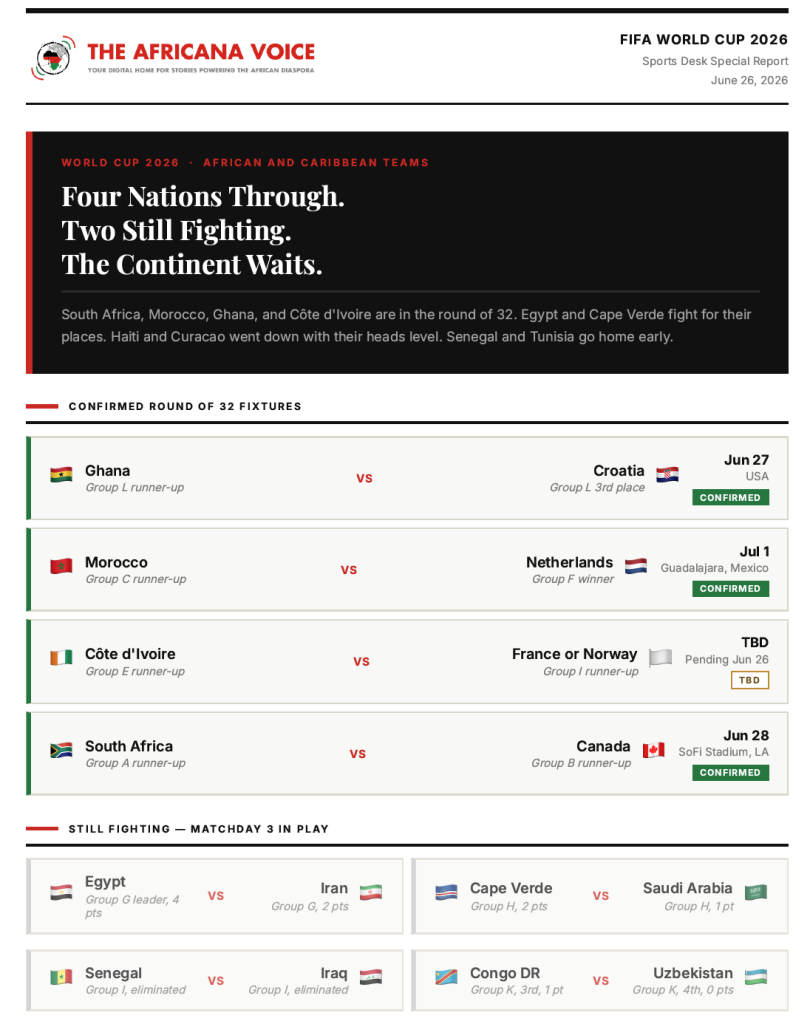
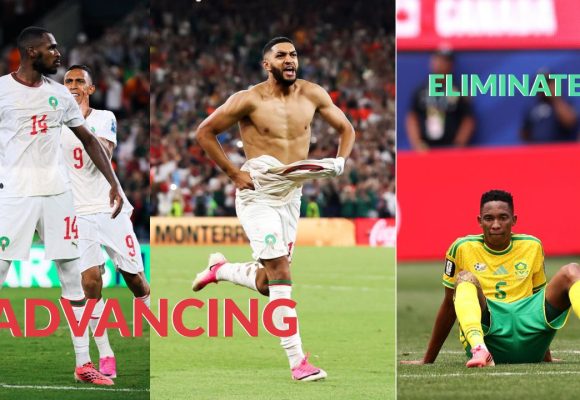
Morocco is through and doing what it does best: winning. The Atlas Lions beat Haiti 4-2 to finish second in Group C behind Brazil. They are confirmed in the round of 32 and will face the Netherlands on July 1. It is a brutal early draw, but no one who watched the 2022 World Cup believes Morocco cannot handle a European giant.
Ghana punched its ticket as well, finishing second in Group L behind England. The Black Stars are confirmed in the knockout stage and will face Croatia on June 27. The Ghanaians have settled old scores with European opponents before. Croatia should not take this lightly.
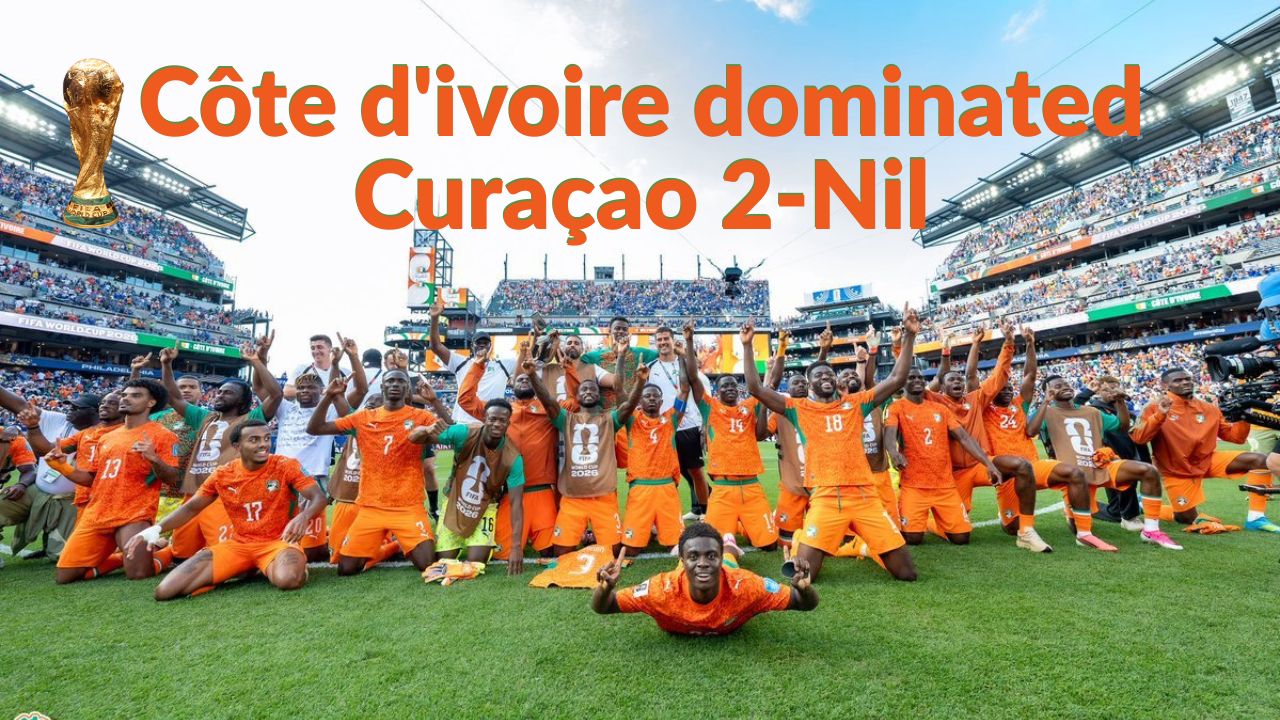
Côte d’Ivoire earned its place with authority. The Elephants defeated Curacao 2-0 on June 25 to finish second in Group E with six points. Their round-of-32 opponent will come from Group I, with a dramatic late-group clash between France and Norway to be settled on June 26. Whichever team emerges, the Elephants will be ready.
Algeria is still alive, sitting third in Group J with three points. Their fate will be decided in the best third-place rankings once all groups conclude.
Still in the Fight
Cape Verde is fighting to the final whistle. The island nation faces Saudi Arabia on June 27, needing a result to confirm their place in the knockout round. With odds nearly level at 36.4 percent for Cape Verde versus 34.8 percent for Saudi Arabia, this is genuinely anyone’s result.
Egypt needs a win or a draw against Iran on June 27 to advance. Egypt leads Group G with four points. They are the favorites but cannot afford a slip.
Congo DR faces Uzbekistan on June 27 in a match where a win keeps their third-place hopes very much alive. The Leopards carry a 54.8 percent win probability heading into that fixture, according to current projections.
Who Has Gone Home
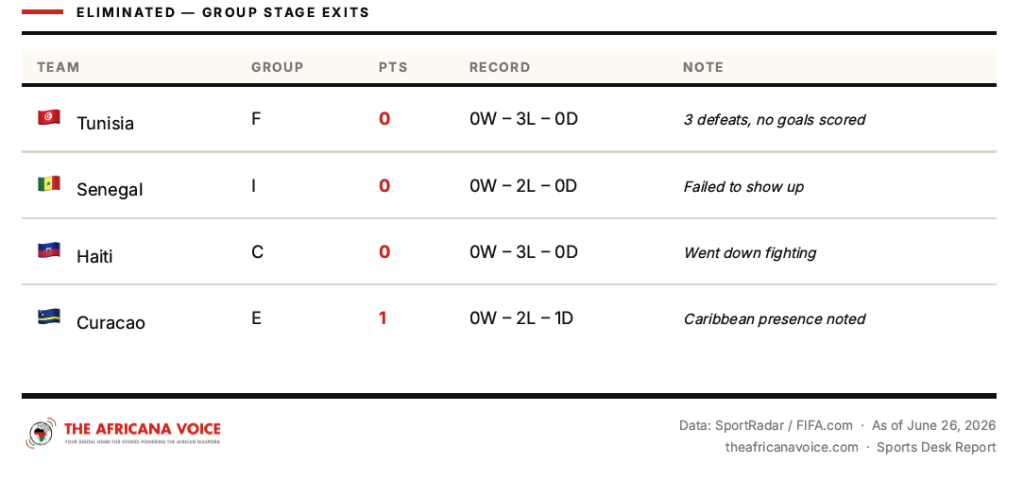
Senegal’s exit is the most jarring African story of the group stage. The Lions of Teranga arrived ranked among the continent’s strongest sides, with European-based talent across every position and a recent AFCON title on their resume. They did not show up. Two defeats and a mathematical elimination before their final game represent a collapse that Senegalese football will be examining for months. No single result defines a squad’s failure more than being beaten to the knockout round by the arithmetic before the last whistle even blows.
Tunisia lost all three group games and finished last in Group F with zero points. Their exit is painful, particularly for a squad that had the technical quality to do more.
The Caribbean
Haiti arrived at the 2026 FIFA World Cup as underdogs and left as something more complicated than a losing record suggests. They fell in all three group games, including a 4-2 defeat to Morocco in their final match, but the Grenadiers were never a passive presence. They scored twice against one of Africa’s most defensively organized sides. Throughout the group stage, they pressed, competed, and refused to settle into the role of tournament fodder.
A nation that has endured political instability, economic strain, and a devastating earthquake cycle still managed to qualify for and compete at football’s biggest stage. Haiti goes home with zero points and their heads level. The program is young, with a long runway.
Curacao also exits at the group stage, finishing bottom of Group E with one point from three matches. Their 2-0 defeat to Côte d’Ivoire on June 25 came against a side that controlled 62 percent of possession and was simply the better team. Curacao’s presence at this tournament is itself a statement about the growth of football in the Dutch Caribbean. They will be back.
The United States: A Co-Host with Mixed Results
The host nation’s World Cup is in better shape than the Türkiye result suggests. The USMNT entered their group finale having already clinched first place in Group D, meaning their place in the round of 32 and their opponent were both confirmed regardless of what happened against Türkiye. Türkiye, meanwhile, had already been eliminated after losing its first two matches, so it had nothing to play for either.
With the outcome irrelevant to both sides, manager Mauricio Pochettino made nine changes to his starting lineup, the most rotations an American side has ever made between two World Cup matches. Four regular starters,
Tyler Adams, Folarin Balogun, Chris Richards, and Antonee Robinson were held out to avoid them picking up a second yellow card, which would have triggered a one-game suspension for the round of 32. Christian Pulisic, returning from a calf injury, began on the bench. The 3-2 defeat was suffered by a reserve lineup in a match with no consequences. The first team is rested, protected, and waiting.
The U.S. now faces Bosnia and Herzegovina in the round of 32, and Pochettino will have his full complement available. Bosnia are not coming to lose, but neither is the real American squad.
Côte d’Ivoire: Precise, Composed, and Built to Win
The Elephants deserve their plaudits. Against Curacao on June 25, Côte d’Ivoire controlled 62 percent of possession, struck the target three times, and scored in the 7th and 64th minutes. The win was professional and controlled, not frantic. Goalkeeper Yahia Fofana was barely tested. The forward line, featuring Amad Diallo, Nicolas Pepe, and Ange-Yoan Bonny, moved with cohesion that reflects weeks of tactical preparation under coach Emerse Fae.
What matters more than the scoreline is the timing. A 2-0 win in the final group game, when teams often freeze or overcomplicate, showed a squad with mental clarity and belief. The Elephants arrived at this tournament as one of Africa’s most technically gifted sides. They are playing like it.
Bafana Bafana’s Draw and What It Actually Means
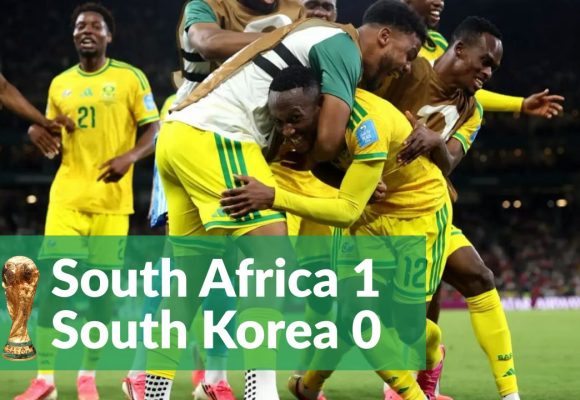
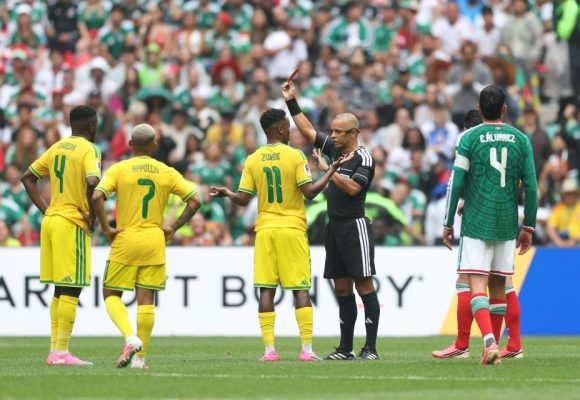
South Africa entered matchday three sitting fourth in Group A. They left it in second place, confirmed in the round of 32 for the first time in their history. Thapelo Maseko’s 63rd-minute strike was the only goal in a 1-0 win over South Korea, a result as hard-fought as it was historic.
The statistics tell the full story of how this team operates. South Africa held only 31 percent possession against Korea and produced 14 total shots to Korea’s 7, but converted when it mattered. They absorbed 69 percent of Korea’s ball time, sat deep, pressed on transition, and punished a single lapse. It is not pretty football. It works.
South Africa will play Canada in the round of 32 at SoFi Stadium in Inglewood, California, on June 28. If you are looking for a favorable bracket gift, that is about as clean as it comes at this stage of the tournament.
Canada finished second in Group B with four points. They drew 1-1 with Bosnia, hammered Qatar 6-0, then lost 2-1 to Switzerland in the group decider. The Canada squad has genuine quality. Jonathan David scored four goals in the group stage. Captain Alphonso Davies and vice-captain Stephen Eustaquio anchor a side built on pressing and rapid transitions. Canada arrived at this tournament still searching for consistency, however, and their loss to Switzerland exposed real defensive vulnerabilities.
Bafana Bafana’s draw is favorable. Let no one confuse favorable with guaranteed. Canada is a co-host, energized, and coached by Jesse Marsch’s demanding tactical system. This will be a fight.
The Most Domestic Squad at the World Cup
Flying under the dark clouds of Afrophobia is a fascinating success story about South Africa’s Bafana Bafana that deserves far more international attention than it is getting.
Nineteen of the 26 players in the South Africa squad are based in South Africa, with Mamelodi Sundowns and Orlando Pirates, the two dominant clubs in South Africa’s Premier Soccer League, supplying eight players each. No other team at this World Cup is built on a domestic foundation anywhere near this scale. Only two players in the entire squad play their club football outside South Africa.
Thapelo Maseko, the man who scored the goal that made history, plays for AEL Limassol in Cyprus. Lyle Foster spent the 2025-26 season with Burnley in the English Premier League before the club’s relegation in April.
Every other player learned the game and is still playing it on South African soil. This is not a squad assembled from European leagues and parachuted home for a tournament. Coach Hugo Broos, 74, took charge in 2021 and made a deliberate choice to build from South Africa’s Premier Soccer League up, not around players whose availability and match fitness depended on foreign clubs. That philosophical bet, and this is his declared final job before retirement, is paying off on the biggest stage.
Consider the players making this team run. Teboho Mokoena of Mamelodi Sundowns is the midfield anchor, described by those who follow the Premier Soccer League closely as the most complete midfielder South Africa has produced in a decade. Relebohile Mofokeng of Orlando Pirates is 21 years old and attacks with the fearlessness of someone who has nothing to prove and everything to win. Oswin Appollis of Orlando Pirates provided width and directness that consistently stretched Korea’s defense on June 25.
The starting eleven against Korea included defenders Khuliso Mudau, Aubrey Modiba, and Mbekezeli Mbokazi, all products of South Africa’s club structure. The system asks them to sacrifice possession and win through organization, tactical discipline, and transition quality. Under this kind of domestic coaching philosophy, these are exactly the attributes the Premier Soccer League develops.
The Deeper Meaning
African football analysts have long argued that dependence on Europe-based squads creates a structural ceiling for the continent’s national teams. Players who spend most of the year in foreign systems, adapting to foreign coaching philosophies and tactical demands, often arrive at tournaments in need of national-team reintegration. Bafana Bafana have no such problem. They know each other. They know the system. They know what is being asked of them.
Whether this approach is sustainable as African clubs face increasing pressure to lose their best players to European scouts remains an open question. Right now, in the summer of 2026, a squad built almost entirely inside South Africa’s own football infrastructure is in the round of 32 of the FIFA World Cup for the first time in history.
That is not a small thing. That is a proof of concept.





LEAVE A COMMENT
You must be logged in to post a comment.