

|
LISTEN TO THIS THE AFRICANA VOICE ARTICLE NOW
Getting your Trinity Audio player ready...
|
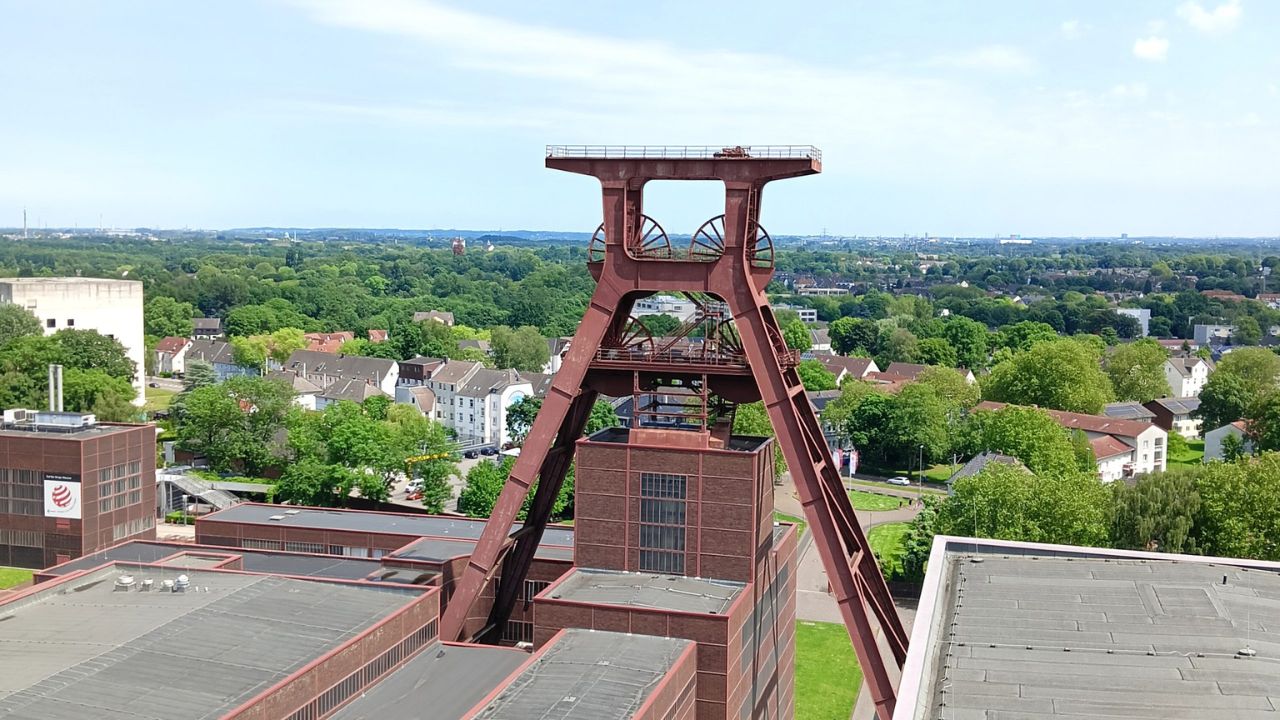
I meet Philipp on a Saturday in late May 2026, the last one of the month, under a sky so clear it almost feels wrong for a place built on coal. The air is clean, the clouds are doing nothing in particular, and the red steel of the Doppelbock; the twin-wheeled winding tower that has become, almost against its will, the unofficial Eiffel Tower of the Ruhr, cuts straight up into the blue sky like something that does not belong to this century anymore.
This story has a companion podcast episode, The Afterlife of Coal
Philipp is 32, hair tied back, glasses on, a jungle-green button-up with sleeves rolled to the elbow, and a black tote bag slung over one shoulder that reads in plain white letters, Glück auf; the old miners’ greeting, wishing each other good luck before the descent. He is dressed like a man who still expects to get his hands dirty even though his job now is talking, not mining. He points up at the tower before he’s even said hello properly.
“This is a monument for Essen and for the whole Ruhr area,” he tells me, and then, “many of my family members were miners and I was raised in this area.”
Philipp was born and raised in this region. His folks worked here. And he himself worked here, before quitting. He is, in many regards, and by his own account, the transition itself, walking around in one body. He trained as an electronics technician and fixed machinery in coal and nuclear plants around the world. He came home to Germany “because my girlfriend was lonely,” he says, and went to work in a coal mine in northern Westphalia.
Then he did something that still seems to surprise him when he says it out loud: he joined the protest camp against that same mine. Miner, then protester. Now he’s a Master’s student in public history at Ruhr University in Bochum, and on weekends he leads people like me through the ruins of the industry his grandfather gave his lungs to.
“I looked at both sides,” he says simply, as if that settles something. I think it does.
Standing Where 8,000 People Once Worked
We start walking, and Zollverein opens up the way old industrial sites do; slowly, then all at once. Philipp explains that this single complex, at its peak, produced ninety percent coking coal; the special, almost-pure carbon fuel that, heated to 900 degrees without oxygen so it wouldn’t simply burn away, fed the blast furnaces of steel mills across the entire Ruhr; the largest urban agglomeration in Germany with over five million people, and a land size of 4,439 square kilometers. “We needed that material to produce iron,” he says, “because it burns very hot and very clean.” Every city in the region had its own steel plant once. Now there’s one left, in Duisburg, 30km to the west.
He tells me the mine’s name comes from a customs union; Zollverein, that German states formed in 1834 to stop charging each other duties every time goods crossed a border. The Haniel family who founded the mine in 1840 were so grateful for the free trade it enabled that they named their pit after the policy.
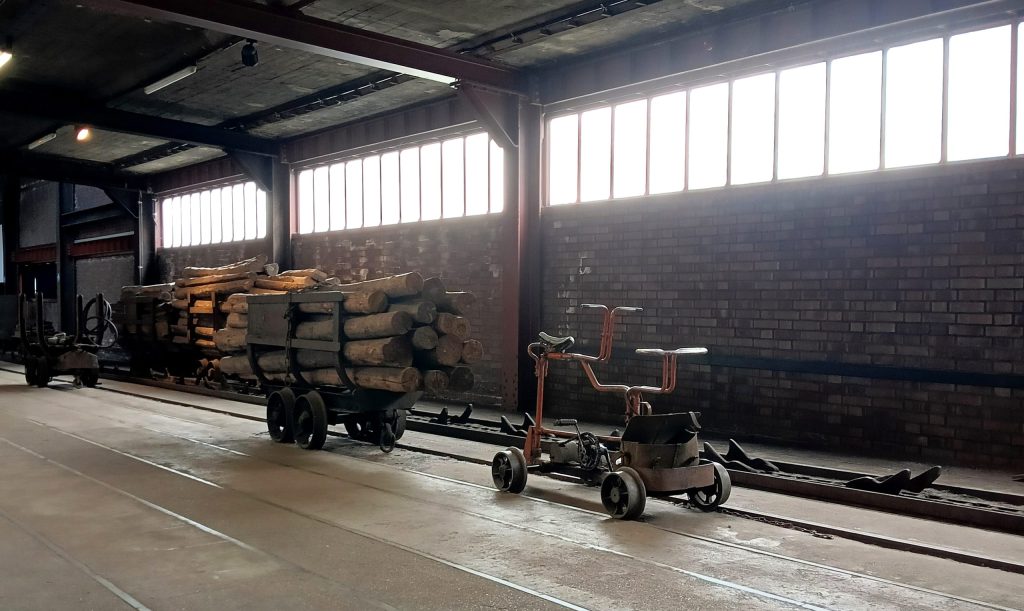
Inside the old hall where coal wagons used to be emptied, “one to two of those steel wagons per second,” he says. Philipp plays me a recording. It’s the actual sound of the building in 1950: a wall of noise that he says hit 120 decibels, thirty times louder than what we’re hearing now through the recording. “Till 1960, no ear protection, no helmet, no safety shoes, no dust mask, nothing,” he says. No insulation either, minus five degrees inside in winter, fifty in summer.
I ask him, almost reflexively, why we still burn the dirtiest kind of coal at all. “Because you have a lot of sulphur and many other materials that are quite hard to filter out,” he says, and then adds: “the spruce speaks before it breaks.”
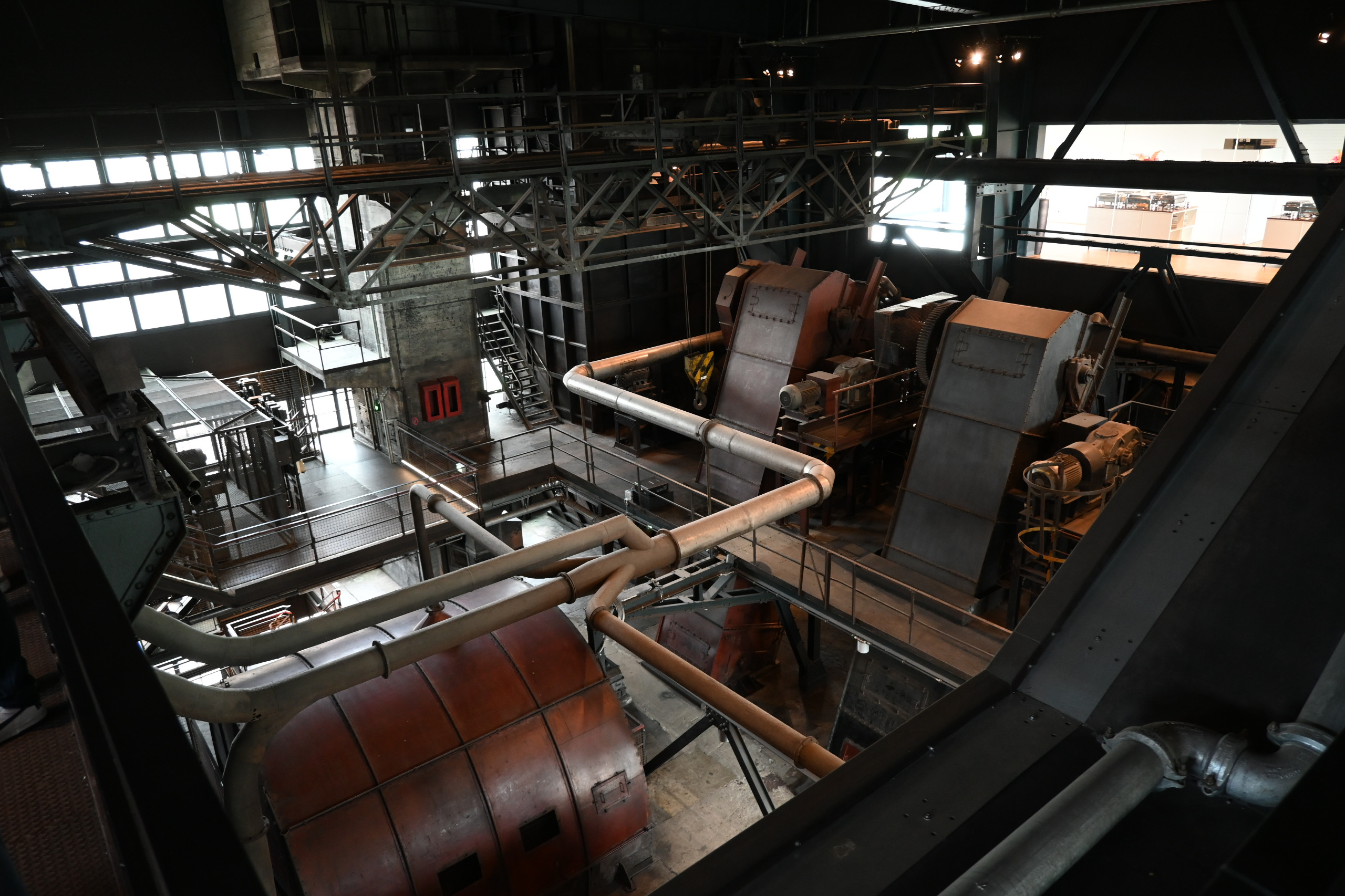
He’s talking about the wooden support beams the miners used to hold up the tunnel ceilings, a thousand metres down. Spruce, not the stronger oak, because spruce cracks and groans under pressure before it gives way, giving the men below twenty seconds of warning to run. Oak would have been silent, and deadlier. “Spruce speaks before it breaks so that means under too high pressure the wood starts cracking and the miners knew oh we have 20 seconds to run out of the tunnel before it collapsed but the oak would be more stable but wouldn’t make a noise so then the miners would have been lost.”
His grandfather worked this mine too, retired at fifty under hazard rules that no longer exist, and recently turned 91. “My grandfather became 91 two weeks ago,” he says. “He went to retirement at 50 and he’s now longer in retirement than he worked so that was perfect because when I was small he had everyday to tell me stories.”
The Law That Finally Caught Up
Standing in that hall, it’s easy to forget that Germany’s coal exit isn’t really about Zollverein at all anymore. Zollverein closed in 1986, decades before anyone in Berlin wrote a phase-out into law. The shutdown that matters now is happening in the lignite basins further west, and it is governed, almost bureaucratically, by the Kohleausstiegsgesetz: a 2020 law that sets a hard ceiling of 2038 for the last coal plant in the country, with built-in checkpoints in 2026, 2029, and 2032 to see whether Germany can move the deadline up to 2035 instead. Hard coal mining itself ended nationally in 2018. Lignite, the dirtier brown coal Philipp says Germany will “close them all in 2032,” now has an even earlier target in some basins, accelerated to 2030 after a government deal in 2022.
Attached to the law is a structural support package worth up to 40 billion Euros, meant for the regions and workers the closures leave stranded. Older miners get compensation payments bridging them to retirement. It is one of the most heavily subsidized industrial phase-outs anywhere, and it exists because Germany already tried the alternative once, here, in this exact region, and watched it nearly fail.
By the late 1950s, Philipp tells me, German coal was already a losing economic bet. Australia had coal seams ten metres thick sitting at the surface; Germany’s had to come up from a thousand metres down, three times more expensive by 1958. The government propped the industry up anyway, not for economics but to avoid a social collapse across the whole Ruhr.
“They knew here that they had to stop all the mining but they didn’t want to because they wanted to protect this area from a social crisis and that’s why they made state subsidies for the coal mining,” he says. “They wanted to do it for 20 years for a longer structural change but they did it for 60 years.” The last mine didn’t close until 2018, sixty years of subsidy where twenty had been planned, a slow-motion unwind whose costs and benefits are still being argued over in exactly the rooms where today’s lignite deadlines are being set.
What the Sixty Years Bought
What that extra time bought, unmistakably, is visible from where we’re standing. The old mining railways are bicycle paths now. The rivers, Philipp says, are clean enough to swim in again in summer. “One thing that my grandfather says that was better in the past was the sundowns because they were bloody red just like in the desert because of all the air pollution in the air,” he says.
“In fact when you see movies from this area from the 70s for example, you would never see a blue sky in the whole area but today there’s not that much air pollution anymore and the sky is blue again and I prefer the blue sky in comparison to the nice sundowns,” he says.
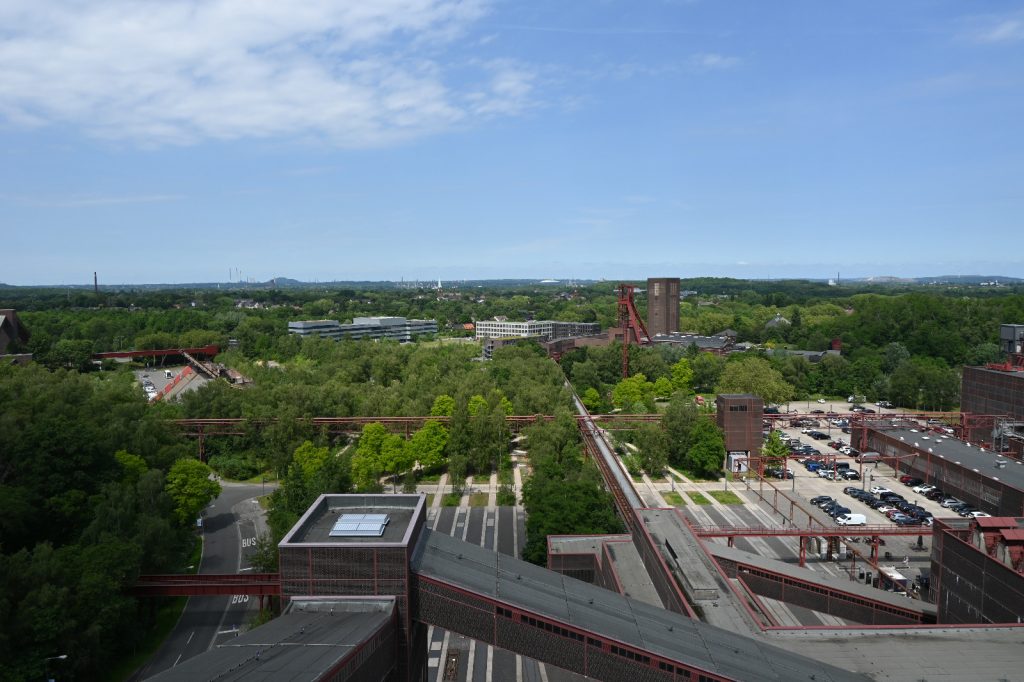
The artificial hills built from a century and a half of mining waste, ten to fifteen of them, some 200 metres high, now host food festivals, raves, and panoramic hiking trails. “We have artificial hills in the area with a height of 100 to 200 metres and many kilometres wide so really big areas that have been repaired with grass and many different trees and they offer a great panorama over the area,” he tells me, pointing out to the hills on the horizon from atop the viewpoint, 45 meters above the ground.
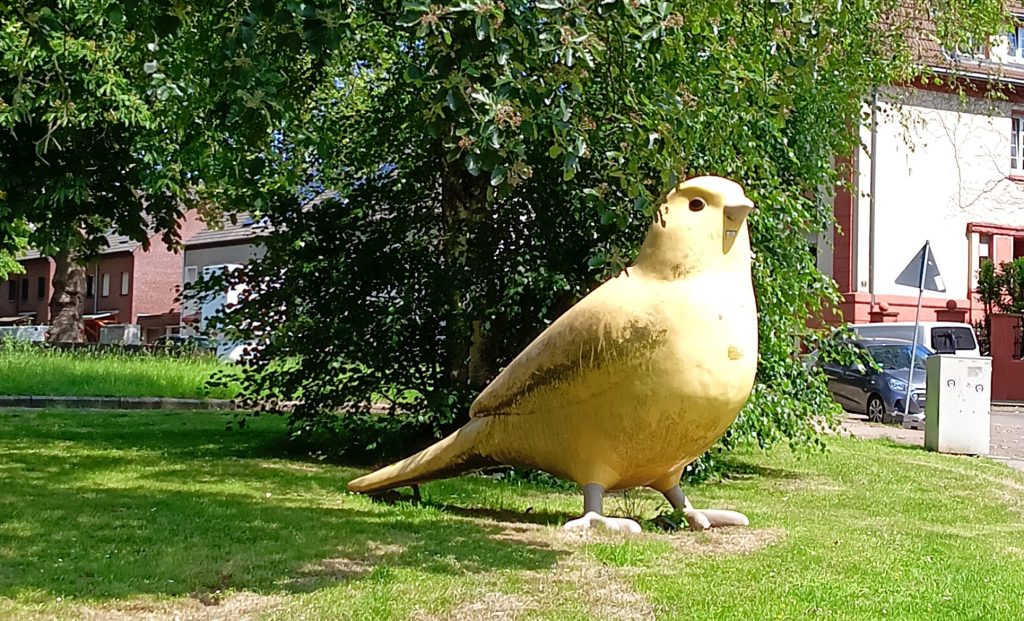
Zollverein itself draws roughly 1.5 million visitors a year, and Philipp tells me, with something between pride and unease, that about as many people are employed here today, above ground, as worked the mine before it closed.
That last fact is the one I keep returning to. The jobs came back. The people did not, well, not the same people, and not in the same towns, and obviously not at the same wages. A miner’s grandson can become a historian who leads tours through the family trade. But not every miner’s grandson gets that option.
What the Ground Still Remembers
Besides being economic, the transition here is quite literal, and unfinished. A century and a half of mining caused the whole region to sink, Philipp tells me, by an average of 30 metres in places. Sinkholes still open without warning; one swallowed two garages and three cars in the year 2000, the ground dropping fifteen metres in a single second. A crater opened beneath Essen’s main train station just last year, and officials called it routine maintenance before admitting, a day later, it was mining subsidence. “These whole sinking scores are causing caves to the ground so we have around 90 holes per year,” he says.
“One year ago at the Essen main station there was a hole two metres wide and two metres deep showing up right in the middle of the day directly under rail so they had to close down the whole main station and they said we had to do some maintenance on the rails… so one day later we heard it from the government that there was a mining destruction.”
Unexploded bombs from Allied raids; 350,000 were dropped on the Ruhr, still surface during construction season. At the current rate, Philipp says, it will take roughly two more centuries to find them all. “I’m 32 right now,” he says. “I can’t imagine that there was one month when they didn’t find a bomb. For example last month they found 25 bombs… so it’s quite normal when you for example go home from work then the police stand on the road and say okay you can go home in six hours because we had to evacuate the whole district because we found bombs.”
It’s a strange inheritance for a region rebranding itself as a cultural destination: blue skies, clean rivers, the highest density of universities in Germany, built on ground that is, quite literally, still settling underneath it.
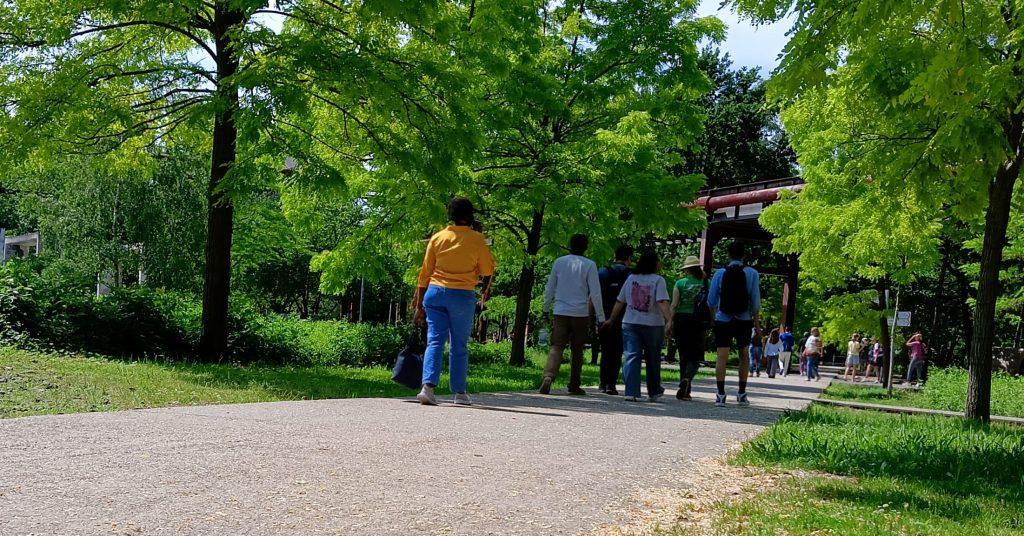
Germany had sixty years, forty billion Euros and, eventually, a UNESCO World Heritage Site to help transform one of Europe’s largest coal regions. Even then, the work remains unfinished. Beneath the museums, cycle paths and restored waterways of the Ruhr Valley, the ground still shifts. Sinkholes occasionally appear without warning. Coal may no longer dominate the landscape, but its imprint remains etched into both the land and memory.
A Fire Still Burning
Nearly 7,000 kilometres away, in India’s coal belt, that legacy is unfolding in real time.
In Dhanbad, Soldi Devi still struggles to speak about the night her husband, Surendra Singh, died. Fearing carbon monoxide leaks linked to underground coal fires, she and her children spent the night in a relief camp. Singh stayed behind in their home.
“He never woke up,” she says.
Across the Jharia coalfields, residents describe living with cracked walls, sinking ground and the uncertainty of what future awaits communities built around coal. For many, the debate about transition is not an abstract discussion about climate targets but a question of survival.
“If we had the money, why would we stay here?” asks Ajit Pandit, whose workshop stands near land scarred by subsidence. “This is our livelihood. Where will we go?”
The question is one Germany spent decades trying to answer.
But while Ruhr’s transformation unfolded gradually over generations, India is attempting to balance two realities at once: continuing to depend on coal while preparing for a future beyond it.
Government officials insist planning is underway. The Ministry of Coal in India says the government has planned the scientific closure, reclamation and repurposing of defunct mines. According to the Ministry, 11 coal mines have been scientifically closed and 147 will be closed between 2025 and 2026.
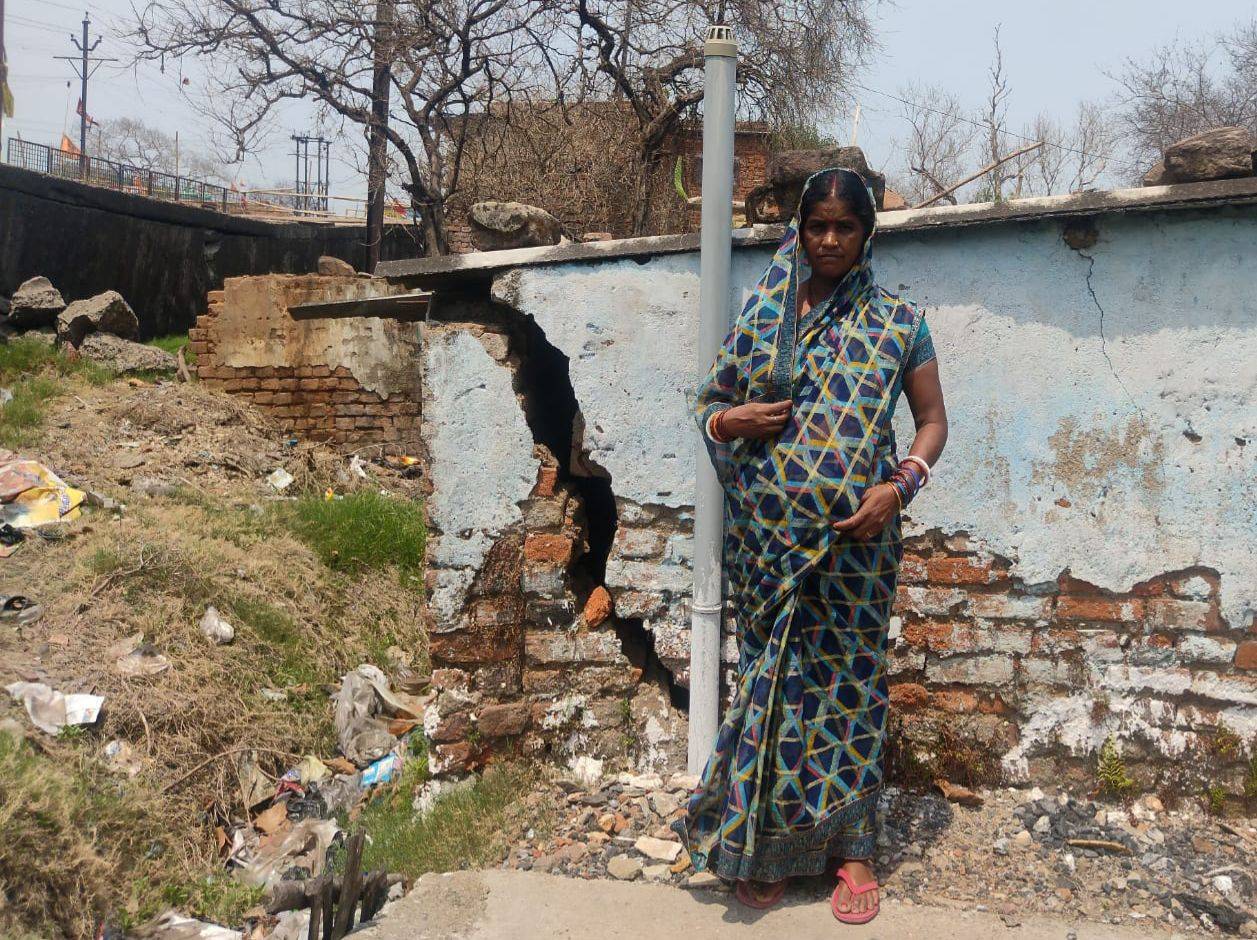
However, many residents and labour representatives interviewed in Jharkhand say they remain uncertain about what those plans will mean in practice.
“There is a huge communication gap between the management and people,” says P.N. Tiwari, the secretary of West Jharia Bihar Colliery Kamgar Union. “The people affected by subsidence are being offered damaged quarters.”
Under India’s Green and Sustainable Development Partnership with Germany, the latter earmarked a 5 million Euros grant for “development and implementation of plans” for “sustainable closure and repurposing of abandoned and about to be closed Indian coal mines” But the grant is still pending approval by the Union government after 1.5 years.
The coal ministry in India said it had not approved any such project in the state.
That tension between policy ambition and lived reality is familiar in Ruhr. The region’s transformation is often remembered through its successes: cleaner air, revitalised rivers and former industrial sites reborn as cultural landmarks. Less visible are the decades of public investment, political negotiation and social support that helped communities navigate the decline of coal.
And the Ruhr demonstrates that coal transitions take long. Long after the last miners leave, the land continues to settle. Communities continue adapting. Governments continue spending.
The rivers are cleaner now. The sky above the Ruhr is blue again. Where miners once descended into the earth, tourists queue for guided tours and schoolchildren wander through exhibitions. Yet beneath the region, old tunnels still shape the landscape. Sinkholes still appear. Long after the last coal was hauled to the surface, the work of managing its legacy goes on. And on.
Additional reporting by Tapasya Pandita from India. Read Tapasya’s full reporting from Dhanbad at The Reporters’ Collective.
This story has a companion podcast episode, The Afterlife of Coal








LEAVE A COMMENT
You must be logged in to post a comment.