


|
LISTEN TO THIS THE AFRICANA VOICE ARTICLE NOW
Getting your Trinity Audio player ready...
|
NAIROBI, Kenya (TAV-Updated 10/15/2025) -Raila Amolo Odinga, Kenya’s former prime minister, veteran opposition leader, and one of Africa’s most enduring champions of democracy, has died in India at the age of 80.
Odinga reportedly suffered a cardiac arrest while undergoing treatment in the southern Indian city of Kochi. According to Indian newspaper Mathrubhumi, he collapsed during a morning walk and was rushed to Devamatha Hospital in Koothattukulam, where doctors pronounced him dead.
Affectionately known to millions as “Baba”, Swahili for “father,” Odinga’s life mirrored Kenya’s own post-independence evolution — from single-party authoritarianism to multiparty democracy, from political repression to reform.
Life journey
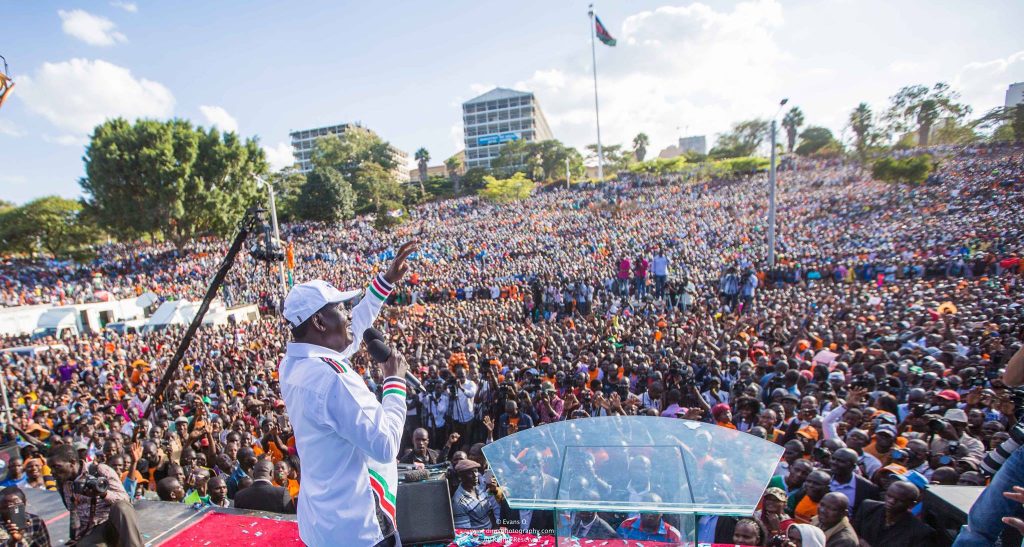
Born in Maseno, western Kenya, in 1945, Odinga was the son of Jaramogi Oginga Odinga, Kenya’s first vice president and a towering figure in the nation’s independence movement. Educated as an engineer in East Germany, he returned home in the 1970s and entered politics during a period of tightening state control under President Daniel arap Moi.
He became a vocal critic of Moi’s one-party state and spent much of the 1980s detained without trial. Yet, in a show of political pragmatism, Odinga later joined forces with Moi in the late 1990s, merging his National Development Party with the ruling KANU in an attempt at national unity. The alliance was short-lived. Odinga broke with Moi after disagreements over succession and, in 2002, stunned the nation by endorsing opposition leader Mwai Kibaki with the declaration “Kibaki Tosha!” “Kibaki is the one.” That moment ended KANU’s 39-year hold on power and became one of the most memorable in Kenya’s political history.
Odinga served as Kenya’s prime minister from 2008 to 2013 in a power-sharing government formed after the disputed 2007 election, which led to widespread violence and the deaths of more than 1,000 people. As prime minister, he helped stabilize the coalition and oversaw reforms that led to the 2010 Constitution, which devolved power and strengthened democratic institutions.
Although he ran unsuccessfully for president five times, Odinga’s influence on Kenya’s political landscape was unparalleled. His career embodied both resistance and reconciliation — a leader who confronted authority yet remained open to dialogue. His 2018 “handshake” with then-President Uhuru Kenyatta marked a powerful act of unity following years of political division.
Tributes and National Mourning
President William Ruto led national mourning, describing Odinga as “a giant of our democracy, a patriot, and a tireless defender of Kenya’s unity.” Ruto announced seven days of national mourning, with national flags to fly at half-mast across the country, and confirmed that Odinga will be accorded a state funeral.
Former President Uhuru Kenyatta, once Odinga’s fiercest rival and later his ally, said Kenya had lost “a father to the nation and a statesman whose courage and conviction guided Kenya through its most trying moments.”
From New Delhi, Indian Prime Minister Narendra Modi expressed his condolences, calling Odinga “a cherished friend of India and a towering African statesman.” Modi said Odinga’s “wisdom, warmth, and leadership left an indelible mark on Africa and strengthened the bond between our two nations.”
Legacy
Odinga’s life was defined by resilience and evolution. To his supporters, he was a symbol of justice and perseverance, a leader who spoke for the voiceless and embodied Kenya’s democratic struggle. To his critics, he was a shrewd political tactician who mastered the art of survival in a volatile political environment.
He is survived by his wife, Ida Odinga, and their children, Rosemary, Raila Jr., and Winnie, and was predeceased by his eldest son, Fidel Odinga, who died in 2015.
Raila Odinga will be remembered as a true democrat and reformer, a leader who fought for freedom, endured setbacks with grace, and transformed Kenya’s politics without ever occupying the presidency. His legacy will endure in the institutions he helped build and in the ideals he stood for.
Side Note: Some Kenyan media outlets have reported that Odinga’s family wishes to fulfill his personal request to be buried within 72 hours of his death at his home in Bondo, Siaya County, but the family or government sources have not independently confirmed this information.


LEAVE A COMMENT
You must be logged in to post a comment.