

|
LISTEN TO THIS THE AFRICANA VOICE ARTICLE NOW
Getting your Trinity Audio player ready...
|
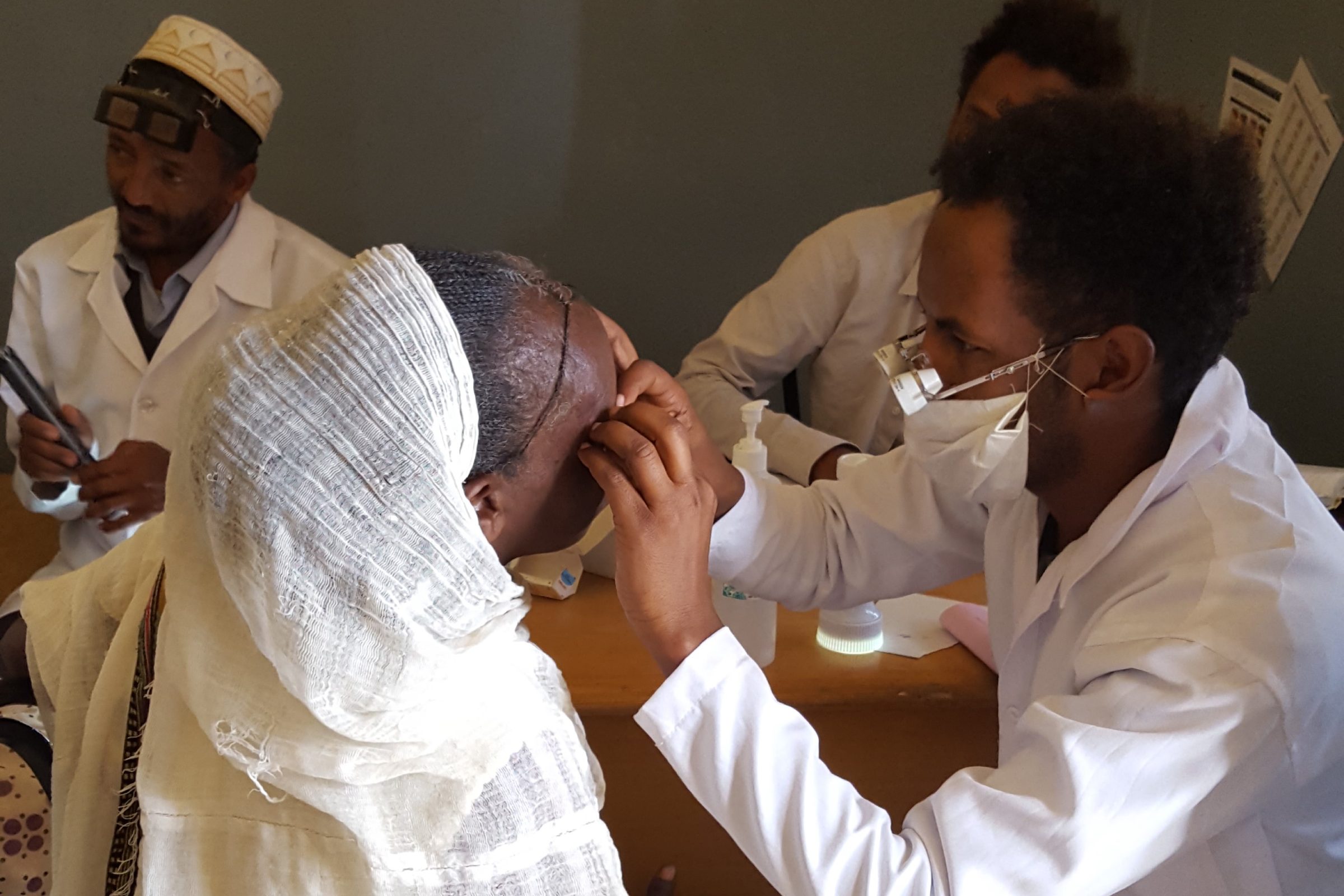
For a disease that can eventually take away someone’s sight, trachoma often begins in an unremarkable way. At first it is an infection of the eye which is easily mistaken for an ordinary irritation.
But when infections return repeatedly over several years, the consequences become devastating. The inside of the eyelid gradually scars, causing the eyelashes to turn inwards and scrape against the surface of the eye. The resulting pain and damage can lead to permanent blindness.
For generations, this disease has affected some of the world’s poorest communities, particularly those where access to clean water, sanitation and basic healthcare remains limited.
In Eritrea, a country where many people live in remote rural areas, tackling trachoma meant addressing the conditions that allowed the disease to spread, identifying affected communities and sustaining interventions long enough to change the pattern of infection.
After more than two decades of work, the country has reached an important milestone. On 16 November 2026, the World Health Organization (WHO) validated Eritrea’s elimination of trachoma as a public-health problem. It became the 11th country in the WHO African Region and the 34th globally to achieve the status.
A disease rooted in poverty
Trachoma is caused by the bacterium Chlamydia trachomatis. It spreads through contact with discharge from the eyes and noses of infected people, including through hands, clothing, bedding and other contaminated surfaces. Certain flies can also transmit the infection.
Children are particularly important in the transmission cycle. In communities where the disease is endemic, repeated infections can occur within households, exposing other family members.
The danger is not necessarily immediate. A single infection may clear, but repeated episodes over several years can cause progressive damage. Eventually, the eyelid can turn inwards, forcing the eyelashes to rub against the eye. This advanced condition, known as trachomatous trichiasis, can cause severe pain, damage the cornea and lead to irreversible blindness if left untreated.
The disease is closely linked to living conditions. Overcrowded homes, inadequate sanitation, limited access to water and difficulties maintaining facial cleanliness all contribute to its spread.
Women and girls can face a particularly high burden. Their frequent close contact with young children, who are an important reservoir of infection, exposes them to repeated infections. WHO estimates that women are blinded by trachoma up to four times as often as men.
Two decades of hard work
Eritrea’s programme began with understanding where the disease was concentrated and how widespread it had become. Baseline surveys were conducted in different parts of the country between 2006 and 2020. These assessments helped health authorities identify affected areas and determine where interventions were needed.
The country eventually surveyed all 58 of its sub-zobas, the second-level administrative divisions used in Eritrea. The programme used the findings to direct resources towards communities where trachoma remained endemic.
Its approach followed WHO’s SAFE strategy, a combination of four interventions: surgery for people with advanced trachoma, antibiotics to clear infection, facial cleanliness to reduce transmission, and environmental improvements, particularly access to water and sanitation.
Each component addressed a different part of the problem. Surgery helped people whose eyelashes had turned inwards, preventing further damage to their eyes. Antibiotics, particularly oral azithromycin, helped reduce infection within affected communities. The medicine was predominantly supplied through donations from Pfizer via the International Trachoma Initiative.
Meanwhile, efforts to promote facial cleanliness and improve sanitation addressed the environmental conditions that allow infection to circulate.
A 2025 study published in the International Journal of Infectious Diseases provides an indication of the scale of progress. It reported that Eritrea had performed 22,546 surgeries for trachomatous trichiasis. The proportion of children aged one to nine with active trachoma had fallen from above 10 per cent in 2006 to below 5 per cent by 2022. Among adults aged 15 and older, the prevalence of trichiasis had declined from 3 per cent to below 0.2 per cent in most regions.
The study also reported that 93 per cent of villages had achieved open-defecation-free status.
Why the achievement matters beyond Eritrea
Trachoma remains a significant public-health challenge in several parts of the world, with Africa carrying much of the burden.
WHO estimates that approximately 92 million people were living in areas where trachoma remained endemic as of March 2026. The disease is responsible for blindness or visual impairment in about 1.9 million people worldwide.
In 2025 alone, nearly 99,000 people received surgery for advanced trachoma, while 47.4 million received antibiotics in affected communities.
The global picture is nevertheless changing. The number of people requiring interventions against trachoma fell from an estimated 1.5 billion in 2002 to fewer than 100 million by November 2025, a reduction of approximately 94 per cent.
Eritrea’s achievement adds to that progress. It is also part of a wider African effort to eliminate neglected tropical diseases, a group of illnesses that disproportionately affect communities living in poverty and with limited access to essential services.
Eritrea’s programme used digital tools to collect data and map affected communities, helping health workers direct interventions even in hard-to-reach areas. WHO has also highlighted the country’s community-led approach to sanitation and the role of partnerships with organisations including the Fred Hollows Foundation.




LEAVE A COMMENT
You must be logged in to post a comment.