

|
LISTEN TO THIS THE AFRICANA VOICE ARTICLE NOW
Getting your Trinity Audio player ready...
|
For the past month, the streets of Kenya’s capital have reeked of smoke and blood.
The acrid sting of tear gas clings to the air, mingling with the sharp metallic scent of fresh gunshot wounds. Nairobi, once a bustling metropolis of enterprise and ambition, now feels like a battlefield.
The protesters, overwhelmingly young, march with placards, mini flags, and an unyielding belief that their future has been stolen. Their defiance rattles the establishment, because it is largely peaceful, organic, fearless, and fueled by betrayal.
President William Ruto, who once positioned himself as the champion of the poor, now stands accused of betraying an entire generation. Ruto, elected in 2022 on promises of economic liberation, his administration has instead delivered soaring inflation, brutal taxation, and a level of police violence that echoes the darkest days of Kenya’s authoritarian past.
The breaking point came in June 2025, when footage spread of a 24-year-old mask vendor, Boniface Kariuki, being executed at point-blank range by a police officer. His crime was selling face masks on the wrong street at the wrong time. The video, grainy but unmistakable, showed him raising his hands in surrender before the fatal shot rang out. He died days later in hospital.
By July, the protests had swelled into a national uprising. Thousands of young Kenyans, many of whom had never engaged in politics before, took to the streets to demand an end to police brutality, better lives, and resignation of President Ruto. What began as opposition to punitive taxes in June 2024 has quickly become a full-throated demand for Ruto’s resignation. The government’s response has been swift and merciless.
On Saba Saba Day, July 7, a date long symbolic of resistance in Kenya, security forces opened fire on unarmed demonstrators. By nightfall, 38 people lay dead. Among them was a 12-year-old girl in Kiambu, struck by a stray bullet while watching television in her living room.

Photo: Daniel Irungu / EPA
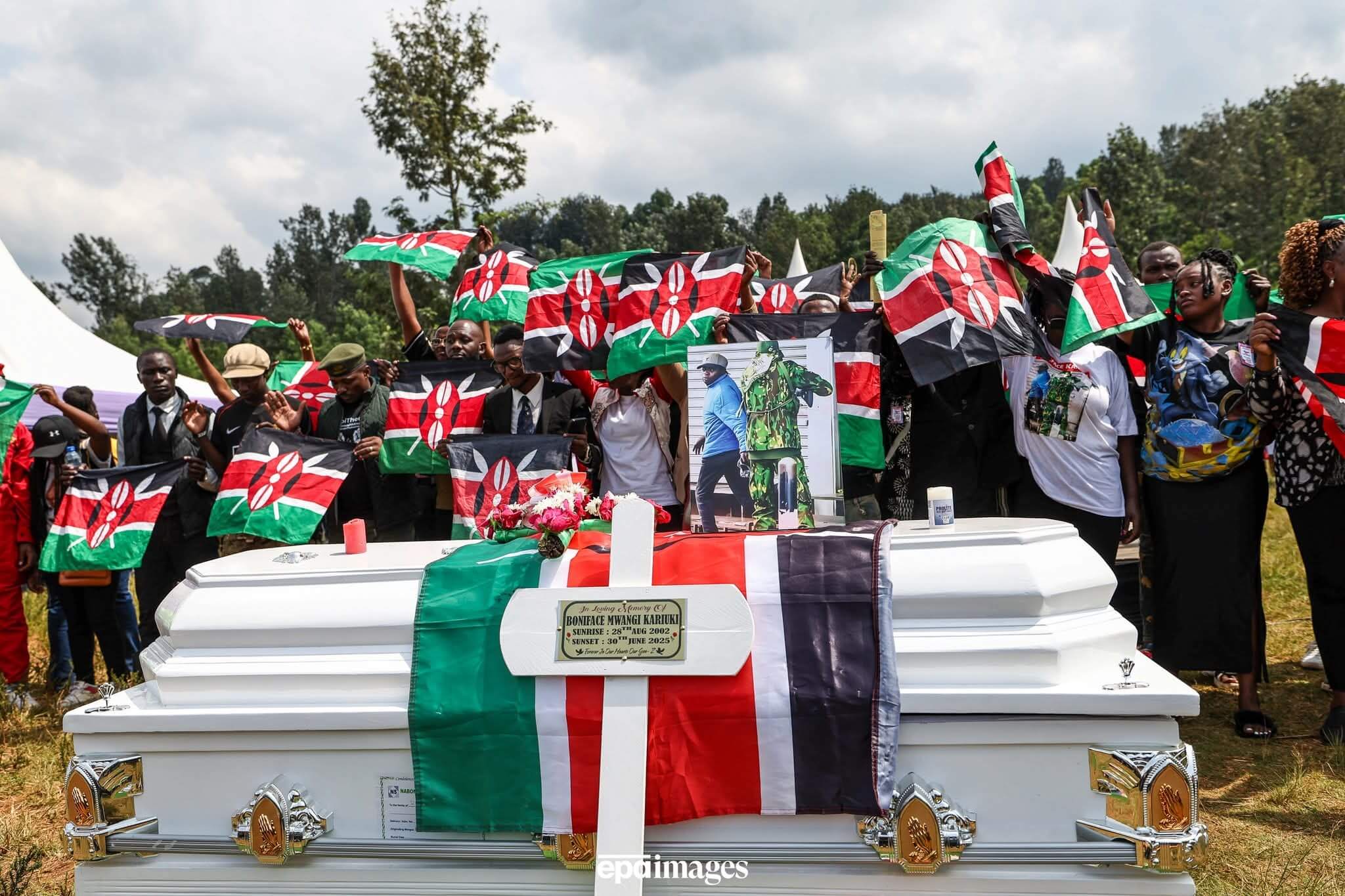
This last week, Boniface Kariuki came home to Murang’a in a white coffin draped with the Kenyan flag. On Friday, July 11, hundreds gathered on the red-earth slopes of his ancestral village in Murang’a, on the slopes of Mt Kenya, their Kenyan flags fluttering in the wind like a thousand silent accusations. The government that sanctioned his killing stayed away, its absence louder than any official statement.
The most haunting image wasn’t in the grave, but beside it. A life-sized banner showing Boniface’s final moments. There, frozen in time, stood Police Officer Klinzy Baraza, service short gun leveled at the unarmed vendor’s head from behind. The photo captured the instant before the trigger pull, before Boniface became another entry in Kenya’s ledger of state-sponsored killings.
Mourners filed past the open casket, some collapsing when they saw what the bullet had done to the young man’s face.
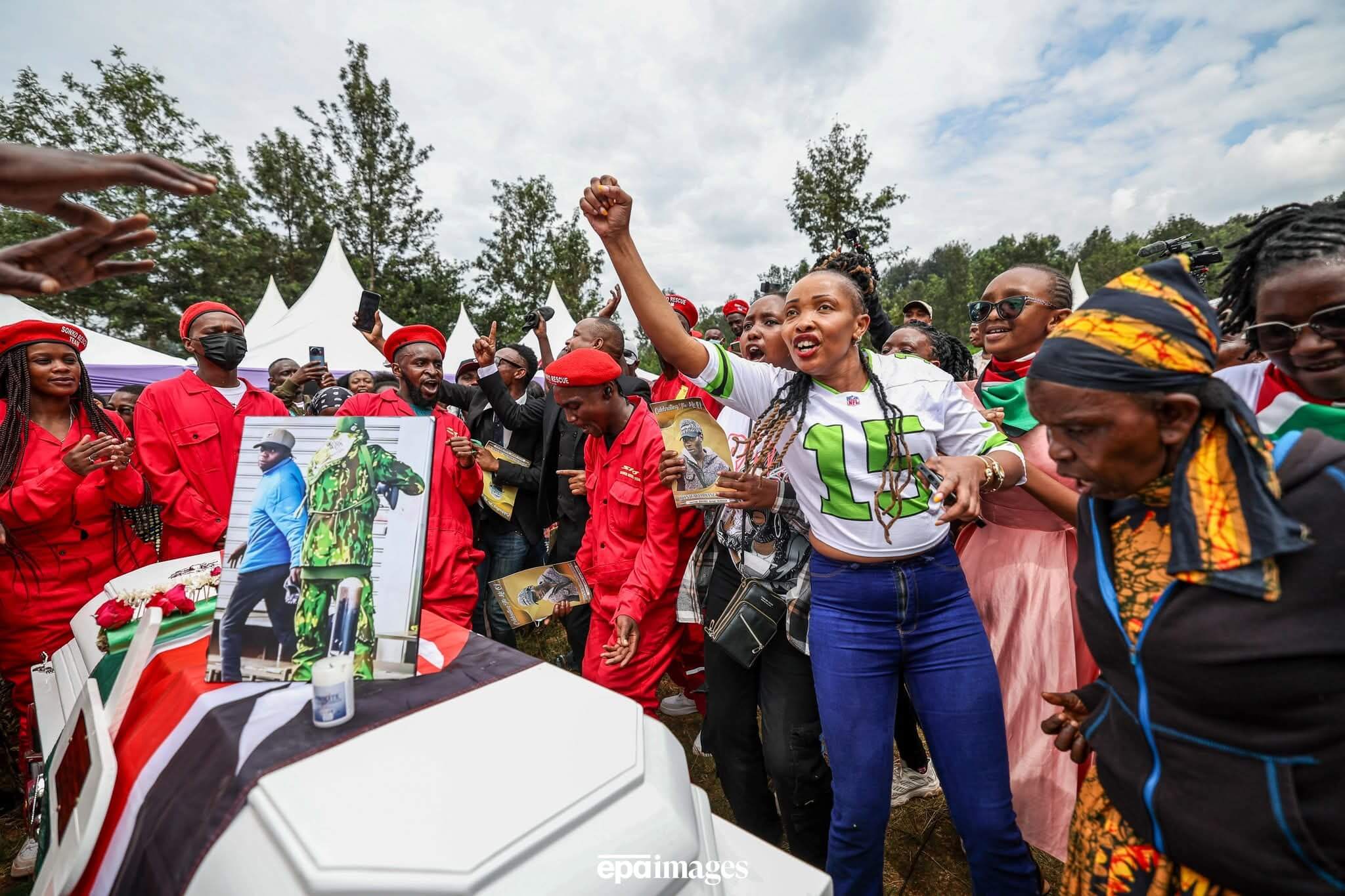
During Boniface’s burial, Governor Irungu Kang’ata spoke with fire.“This young man did not commit a crime. He was striving to make ends meet. These youths don’t deserve to die. They deserve protection. This government must take responsibility for the death of Boniface. We shall not rest until Boniface gets justice.”
Wiper leader Kalonzo Musyoka, also in attendance, added: “Not even a word of condolence from the government. Their silence screams of complicity.”
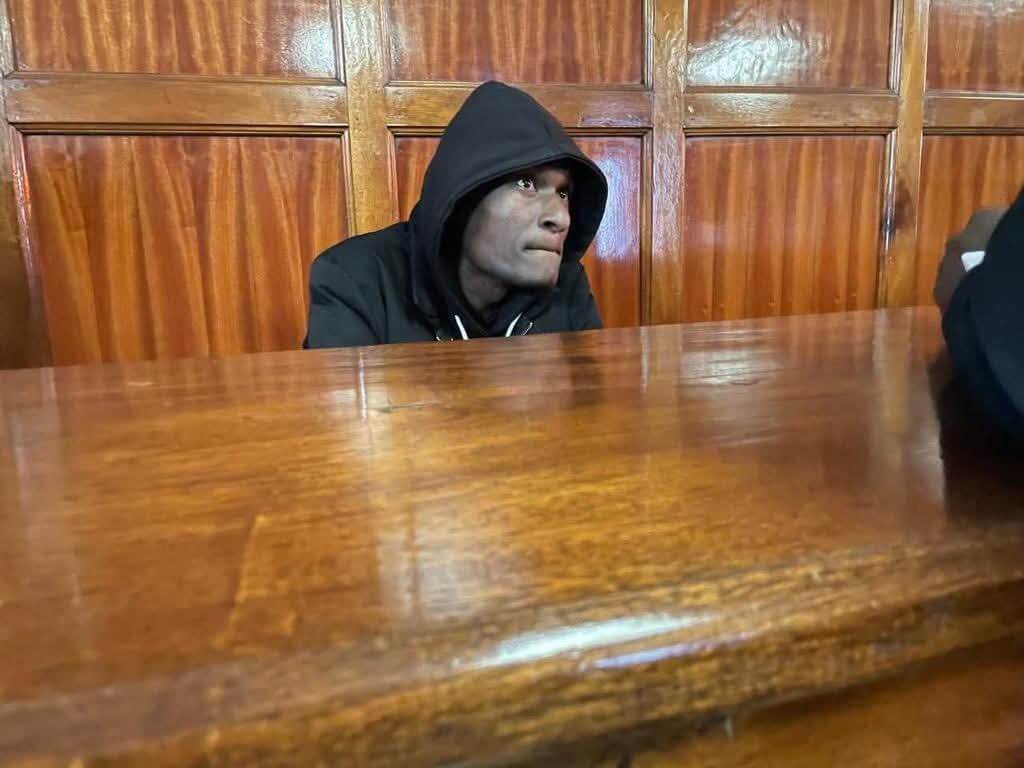
In Nairobi, police Officer Klinzy Masinde Baraza, accused of firing the bullet that killed Boniface, was officially charged with murder on July 10. But when he appeared in court, he stood alone. There were no superiors. No police union. He was by himself.
His fellow officer, Sammy Ondimu Ngare, offered a reflection on Facebook. “When the gun was issued, it came with personal responsibility. And when he pulled the trigger, the consequences became his alone… When things go wrong, you will be alone.”
In Murang’a, the dirt rained down on polished mahogany, each shovelful sounding like another nail in a regime’s coffin. And across Kenya, millions of young people scrolling funeral live streams shared the last heartbreaking moments of the funeral procession.
That same evening, a disturbing statement from the Kenya National Commission on Human Rights (KNCHR) confirmed what many feared. Boniface was not alone. The death toll from the Saba Saba Day protests of July 7 stood at thirty-eight. Over 130 more were wounded. A dozen were children. Fourteen of the 15 completed autopsies showed the victims died from gunshot wounds, including a 12-year-old girl who was shot while watching TV at home in Kiambu.
“The majority of those already identified are youth below 25 years,” said the statement, signed by KNCHR Vice Chairperson Dr. Raymond Nyeris.
The Commission further revealed families were being asked to pay for post mortems and medical bills, despite a government waiver. “A majority of these families are underprivileged and unable to pay the bills,” the KNCHR noted.
It called on the Ministry of Health to waive all related costs, and for postmortems to be done urgently, transparently, and under independent oversight.
A Government That Shoots Its Youth
What began as peaceful protests against an unpopular Finance Bill in June 2024 has now ballooned into a national uprising, with young Kenyans, mostly Gen Z, at its heart. Their call is an end to corruption, police brutality, and disregard for human rights. But instead of listening, the government has responded with tear gas, live bullets, arrests, and what many describe as state-sanctioned terror.
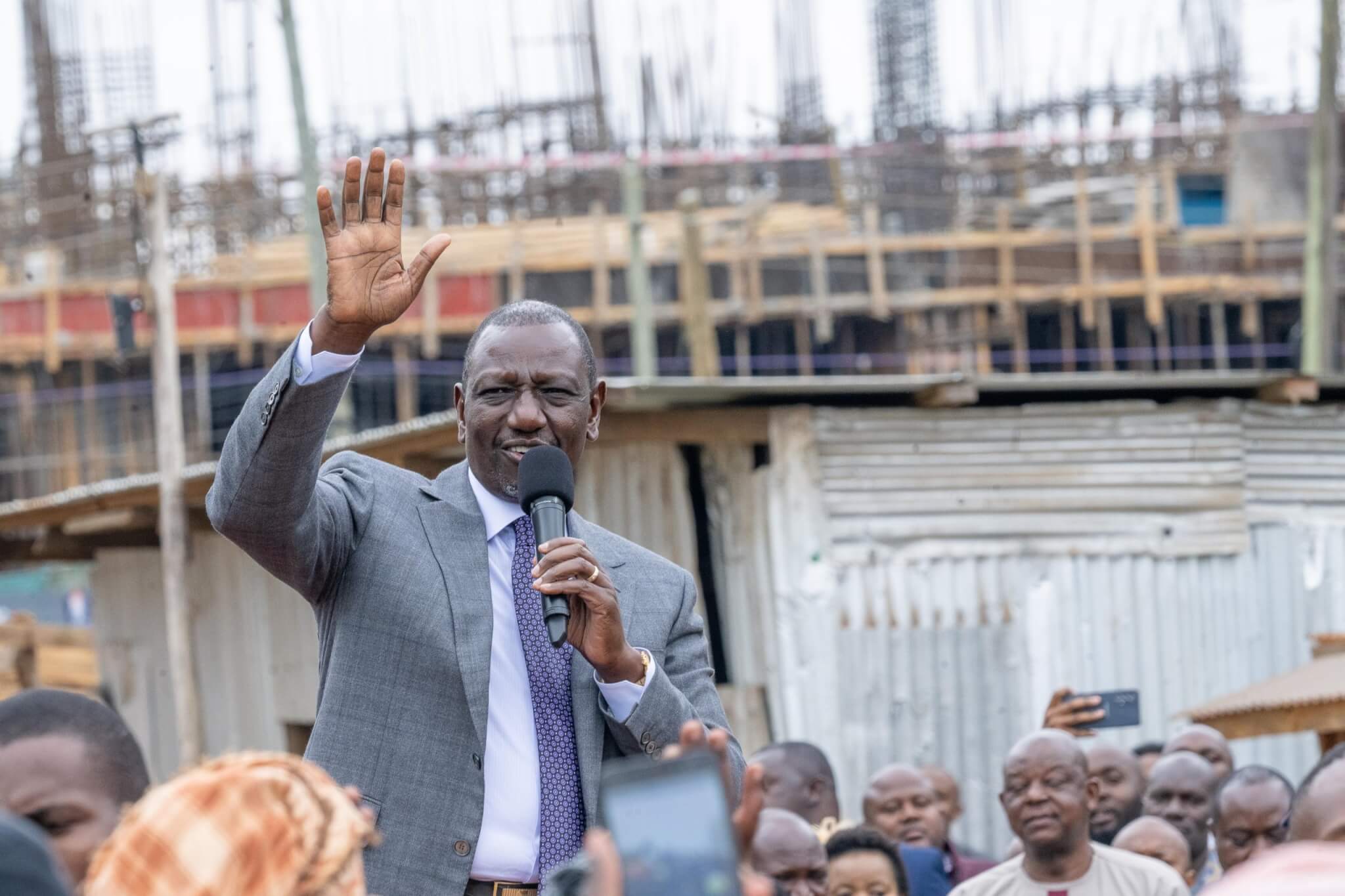
On Wednesday, July 9, 2025, President Ruto stood before a crowd in Kilimani, Nairobi and delivered a speech that would send shockwaves across the nation. A speech that will stain his legacy forever.
“A person who goes to set ablaze another person’s business… such a person should be shot on the leg and go to the hospital as he goes to court,” Ruto said, his words met with scattered applause from supporters. “They should not kill him but should shoot to break the legs.”
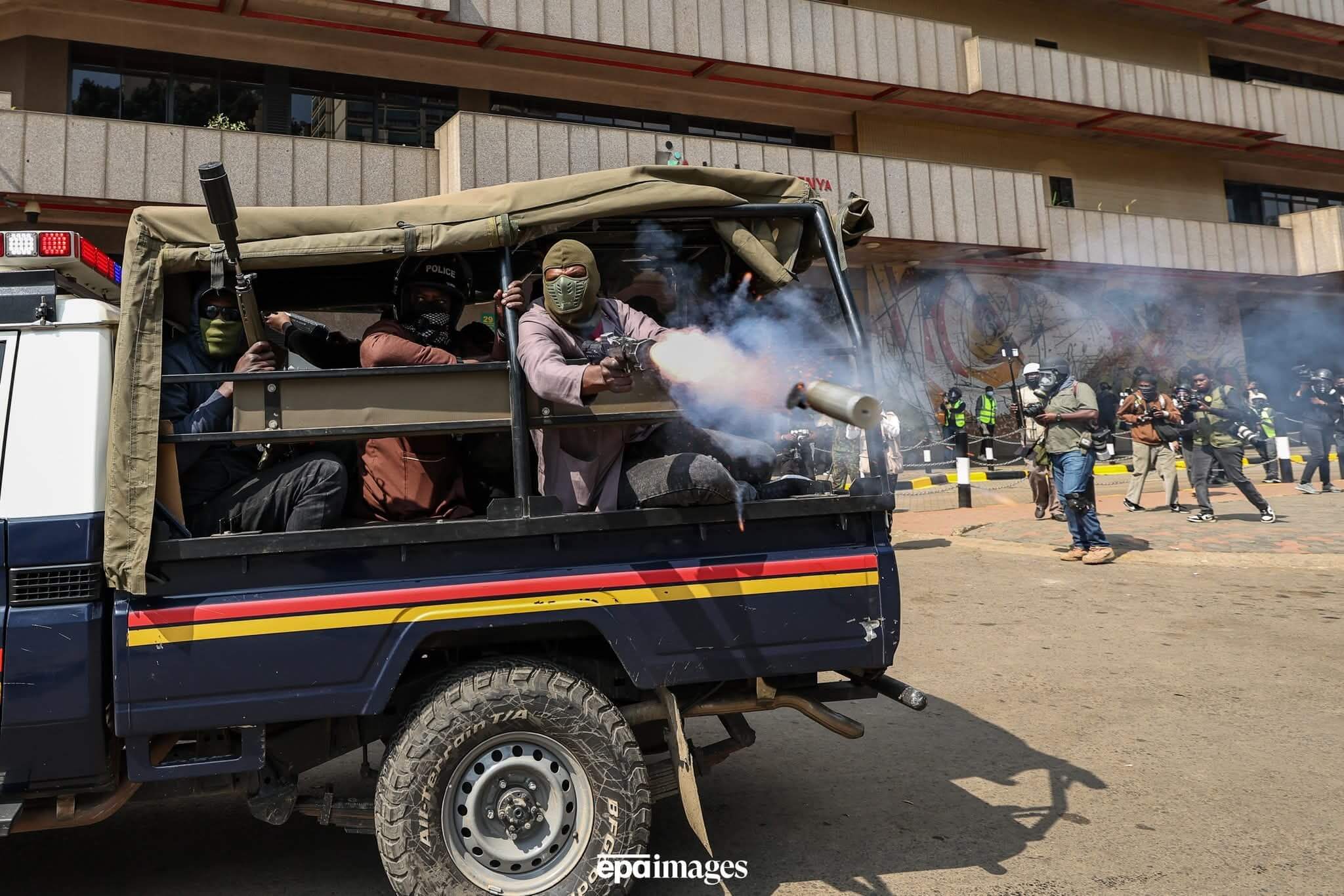
The statement was a slight walk-back from an earlier, even more incendiary remark by Interior Cabinet Secretary Kipchumba Murkomen, who had openly called for police to “shoot anyone going to a police station to cause mayhem.”
But Ruto’s words did little to calm the fury of a nation already reeling from bloodshed. Medical experts quickly pointed out the fatal flaw in his logic.
“You will die if you are shot on the leg,” wrote Simon Gikondu, a social commentator, on X. “The femoral artery carries a lot of blood. A shattered bone can kill you from pain or infection. A blood clot can form if you can’t walk. Shooting the leg is not immune from death.”
If Ruto’s words were alarming, Belgut MP Nelson Koech’s were outright genocidal. Speaking in Kericho on July 10, the chair of Parliament’s Defence Committee went further than even the president dared.
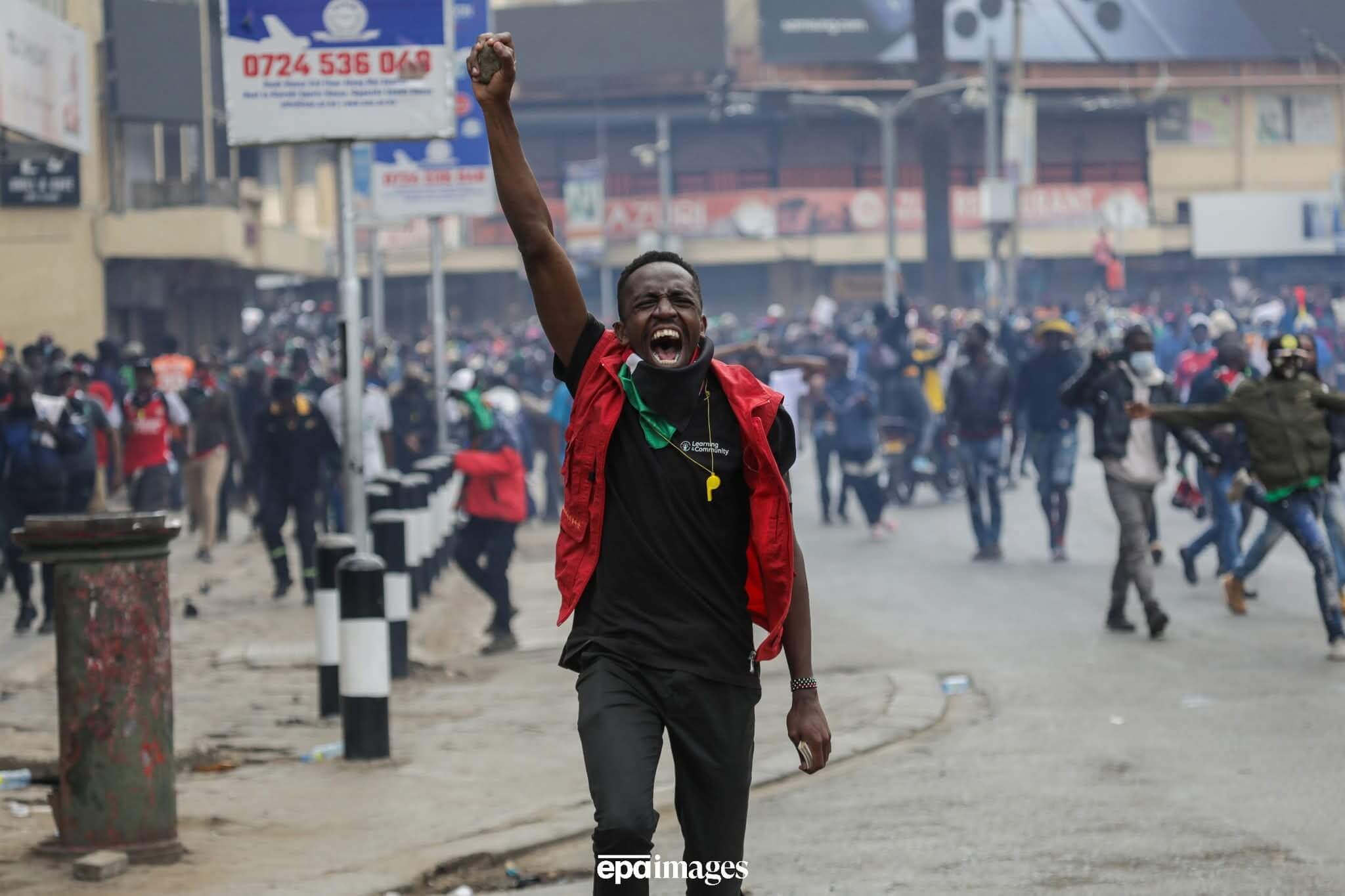
Photo: Daniel Irungu / EPA
“The president said shoot but do not kill. I want to repeat it here. In fact, shoot and kill,” Koech thundered. “You cannot have someone coming after your life and you do not want to shoot and kill.”
His rhetoric was steeped in tribal undertones, warning protesters that his community would not be “cowards” and would retaliate if pushed.
“Stop your nonsense of you telling us one term, one term. One term for who? Who told you it is us who will rule for a single term? Kibaki did not rule for one term. Uhuru Kenyatta didn’t rule for one term. So you think we are so stupid to rule for one term only? We are going two terms.,” he sneered, dismissing calls for Ruto to serve only one.
In a fiery Senate address on July 10, Nairobi Senator Edwin Sifuna tore into the government’s violent crackdown on protestors.
“Is Albert Ojwang supposed to vote from the grave?” he thundered, his voice shaking with fury. “You can’t ask me to meet you at the ballot, then ensure I never make it there.”
Sifuna dismissed President Ruto’s infamous “shoot the leg” directive as dangerously naive, recalling the fatal shooting of Rex Masai in June 2024.
“We all saw Rex Masai, he was shot in the leg, and he still died. How can you suggest such injuries aren’t fatal?”
He ended with a blistering indictment: “As a country we have totally lost our way and we will not have a conversation with someone who is telling us to wait until 2027 when he’s not giving us a chance to get to 2027. He (Ruto) has become an existential threat in this country and he must go as soon as possible.
On July 11, former Prime Minister Raila Odinga, Kenya’s longtime opposition figure and now a partner in the broad-based government, broke ranks to sound the alarm. He warned that the creeping militarization of the police force poses a grave threat to Kenya’s democratic fabric.
“In a protest or any other environment that requires law enforcement, all the above orders,shoot to kill, maim, disorient or shock citizens,are wrong,” Raila said.
He urged due process, arrests over executions, and respect for human rights, a stark contrast to the government’s shoot-first approach.
“Examples from around the continent show that such an approach only increases the risk of violence.”
Kenyans Reactions On Social Media
Social media has become a war room for Gen Z. From raw video evidence to powerful threads, Kenyans are documenting their trauma in real-time.
Famous blogger Cyprian Nyakundi wrote, “Let this be a lesson. When you kill, you’ll face it alone. When you shoot someone in the leg on orders, you’ll still go to jail alone.”
An X user by the name Evans Owino, also wrote: “Nelson Koech, I believe that by virtue of being a member of Parliament, you own a gun. A licensed one for that matter. In the next protests, appear and shoot anyone yourself. Do not lie to junior police officers to do it. They too have loved ones.”
Health communicator Simon Gikondu broke down the anatomy of a leg shot: “A bullet that hits the femoral artery can bleed you out in minutes… Sepsis, pain, or blood clots can kill you. Shooting the leg is not immune from death.”
Silas Nyanchwani, a journalist and author, reminisced: “If you told me that 15 years after the 2010 Constitution was promulgated, a professor of law would be telling police to shoot protesters dead, I’d have laughed like a hyena hit with delirium.”
“Some 15 years later, the president thinks protesters should be shot on their legs. That is his version of talking tough. Showing us that he has some skin in the fight. President Ruto by the way was the only opponent of the new constitution,” he added.
Former Deputy President Rigathi Gachagua, now in opposition, issued perhaps the bluntest warning to his former boss.
“You have even gone further to add insult to injury by directing them to shoot innocent Kenyans on the legs.You could not even send condolences to the dead,” he said through a statement.
“You lack feelings and humanity. We shall report you NOT to the Kenyan police but the International Criminal Court an address you are familiar with.”
President Ruto faced ICC charges between 2010-2016 for alleged crimes against humanity during Kenya’s 2007-08 post-election violence, though the case collapsed due to witness interference issues.




LEAVE A COMMENT
You must be logged in to post a comment.