

|
LISTEN TO THIS THE AFRICANA VOICE ARTICLE NOW
Getting your Trinity Audio player ready...
|
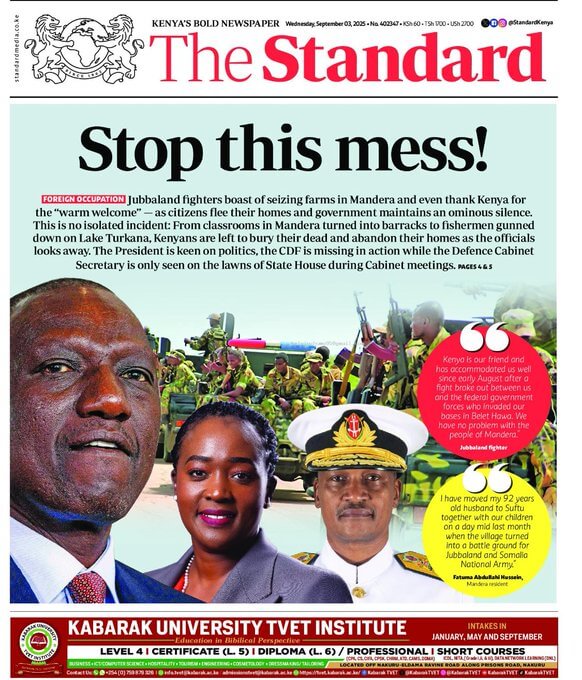
On the sunbaked plains of Kenya’s northeastern frontier, whispers of foreign troops moving through villages have unsettled an already anxious population. In recent weeks, residents of Border Point One, a remote community where Kenya bleeds into Somalia, staged rare street protests. They accused soldiers from Somalia’s Jubaland region of occupying schools, displacing families, and rattling a fragile sense of belonging in a place long accustomed to being on the margins.
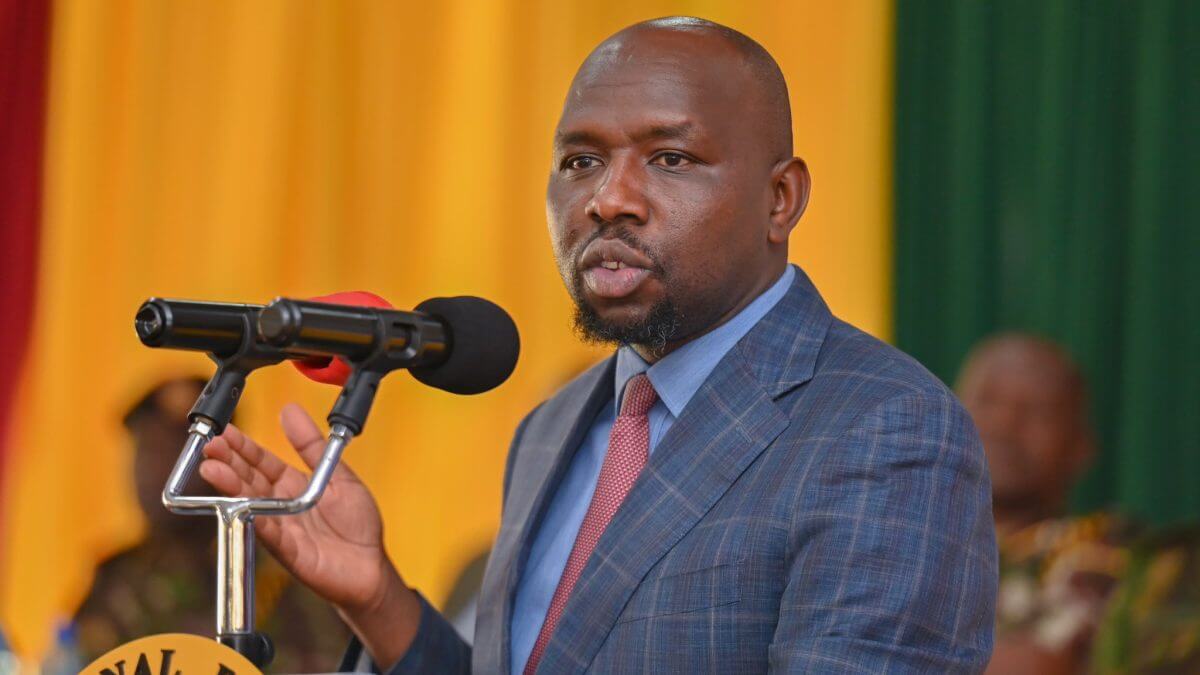
But in Nairobi, Interior Cabinet Secretary Kipchumba Murkomen has rejected these claims outright. Speaking on Friday in Kakamega during his Jukwaa La Usalama tour, a security forum now in its 36th edition, Murkomen insisted there was “no cause for alarm.” “Kenya is safe and is under no threat whatsoever from any foreign force,” he told the gathering, calling suggestions of foreign “occupation” a reckless distortion of the truth.
A border shaped by fear and suspicion
Mandera sits at the corner where Kenya, Somalia, and Ethiopia meet, a borderland whose fate is often tied less to Nairobi than to conflicts spilling over from across the frontier. For decades, communities here have lived with the ebb and flow of Somali instability: civilians fleeing clashes, militias shadowing the border, and Al-Shabaab fighters striking at will.
This history has bred suspicion, particularly when reports surface of armed men moving into Kenyan villages. Residents say they know the difference between refugees seeking shelter and uniformed soldiers asserting control. For them, the latest sightings raised old fears of Nairobi losing its grip on the periphery.
Murkomen sought to draw a firm line. “The only constant threat we face is that of terrorist elements, particularly Al-Shabaab,” he said. “Kenya is not fighting Somalia or any regional force from Somalia, we are fighting one enemy, which is Al-Shabaab.”
Yet his words were aimed as much at the political class as the public. Opposition leaders Rigathi Gachagua, Kalonzo Musyoka, and Justin Muturi have all accused the government of allowing a dangerous breach of sovereignty. The word “occupation,” once confined to international conflicts, has been deployed liberally by critics seeking to portray the government as weak.
Murkomen pushed back sharply. “I have seen senior politicians, some who have even been vice presidents and security ministers, using the word ‘occupation.’ This is unfortunate. They know very well that occupation is a technical term which means a takeover. Nothing of the sort has happened,” he said.
Residents caught in the middle
In Mandera itself, the politics in Nairobi matter less than the lived reality. Former Chief Justice David Maraga, Governor Mohamed Khalif, and Senator Ali Roba have amplified local voices calling for “the withdrawal of Jubaland forces.” Protests in Border Point One highlighted grievances that stretch beyond troop movements: chronic insecurity, underfunded schools, and a sense that life in Mandera remains hostage to decisions made far away.
When journalists reported from schools in the county, Murkomen dismissed the coverage. “Did you see foreign troops in those reports? Our country is safe, very safe, and I insist, very safe,” he said, urging the media to avoid inflaming tensions with “unverified claims.”
For years, Mandera has lived under the shadow of Al-Shabaab, whose attacks on buses, quarries, and police convoys have left hundreds dead. Kenya’s military campaigns in Somalia, launched in 2011 and later folded into the African Union mission, were meant to push the militants back. Yet Al-Shabaab has remained resilient, blending across borders and exploiting weak governance in Somalia.
Against this backdrop, Jubaland, a semi-autonomous Somali region bordering Kenya, has played both a stabilising and complicating role. Its forces have at times acted as a buffer against militants, but their proximity has also raised questions in Nairobi about sovereignty and consent.
Murkomen acknowledged the cross-border complexities but insisted they were being handled. “What we have always had from time to time are our neighbours running away from conflict to seek refuge, and there is a way of handling their return under established diplomatic protocols,” he said.



LEAVE A COMMENT
You must be logged in to post a comment.