

|
LISTEN TO THIS THE AFRICANA VOICE ARTICLE NOW
Getting your Trinity Audio player ready...
|
Freedom became law on Jan. 1, 1863. Records show it did not reach most of Texas for 2.5 years.
Juneteenth gets marked every June 19 with cookouts, parades, and a spot on the federal calendar. Fewer people know what happened during the 30 months the law sat unenforced in Texas, or who decided to keep that news from the people it concerned most. This report goes back to the federal archive and the formerly enslaved Texans who lived through it.
The Obama Presidential Center opens to the public this year on June 19, the same date enslaved Texans finally heard the news in 1865. Barack Obama, the first Black president, has called the center a place built for learning, not a monument.
“This is not a monument to the past,” he said. “It is a living destination for people who refuse to accept the status quo.” He chose to open it on the exact anniversary of one of America’s most documented failures to tell the truth in time.
A Law With No One to Enforce It
President Abraham Lincoln’s Emancipation Proclamation took legal effect on Jan. 1, 1863, but it applied only where Union troops could enforce it. Texas had almost none. Historian Randolph B. Campbell found that no major battles touched the state during the war, so enslaved Texans had no advancing army to flee toward.
Confederate forces tightened their grip on the Texas coast during this period instead. Galveston fell back into Confederate hands on Jan. 1, 1863, the same day emancipation took legal effect, and stayed there for the rest of the war. That absence of enforcement created an opportunity, and enslavers across the Confederacy took it.
Moving People Beyond the Army’s Reach
As Union forces advanced through Mississippi, Louisiana, and Arkansas, slaveholders relocated enslaved people to Texas specifically to keep them beyond federal reach, a practice historians call refugeeing. Texas A&M historian Dale Baum calculated more than 50,000 people were moved this way, with roughly 60 percent still in the state when the war ended.
The people being moved understood exactly what was happening. Elvira Boles recalled what she was told as a child: “Dey say we’d never be free iffen dey could git to Texas wid us.” Frederick Douglass’s own brother, Perry Downs, enslaved in Texas, recalled his enslaver vowing to run his “property” even farther south rather than free them.
Some enslavers followed through on that threat. Slavery remained legal in Cuba until 1886 and in Brazil until 1888, and historian C.R. Gibbs found that an unknown number of enslaved Black Texans were taken out of the country entirely to keep them in bondage.
Descendants of Confederates who relocated to Brazil still hold annual festivals in Americana and Santa Bárbara d’Oeste, complete with Confederate flag displays.
What Enslaved Texans Heard, in Their Own Words
Between 1936 and 1938, the Federal Writers’ Project interviewed more than 300 formerly enslaved Texans. Those interviews, held at the Library of Congress, are the closest surviving record of how freedom actually arrived.
Felix Haywood described enslaved communities tracking the war’s progress on their own.
“We knowed what was goin’ on in it all the time,” he said.
Steve Robertson’s enslaver never announced General Order No. 3. Robertson learned he was free through whispered words and had to run away from a plantation whose owner had chosen silence.
Susan Merritt of Rusk County wasn’t told until September 1865, three months after Granger’s order, when a government agent showed up asking why she hadn’t been released. Researchers caution that most fieldworkers were white, and some formerly enslaved people likely softened their accounts out of caution. Wes Brady said as much directly: “Some white folks might want to put me back in slavery if I tells how we was used in slavery times.”
An Order Defied Within Days
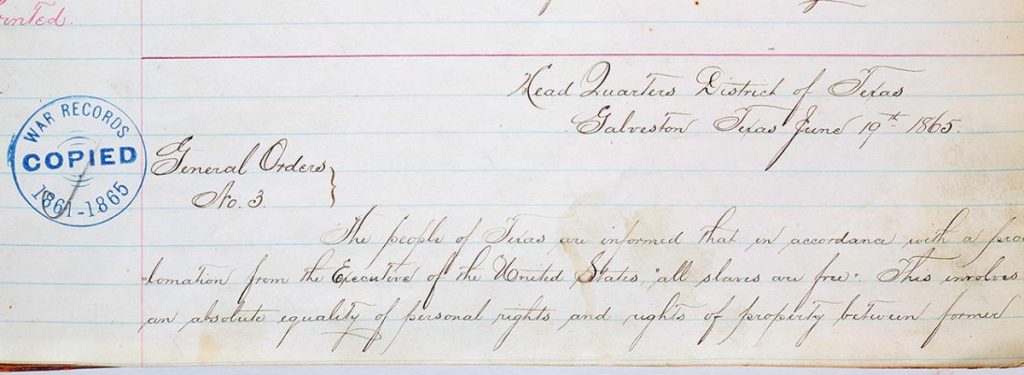
Maj. Gen. Gordon Granger read General Order No. 3 aloud in Galveston on June 19, 1865, declaring “absolute equality of personal rights and rights of property between former masters and slaves.” Compliance wasn’t automatic, even there.
The Galveston Historical Foundation traces one clear example to that summer.
About a month after the order, a promoter held the city’s first Freedmen’s Fancy Ball downtown after securing permission from the Union general stationed there. The mayor had the promoter arrested the next day for failing to obtain city permission. The general responded by arresting the mayor.
Historian Elizabeth Hayes Turner, whose essay remains the field’s most cited academic treatment of the holiday, summarized what followed Granger’s order as “a ragged version of emancipation.”
A Federal Holiday Under Pressure
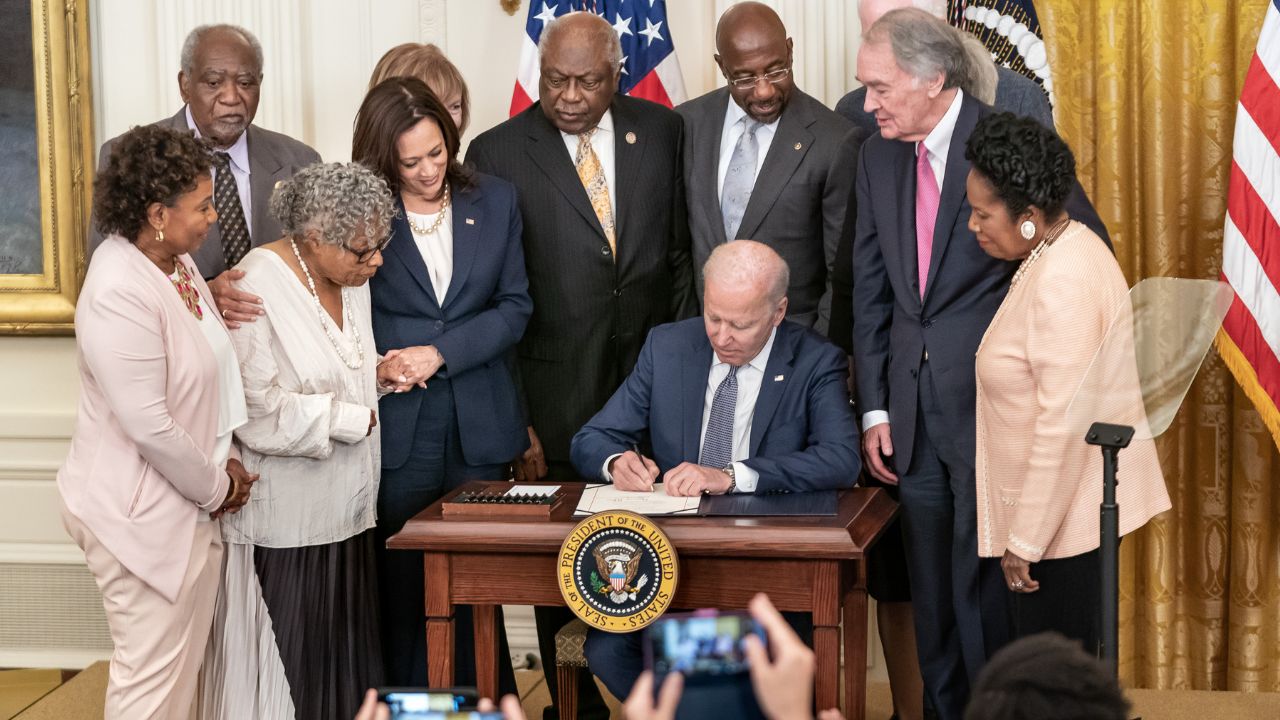
Juneteenth’s recognition as a national holiday is itself recent. President Joe Biden signed legislation establishing Juneteenth National Independence Day on June 17, 2021, the first new federal holiday created since 1983.
The holiday’s status shifted again in 2026. The Trump administration removed Juneteenth and Martin Luther King Jr. Day from the National Park Service’s list of fee-free entry days. The 2026 list added Trump’s birthday, June 14, which is observed under the existing Flag Day holiday.
Juneteenth itself remains on the federal calendar. Eliminating a federal holiday requires an act of Congress, a step that has not been taken. Federal offices are still scheduled to close for Juneteenth in 2026, as they have every year since 2021.
Bondage That Continued for Years
Freedom didn’t arrive on a single date, even after June 19. Historian C.R. Gibbs found near-universal agreement among formerly enslaved people that Texas slaveholders delayed the announcement deliberately. “They wanted another crop,” Gibbs said. Many Black Texans didn’t learn they were free until 1866, a full year after Granger’s order. “Slaveowners resorted to tricks,” Gibbs said. “They delayed. They postponed. This was money. They wanted to continue to get every last drop of sweat from slavery.”
Katie Darling’s own Federal Writers’ Project interview holds the starkest individual record. She continued working for her former enslaver for six years after the legal end of slavery. “She whip me after the war jist like she did ‘fore,” Darling said. The Washington Post reported a more extreme case still: in 1903, nearly four decades after Granger’s order, a Black man in a small Texas town walked into an office still asking whether slavery had ended.
Were Some Freedpeople Simply Unprepared for Freedom?
A common claim holds that some formerly enslaved people stayed on plantations because they didn’t know how to live independently, or because conditions outside bondage were too hostile for survival. The documented record complicates that claim more than it confirms it.
The text of General Order No. 3 itself instructed freedpeople to stay exactly where they were. It declared them “advised to remain quietly at their present homes and work for wages,” and warned they would not be “supported in idleness either there or elsewhere.” Historian W. Marvin Dulaney points to that language as the mechanism. “Granger was warning them against idleness,” Dulaney said. “That order would lead to creation of vagrancy laws and Black codes that would be wielded against Black people, forcing many into forced labor without pay.”
That pressure hardened into formal law within a year. The Texas State Historical Association documents that the Texas legislature passed Black Codes in 1866, criminalizing unemployment itself and requiring laborers to sign year-long contracts. “You had to sign a work contract at the beginning of each year, or you could be rented out to a plantation,” Dulaney said. “In many cases, it was like being sold. The owners would have control over you.”
Historian Eric Foner, the leading scholar of Reconstruction, found that freedpeople across the South emerged from slavery having been given “nothing but freedom,” without land, capital, or any independent means of survival. Staying on a former enslaver’s land was frequently the only legal option available, not a preference born of ignorance.
What Historians Agree Happened, and Why It Matters
Some historians emphasize structural causes. Campbell’s research stresses that Texas’s isolation from Union forces made enforcement nearly impossible for most of the war. That argument explains the conditions that enabled the delay.
It doesn’t fully explain why so many enslavers, once those conditions lifted, still chose concealment. Dulaney calls the pattern “deceitful,” pointing to enslavers who moved people to Texas and delayed disclosure for profit. He describes what followed in even starker terms, citing a speech by Gallaudet University historian Barry A. Crouch.
“Texans were so resentful that African Americans would become free, they literally carried out a pogrom,” Dulaney said. “They killed as many as 2,500. They were just murdered outright across the state.”
Violence against Black Texans intensified between 1865 and 1868, with some freedpeople run down by bloodhounds rather than released from bondage.
Author Nancy Isenberg’s “White Trash” frames the broader economic logic: slavery functioned as the foundation of planter wealth, not merely a labor preference. Journalist Nikole Hannah-Jones’s “The 1619 Project” carries that logic forward, arguing the system never ended cleanly but continued through vagrancy laws and labor contracts that replaced bondage with coercion by another name.
The strongest case for deliberate concealment doesn’t come from any single historian. It comes from the formerly enslaved Texans whose own words survive in the federal archive: the people who recalled being told nothing, the people who moved hundreds of miles to avoid the law, and the people still being beaten years after a general had already declared them free.
The Obama Presidential Center will welcome its first public visitors on the anniversary of the day Granger’s order was finally read aloud in Galveston. The fuller record tells a more complicated story than a single liberation date. For some enslaved Texans, June 19 was the day someone was finally forced to say the word “free” out loud. For others, it was merely the day a quieter, more legal system of control began.
Methodology Note: This report draws on the Federal Writers’ Project Slave Narrative Collection at the Library of Congress, the Galveston Historical Foundation, the Texas State Historical Association, the Washington Post, and peer-reviewed scholarship by Elizabeth Hayes Turner, Randolph B. Campbell, Dale Baum, Eric Foner, W. Marvin Dulaney, and C.R. Gibbs. Every claim is attributed inline to its source.





LEAVE A COMMENT
You must be logged in to post a comment.