

|
LISTEN TO THIS THE AFRICANA VOICE ARTICLE NOW
Getting your Trinity Audio player ready...
|
In a new move to prevent rhino poaching, South African scientists have launched an initiative to inject radioactive isotopes into rhino horns, making them detectable at international borders. The campaign, known as the Rhisotope Project, is spearheaded by the University of the Witwatersrand in collaboration with nuclear energy officials and conservationists.
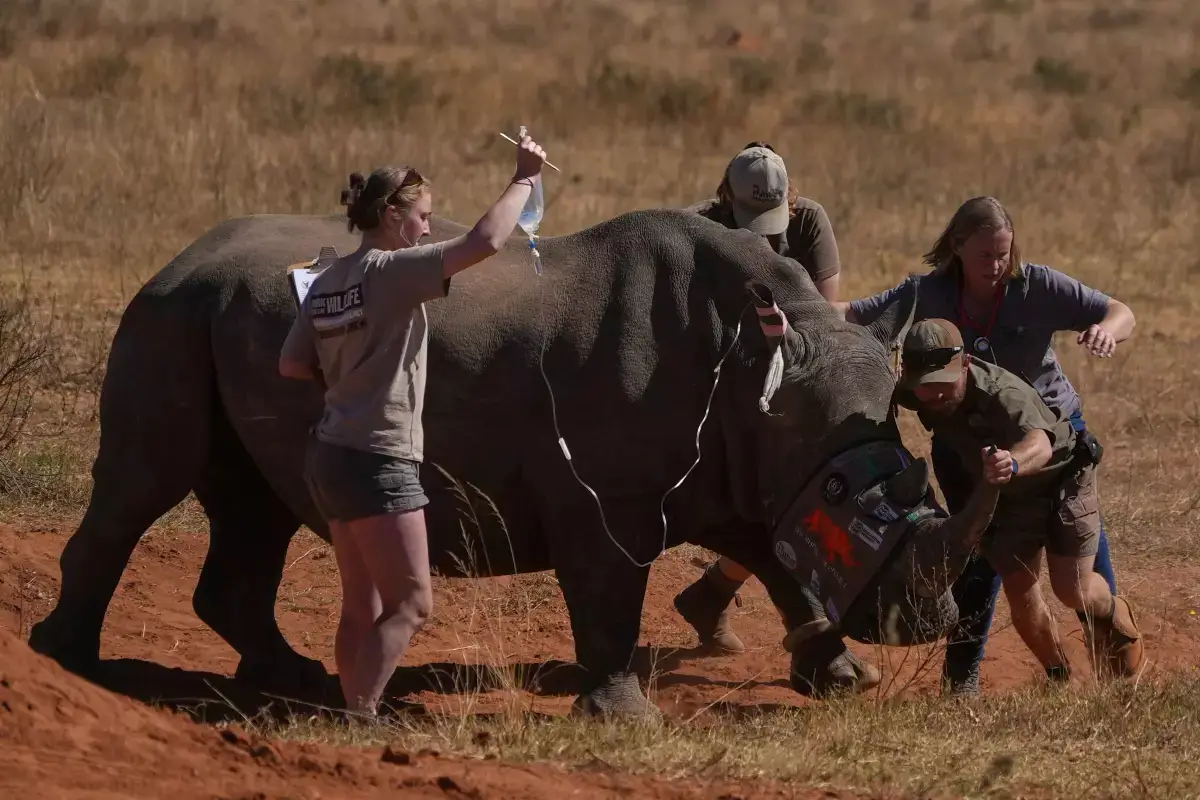
On Thursday, July 31, five rhinos were sedated and treated in the Waterberg UNESCO biosphere as part of the official rollout. The university says this could mark the beginning of a mass injection effort targeting the country’s remaining rhino population.
The technology, developed over six years at a cost of nearly $290,000, involves implanting trace amounts of radioactive material into the horn, an amount researchers say is entirely safe for the animals but strong enough to trigger radiation detectors used by customs agents worldwide. The goal is to disrupt illegal trafficking routes and provide authorities with reliable data on horn smuggling patterns.
“We have demonstrated, beyond scientific doubt, that the process is completely safe for the animal and effective in making the horn detectable through international customs nuclear security systems,” said Professor James Larkin, chief scientific officer at the Rhisotope Project. “Even a single horn with significantly lower levels of radioactivity than what will be used in practice successfully triggered alarms in radiation detectors.”
Larkin added that tests proved the horns could be picked up by scanners even when hidden in large shipping containers.
The stakes are high. According to the International Union for Conservation of Nature, the global rhino population has plummeted from about 500,000 in the early 1900s to around 27,000 today. South Africa holds the majority; an estimated 16,000 rhinos, but faces rampant poaching, with more than 400 rhinos killed annually for their horns.
“At least one animal a day is still being poached,” Larkin said. “I think the figures are only going to go one way if we don’t watch out…. this is a significant tool to help reduce the numbers of poaching, because we’re proactive rather than being reactive.”
The team at Witwatersrand collaborated with the International Atomic Energy Agency to conduct a successful pilot study last year, which involved injecting 20 rhinos at a sanctuary. Those results paved the way for Thursday’s broader campaign.
Jamie Joseph, director of the Saving the Wild charity, praised the project as “innovative and much needed.”
“It’s not the endgame, only better legislation and political will can bring an end to the rhino crisis,” she said. “But it will certainly help disrupt the flow of horns leaving the country and help experts better map out the illegal channels by providing reliable data.”
Jessica Babich, head of the Rhisotope Project, emphasized the long-term goals of the campaign: “Our goal is to deploy the Rhisotope technology at scale to help protect one of Africa’s most iconic and threatened species. By doing so, we safeguard not just rhinos but a vital part of our natural heritage.”
Rhino horns, composed of keratin, are often trafficked to Asian markets, where they are used in traditional medicine and valued as status symbols. Conservation groups have warned that both white and black rhinos face increasing threats, with white rhinos considered threatened and black rhinos critically endangered.












LEAVE A COMMENT
You must be logged in to post a comment.