

|
LISTEN TO THIS THE AFRICANA VOICE ARTICLE NOW
Getting your Trinity Audio player ready...
|
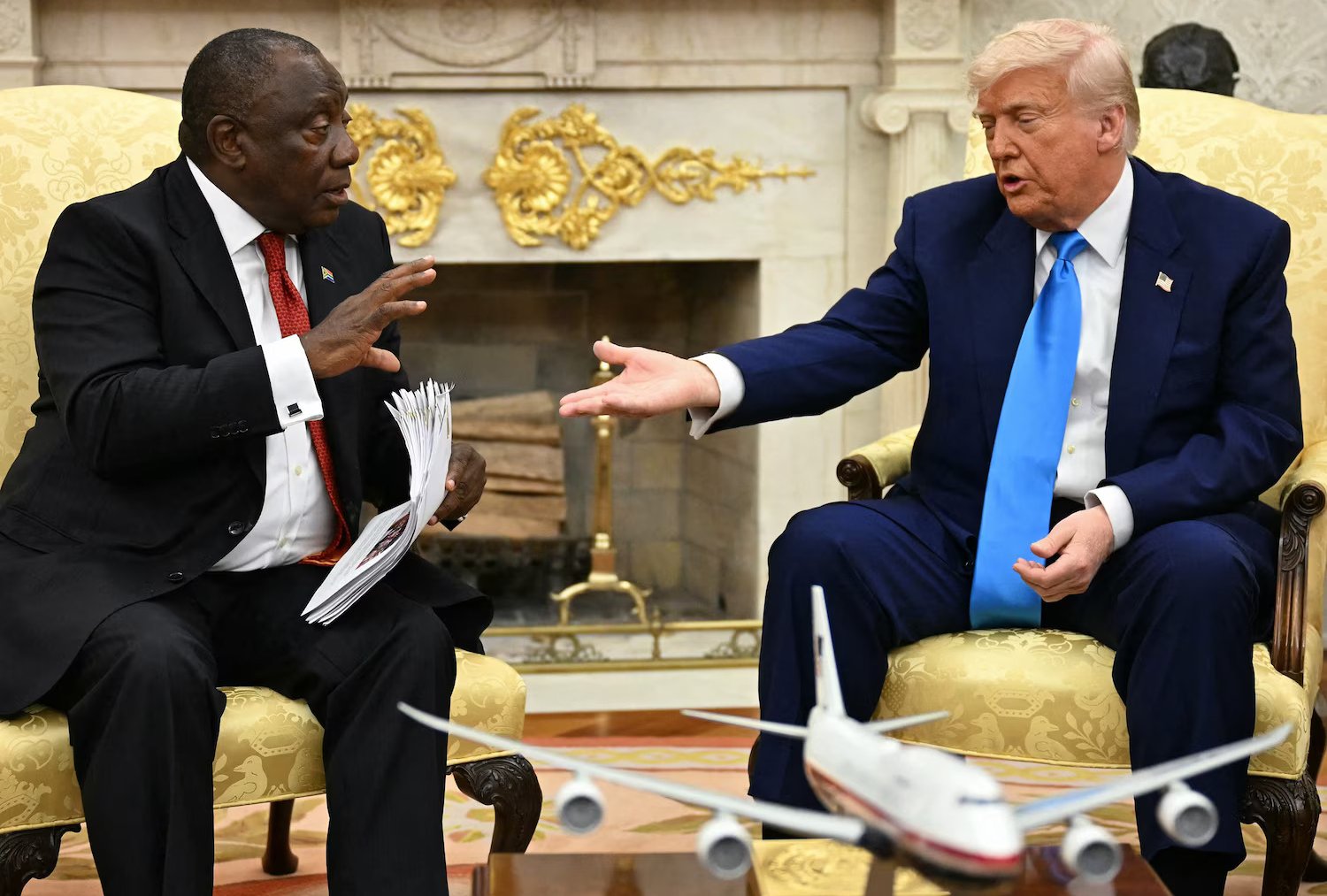
A high-stakes meeting between South African President Cyril Ramaphosa and U.S. President Donald Trump unfolded on Wednesday, May 21, 2025, against the backdrop of growing diplomatic friction and misinformation over land reform and race relations in South Africa.
In one of the most confrontational exchanges of Ramaphosa’s presidency, President Trump ambushed his guest in the Oval Office with a choreographed video screening alleging widespread violence against white South Africans; claims his administration has used to justify punitive measures, including aid cuts and ambassadorial expulsions.
The video, played on Trump’s request with dimmed lights, included footage of political chants and an aerial shot of white crosses lining a rural road, presented as evidence of “mass graves” of murdered Afrikaner farmers. Trump, pointing at the screen, said simply: “South Africa.”
But within 24 hours, those claims began to unravel.
The footage had been shot years earlier along the P39-1 highway in KwaZulu-Natal, near the small town of Normandien. The crosses were part of a temporary memorial erected by local farmers following the 2020 murders of Glen and Vida Rafferty, an Afrikaner couple killed in their home by armed robbers. The two convicted men; Doctor Fikane Ngwenya and Sibongiseni Madondo, are serving life and 21-year prison terms, respectively.
“It’s not a burial site,” clarified Rob Hoatson, a businessman who helped organize the memorial. “It was a symbolic protest, not a mass grave. The crosses are long gone.” Roland Collyer, a local farmer and relative of the Raffertys, added: “We were trying to raise awareness, it was a memorial. It was not a permanent memorial that was erected. It was a temporary memorial.””
Locals, including Black residents of the area, were stunned by Trump’s portrayal of their community. Bethuel Mabaso, a 63-year-old farm worker from the region, told the BBC: “Nothing like that is happening here… We were shocked when we saw our area in the news.”
Ramaphosa, flanked by billionaire Johann Rupert and golfing icons Ernie Els and Retief Goosen, both close to Trump, responded with calm restraint.
“If there was Afrikaner farmer genocide, I can bet you these three gentlemen would not be here,” Ramaphosa told Trump, referencing the white Afrikaner members of his delegation, including his Agriculture Minister Pieter Mulder.
He emphasized that South Africa’s land reform program is constitutional, legal, and intended to correct decades of racial dispossession. “Listen to the voices of South Africans,” Ramaphosa urged, rejecting Trump’s narrative of persecution.
The South African leader also brought forward a portfolio of proposals, including trade incentives, green energy partnerships, and even a preferential entry for Tesla’s products in South African markets, aimed at resetting relations between the two countries.
Trump’s performance, likened to his earlier Oval Office confrontation with Ukraine’s Volodymyr Zelensky, appeared designed more for his domestic audience than international diplomacy. His alignment with Afrikaner farmer grievances, amplified by allies like Elon Musk, who was present but silent during the meeting, aligns with his campaign-era narrative of defending “forgotten” white communities globally.
While Ramaphosa largely let Trump’s provocations pass without escalation, analysts noted the South African team’s strategy was deliberate. By surrounding himself with prominent white South Africans, Ramaphosa appeared to counter Trump’s “white genocide” claims through the optics of inclusion and unity, rather than verbal sparring.
Though South Africa faces serious challenges, including one of the world’s highest murder rates, there is no statistical or legal basis for claims of targeted genocide against white farmers. Government data and independent watchdogs confirm that the vast majority of murder victims are Black, and land expropriation without compensation remains unimplemented.
Still, the violence faced by rural communities, white and Black, is real, and unresolved tensions linger. “It’s not easy just to leave what generations have built,” said Collyer. “But I still love this country. We just need to join hands.”




LEAVE A COMMENT
You must be logged in to post a comment.