

|
LISTEN TO THIS THE AFRICANA VOICE ARTICLE NOW
Getting your Trinity Audio player ready...
|
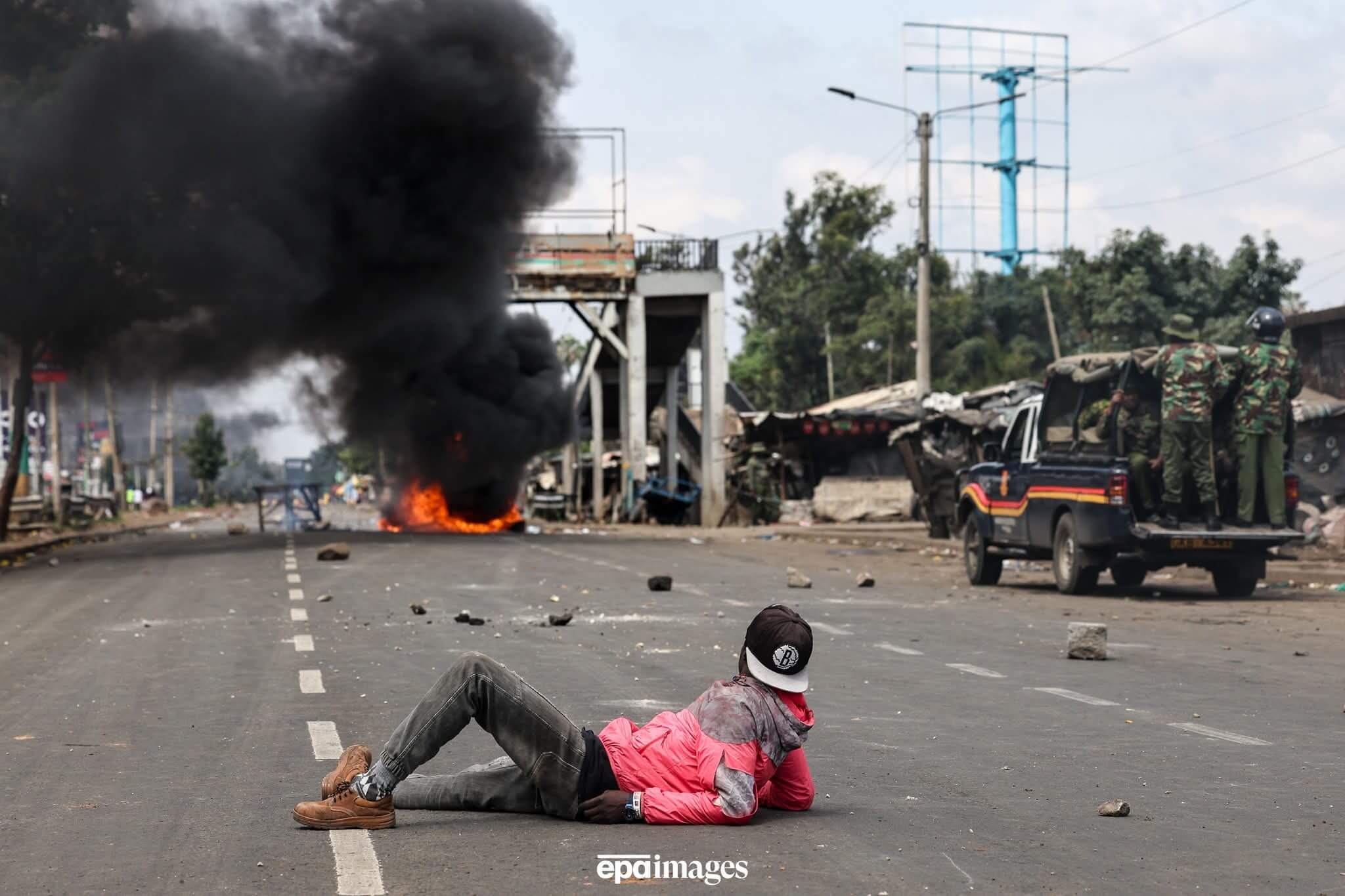
What began as a commemorative protest turned violent on Monday, July 7, 2025, as more than ten demonstrators were shot dead and dozens injured in Nairobi during Saba Saba Day rallies. The 35th anniversary of Kenya’s iconic pro-democracy uprising erupted into chaos, with police clashing with demonstrators calling for accountability, economic reforms, and an end to police brutality.
The deceased were reportedly shot in Kajiado, Kangemi, and Nyandarua. Families say some of their kin were going about their business and not even part of the protests when they were shot.
The protests, organized primarily by youth-led groups without formal leadership structures, saw hundreds flood the streets of Nairobi and other towns, despite heavy police deployments. Some carried placards and blew whistles, chanting for justice and government accountability. Others simply marched, holding up the Kenyan flag.
A Show of Force
The police response was swift and forceful. Key roads leading into the city centre, including access to Parliament and State House, were barricaded with razor wire. Long-distance travelers were stranded as major routes remained blocked for hours. “We started travelling at 8:30pm last night,” said Humphrey Gumbishi, a bus driver stranded in Kabete. “We want the government to engage in a dialogue with Gen Zs so all this can come to an end.”
In Mombasa, scores of young people returning from the Summer Tides Festival in Diani were stopped at the Dongo Kundu Bypass in Likoni. Traffic backed up for hours, and many missed their 2pm SGR ride to Nairobi. “Now police are curtailing freedom of movement! Nkt!” said activist Hussein Khalid. “They were to catch the 2pm SGR to Nairobi, but they have been stopped by police who are saying if allowed to proceed, the youth will go to Nairobi and attend Saba Saba Day protests.”
Khalid denounced the move as “absolute madness,” saying it violated the constitutional right to movement. “Now police want to dictate to Kenyans where to go and where not to?” he posed.
Later that evening, chaotic scenes unfolded at the Mombasa SGR terminus after Kenya Railways abruptly suspended the 10pm Madaraka Express to Nairobi. Hundreds of festival-goers and other passengers were left stranded. “We were coming from Summer Tides but apparently, we got a notification from the SGR team that the 10pm train has been suspended. Right now, all of us here are stranded, we don’t know whether to book a bus, we have seen police road blocks, we don’t know what is happening, we are very unsure,” one frustrated passenger said.
“The SGR team has not communicated if they are going to issue a refund, they have not communicated if they are going to offer accommodation for us, they have locked us out of the terminus so what are we supposed to do and we are stranded?” he added.
In a statement issued the previous evening, the National Police Service (NPS) warned against any form of disorder, stating they would act firmly against criminal activity.
“While the Constitution, under Article 37, guarantees every citizen the right to peaceably and unarmed to assemble… this right must be exercised within the confines of the law,” read the statement signed by NPS Spokesperson Muchiri Nyaga.
The Service cautioned that “entering or attempting to access Protected Government installations or restricted areas is a violation of The Protected Areas Act,” and added that looting, vandalism, or blocking roads “shall not be tolerated.”
“Any form of riotous, unlawful or violent behaviour shall be met with the appropriate lawful force to preserve order and protect lives and property,” the statement emphasized.
“They Just Want Us Silent”
But as clouds of tear gas settled and streets fell quiet, anger among demonstrators simmered. “We are not ready to go back [home] because who will fight for our rights then?” said Francis Waswa, a construction worker who marched from Eastlands. “We will be here till evening.”
Online, activist Hanifa Aden captured the mood: “The police getting rained on as they block every road while we stay at home warming our beds… Total shutdown and forced holiday executed by the state.”
Monday’s protests came just weeks after the death of Albert Ojwang, a teacher and blogger, while in police custody. His death reignited public fury. Prosecutors have charged six people, including three police officers, with murder in connection to the case. All have pleaded not guilty.
The Kenya National Commission on Human Rights (KNCHR) expressed deep concern over serious human rights violations committed during the day’s protests. By 6:30 p.m., KNCHR had documented ten deaths, twenty-nine injuries, two abductions, and thirty-seven arrests in seventeen counties. The commission also noted that education was disrupted nationwide, and many patients were unable to access medical services due to roadblocks. Public transportation, including air and rail, faced severe disruptions.
KNCHR further highlighted violations of a court order requiring all officers policing demonstrations to be uniformed and identifiable. Instead, numerous hooded, unidentified officers were spotted patrolling in unmarked vehicles in Nairobi, Kajiado, and Nakuru. In some areas, including Nairobi, Kiambu, Kajiado, and Eldoret, the Commission documented armed gangs allegedly working with police to intimidate and assault protesters. These gangs wielded clubs, machetes, and bows and arrows.
The Commission condemned the attack on the Kenya Human Rights Commission’s (KHRC) offices, during which hired goons reportedly beat staff and civilians, stole valuables, and assaulted journalists. KNCHR called for the immediate arrest and prosecution of those responsible, who were allegedly captured on CCTV.
The Commission also warned against the increasing harassment of human rights defenders, stating that more than twenty had faced arbitrary arrests, intimidation, and beatings over the past week alone.
Amid fears of looting, several business owners around Nairobi’s Central Business District were seen guarding their shops with clubs, prepared to defend their premises against intruders.
Former Prime Minister Raila Odinga said police roadblocks mounted across Nairobi had prevented him and others from attending the Saba Saba Day commemoration at Kamukunji Grounds. “I was going to join Kenyans at Kamukunji to commemorate Saba Saba Day. Unfortunately, as you all know, there are roadblocks all over town, which have made it difficult for people to move to Kamukunji. In the circumstances, I have decided to talk to the media here at Serena,” he said.
He recalled the events leading up to the original Saba Saba protest in 1990, citing the outlawing of multiparty democracy under Section 2A of the Constitution. “Come 1990, by that time, I had been to detention two times. Kenneth Matiba and Charles Rubia, on the 2nd of May 1990, addressed a press conference saying the time had come for Kenya to become multiparty. They were condemned seriously as being ethnic chauvinists, anarchists, people who wanted to bring chaos to this country,” he said.
Police set up barricades as early as 4 am on major highways and feeder roads in Nairobi, including Mombasa Road, Lang’ata Road, Ngong Road, Waiyaki Way, Thika Road, Kiambu Road, Donholm, Spring Valley, and Madaraka Roundabout. In Mombasa, roadblocks were mounted in Likoni, Nyali, and Changamwe.
Despite the visible disruptions, Deputy Inspector General of Police Gilbert Masengeli maintained that access to the city remained open. “Everybody is getting into the CBD, everybody is going for duty as normal,” he said. But commuters stranded at roadblocks on Thika Road, Waiyaki Way, and Mombasa Road described a different reality.
Rights Violations and Silencing
A day before the protests, on Sunday, an armed gang stormed the headquarters of the Kenya Human Rights Commission, disrupting a press conference by women leaders calling for an end to state violence.
“They were carrying stones, they were carrying clubs… they stole laptops, they stole a phone and they also took some valuables from journalists who were there,” said KHRC’s Ernest Cornel.
Witnesses claim the attackers arrived on motorbikes, chanting: “There will be no protest today.”
What sets the 2025 Saba Saba apart is the decentralized nature of its organization. Analysts have drawn parallels between the youth-led protests of today and those of 1990. Back then, political figures like Kenneth Matiba, Charles Rubia, and Raila Odinga defied the Moi regime, leading to the repeal of Section 2A and ushering in multiparty democracy.
“It was the day people came out in open defiance of a brutal dictatorship… it was a day we reclaimed our voice,” recalled rights activist Wanjira Wanjiru.
Today’s demonstrators are not affiliated with political parties, nor do they recognize traditional opposition figures. Political historian Mutuma Kithinji noted, “The striking similarity between the Gen Z protests of 2024–25 and the Saba Saba protests of the ’90s is that both were centred on a clamour for better leadership.”
But the landscape has changed. President William Ruto, elected in 2022, maintains a firm grip on power after forming an alliance with opposition leader Raila Odinga. With no formidable challenger ahead of 2027, protests have become the de facto opposition.
Still, the government maintains that its actions are lawful and necessary. “We urge all Kenyans to remain peaceful and law-abiding,” the NPS spokesperson said. “Let us stand together as one Nation, upholding the rule of law.”
Political commentator Gabrielle Lynch believes the state is misreading the moment. “They don’t seem to have realised the world is different,” she said. “People don’t have the same inbuilt fear of the state.”
On the ground, many agreed.
“They want us scared. They want us to be quiet,” said a protester. “But we have grown up seeing all of this. And we are not our parents. We will not stop.”


LEAVE A COMMENT
You must be logged in to post a comment.