

|
LISTEN TO THIS THE AFRICANA VOICE ARTICLE NOW
Getting your Trinity Audio player ready...
|
South Africa is facing renewed diplomatic pressure after reports of xenophobic attacks, harassment, and anti-migrant protests targeting foreign nationals, including Zimbabweans, Ghanaians, and Nigerians.
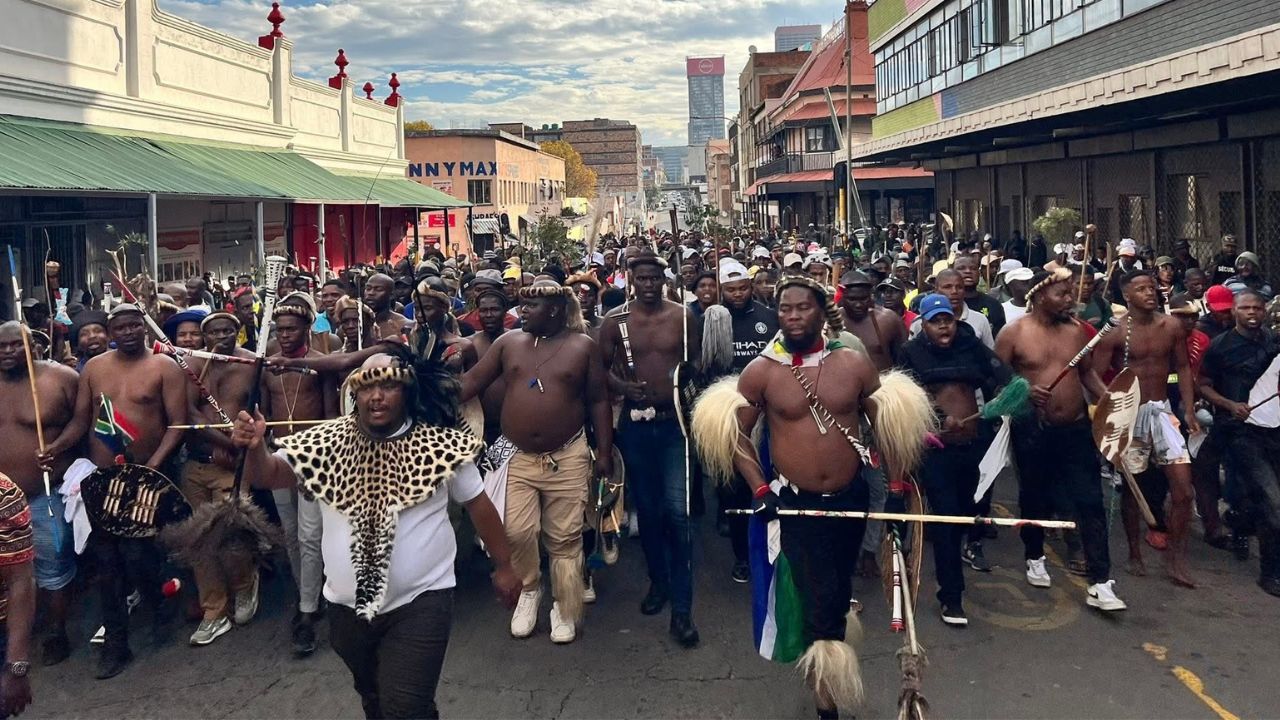
The latest tensions are unfolding alongside organized anti-immigration mobilization. The Associated Press reported that hundreds of South Africans marched in Johannesburg on April 27 against illegal immigration. Many shops closed because owners feared looting or opportunistic crime.
The demonstration was organized by March and March, an anti-immigration group. It also drew Operation Dudula, ActionSA, and the Patriotic Alliance, AP reported.
The march followed a similar protest in Pretoria. The groups are calling for strict immigration enforcement and mass deportations.
The violence and protests have raised an uncomfortable question for Africa. At a time when leaders speak of free movement, shared markets, and continental unity, some Africans are telling other Africans to go home.
South Africa attracts migrants from across the continent. Some enter legally. Others arrive without legal status in search of work and safety. AP described South Africa as one of Africa’s most industrialized economies.
Viral videos fuel outrage
Videos circulating on social media appear to show foreign nationals being attacked, beaten, and ordered to leave South Africa by mobs.
Some footage has not been independently verified by police, consulates, or major news organizations. Still, the images have fueled outrage across the continent. They have also deepened fear among African migrants living in South Africa.
One reported incident involved a Ghanaian man in KwaZulu-Natal. Reuters reported that he was asked to prove his legal status and told to leave South Africa. He was also told to “fix his country.” Ghana later summoned South Africa’s envoy and demanded action.
That message has spread beyond one incident.
Go home.
For many migrants, those words carry the deeper wound. They are being accused not only of breaking immigration laws. They are being treated as if they do not belong anywhere in Africa except the countries printed on their passports.
Some social media claims allege wider attacks, deaths, and organized targeting of West Africans.
Xenophobia or Afrophobia?
The attacks are widely described as xenophobia, the fear or hatred of foreigners. But some observers say the word is too broad.
They call it Afrophobia, also known as Afriphobia.
Political analyst Pieter Kriel has argued in a Facebook video that South Africa has many non-African foreigners who are not targeted in the same way. His point is that the anger falls most heavily on African migrants, especially Black Africans.
That distinction matters.
Xenophobia highlights hostility toward foreigners. Afrophobia highlights the painful fact that the targets are often other Africans.
Operation Dudula has pushed back against that label. In a Facebook post responding to Kriel’s argument, the group rejected the term, calling it “classic gaslighting.” It said South Africans are frustrated by illegal immigration and weak enforcement, not hatred of fellow Africans.
The dispute over language is not academic. Calling it xenophobia frames the issue as hostility to foreigners. Calling it Afrophobia frames it as African-on-African rejection.
Rejecting both terms, as anti-immigration groups often do, frames the crisis as a fight over jobs, crime, public services, and state failure.
But human rights groups warn that rhetoric about foreigners “taking over” South Africa can turn migrants into targets. Once African migrants are blamed for crime, unemployment, and failing services, legal status can become a license for public humiliation or mob violence.
A country can enforce immigration laws without attacking migrants. It can protect jobs and public services without treating other Africans as enemies.
Ghana and Nigeria demand action
Ghana has taken the issue directly to South Africa.
Reuters and BBC reported that Ghana’s foreign affairs minister, Samuel Okudzeto Ablakwa, summoned South Africa’s envoy after viral videos showed alleged attacks on Ghanaians and other foreign nationals. South African authorities then promised a crackdown on people carrying out xenophobic attacks.
Nigeria has also raised concerns. The Nigerians in Diaspora Commission urged South Africa to protect Nigerians and other Black immigrants amid renewed attacks. Its chair, Abike Dabiri-Erewa, said the situation was deteriorating, according to Channels Television.
Nigerian officials have also warned against profiling Nigerians as criminals. That warning goes to the heart of the crisis. Crime has suspects. Xenophobia creates targets.
South Africa promises a crackdown.
South African officials say xenophobic violence is criminal and will not be tolerated.
Reuters reported that South Africa’s Police Ministry said people who participate in or incite xenophobic acts would be identified, arrested, and brought before the courts. Foreign Affairs Minister Ronald Lamola also condemned the violence, saying it threatened the country’s constitutional foundation.
The government is trying to draw a line between immigration enforcement and mob action. That line matters.
Every country has the right to enforce immigration laws. But enforcement belongs to the state, not mobs. It must follow the law. It must target violations, not nationalities.
Protests deepen tension
The Johannesburg march turned immigration anger into a public show of force.
AP reported that March and March organized the protest. Operation Dudula, ActionSA, and the Patriotic Alliance also took part. The groups are calling for strict immigration enforcement and mass deportations.
ActionSA’s Themba Mabunda rejected the xenophobia label, telling AP, “We are not xenophobic.” He said foreign nationals should be in the country legally.
That argument shows the political tension now facing South Africa. Many protesters frame their demands as law enforcement, not hatred. Migrant advocates warn that anti-immigration rhetoric can quickly become intimidation, exclusion, and violence.
AP reported that estimates of undocumented migrants in South Africa vary widely, with figures often cited between 3 million and 5 million. Accurate numbers are difficult to obtain because many migrants lack legal status.
Anti-immigration groups argue that illegal immigration contributes to overcrowding, labor tensions, lost tax revenue, crime, and border security threats. South Africa’s unemployment rate exceeds 30%, AP reported.
Why some South Africans say they are angry
Many South Africans who support the protests say their anger is not about hatred of foreigners. They say it is about jobs, crime, public services, and the rule of law.
Their argument is direct. They say foreign nationals have entered South Africa in large numbers. They say migrants have taken jobs in an already weak economy. They also say migrants place pressure on taxpayer-funded services, including hospitals, schools, housing, and clinics.
Some argue that undocumented migrants operate outside the tax system while benefiting from public resources. Others say migrants should return home and help rebuild their own countries.
AP reported that anti-immigration groups link illegal migration to overcrowding, labor tension, tax losses, crime, and border insecurity. Those arguments carry weight in a country where unemployment exceeds 30%.
That perspective is politically powerful because many South Africans are struggling. Jobs are scarce. Clinics are crowded. Housing is limited. Crime is a daily fear in many communities.
But the danger comes when frustration turns into collective blame. A country can enforce immigration laws without attacking migrants. It can debate borders without beating people in the streets. It can demand accountability from the government without turning foreign Africans into scapegoats.
Malema pushes back
EFF leader Julius Malema has challenged South Africans taking part in anti-immigrant protests. He asked whether expelling foreign nationals has created jobs for locals.
Speaking at the EFF’s Workers’ Day rally in Rustenburg, Malema dismissed March and March protests as a distraction, The Whistler reported. He said South Africans should ask whether closing Zimbabwean, Nigerian, and Ghanaian shops has produced jobs for South Africans.
Malema also rejected demands that foreign children be removed from schools and pregnant women from clinics.
“I will never do it,” he said. “I am not going to take a pregnant woman out of a clinic because she is not South African.”
He acknowledged that some foreign nationals commit crimes. But he said South Africans also commit crimes. He urged people with concerns about illegal immigration to use the Department of Home Affairs, not street protests.
“Let’s deal with illegal immigration through the law,” Malema said.
His stance provides a South African counterpoint to the debate. It also challenges the idea that removing migrants will solve unemployment.
A long-running crisis
The latest violence did not come from nowhere. South Africa has seen waves of attacks on African migrants for years.
In 2015, NPR reported that Zulu King Goodwill Zwelithini was accused of inflaming anti-immigrant violence after reportedly saying foreigners should pack their belongings and leave.
NPR reported that at least seven people died in that wave of violence. Zwelithini denied inciting attacks and later called the violence “vile.”
Mondli Makhanya, then a City Press editor-at-large, told NPR that the king’s remarks could not be misunderstood.
“There can be no misinterpreting what he meant when he likened foreigners, foreign nationals, to parasitic fleas,” Makhanya said.
That history matters because words from influential figures can carry consequences. When leaders blame migrants, mobs may feel they have permission to act.
Operation Dudula rises

Zandile Dabula, president of Operation Dudula, appears in a camouflage cap and jacket in a photo shared by the Operation Dudula SA Movement Facebook page. Photo via Operation Dudula SA Movement/Facebook.
Operation Dudula later formalized anti-migrant street politics.
BBC Africa Eye reported that the group became notorious for raiding foreign-owned businesses and forcing shops to close.
The word “dudula” means “to force out” in Zulu.
The BBC reported that Operation Dudula was set up in Soweto. The township was once a center of anti-apartheid resistance. It is now also home to South Africa’s most prominent anti-migrant movement.
Zandile Dabula, the president of Operation Dudula, told the BBC that foreigners are central to South Africa’s hardships.
“We must be realistic here that most of the problems that we have are caused by the influx of foreign nationals,” Dabula said. “Our country is a mess.”
The BBC also reported that Dabula claimed foreign nationals had a 20-year plan to take over South Africa. When challenged, she admitted it was a rumor but said she believed it.
That detail is important. It shows how rumor, fear, and politics can harden into public action.
The BBC also found that many South Africans overestimate the number of migrants.
It cited a 2022 Institute for Security Studies report estimating that there were about 3.95 million migrants in South Africa, or 6.5% of the population.
Yet a 2021 survey found almost half of South Africans believed there were between 17 million and 40 million immigrants in the country.
That gap between perception and data helps explain the crisis. When people believe migrants are “taking over,” fear can outrun facts.
The BBC also quoted Operation Dudula member Mandla Lenkosi, who said South Africa was better off under apartheid.
“We grew up in apartheid times, where things were much better than what it is now,” Lenkosi said.
His fellow Dudula supporter Cedric Stone told the BBC, “South Africa needs to go back to the old South Africa that we know.”
Those comments reveal the depth of disillusionment in some communities. They also show how anger over present hardship can distort memory, even about apartheid.
Public services become a flashpoint.
The tensions have also reached hospitals and clinics.
AP reported that anti-migration groups have, in some cases, chased foreign nationals away from public health facilities.
The groups claimed migrants were causing medicine shortages and overcrowding.
The BBC reported that President Cyril Ramaphosa has condemned vigilante groups for harassing and attacking migrants. He has compared their behavior to apartheid-era strategies used to oppress Black communities.
Violence spreads beyond Johannesburg.
The AP report shows that the unrest is not limited to Johannesburg.
In Eastern Cape Province, AP reported that an anti-migration march last month led to the torching of minibus taxis and public infrastructure.
In KwaZulu-Natal, alleged attacks on Ghanaian nationals sparked a diplomatic incident. South Africa’s ambassador to Ghana was summoned to explain the attacks, AP reported.
South Africa has also increased immigration enforcement. AP reported that the country deported 109,344 immigrants living illegally in South Africa over the past two years.
That figure shows the government is already acting on illegal immigration. Yet vigilante groups continue to demand more. Their actions risk replacing lawful enforcement with street-level punishment.
AU human rights body condemns attacks.
The African Commission on Human and Peoples’ Rights, an African Union human rights body, has condemned the attacks.
In an April 27 statement, the commission said it had grave concern over reports of xenophobic violence and intimidation against nationals of other African countries in South Africa. It cited allegations of assaults and harassment by vigilante groups targeting people perceived to be undocumented migrants.
The commission said the latest incidents form part of a long-running pattern of xenophobic violence in South Africa, including the 2008 attacks that left more than 60 people dead and displaced about 100,000 people.
It said the conduct may violate rights protected by the African Charter, including equality, dignity, security, life, property, and freedom of movement.
The U.N. also raises alarm.
The United Nations has also voiced concern.
AP reported that U.N. Secretary-General António Guterres expressed concern over reports of xenophobic attacks, harassment, and intimidation against migrants and foreign nationals in South Africa. The concerns included incidents in KwaZulu-Natal and Eastern Cape Province.
That concern adds international pressure on South Africa. It also shows that the issue has moved beyond local politics. African governments, human rights bodies, and global institutions are now watching closely.
A familiar script beyond South Africa
South Africa is not alone in turning immigration into a political flashpoint.
Across the world, migrants have become easy targets for anger over jobs, crime, housing, and weak public services.
In the United States, immigration enforcement has also become central to national politics. Reuters reported that the U.S. House approved a three-year budget plan that could add $70 billion to federal immigration enforcement.
The comparison is not exact. In the United States, immigration crackdowns are largely driven by federal policy. In South Africa, the most alarming scenes involve vigilante groups, protests, and alleged mob attacks, even as the government says such conduct is criminal.
Still, the political logic is similar.
Migrants are cast as the cause of problems they did not create alone. Public frustration gets redirected toward people with less power. Legal status becomes a moral label.
A person becomes “illegal” before being seen as human.
That pattern is dangerous in any democracy. It weakens the rule of law. It invites abuse. It also allows governments to avoid harder questions about unemployment, corruption, inequality, and failing public systems.
Ruto’s visa-free vision faces reality.
The crisis comes as some African leaders push for easier movement across the continent.
Kenyan President William Ruto has been one of the loudest voices. In 2023, Reuters reported that visitors to Kenya from around the world would no longer need visas starting in January 2024. Kenya would use an electronic travel authorization system instead.
Ruto has not abolished borders. But he has championed easier movement and a visa-free Africa.
That vision supports the African Union’s long-standing goal of freer movement. It also supports the African Continental Free Trade Area. Goods cannot move freely if people cannot. Businesses cannot grow across borders if traders, workers, and students are treated as threats.
South Africa’s crisis shows how far Africa remains from that dream.
African unity under pressure
The irony is hard to ignore.
South Africa’s freedom struggle received support from African nations during apartheid. Many countries sheltered South African exiles. Others backed liberation movements and paid diplomatic costs.
Today, citizens from some of those same countries are being told they do not belong.
That history does not erase South Africa’s right to enforce immigration laws. Every country has that right. But enforcement must follow the law.
It must target violations, not nationalities. It must protect human rights, even under public pressure.
For Africa, the stakes go beyond South Africa.
The continent cannot build unity while Africans are attacked for crossing colonial borders. It cannot build free trade while traders, workers, and students are treated as threats. It cannot speak of Pan-Africanism while African migrants live in fear.
Africa’s unity project will not be judged by speeches alone. It will be judged by whether a Ghanaian trader, a Nigerian student, a Zimbabwean worker, a Kenyan professional, or a Congolese asylum-seeker can live safely in another African country.
South Africa’s Afrophobic violence is forcing the continent to confront a painful contradiction.
Africa says it wants unity. But too many Africans are still being treated as outsiders by other Africans.




LEAVE A COMMENT
You must be logged in to post a comment.