

|
LISTEN TO THIS THE AFRICANA VOICE ARTICLE NOW
Getting your Trinity Audio player ready...
|
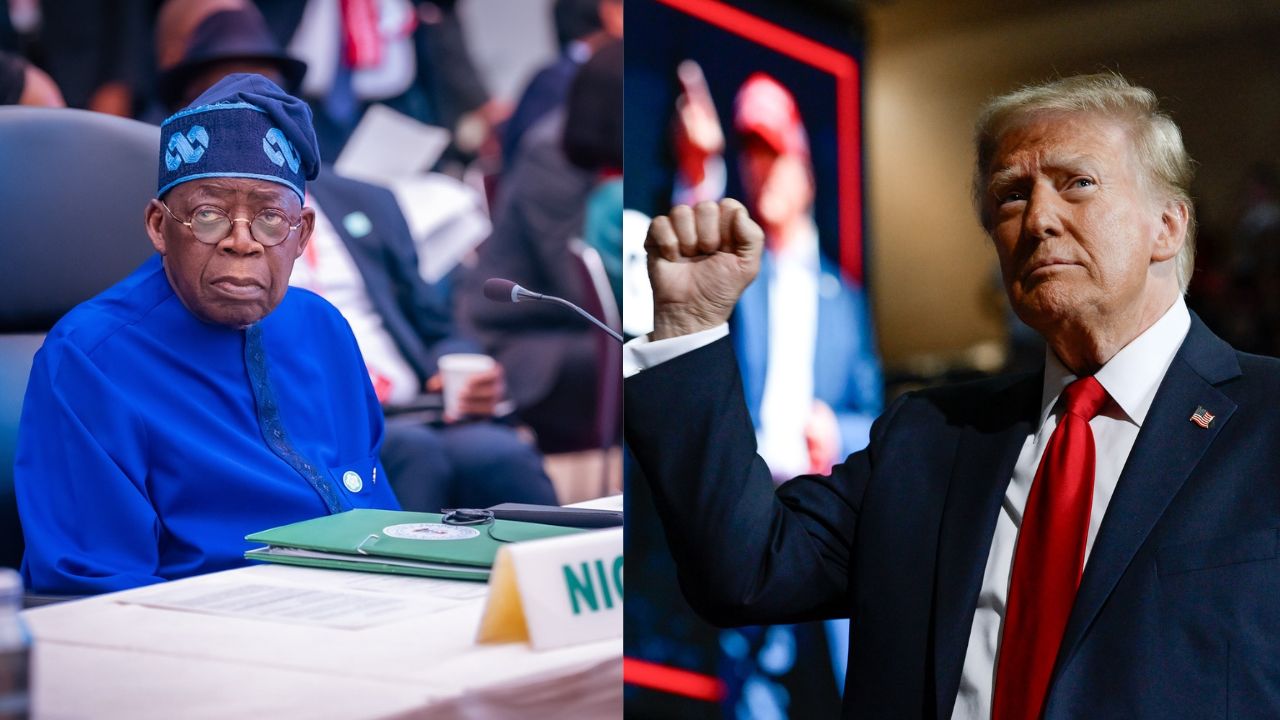
Outrage, disbelief, and calls for restraint have followed U.S. President Donald Trump’s warning that Washington could “go into Nigeria guns-a-blazing” if the government fails to protect Christians.
The threat, made on Truth Social on Nov. 1 and echoed by Defense Secretary Pete Hegseth on X, has triggered intense debate across Africa and the United States.
Nigerian President Bola Ahmed Tinubu swiftly rejected the claim. At the same time, analysts, diplomats, and even Trump’s own adviser say the situation in Nigeria is far more complex than the president’s post suggests.
Trump’s claim and the pushback
Trump wrote that Nigeria’s government was “allowing the killing of Christians” and warned that the U.S. “may very well go into that now disgraced country, guns-a-blazing.” Hegseth followed, saying the Department of War was “preparing for action.”
In response, Tinubu reaffirmed Nigeria’s constitutional guarantees of religious freedom, saying the portrayal of the country as intolerant “does not reflect our national reality.”
Daniel Bwala, a presidential spokesperson, described Trump’s post as “a miscommunication” and said Nigeria would continue to engage with the U.S. in partnership.
The Guardian’s findings
Reporting by The Guardian shows that Nigeria is nearly evenly divided between Muslims (53 percent) and Christians (45 percent).
While attacks on Christian communities have drawn international attention, the British daily noted that “violence against Christians is often rooted in competition for land and water, not faith.”
Citing security experts, The Guardian wrote that both Muslim and Christian communities “are dying as a result of terrorist acts,” and that ransom demands, not religious hatred, often drive kidnappings of priests and pastors.
Christians and Muslims are equally victimized.
In an interview published on YouTube before the threats, Trump adviser Massad Boulos said there is “no religious genocide in Nigeria” after meeting with Tinubu.
“Those who know the terrain well know that terrorism has no color and no religion and no tribe,” Boulos said. “People of all religions and all tribes are dying as a result of terrorist acts. Boko Haram and ISIS are killing more Muslims than Christians.” Boulos added that any loss of life is “too many” and urged cooperation between Washington and Abuja to end violence, calling it “unfortunate” that the issue had been framed as a religious one.
Layers of conflict
As The Guardian and other international observers note, Nigeria’s security crisis spans multiple regions.
In the northeast, Boko Haram and Islamic State West Africa Province have waged insurgencies since 2009, killing tens of thousands.
The group gained worldwide infamy in 2014 after kidnapping more than 270 schoolgirls from the town of Chibok, an act that drew global condemnation and the #BringBackOurGirls campaign.
In the northwest, criminal gangs carry out mass kidnappings that affect both faiths. In the central “Middle Belt,” disputes between herders and farmers have taken on ethnic and religious overtones, but remain primarily driven by competition for resources.
The picture is one of overlapping crises, not a single campaign of religious persecution.
Possible future fallout
While Trump’s statement satisfied parts of his evangelical base, it unsettled policymakers who fear his rhetoric could damage counter-terrorism cooperation and embolden extremists.
This is not the first time the Trump administration has threatened to take adverse action against Nigeria. In June, Nigeria was included on a list of 36 countries, primarily from Africa, facing a U.S. travel ban. The move drew criticism from African diplomats, who said it unfairly penalized nations that have been key partners in regional security and migration management.
In Abuja, Tinubu’s government has continued to call for restraint. His measured tone, reinforced by Boulos’s clarification, has eased immediate fears of escalation but underscored a deeper issue: how Africa is still invoked in U.S. politics as a stage for domestic agendas.






LEAVE A COMMENT
You must be logged in to post a comment.