

|
LISTEN TO THIS THE AFRICANA VOICE ARTICLE NOW
Getting your Trinity Audio player ready...
|
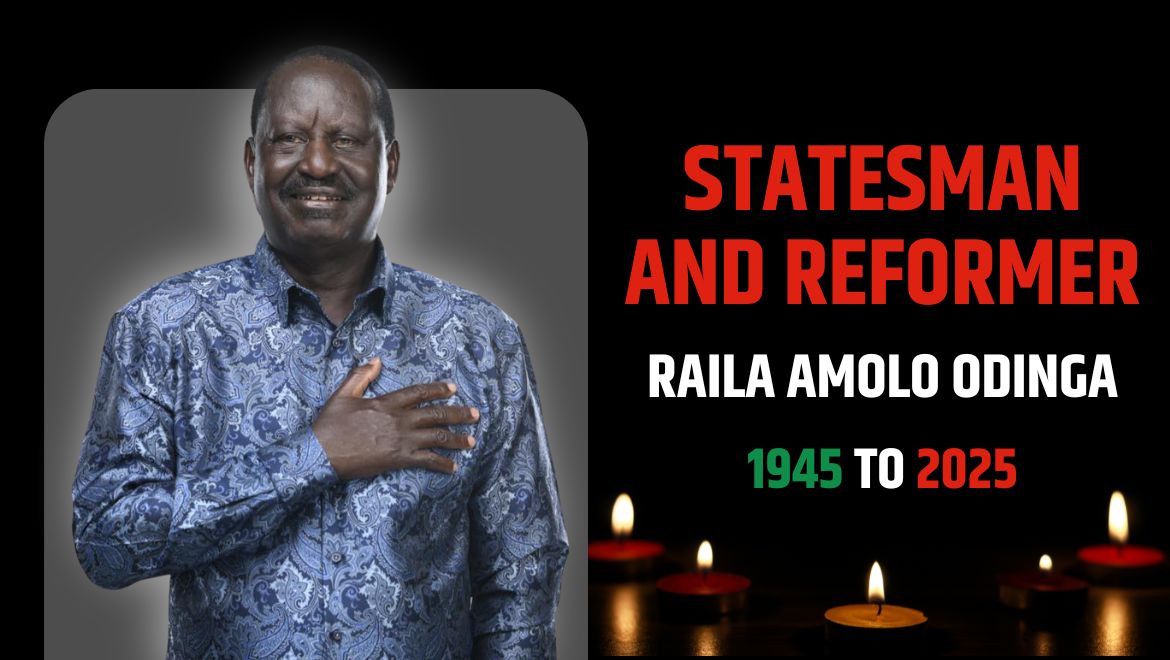
Few African politicians have shaped their nation’s destiny as profoundly as Raila Amolo Odinga. His five-decade career spanned prison cells, protest marches, power-sharing deals, and moments of near-revolutionary symbolism. These six episodes capture the arc of a life that helped define modern Kenya.
1. The 1982 coup attempt and years in detention
Odinga’s political awakening was forged in dissent. After a failed coup attempt against President Daniel Arap Moi’s government in August 1982, Odinga was accused of links to the plotters. He was detained without trial for six years, enduring isolation and torture.
Though never convicted, his imprisonment transformed him from a quiet engineer into one of Kenya’s most recognizable symbols of resistance and democracy.
2. The fight for multiparty democracy
Emerging from detention, Odinga threw himself into Kenya’s pro-democracy movement of the late 1980s and early 1990s. Alongside his father, Jaramogi Oginga Odinga, and figures such as Kenneth Matiba and Charles Rubia, he demanded an end to one-party rule and greater political freedoms.
Despite arrests and constant surveillance, Odinga’s persistence helped bring about the repeal of Section 2A of the Constitution in 1991, restoring multiparty politics in Kenya.
3. The “Kibaki Tosha” moment (2002)
After a short-lived alliance with Moi in the late 1990s, Odinga broke away and shocked the country in 2002 with his famous declaration, “Kibaki Tosha!” “Kibaki is the one.”
That endorsement united the opposition and propelled Mwai Kibaki to victory, ending 39 years of KANU rule. It remains one of the most electrifying turning points in Kenya’s political history.
4. Prime ministership and the 2010 Constitution
Following the disputed 2007 election and the subsequent violence, Odinga entered into a power-sharing agreement with President Kibaki, becoming Kenya’s prime minister in 2008.
He was instrumental in stabilizing the coalition and steering the reforms that led to the 2010 Constitution, which devolved power and established stronger checks on the presidency.
The charter remains one of his proudest political legacies.
5. The “People’s President” swearing-in (2018)
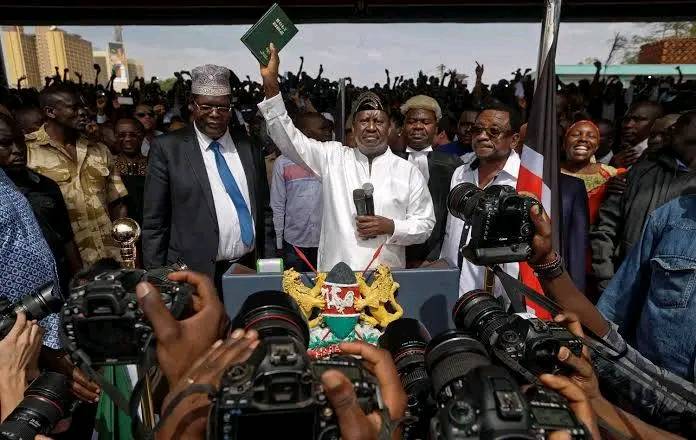
After rejecting the results of the 2017 presidential election, Odinga took the extraordinary step of swearing himself in as the “People’s President” during a public ceremony in Nairobi on Jan. 30, 2018. Lawyer Miguna Miguna administered the oath before thousands of jubilant supporters at Uhuru Park.
The move deepened tensions with President Uhuru Kenyatta’s government and led to arrests of opposition figures and a media shutdown. Yet just weeks later, Odinga stunned the nation again by reconciling with Kenyatta — an act that paved the way for the next defining moment of his career.
6. The 2018 handshake with Uhuru Kenyatta
On March 9, 2018, Odinga and Kenyatta appeared together on the steps of Harambee House, clasping hands in a symbolic gesture of peace that came to be known simply as “the handshake.”
The truce ended months of political unrest and restored calm to a divided nation. To many, it was Odinga’s ultimate act of statesmanship; to others, a reminder of his unmatched political pragmatism.
Legacy
Raila Odinga’s life was a chronicle of defiance, endurance, and reinvention. From prisoner to prime minister, from opposition icon to unifier, he remained steadfast in his belief that Kenya’s best days lay ahead.
He will be remembered not only as a reformer and democrat, but as a man who embodied his country’s struggle, and its unbroken hope for freedom and justice.




LEAVE A COMMENT
You must be logged in to post a comment.