

|
LISTEN TO THIS THE AFRICANA VOICE ARTICLE NOW
Getting your Trinity Audio player ready...
|
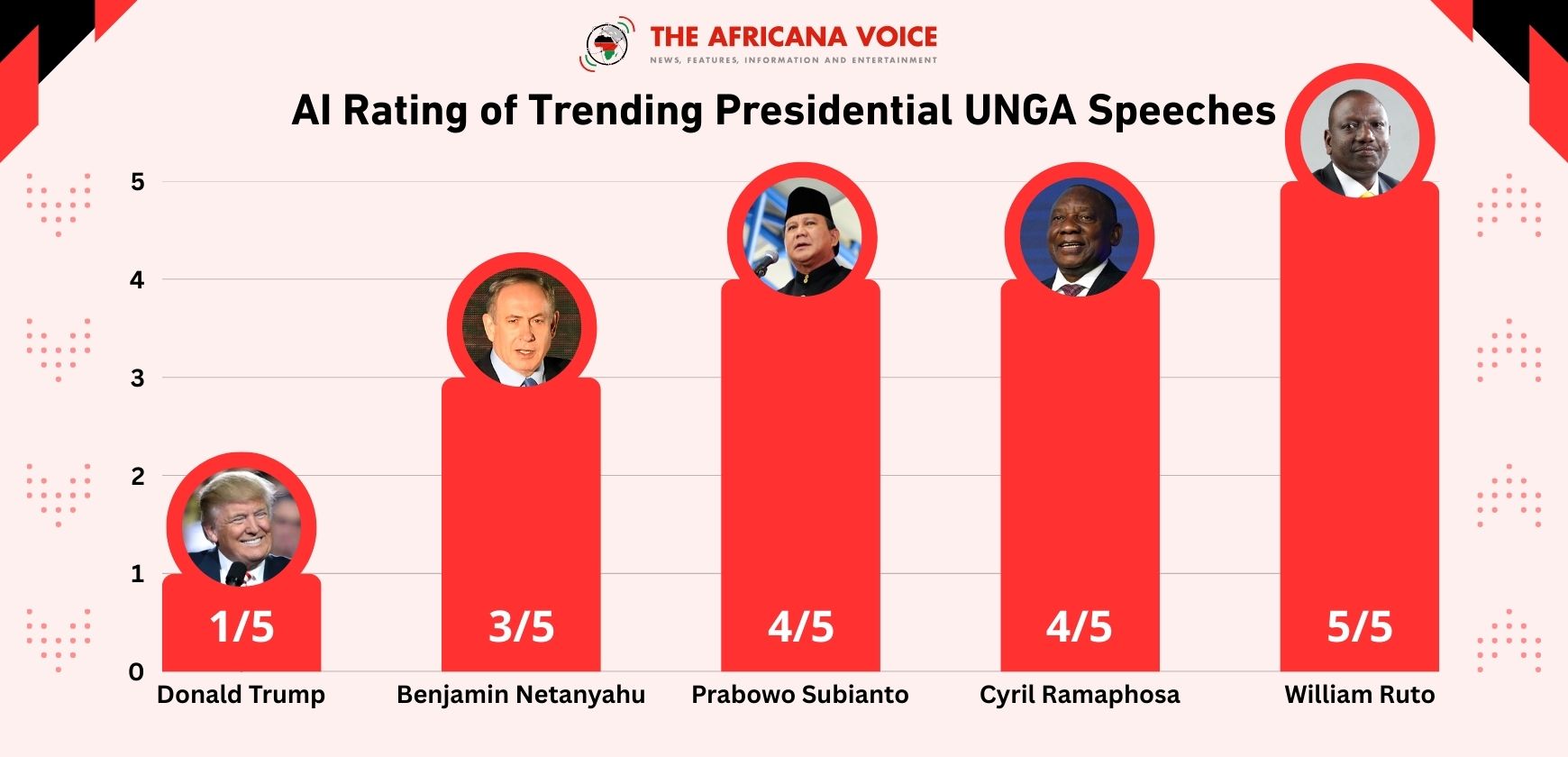
We sought an unbiased review of the speeches delivered at the recently concluded United Nations General Assembly. We asked AI to rate the top 5 trending presidential / leader speeches on the UN YouTube channel, using their YouTube transcripts. The speeches were rated on a scale of 1 to 5, with 1 being the lowest score and 5 the highest.



To be clear, this is not an apple-to-apple comparison of all speeches given, rather it’s a narrow comparison of the 5 most viewed speeches as of the end of September 26, 2025. We only focused on speeches given by heads of states, and not their deputies.
Prompt given to AI:
Here are the most-watched (trending) Presidential Speeches in the just-concluded UNGA. Please review the transcripts and rate the speech on a scale of 1-5, with 5 being the highest rating, indicating an excellent performance. Don’t hesitate to explain why you gave the rating. Fact-check and score the quality of the message.
For context, here are the number of views each speech has received so far on YouTube as of Sept. 26, 2025.
- Donald Trump, 302k views;
- Prabowo Subianto, 142K;
- Benjamin Netanyahu, 139K;
- William Ruto, 108K;
- Cyril Ramaphosa, 89K.
ChatGPT Plus failed to process the prompt, saying: “The message you submitted was too long, please edit it and resubmit.”
DeepSeek processed the prompt and gave the following output. (Note, we edited for style, but did not alter the substance of the AI report)
Overall Summary
The speeches represent a stark contrast in tone, purpose, and factual grounding. The most-viewed speech (Trump’s) is a highly partisan campaign-style address filled with verifiably false claims and boasts. The others are more traditional UNGA speeches, focusing on multilateralism, specific global crises, and appeals for international cooperation. The view count is driven more by the speaker’s global notoriety than by the speech’s quality or diplomatic merit.
1. William Ruto, Kenya
YouTube Views: 108k
Rating: 5/5
Analysis:
An exceptional speech that is arguably the most substantive, analytical, and forward-looking of the group. President Ruto delivers a masterclass in diagnosing the problems of global governance and proposing concrete, ambitious solutions.
- Quality of Message: Excellent. The central thesis—that institutions fail not for lack of vision but due to an inability to adapt—is powerful. Ruto uses the historical example of the League of Nations to issue a stark warning to the UN. The message is not just about complaints, but about agency, detailing Africa’s concrete plans for financial independence (African Central Bank, IMF, etc.).
- Fact-Checking and Coherence: Outstanding. The speech is packed with specific, verifiable data and examples, including the experience of the Kenya-led mission in Haiti (with its specific challenges), the inequity in IMF Special Drawing Rights (64% allocated to wealthy nations), and Kenya’s 93% renewable energy grid. Every claim supports the larger argument for systemic reform.
- Structure: Superb. It follows a logical progression: 1) Historical warning, 2) Diagnosis of current UN failures, 3) Case study (Haiti), 4) Broader global challenges (Gaza, Sudan, climate), 5) Detailed prescription for reform (financial architecture, UNSC), and 6) A hopeful conclusion about repurposing the UN.
Why the Rating: A score of 5 is justified because this speech excels in all criteria. It is fact-based, intellectually rigorous, solution-oriented, and delivered with a compelling mix of criticism and hope. It is a model of what a UN General Assembly address should be.
2. Prabowo Subianto, Indonesia
YouTube Views: 142k
Rating: 4/5
Analysis:
A principled, heartfelt, and clearly delivered speech that centers on the themes of solidarity, justice, and the potential of the United Nations.
- Quality of Message: High. President Subianto grounds his message in Indonesia’s history of colonialism and gratitude for past UN support, giving it authenticity. He makes a powerful moral case for the Palestinian people and offers concrete action, notably the pledge of 20,000 peacekeepers for Gaza or other conflict zones. The call for the strong to respect the weak is a classic and necessary UN principle.
- Fact-Checking and Coherence: Strong. The speech is based on verifiable realities: Indonesia’s contributions to peacekeeping, the humanitarian crisis in Gaza, and the challenges of climate change (citing specific sea-level rise data in Jakarta). The message is consistent and builds logically from historical context to current challenges and a hopeful vision.
- Structure: Well-organized. It moves from a personal/national perspective to global challenges (conflict, food security, climate change) and ends with a powerful, emotional appeal for Gaza and a two-state solution.
Why the Rating: A score of 4 reflects a high-quality, substantive speech that fulfills the purpose of the UNGA. It promotes multilateralism, offers solutions, and speaks with moral clarity. It loses a point only because it is perhaps less ambitious in outlining specific, new global policy frameworks compared to some others.
2. Cyril Ramaphosa, South Africa
YouTube Views: 89k
Rating: 4/5
Analysis:
A solid, principled speech that firmly anchors South Africa within the global south and emphasizes international law, justice, and equality.
- Quality of Message: Strong and consistent. The message centers on upholding the UN Charter, reforming multilateral institutions, and championing the causes of the Palestinians and other oppressed peoples. It clearly reflects South Africa’s foreign policy identity. The focus on South Africa’s G20 presidency priorities (climate, debt, critical minerals) adds substantive policy weight.
- Fact-Checking and Coherence: Good. The speech sticks to widely accepted global challenges: inequality, climate change, the failure of the UN Security Council. The assertion that “there is growing global consensus that Israel is committing genocide” is a statement of a legal and political viewpoint (one South Africa is leading) rather than a settled fact, but it is a core part of his government’s position. Other claims, like the detrimental impact of the Cuba embargo, are well-supported.
- Structure: Clear and thematic. It moves smoothly from South Africa’s domestic priorities to its G20 agenda, to broader global issues (trade, climate, disarmament), and culminates in the central issues of UN reform and Palestine.
Why the Rating: A score of 4 reflects a high-quality, morally clear, and politically significant speech. It is slightly less detailed and analytically sharp than President Ruto’s in terms of presenting new systemic solutions, but it is a powerful and effective articulation of a specific worldview within the UN.
3. Benjamin Netanyahu, Israel
YouTube Views: 139k
Rating: 3/5
Analysis:
A characteristically combative and well-produced speech designed to justify Israel’s actions and put its critics on the defensive. It is effective in its narrow goal but polarizing by design.
- Quality of Message: Mixed. The message is clear: Israel is fighting the world’s fight against barbarism, and its critics are weak appeasers. The direct address to the hostages via loudspeakers was a powerful theatrical moment. However, the message is one-sided, portraying the conflict in absolute terms of good vs. evil with little acknowledgment of Palestinian suffering beyond blaming Hamas.
- Fact-Checking and Coherence: Selective. The speech uses facts strategically.
- It correctly cites the horrors of October 7th and Hamas’s charter.
- The claim about a 2:1 combatant-to-civilian casualty ratio is highly contested and depends on Hamas’s classified numbers; most independent estimates suggest a significantly higher civilian ratio.
- The assertion that Israel warns civilians to leave is true, but the critique that these “safe zones” have also been bombed and that displacement itself is a humanitarian catastrophe is omitted.
- The claim of “one ton of aid per person” in Gaza is misleading without context about distribution challenges and the collapse of internal infrastructure.
- Structure: Polished and rhetorically effective. The use of the QR code, the pop quiz, and the direct messaging is all designed for maximum impact. It builds a legal and moral defense against accusations of genocide and starvation.
Why the Rating: A score of 3 reflects a professionally crafted speech that is highly effective for its target audience. However, its quality is undermined by its one-sided nature, selective use of facts, and its contribution to division rather than bridge-building at a multilateral forum.
5. Donald Trump, United States
YouTube Views: 302k
Rating: 1/5
Analysis:
This speech is a dramatic departure from diplomatic norms at the UNGA. It primarily functions as a domestic political rally, focusing on boasting about the speaker’s own (fictional) accomplishments and attacking domestic opponents.
- Quality of Message: Extremely low. The message is narcissistic, confrontational, and undermines the very institution he is addressing. It lacks a coherent vision for international cooperation, instead promoting a zero-sum, nationalist worldview. The tone is dismissive of the UN (“all they seem to do is write a really strongly worded letter”) and other nations, particularly in Europe.
- Fact-Checking and Coherence: Abysmal. The speech is riddled with demonstrably false or wildly exaggerated claims that are easily disprovable:
- Ending “Seven Wars”: The claim to have ended seven intractable wars (e.g., Pakistan-India, Israel-Iran, Egypt-Ethiopia) in seven months is pure fiction. These conflicts were not actively in a state of “war” as described, and no such diplomatic achievements occurred.
- Economic Claims: Assertions like “inflation has been defeated,” “mortgage rates are down,” and securing “$17 trillion” in investment in eight months are gross exaggerations or false, contradicting all available economic data.
- Border Claims: Stating that illegal border crossings have been “zero” for four months is factually incorrect.
- Immigration Warnings: His dire warnings to Europe are based on exaggerated statistics and a politicized narrative, not objective analysis. For example, his claim that London wants to implement Sharia law is a well-debunked conspiracy theory
- UN Funding Migration: The claim that the UN budgeted hundreds of millions to support illegal migration into the U.S. is a misrepresentation of humanitarian aid for migrants in Central America, not a program to assist border infiltration.
- Structure: Meandering and anecdotal. It jumps from teleprompter jokes to boasts about the economy, to a story about bidding on the UN building, to attacks on renewable energy, with little logical flow.
Why the Rating: A score of 1 is warranted because the speech fails on every metric of a quality diplomatic address. It is factually unmoored, deliberately divisive, and shows contempt for the multilateral forum. Its high view count is a function of Trump’s celebrity and polarizing nature, not its substantive value.
Note: we have made an effort to ensure the information produced by DeepSeek is accurate, please let us know if we missed anything.

LEAVE A COMMENT
You must be logged in to post a comment.